Blog
100 Amp to 200 Amp Upgrade Cost: A Realistic Breakdown (Permits, Utility Work, and Panel)
Upgrading from 100A to 200A can be a simple panel swap or a full service upgrade. Here's what's included, what triggers extra cost, 2026 price ranges, and a quote checklist.
If you’re searching “100 amp to 200 amp upgrade cost,” you’re probably electrifying something: a heat pump, an EV charger, an induction range, maybe a battery. The honest answer to “what does it cost” is a range, and the range is wide for a real reason.
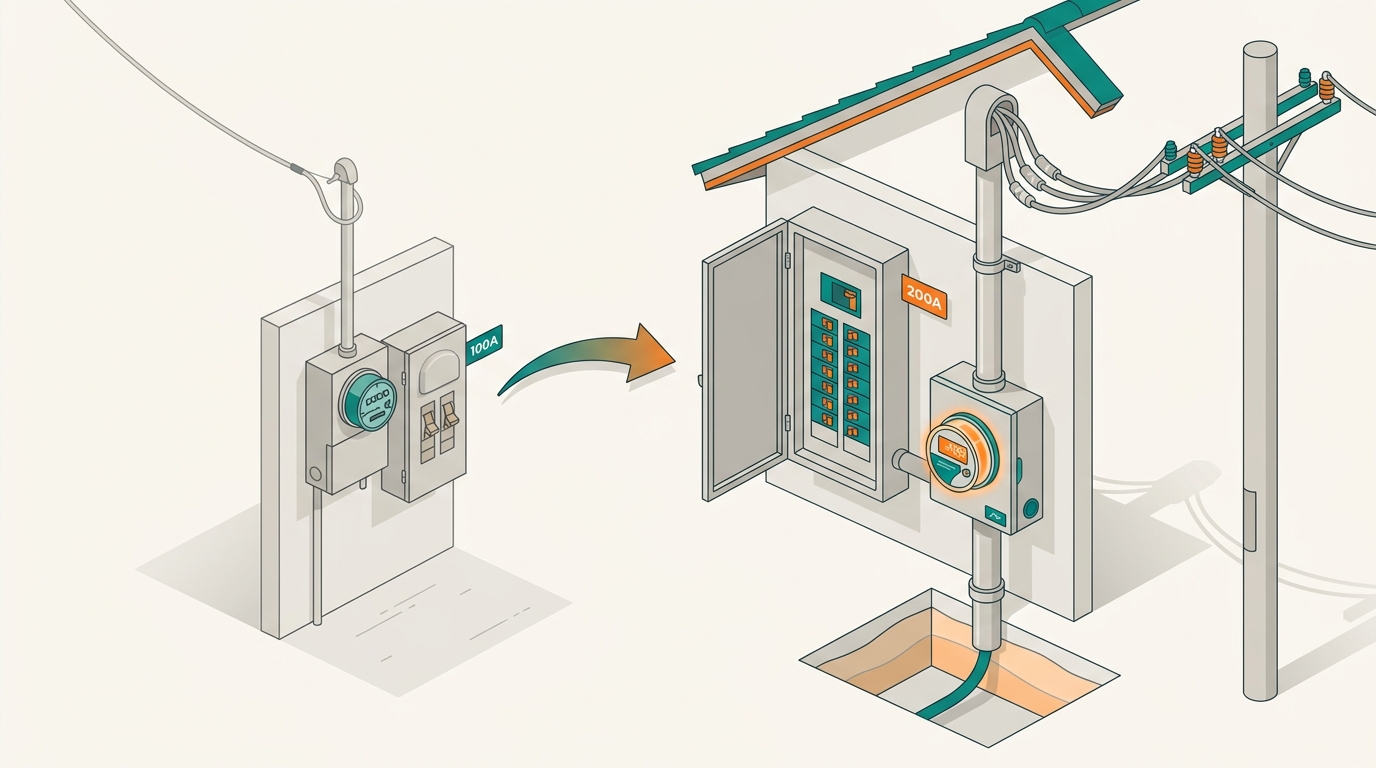
Here’s the truth most quote calculators skip. A 100A → 200A upgrade is sometimes a simple panel swap, and sometimes it’s a full service upgrade that pulls in the utility, the meter, the wires feeding your house, and an inspector. Those are two different jobs at two different prices, and a lot of confusion (and sticker shock) comes from not knowing which one you’re buying.
Keep your future loads and every quote note in one place: My Plan.
$1,500–$3,000
Panel-only swap
same location, no service change
$3,000–$6,000
Full service upgrade
meter / mast / feeder + utility
$50–$500
Permit fee
varies a lot by jurisdiction
On this page
- Panel swap vs full service upgrade: the price gap explained
- Panel-only swap (the cheaper end)
- Full service upgrade (where the money goes)
- The real cost components (with 2026 ranges)
- Trenching is the wildest variable
- The meter base and utility fees
- Drywall and finish patching
- Permits and inspections (varies by jurisdiction)
- When 200A is required vs when 100A may still be enough
- The simple load picture
- Two things that change the math
- Future loads: size once, not twice
- Printable quote checklist (100A → 200A)
- Scope clarity
- Utility and permits
- Site and finish work
- Future loads
- What triggers a change order
- Common mistakes to avoid
- If you only do three things
- Related reading
Panel swap vs full service upgrade: the price gap explained
These two phrases get used interchangeably, and that’s the root of most quote confusion. They are not the same scope.
Panel-only swap (the cheaper end)
A panel swap replaces the load center (the box with the breakers) and the breakers, usually in the same spot on the same wall. The electrician updates grounding and bonding to current code, relabels circuits, and pulls a permit. If your existing meter base, service conductors, and mast are already rated for 200A, this can be the whole job.
Parts for a 200A load center are genuinely inexpensive, often a few hundred dollars. The rest is labor, permit, and the cutover. This is why some bids look low: they assume nothing upstream of the panel has to change.
Full service upgrade (where the money goes)
A full service upgrade does everything the panel swap does plus the utility-facing equipment:
- New meter base (the socket the meter plugs into), often replaced or relocated
- New service conductors (the wires running from the utility to your meter and panel)
- A new service mast and weatherhead for overhead services, or trenching and conduit for underground
- Utility coordination to disconnect and reconnect power
That’s more material, far more labor, an outside agency (the utility) on the critical path, and usually two inspections. The 200A rating on the panel is the easy part. Bringing the service up to 200A is what costs you.
One line buried in a real quote
A homeowner we talked to had a bid with a vague “misc. utility coordination — $1,900” line. When they asked what it was, the answer: a meter-base swap the utility required before it would reconnect at 200A. That single line was the difference between a “panel swap” price and a “service upgrade” price. Always make the electrician spell out what a generic line item actually covers.
This is why comparing bids without a scope checklist is so frustrating, and why a $1,500 quote and a $7,000 quote can both be honest. They’re pricing different jobs.
The real cost components (with 2026 ranges)
Here’s the line-item view. These are estimates for typical U.S. single-family work in 2026, not guaranteed prices. Your region, your utility, and the condition of your existing equipment can move every one of these.
| Component | What it is | Typical 2026 range |
|---|---|---|
| 200A load center + breakers | The panel and breakers (parts) | $250–$600 |
| Panel labor (swap, same spot) | Remove old, install new, terminate, label | $800–$2,000 |
| Meter base / main | New 200A meter socket, sometimes a disconnect | $300–$1,000 (part) + labor |
| Service mast + weatherhead (overhead) | Pipe, fittings, weatherproof entry | $400–$1,500 installed |
| Service conductors | New wire from utility point to meter/panel | $300–$1,500 |
| Trenching + conduit (underground) | Digging, conduit, backfill for buried feed | $1,000–$4,000+ (can be far more) |
| Grounding / bonding | Ground rods, bonding to water/gas as required | $150–$600 |
| Utility disconnect / reconnect fee | Utility charge to drop and restore power | $0–$1,000+ (utility-specific) |
| Drywall / stucco / finish patching | Repair after relocation or new penetrations | $0–$2,000+ |
| Permit + inspection | Jurisdiction permit and inspection fees | $50–$500 |
Where the money goes (typical installed ranges)
Meter, mast, feeder, utility coordination
Long runs or hard ground can run far higher, per foot
A few of these deserve a closer look, because they’re where “simple” jobs blow up.
Trenching is the wildest variable
For an underground service, the feed runs in a buried conduit from the utility point to your meter. If that has to be replaced or rerouted, you’re paying to dig. Short, easy runs in soft soil are modest. Long runs, rock, driveways, or landscaping you care about are not. One thread we read had a homeowner quoted roughly $300 per foot for a 70-foot trench, which alone came to over $21,000. That’s an extreme case, but it shows why “is trenching included?” is the most important question for any underground home.
The meter base and utility fees
The meter base is often the trigger that turns a panel swap into a service upgrade. Utilities frequently require a specific, current meter socket before they’ll reconnect at 200A. On top of the equipment, many utilities charge a disconnect/reconnect or service fee (commonly up to around $1,000, sometimes more, occasionally nothing). Ask the electrician who pays it and whether it’s in the quote.
Drywall and finish patching
If the panel moves, or the new mast/conduit punches through finished wall, someone has to patch it. We’ve watched a clean panel relocation turn into a drywall-plus-stucco patching project that added real money and a week of waiting on a separate trade. If finish work isn’t in the electrician’s scope, find out who’s doing it before you sign.
Permits and inspections (varies by jurisdiction)
Skip the temptation to skip the permit. The utility generally won’t reconnect an unpermitted, uninspected service upgrade, so the permit isn’t optional paperwork; it’s part of getting your power back on.
- Permit fee: commonly $50–$500, set by your city or county. Some jurisdictions add separate electrical or utility fees.
- Inspections: most service upgrades need at least a final inspection, and many require a rough-in / pre-cutover check too. The inspector signs off, the utility reconnects, you’re done.
- Who pulls it: a licensed electrician should pull the permit in their name and schedule inspections. If a bidder asks you to pull an owner permit on service work, ask why.
Inspectors sometimes hand back a correction list: deteriorated grounding, an unbonded water line, a double-tapped neutral from a past job. Those have to be fixed before final sign-off. That’s normal on older homes, and a reason honest quotes hedge on “what we find once it’s open.”
When 200A is required vs when 100A may still be enough
A 200A upgrade is sometimes genuinely necessary and sometimes avoidable. The deciding factor is a load calculation, not a hunch.
The simple load picture
The National Electrical Code (NEC, Article 220) gives electricians a method to estimate your home’s demand. Roughly, they total your general lighting and receptacle load, your large appliances, your heating or cooling (whichever is larger), and any new electric loads, then apply demand factors. The result, in amps, tells you whether your existing service has headroom.
A rough mental model: a 100A service has about 100A of capacity. A modern home with gas heat, gas cooking, and gas water heating might only be using a fraction of that. Add a heat pump, an EV charger, and an induction range, and you can blow past 100A in a hurry. The load calc is what turns “probably fine” or “probably not” into a number you can act on.
Two things that change the math
- Breaker space, not just amps. Even if your 100A service has electrical headroom, your panel may be physically full. Sometimes the real driver is needing more breaker slots, which can be solved with a larger panel without a full service upgrade.
- Load management can avoid the upgrade. This is the part many quotes never mention. 240V circuit splitters (UL-listed devices that let two appliances share one circuit by never running both at full tilt simultaneously) and smart panel / load-management systems can let you add an EV charger or a big appliance to a 100A service. If a load calc shows you’re close, ask whether a load management device costs less than a full service upgrade. Often it does.
Ask for the load calc first
Before you commit to 200A, ask a licensed electrician to run an NEC load calculation for your future plan, not just today. It might confirm you need the upgrade, or it might show that a panel with more slots plus a load management device gets you there for less. Either way, you’re deciding on numbers instead of fear.
Future loads: size once, not twice
If you’re upgrading because you’re electrifying, plan for everything you intend to add, then size for that. Paying for two service upgrades because the first one only covered today’s needs is the most common expensive mistake here.
Rough added demand for the big electrification loads (actual amperage depends on the specific model and the NEC demand factors your electrician applies):
| New load | Typical circuit | Rough added demand |
|---|---|---|
| Heat pump HVAC (air-source) | 240V dedicated | ~15–40A |
| EV charger (Level 2) | 240V, 40–60A breaker | ~24–48A continuous |
| Induction range | 240V, 40–50A breaker | ~30–40A |
| Heat pump water heater (HPWH) | 240V (or 120V models) | ~15–30A |
Add two or three of those to a home that’s already running near its limit, and 100A stops being realistic. That’s the “size once” argument: the marginal cost of going to 200A while the service is already open is much smaller than coming back to do it again.
Two tools make this concrete:
- Map your full electrification sequence in My Plan so the electrician sizes for the finished picture.
- Sanity-check the heat pump piece (and whether it even needs backup electric heat) with the Heat Pump Calculator.
For the bigger picture on going all-electric, see the electrification overview.
Printable quote checklist (100A → 200A)
Bring this to every electrician and ask for written answers. This is the single best defense against comparing two quotes that aren’t the same job.
Scope clarity
- Is this a panel swap or a full service upgrade? Which line items are which?
- Is meter base work included? If not, what specifically triggers it?
- Are service conductors (the feed wires) being replaced, or reused?
- Does the quote include grounding and bonding updates to current code?
- Is a load calculation part of this, and can you share it?
Utility and permits
- Are permits included, and who pulls them (you or the electrician)?
- Who coordinates the utility disconnect/reconnect and scheduling?
- What utility fees apply, and are they in the quote or billed separately?
- What is the realistic power-off window, and is the reconnect same-day?
- How many inspections, and who schedules them?
Site and finish work
- Overhead: is the mast/weatherhead work included?
- Underground: is trenching included, and how is it priced (flat or per foot)?
- What patching (drywall, stucco, siding) is included, and who does it?
Future loads
- What future loads are we sizing for (heat pump, EV, induction, HPWH, battery)?
- Would a load management device avoid or shrink this upgrade?
- If we add load later, what would need to change?
What triggers a change order
- What is included no matter what?
- What specific conditions add cost (corrections, hidden conditions, utility requirements)?
- Can you price the common contingencies as optional add-ons up front?
Common mistakes to avoid
Treating a service upgrade like a panel swap. The panel is the cheap part. If the meter, conductors, or mast have to change, you’re in service-upgrade territory and the price reflects it.
Trusting the cheapest quote without matching scope. A low bid often assumes no service work. Make every bid state the same scope before you compare dollars.
Skipping the load calculation. You might be paying for 200A you don’t need, or under-sizing for the loads you’ll add. The calc is cheap insurance either way.
Upgrading in stages without a plan. Add the heat pump now, the EV charger next year, the induction range the year after, each as a one-off, and you can end up paying for electrical work three times. Plan the whole sequence and size once.
Forgetting finish work. A relocation or new penetration means patching. If it’s not in the electrician’s scope, budget for the trade that handles it.
If you only do three things
- List your future loads so you size once, not twice. Track them in My Plan.
- Force scope clarity: panel swap vs full service upgrade, in writing, line by line.
- Get permits, the power-off window, and finish work in writing before you sign.
Related reading
- The broader cost picture: Electrical panel upgrade cost
- The detailed quote checklist: Panel upgrade checklist
- Can you write any of this off? Electric panel upgrade tax credit
- The appliance that often drives the upgrade: Heat pump installation cost
- Water heater incentives: Heat pump water heater tax credit
- Plan the whole electrification path: Electrification overview
Sources & further reading
- Energy Saver — Home electrical and energy basics — U.S. Department of Energy
- Electrical Safety in the Home — NFPA
- Electric Vehicle Charging at Home — U.S. Department of Energy
- Heat Pump Systems — U.S. Department of Energy
About this post: We wrote this to help homeowners compare 100A → 200A upgrade quotes based on scope, real cost ranges, and future loads. Ranges are 2026 estimates and vary by region, utility, and the condition of your existing equipment. Always use a licensed electrician and follow the permitting and inspection rules in your area.
Frequently asked questions
How much does it cost to upgrade from 100 amp to 200 amp service in 2026?+
Panel-only swaps in the same location run about 1,500 to 3,000 dollars; a full service upgrade that touches the meter base, mast, or service conductors runs 3,000 to 6,000 dollars or more. The single biggest swing is whether the utility service entrance has to change, not the panel itself, which is only a 250 to 600 dollar part. Underground services needing trenching add 1,000 to 4,000 dollars and occasionally far more, plus a utility disconnect/reconnect fee up to about 1,000 dollars and a 50 to 500 dollar permit.
Why do some quotes say 1,500 dollars and others say 7,000 dollars for the same upgrade?+
They are pricing different scopes. The 1,500 dollar bid assumes a clean panel swap in the same spot with no meter or service changes, where the load center is a 250 to 600 dollar part and the rest is labor. The 7,000 dollar bid assumes a full service upgrade: new meter base (300 to 1,000 dollars plus labor), new service conductors, mast or trenching, utility coordination, and two inspections. A vague line like misc. utility coordination can hide a required meter-base swap, so make each electrician spell out exactly what every line item covers.
Is a 100 amp to 200 amp upgrade just a bigger breaker panel?+
Only when your existing meter base, service conductors, and mast are already rated for 200 amps; then an electrician swaps just the load center for roughly 1,500 to 3,000 dollars. More often the service entrance must also change, adding a new meter base, new feed wires, and a mast or trench, which is what pushes the job to 3,000 to 6,000 dollars and brings the utility onto the critical path. Utilities frequently require a current 200A meter socket before they will reconnect, and that one requirement is what turns a panel swap into a full service upgrade.
Do I actually need 200 amps, or can I keep my 100 amp panel?+
An NEC Article 220 load calculation decides it: the electrician totals lighting and receptacle load, large appliances, the larger of heating or cooling, and new loads, then applies demand factors to see if your 100A service has headroom. A home with gas heat, cooking, and water heating may use only a fraction of 100A, but adding a heat pump (~15 to 40A), a Level 2 EV charger (~24 to 48A continuous), and an induction range (~30 to 40A) can blow past it fast. If the calc shows you are close, a UL-listed 240V circuit splitter or a smart load-management device can let two big appliances share a circuit and often avoid the upgrade for less.
How much is the permit and inspection for a panel or service upgrade?+
Permit fees are commonly 50 to 500 dollars, set by your city or county, with some jurisdictions adding separate electrical or utility fees. Most service upgrades need at least a final inspection, and many also require a rough-in or pre-cutover check, because the utility will not reconnect an unpermitted, uninspected service. A licensed electrician should pull the permit in their own name and schedule the inspections; a bidder who omits the permit or asks you to pull an owner permit on service work is a red flag.
What is the difference between a panel swap and a full service upgrade?+
A panel swap replaces the load center and breakers in the same spot and updates grounding and bonding to code, landing around 1,500 to 3,000 dollars. A full service upgrade adds the utility-facing equipment: a new meter base (300 to 1,000 dollars plus labor), new service conductors (300 to 1,500 dollars), a mast and weatherhead for overhead or trenching and conduit for underground, plus a utility disconnect and reconnect, totaling 3,000 to 6,000 dollars or more. The 200A rating on the panel is the easy part; bringing the service entrance up to 200A is what drives the cost.
How long is the power off during a 100 to 200 amp upgrade?+
A straightforward panel swap typically takes a few hours of power-off in a single day. A full service upgrade hinges on the utility's disconnect and reconnect schedule, which the electrician cannot control, so the window can stretch across most of a day and in some areas the reconnect is booked separately on a different day. Ask the electrician to put the realistic power-off window and whether the reconnect is same-day in writing.
Does upgrading to 200 amps lower my electric bill?+
No. Amperage is capacity, not consumption, so a 200A service draws no electricity on its own; it only lets you safely run more circuits at once. Your bill is driven by the appliances you add and how you use them, not the panel rating. The reason to upgrade is to add loads like a heat pump, Level 2 EV charger, or induction range without overloading the service, not to save energy directly.
Should I go straight to 200 amps or even 400 amps for future electrification?+
For most single-family homes adding a heat pump, a Level 2 EV charger, and an induction range, 200 amps is the practical target and usually enough with a proper NEC load calculation and load management. Jumping to 400 amps is rarely needed for a typical home and adds cost without a payoff. The real savings is sizing once: the marginal cost of going to 200A while the service is already open is far smaller than paying for two rounds of electrical work, so plan a heat pump, EV charger, induction range, and heat pump water heater into a single upgrade.
Can I do a 100 to 200 amp upgrade myself to save money?+
No; most jurisdictions require a licensed electrician for service work, and the utility will not reconnect an unpermitted, uninspected upgrade, so a DIY job leaves you without power. It involves the utility-owned service connection and live service equipment that can be lethal, plus a 50 to 500 dollar permit and one or two inspections. Labor is a real share of the 1,500 to 6,000 dollar cost, but it buys the permitting, utility coordination, and inspection sign-off that getting your power restored depends on.
Try the companion tool
This post links to an interactive tool built for this topic. Open it to see numbers tailored to your home.
Open the toolGet practical energy tips
Join homeowners getting practical tips on cutting energy bills and staying comfortable.
Practical tips only. Unsubscribe anytime.
Read this next
Related guides selected by topic overlap and upgrade path.
Electrical panel upgrade cost depends on more than the panel. Use this homeowner checklist to understand scope, avoid surprises, and compare quotes.
Tesla Powerwall 3 installed cost in 2026 is about $13,000 to $16,500 all-in (battery, Gateway, labor, permits). The 30% federal credit is gone. Full breakdown.
Whole-house battery backup is a sizing problem, not a shopping problem. Learn how to estimate how many batteries you need, what drives installed cost, and what to ask.

A practical, documentation-first guide to electric panel upgrade tax credits: what to confirm before work starts, what receipts to keep, and how to reduce uncertainty.