Blog
120V Heat Pump Water Heater (2026): Specs, Cost, and the Recovery Catch
A 120V plug-in heat pump water heater runs on a normal outlet and skips $300–$4,000 of electrical work. The catch is ~12 GPH recovery, so you size up. Specs, costs, and who it fits in 2026.
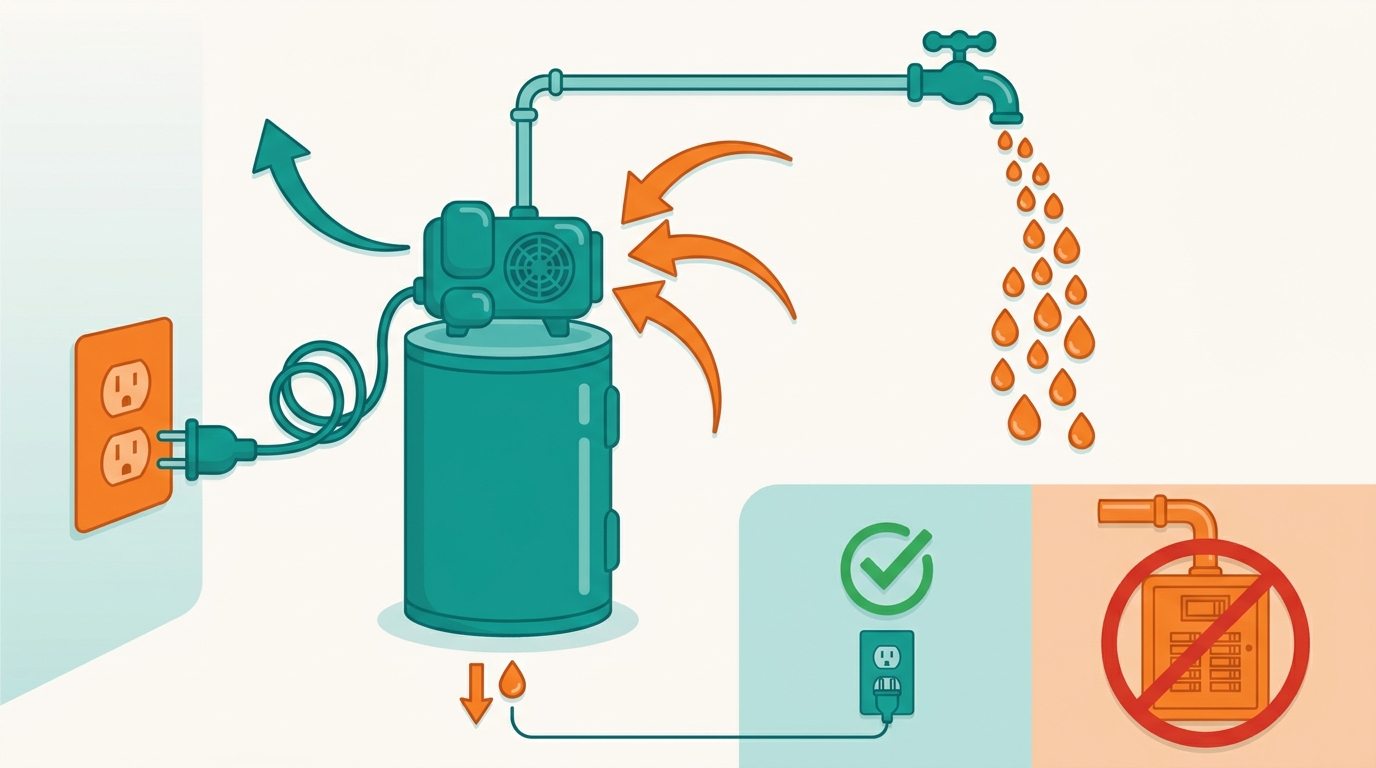
If you are searching "120V heat pump water heater," you are almost certainly trying to solve one constraint: getting heat pump efficiency without paying an electrician to run a new 240V circuit or upgrade your panel. The short answer is yes, a 120V plug-in does exactly that. It runs on the same standard outlet that powers your microwave, and it can save roughly $300 to $4,000 in electrical work. The catch is recovery speed. Once you understand that one tradeoff, the rest of the decision is straightforward.
These units exist for a specific reason. Roughly 60 million U.S. homes have a gas water heater and no 240V outlet anywhere near it. A standard 240V heat pump water heater would force a new circuit, and in older homes a panel upgrade on top of that. The 120V plug-in sidesteps that by shrinking the electrical draw to fit a normal household outlet. Below is the 2026 breakdown: how they pull it off, real model specs, what they cost, where the recovery limit actually bites, and who should pass.
120V / 15A
Standard outlet
~9–10 running amps, no new circuit
~12 GPH
Heat-pump recovery
Rheem plug-in, any tank size
$2,000–$4,600
Installed cost (2026)
Unit alone ~$1,500–$3,000
~$550/yr
Savings vs electric tank
Household of 4, per ENERGY STAR
Before you shortlist a model, it helps to see the numbers for your own house. Drop your current fuel, local electricity rate, and household size into Tankless vs Tank Water Heater Calculator. It puts a 120V heat pump next to a 240V model, a standard electric tank, and a gas tank on one screen, so the install premium and the yearly operating gap sit side by side instead of as guesses. Run it once before you read any quote.
On this page
- How a 120V plug-in actually works
- Real 2026 models and specs
- Dedicated vs shared circuit (and the NEC catch)
- What it costs in 2026
- Operating cost: where it earns the premium back
- Sizing: match the first-hour rating, then size up
- Installation realities
- Tax credits and rebates in 2026
- Who it's right for, and who should pass
- Common mistakes to avoid
- Frequently asked questions
- Next steps
How a 120V plug-in actually works
Every heat pump water heater moves heat instead of making it. A small compressor pulls warmth out of the surrounding air and dumps it into the tank, which is why these units are two to four times more efficient than a resistance tank that turns electricity straight into heat.
The 120V part is a power-budget trick. A standard household 120V/15-amp circuit can deliver about 1,800 watts, and only around 1,440 watts continuously once you account for safe derating. A conventional 240V hybrid's backup elements alone are 4,500 watts, which physically cannot run on that circuit. So manufacturers took one of two paths to fit inside the budget, and the path they pick changes how the unit behaves in your house.
| Design | Brands | Backup element? | How it fits 120V/15A |
|---|---|---|---|
| Heat-pump-only | Rheem ProTerra plug-in, Ruud Ultra | None | Low-draw compressor + larger tank + built-in HydroBoost mixing valve |
| 120V hybrid | A.O. Smith, State, GE Profile, American, Reliance | Yes, small 900W elements | Elements shrunk to ~7.5A so one can run, but never alongside the compressor |
Most competitor pages miss this distinction. Rheem dropped the resistance element entirely and leans on a bigger tank plus a mixing valve to deliver usable hot water. A.O. Smith, State, and GE kept a backup element but shrank it to 900 watts, small enough to stay inside the 15-amp ceiling. Either way, there is no 4,500-watt surge element waiting to bail you out during a long shower. That is the root of the recovery tradeoff. It is the design, not a defect.
The mixing-valve trick, in plain terms
A mixing valve lets the tank store water hotter than you actually use it, say 140°F, then blend in cold at the outlet to deliver a safe ~120°F. Storing hotter stretches the tank: a rough rule from the trade is that every extra 10°F of storage adds about 10 gallons of usable hot water. Rheem builds this in as HydroBoost; GE calls its version FlexCAPACITY. The A.O. Smith family skips the mixing valve and relies on raw tank size instead. The catch with hotter storage is slightly higher standby loss and a real scald risk, which is why the mixing valve down at the outlet matters.
Real 2026 models and specs
Three platforms cover almost the entire 120V plug-in market. The A.O. Smith unit is the same hardware sold under State, American, Reliance, and Lochinvar nameplates, so do not let the badge confuse you.
| Model (50-gal class) | Type | UEF | First-hour rating | Recovery | Backup element | Mixing valve | Noise |
|---|---|---|---|---|---|---|---|
| Rheem ProTerra plug-in (shared) | Heat-pump-only | 3.0 | 55 gal | ~12 GPH | None | Yes (HydroBoost) | ~49 dB* |
| A.O. Smith Voltex 120V / State Premier | 120V hybrid | 3.0 | 52 gal | Not published | 2× 900W | No | 45 dB |
| GE Profile GeoSpring 120V (PF) | 120V hybrid | EF ~3.2* | 59 gal | Not published | 2× 900W | Yes (FlexCAPACITY) | 41 dB |
Specs from Rheem (Form RH-PIHP-SC Rev. 7, 03/2025), A.O. Smith spec sheet ARXSS00123, GE spec sheet PS126225, and ENERGY STAR listings. *Rheem does not publish a sound rating on the shared-circuit sheet (marketing cites ~49 dB); GE's 120V UEF is not on the official sheet, only a legacy EF figure. All units are 120V/15A, draw ~9–10 running amps, and carry a 10-year tank-and-parts warranty.
A few specifics worth pulling out, because they decide whether a unit fits your space and your household:
- Capacities run 40, 50, 65/66, and 80 gallons across the lineup. The larger sizes are the point on 120V, since stored volume is how you cover slow recovery.
- The Rheem 80-gallon hits an 84-gallon first-hour rating despite the flat 12 GPH recovery. That tells you the tank, not the compressor, is doing the heavy lifting.
- Dimensions matter in a tight closet. The Rheem 80-gallon is about 75 inches tall and 24 inches across; the A.O. Smith 66-gallon is wider at 26.5 inches but shorter at about 62 inches. Measure your doorway and ceiling before you buy.
- Rheem's ambient operating range is 37°F to 145°F, the widest in class. A.O. Smith and GE heat pumps run roughly 35°F to 120°F and fall back to elements below that.
Field note: the recovery number that isn't on the box
On a 1980s split-level I looked at outside Portland, the homeowner had replaced a 40-gallon gas heater with a 50-gallon Rheem 120V plug-in and called it "weak" after a month of cold morning showers. The unit was fine. The problem was that the old gas heater recovered at roughly 40 gallons an hour, so it never ran out even at 40 gallons of storage. The 120V heat pump recovers at 12. We did not swap the unit; we bumped the storage setpoint and added a few minutes between the two longest showers, and the complaint disappeared. If they had bought the 65-gallon to begin with, there would have been no call at all. Slow recovery is real, but it is a sizing problem, not a quality problem.
Dedicated vs shared circuit (and the NEC catch)
"Plug-in" makes it sound like any outlet works. Mostly true, with one nuance worth getting right so you do not trip a breaker every laundry day.
Rheem's shared-circuit ProTerra is rated to share an existing 15-amp circuit, which is what makes it a clean gas-to-electric swap. Rheem's older dedicated-circuit version and the A.O. Smith/State family are happier on their own circuit. Even when a unit is rated to share, the National Electrical Code limits how much else can sit on that circuit, and an appliance drawing close to 10 amps does not leave much room. A 120V heat pump on the same circuit as a beer fridge and a freezer is asking for nuisance trips.
The practical move: if there is already an outlet within reach of the install spot and nothing heavy shares it, a shared-circuit model can be a true zero-electrician install. If you are not sure what else is on that circuit, the cheapest insurance is a dedicated 120V outlet, which is a small job next to a 240V circuit or a panel upgrade. If your panel is the real constraint, the panel upgrade checklist walks through how to tell whether you are actually out of room.
What it costs in 2026
Here is the part that surprises people: a 120V plug-in usually costs a little more at the box than the same brand's 240V model. GE's 120V GeoSpring lists around $2,639 against $2,529 for the 240V version. The savings are not in the unit, they are in the install.
| Cost piece | 120V plug-in | Standard 240V HPWH |
|---|---|---|
| Unit (50-gal, list) | $2,100–$2,640 | $1,900–$2,500 |
| New circuit | Often $0 (uses existing outlet) | $250–$1,500 |
| Panel upgrade if needed | Rarely needed | $1,500–$4,000 |
| Typical install (program data) | ~$1,700 | ~$2,176 |
| Typical total installed | $2,000–$4,600 | $2,800–$6,500 |
Unit list prices from Home Depot, Lowe's, and GE (street prices are often $400–$700 lower on promotion). Install figures from California TECH program data (n≈7,665), where 120V installs averaged about 22% less than 240V. Total installed ranges per HomeGuide and Angi 2026 cost guides. Standard tank for comparison: $600–$3,100 installed.
The cleaner way to see the gap is by scenario, because the 120V advantage is biggest exactly where a 240V install gets expensive: replacing a gas heater in a home with a full or distant panel.
120V plug-in vs 240V install by scenario (2026)
the easy case
electric-to-electric
where 120V wins big
In the field data, only about 2% of 120V installs needed an electrical service upgrade, versus more than 25% of 240V installs. That one line is the financial case for going 120V: you are betting that avoiding the panel work is worth living with slower recovery. For most households with steady demand, it is. For a full breakdown of installed pricing across both voltages, see heat pump water heater cost, and if you want the payback math, heat pump water heater ROI walks through a worked example.
Operating cost: where it earns the premium back
The reason to pay more upfront is the running cost. Because a heat pump moves heat rather than making it, it sips electricity.
ENERGY STAR's savings figures, verified against their current benefits page, scale with household size:
| Household | Annual savings vs electric tank | Payback | Lifetime savings |
|---|---|---|---|
| 2 people | $270 | 5.5 yr | $2,050 |
| 3 people | $410 | 3.7 yr | $3,830 |
| 4 people | $550 | 2.7 yr | $5,610 |
Source: ENERGY STAR Heat Pump Water Heater benefits and savings page. A household of four saves roughly $550 a year and over $5,600 across the unit's life, versus a standard electric resistance tank.
In dollars, a 120V heat pump typically runs about $100 to $160 a year to operate, against roughly $400 to $600 for an electric resistance tank and $325 to $475 for gas, depending heavily on local rates. Against cheap natural gas the operating gap narrows, so the case there leans more on getting off combustion than on the bill. Against an electric resistance tank, the math is lopsided in the heat pump's favor.
One caveat for 120V specifically: the slightly lower UEF means marginally higher running cost than a 240V model of the same size. The difference is small, a few dollars a year, and nowhere near the install savings. Run your own rate through Tankless vs Tank Water Heater Calculator if you want the exact figure for your ZIP.
Here is a one-year owner's-eye view of living with a Rheem 120V plug-in, including the recovery question and the noise:
Sizing: match the first-hour rating, then size up
The DOE does not publish a tidy "X gallons per person" chart. It sizes by peak-hour demand against first-hour rating (FHR), which is the gallons of hot water a full tank can deliver in your busiest hour. The DOE worksheet uses real numbers: a shower is about 20 gallons, a dishwasher run 7, a top-load washer 25. Add up your worst hour and that is your target FHR.
A common family-of-four morning, three showers plus dishwashing, lands around 66 gallons. Because 120V recovery is slow, you cover that with stored volume rather than reheat speed:
- 1 to 2 people: a 50-gallon tank usually covers a 30 to 45-gallon peak hour comfortably.
- 3 to 4 people: 65 gallons is the sweet spot, matching that ~66-gallon peak.
- 5+ people: go 80 gallons, which delivers an 84-gallon first-hour rating.
The rule of thumb that floats around forums, "size up two tank sizes from what you would buy in a gas heater," holds up here. The gas heater you are replacing likely had a ~75-gallon FHR, so a 65 or 80-gallon 120V unit is what actually matches it. Undersize it and you will blame the technology for a sizing mistake.
Installation realities
The electrical is the easy part. The rest is where a 120V install still needs care, and usually a plumber.
- Air volume. These units breathe. Rheem and GE want roughly 700 cubic feet of surrounding air, A.O. Smith about 450; that is a small-to-medium room. A tight closet needs a louvered door or a duct kit (about $150 to $500). Starve it of air and efficiency tanks.
- Condensate. The heat pump pulls moisture out of the air, so it produces condensate that needs a gravity drain or, where there is none, a condensate pump (not included on any model). Skipping this is a classic mistake that ends in a wet floor.
- Temperature. Performance falls as the surrounding air gets colder. An unheated garage that regularly drops below 40°F is a poor home for most 120V units; Rheem's wider 37°F range tolerates it better than the others.
- Noise and cool air. Expect roughly 41 to 49 dB, about a quiet window AC, plus a stream of cool air. Fine in a basement or utility room, annoying next to a bedroom.
- Permits. "No electrician" does not mean "no permit." A water heater swap typically still needs a plumbing permit and inspection. Budget for it.
Tax credits and rebates in 2026
This is the section most competing pages get wrong, so read the date carefully.
The federal 25C credit is gone for 2026 installs. The One Big Beautiful Bill Act, signed July 2025, ended the 25C Energy Efficient Home Improvement Credit early. It now applies only to property placed in service on or before December 31, 2025, not the 2032 date the Inflation Reduction Act had set. If your unit was installed and running by then, you can still claim 30% of eligible cost up to $2,000 on IRS Form 5695 with your 2025 return. The placed-in-service date controls, so a deposit paid in 2025 does not rescue a 2026 install.
Ignore the '$2,000 federal credit' on most product pages
As of June 2026, many manufacturer and retailer pages, and even parts of the ENERGY STAR site, still advertise the 25C credit as if it were current. It is not, for 2026 installs. Verify credit status against IRS.gov, not a marketing page, and budget your project without the federal credit unless your unit was placed in service in 2025.
What does survive: state energy-office rebates under the IRA Home Energy Rebates (HEEHRA point-of-sale and HOMES performance-based) and utility heat pump water heater rebates. These are separate from the dead federal credit and still running in much of the country, though availability varies sharply by state and some programs are already fully reserved. Check your state energy office and utility before you sign. For the full breakdown of what ended and what remains, see the heat pump water heater tax credit guide.
Who it's right for, and who should pass
A 120V plug-in is the right call when:
- Your panel is full or the circuit run to the water heater is long and expensive, so avoiding electrical work saves real money.
- You are replacing a gas heater and there is no 240V outlet anywhere nearby.
- Your hot-water demand is steady and spread out rather than a single brutal morning spike.
- You can put it somewhere with adequate air, a drain path, and tolerance for a little noise.
Lean toward a standard 240V model instead when:
- You already have a 240V circuit and a drain, so the install savings mostly evaporate.
- You have a large household with heavy, spiky demand, where 240V recovery and a surge element earn their keep.
- The only install spot is an unheated space that drops below 40°F for much of the year.
- You want the option of a resistance boost during guests, holidays, or a cold snap.
Common mistakes to avoid
- Buying on "no electrical work" without confirming there is actually a usable outlet, and that nothing heavy shares it.
- Sizing for the gallons you had instead of the first-hour rating you need, then blaming slow recovery.
- Ignoring condensate drainage, which is the number-one callback on these installs.
- Putting it in a tight closet with no louvered door or duct kit, then wondering why it underperforms.
- Pricing the project around a federal tax credit that no longer exists for 2026 installs.
Frequently asked questions
Can you plug it into a regular outlet? Yes. A 120V/15-amp model draws about 9 to 10 running amps and uses a standard household outlet, no new 240V circuit or panel upgrade.
Will it keep up with showers? For one to four people with a right-sized tank, usually yes. Recovery is the limit, about 12 GPH on a Rheem plug-in, so size the tank up to cover back-to-back use.
Does it need a backup heating element? Rheem 120V models are heat-pump-only with a mixing valve; A.O. Smith, State, and GE add small 900W elements. None has a 240V hybrid's 4,500W surge element.
How much does it cost installed? About $2,000 to $4,600 in 2026. The unit costs a touch more than a 240V model, but the install runs roughly 22% cheaper because there is no circuit or panel work.
Is there a tax credit in 2026? No federal 25C credit for units placed in service in 2026 or later. A 2025 install can still claim 30% up to $2,000. State and utility rebates often remain.
Next steps
- Model your own numbers. Put your fuel, rate, and household size into Tankless vs Tank Water Heater Calculator to see the 120V install savings against the slightly higher running cost.
- Check your outlet and your panel. If a usable 120V outlet is nearby, a shared-circuit model may be a zero-electrician swap. If your panel is the question, start with the panel upgrade checklist.
- Capture the scope in one place so every installer quotes the same job, and decide between tank and tankless first with tankless vs tank water heater. Then keep the whole upgrade plan in My Plan. Replacing a gas heater in a high-cost metro? See heat pump water heater installation cost in Austin for a regional example.
Sources & further reading
- Heat Pump Water Heaters: Benefits and Savings — ENERGY STAR
- Plug-in Heat Pump Water Heater with HydroBoost spec sheet — Rheem
- Sizing a New Water Heater (first-hour rating method) — U.S. Department of Energy
- FAQs: Modification of Section 25C under Public Law 119-21 (OBBB) — IRS
- Significant Savings From 120-Volt Heat Pump Water Heaters — CleanTechnica / TECH Clean California
- Plug-in Heat Pump Water Heaters: An Early Look at 120-Volt Products — NEEA
Frequently asked questions
Can you plug a heat pump water heater into a regular outlet?+
Yes. A 120V plug-in heat pump water heater runs on a standard 120-volt, 15-amp household outlet, the same kind that powers a microwave or vacuum. Models like the Rheem ProTerra plug-in and A.O. Smith Voltex 120V draw only about 9 to 10 running amps, so no new 240V circuit and no panel upgrade are needed. That is the whole point: it lets you electrify a gas water heater without rewiring.
Does a 120V heat pump water heater need a dedicated circuit?+
It depends on the model. Rheem's shared-circuit ProTerra (with HydroBoost) is rated to share an existing 15-amp circuit because its running draw is low, while Rheem's older dedicated-circuit version and the A.O. Smith/State family want their own circuit to avoid nuisance trips. Even when a model can share, a dedicated 120V outlet is the safer install. Check the spec sheet, because the NEC limits what else can sit on a shared circuit.
Will a 120V heat pump water heater keep up with showers?+
For a household of one to four with a right-sized tank, usually yes. The catch is recovery: a Rheem 120V plug-in reheats at about 12 gallons per hour regardless of tank size, versus roughly 20 to 25 GPH for a 240V hybrid in backup mode. You make up for slow recovery with stored volume, so size up. An 80-gallon 120V model delivers an 84-gallon first-hour rating, enough for back-to-back showers if you are not also running laundry.
How much does a 120V heat pump water heater cost installed?+
About $2,000 to $4,600 fully installed in 2026, with the unit alone running roughly $1,500 to $3,000 (50-gallon list prices: Rheem ~$2,100, A.O. Smith ~$2,200, GE ~$2,640, often discounted). The savings versus a 240V model come from the install, not the box. California program data put a typical 120V install near $1,700, about 22% less than a 240V install, because no new circuit or panel work is needed.
Is a 120V heat pump water heater less efficient than a 240V model?+
Slightly, but both are far more efficient than any standard tank. ENERGY STAR sets a UEF floor of 2.20 for 120V/15-amp units versus 3.30 for 240V integrated models. Real 120V units beat the floor: the Rheem ProTerra plug-in runs UEF 2.8 to 3.46 depending on size. A standard electric tank sits below 1.0, so a 120V heat pump still uses roughly 70% less energy for water heating.
What size 120V heat pump water heater do I need?+
Size by first-hour rating (FHR), not just gallons. The DOE method adds up your busiest hour of hot water use; a family of four often lands near a 66-gallon peak. Because 120V recovery is slow, size the tank up: roughly 50 gallons for one to two people, 65 gallons for three to four, and 80 gallons for five-plus. A gas heater being replaced often had a ~75-gallon FHR, so a 65 or 80-gallon 120V unit matches it best.
Do 120V heat pump water heaters have a backup heating element?+
Some do, some do not, and it changes how they behave. Rheem ProTerra plug-in models are heat-pump-only with no resistance element, relying on a larger tank and a built-in HydroBoost mixing valve. A.O. Smith, State, and GE 120V units include small 900-watt backup elements that fit inside the 15-amp budget but cannot run alongside the compressor. Either way, there is no 4,500-watt surge element like a 240V hybrid has, which is why recovery is slower.
Is there a federal tax credit for a 120V heat pump water heater in 2026?+
No federal 25C credit applies to a heat pump water heater placed in service in 2026 or later. The One Big Beautiful Bill Act, signed July 2025, ended the 25C credit early, limiting it to property placed in service on or before December 31, 2025. A qualifying unit installed in 2025 can still claim 30% of cost up to $2,000 on the 2025 return. For 2026 installs, look to state energy-office and utility rebates, which remain available in many areas.
Does a 120V heat pump water heater work in a cold garage or basement?+
It works, but performance drops as the surrounding air gets colder, because the unit pulls heat from that air. Rheem's 120V line operates from 37°F to 145°F ambient, the widest range in its class; A.O. Smith and GE heat pumps run roughly 35°F to 120°F and lean on backup elements below that. The unit also needs about 450 to 700 cubic feet of air, or a louvered door or duct kit, and it blows cool air and runs at roughly 41 to 49 dB.
Can I install a 120V heat pump water heater myself?+
The electrical is plug-and-play, but the plumbing and condensate work usually are not DIY, and a permit is typically still required. You need a condensate drain (or a condensate pump where there is no gravity drain), correct clearances and air volume, and a code-compliant connection. Many homeowners handle the swap with a plumber and skip the electrician entirely, which is where the savings come from. No electrician does not mean no permit.
Try the companion tool
This post links to an interactive tool built for this topic. Open it to see numbers tailored to your home.
Open the toolGet practical energy tips
Join homeowners getting practical tips on cutting energy bills and staying comfortable.
Practical tips only. Unsubscribe anytime.
Read this next
Related guides selected by topic overlap and upgrade path.

A heat pump water heater costs about $2,800–$6,500 installed in 2026. Real prices by tank size, the add-ons that move the number, and operating-cost math.

The federal 25C heat pump water heater tax credit ended for 2026 installs. Here's how to still claim it for a 2025 install on Form 5695, what changed under the OBBBA, the ENERGY STAR and CEE-tier rules, and the rebates that remain.

Electrical panel upgrade cost depends on more than the panel. Use this homeowner checklist to understand scope, avoid surprises, and compare quotes.

Tesla Powerwall 3 installed cost in 2026 is about $13,000 to $16,500 all-in (battery, Gateway, labor, permits). The 30% federal credit is gone. Full breakdown.