Blog
Heat Pump vs Furnace in Winter: Do Heat Pumps Work in the Cold?
Heat pumps work below freezing, but the right choice depends on your electric vs gas price, your climate, and whether you pick a cold-climate model. Here is how to decide, with your own rates.
Standing in front of a big winter bill, one question hits hard: am I better off with a heat pump or a gas furnace? And the one most people ask first: do heat pumps even work when it is freezing outside?
They do. A modern air-source heat pump still pulls heat out of cold air below freezing, and cold-climate models keep heating down toward 5 degrees Fahrenheit and lower. The real question is not whether a heat pump works in winter. It is which system costs you less to run, keeps you comfortable, and fits your house, given your electricity price, your gas price, and how cold your winters get.
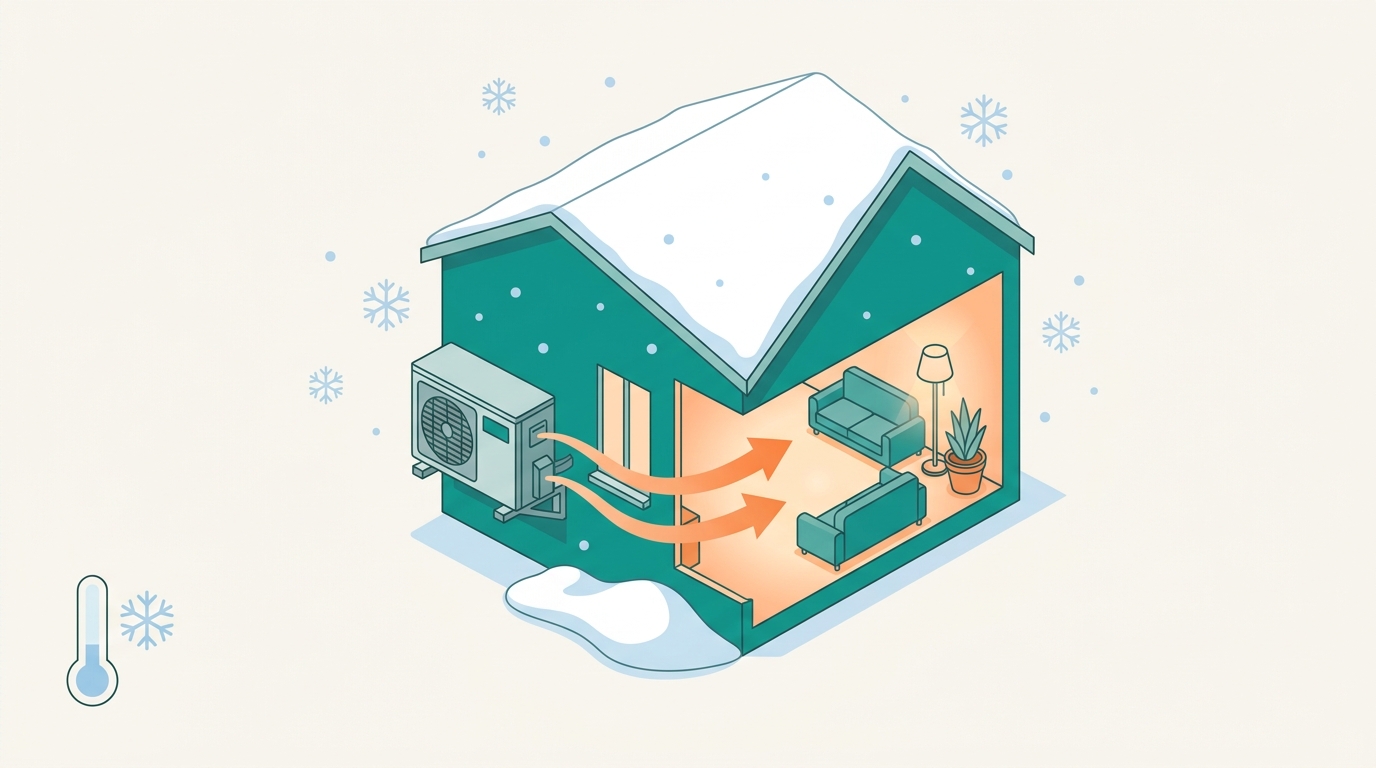
Want the dollar answer for your home? Put in your own electric and gas rates with the Heat Pump vs Furnace Calculator. Every example below turns into your numbers, not a national average.
When a heat pump wins in winter, and when to keep a furnace
Five things drive the choice:
- Your prices. Compare cost per unit of heat: your electricity rate divided by the heat pump's winter COP, versus your gas rate per therm divided by the furnace's AFUE. Cheap gas and pricey power favors the furnace; moderate power favors the heat pump.
- Your climate and design temperature. The colder your typical winter low (your "design temp"), the more capacity and backup you need to plan for.
- The model you choose. A standard heat pump fades faster in the cold than a cold-climate (ccASHP) unit, which holds capacity and efficiency much deeper into winter.
- Your building shell. A tight, well-insulated home needs less heat, so a heat pump carries more of the load and the furnace becomes optional.
- Your backup strategy. Electric resistance strips, or a gas furnace in a dual-fuel setup, handle the coldest hours. The strategy you pick changes both comfort and cost.
Where moderate electricity, a mild-to-mixed climate, a cold-climate model, and a decent shell line up, the heat pump usually wins on cost and adds cooling for free. Where gas is cheap, winters are long and severe, and the house is leaky, a high-efficiency furnace (or a dual-fuel hybrid) often still makes sense.
This guide gives you a clear way to compare the two so you can choose a system that matches your winter reality. If you have your bills handy, the one-minute setup below makes every number on this page yours.
One-minute setup (do this first)
- Grab your latest electric bill for the cents per kWh line.
- Grab your latest gas bill for the dollars per therm line.
- Open the Heat Pump vs Furnace Calculator and enter those two rates plus your winter climate (mixed, cold, or mild).
Now every example below will translate into your dollars, not averages.
47°F
High-temp rating point
where rated capacity and HSPF are measured
5°F
Cold-climate rating point
ccASHP capacity is also listed here
~2.2–2.8
Typical seasonal COP
heat delivered per unit of electricity, cold/mixed climates
On this page
- Quick answer: when each one wins in winter
- What you are really comparing in winter
- How a heat pump heats in winter
- What rated capacity at 5°F vs 47°F actually means
- Defrost cycles, and the moment backup kicks in
- Why a right-sized system "feels different"
- How a gas furnace heats in winter
- COP vs AFUE: the two efficiency numbers compared
- Operating cost in winter: the simple math
- Step 1: estimate heat pump cost per unit of heat
- Step 2: estimate gas furnace cost per unit of heat
- Comfort in winter: how each system feels
- Heat pump comfort profile
- Gas furnace comfort profile
- Climate: where you live changes the answer
- Mild winter climates
- Mixed and cold climates
- When a heat pump is the stronger winter choice
- When a gas furnace still makes sense in winter
- When a hybrid system is the right winter compromise
- Switchover (balance point) temperature
- Sizing and Manual J: the step most people skip
- Emissions and the long-term bet
- How to decide for your home in 5 steps
Quick answer: when each one wins in winter
If you want the headline before the details:
-
Heat pump tends to win in winter when
- electricity prices are moderate,
- winters are mild or mixed,
- you want both heating and cooling in one system,
- you care about lower emissions over the next 10–15 years.
-
Gas furnace tends to win in winter when
- natural gas is cheap in your area,
- winters are long and harsh,
- your house is still leaky and under-insulated,
- you need high supply temperatures during deep cold.
-
Hybrid or dual fuel systems earn their keep when
- you want heat pump efficiency during most of the season,
- you still want a gas furnace to carry the coldest days,
- your region offers incentives for both.
The rest of this guide helps you figure out which bucket you live in. If you are weighing this for a specific cold city, the worked example in heat pump vs furnace in Minneapolis shows how the math plays out where winters are genuinely harsh.
What you are really comparing in winter
Forget labels for a moment. Think about how each system makes heat on a cold day.
How a heat pump heats in winter
A heat pump is an air conditioner that can run backward. In heating mode it:
- pulls heat from outside air,
- uses electricity to move that heat indoors,
- blows warm air into your ducts or through indoor wall units.
Because it moves heat instead of making it from scratch, a heat pump can deliver two to three units of heat for every unit of electricity it draws, even in cold weather when designed for that climate. Studies and field data from the U.S. Department of Energy and others report heating efficiencies in that range for air source heat pumps, with cold climate models holding usable capacity near 5°F instead of falling off a cliff.
You will see this expressed as a coefficient of performance, or COP:
- COP 1.0: 1 unit of electricity in, 1 unit of heat out.
- COP 2.5: 1 unit of electricity in, 2.5 units of heat out.
Higher COP in winter means more heat per dollar of electricity. Real-life seasonal COP in cold and mixed climates often lands around 2.2 to 2.8 once you account for defrost cycles and temperature swings, with milder climates running higher and the coldest stretches dragging it lower.
What rated capacity at 5°F vs 47°F actually means
Open any cold-climate heat pump's spec sheet and you will see capacity listed at two outdoor temperatures: 47°F and 5°F. The 47°F number is close to the unit's headline rating. The 5°F number is the one that decides whether your house stays warm in a cold snap.
Here is the practical difference. A standard heat pump might deliver only 50 to 60 percent of its rated capacity once the air drops to 5°F. A true cold-climate (ccASHP) unit holds far more, often 70 to 100 percent of its 47°F capacity at 5°F, because the variable-speed (inverter) compressor can spin up to compensate. So two units with the same 47°F rating can behave completely differently at 5°F. If you size off the 47°F number alone, a standard unit can come up short on the exact night you need it most, and the backup heat takes over.
That is also why a contractor's load calculation has to be matched against the 5°F (or colder) capacity for your design temperature, not the brochure headline.
Reading the spec sheet
When you compare two heat pumps, look past the SEER and HSPF on the box. Find the capacity at 5°F (and at 17°F if listed) and compare it to your home's heat loss at your design temperature. The Northeast Energy Efficiency Partnerships keeps a free, searchable list of cold-climate models with these numbers published. That single comparison tells you more about winter comfort than the marketing label "high efficiency."
Defrost cycles, and the moment backup kicks in
When it is cold and damp, frost builds up on the outdoor coil. To clear it, the heat pump briefly runs in reverse, sending warm refrigerant outside to melt the ice. During those few minutes (typically once or twice an hour in frosty weather, lasting a couple to several minutes each) the unit is not heating your house, and you may see steam rolling off the outdoor unit. To avoid blowing cool air indoors, the system often fires the backup heat during defrost.
Backup heat is the other thing to understand. In an all-electric setup, that backup is usually electric resistance strips running at COP 1. They turn on in three situations: during defrost, when the outdoor temperature falls below the unit's capacity (the heat pump simply can't keep up), and during a fast recovery from a deep thermostat setback. Resistance strips are what drive the scary cold-snap bills people talk about, because for those hours you are paying full electric-resistance prices. A cold-climate unit cuts those strip-heat hours sharply, and a dual-fuel system shifts them to gas instead.
Why a right-sized system "feels different"
Homeowners who switch from an oversized furnace to a properly sized cold-climate heat pump often describe the heat as feeling different, and they mean it as a compliment once they get used to it. A gas furnace blasts 120°F-plus air in short bursts, then shuts off and lets the house drift. A modulating heat pump delivers cooler air (often 95 to 105°F) but runs long, gentle cycles that hold the temperature steady, so rooms stop swinging warm and cool.
An oversized heat pump loses that advantage. It short-cycles, can't modulate down to match a mild day, and ends up feeling drafty and noisier, the same problem oversized furnaces have. The comfort comes from matching the equipment to the actual load, which is why the Manual J calculation below matters so much.
How a gas furnace heats in winter
A gas furnace burns natural gas and sends the heat through a heat exchanger into your ducts. The main efficiency rating is AFUE:
- Older furnaces: sometimes 60–80 percent AFUE.
- Standard newer models: around 80–90 percent.
- High efficiency models: about 90–98 percent AFUE.
AFUE 95 percent means 95 percent of the gas energy becomes heat in your home, while 5 percent leaves through the vent.
In winter, a gas furnace does not lose as much efficiency as outdoor temperatures fall. Fuel burns the same way on a mild day and a very cold night. That steadiness is one reason gas holds an edge in some deep cold climates where electricity is expensive.
COP vs AFUE: the two efficiency numbers compared
Winter exposes the real difference. A heat pump's COP falls gradually as it gets colder: roughly COP 3 or higher on a cool fall day, the COP 2 range near freezing, and toward COP 2 or a bit lower in the single digits, with a cold-climate model holding higher numbers deeper in. A condensing gas furnace, by contrast, holds its rated AFUE whether it is 35°F or 5°F outside, because fuel burns the same way regardless. Gas efficiency is predictable; heat pump efficiency is high but more sensitive to temperature and design. Efficiency, though, is only half the story. The other half is energy price.
Operating cost in winter: the simple math
You do not need a full spreadsheet to compare winter cost. You only need three pieces of information:
- Your electricity price per kWh.
- Your natural gas price per therm.
- Realistic efficiency numbers for each system.
From there, think in terms of cost per unit of heat delivered.
Step 1: estimate heat pump cost per unit of heat
Take:
- electricity price (cents per kWh) from your bill,
- a realistic seasonal COP (use 2.0–3.0 unless you have colder design data).
Cost per kWh of heat delivered is:
- electricity price ÷ COP.
Example with a recent U.S. average electric rate of about $0.17 per kWh and a seasonal COP of 2.5:
- $0.17 ÷ 2.5 ≈ $0.068 per kWh of heat.
If your local rate is higher or your COP lower, this number rises.
Step 2: estimate gas furnace cost per unit of heat
Natural gas is usually priced in therms:
- 1 therm ≈ 29.3 kWh of heat energy.
Take:
- gas price from your bill (dollars per therm),
- furnace AFUE.
Cost per kWh of heat delivered is:
- convert price per therm to price per kWh: gas price ÷ 29.3,
- divide by AFUE.
Example with a recent U.S. average gas price of about $1.70 per therm and a 95 percent AFUE furnace:
- $1.70 ÷ 29.3 ≈ $0.058 per kWh of fuel energy,
- $0.058 ÷ 0.95 ≈ $0.061 per kWh of heat delivered.
In this example:
- Heat pump heat costs about 6.8 cents per kWh of heat.
- Gas furnace heat costs about 6.1 cents per kWh of heat.
Illustrative cost per unit of heat delivered
electricity price ÷ COP
gas price per kWh ÷ AFUE
milder weather / cold-climate model
backup heat during deep cold
That is nearly a tie in the base case. With cheaper electricity, a higher COP, or pricier gas, the heat pump pulls ahead. Swap any of those the other way and the furnace wins. Notice the last bar: when the heat pump falls back on resistance strips, the cost per unit of heat roughly triples, which is exactly why backup strategy matters in cold climates. Your calculator lets you test those swaps quickly. For a deeper walk-through of what a real January looks like on the bill, see what a heat pump actually costs to run.
Recent analysis from the National Renewable Energy Laboratory found that high efficiency heat pumps can cut site energy use for heating by roughly one third to nearly half compared with furnaces on average. Energy cost savings are smaller in regions where gas prices are low relative to electricity, and larger where electric rates and incentives align.
This is why you need local math. National averages hide the swings that matter to you, so plugging your own electric rate, gas rate, furnace AFUE, and heat pump COP or HSPF into the calculator gives a much clearer answer than any generic rule.
Comfort in winter: how each system feels
Money matters. Comfort matters too, especially on winter nights.
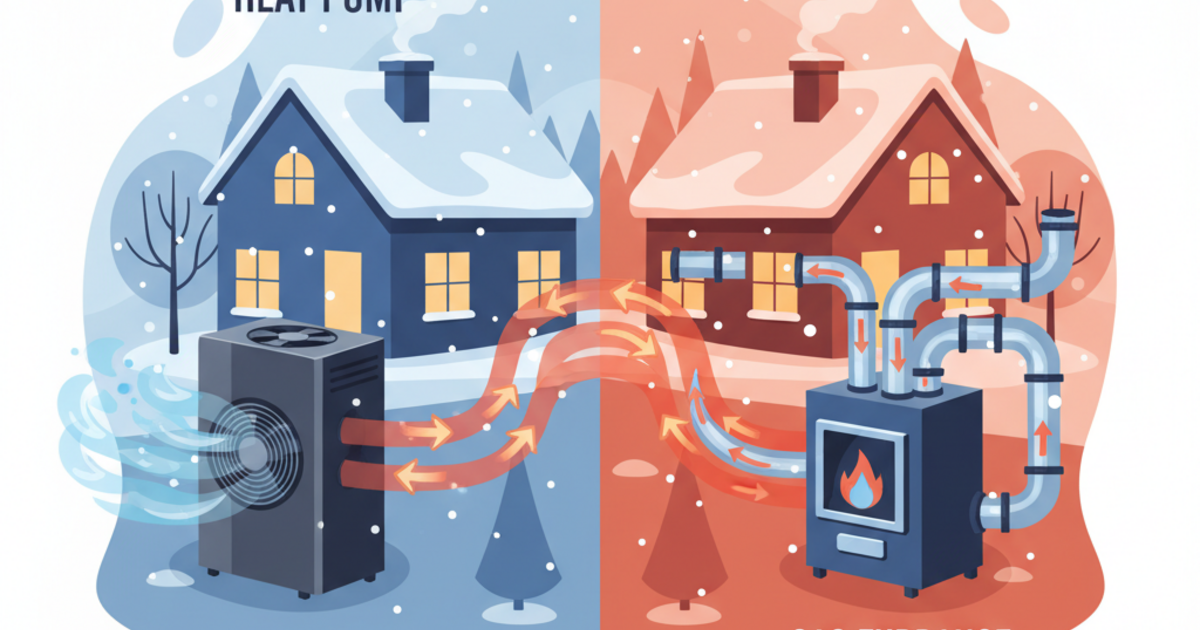
Heat pump comfort profile
Heat pumps:
- deliver warm air at lower supply temperatures than gas furnaces,
- run longer, steadier cycles,
- keep room temperature more even across the day.
Many people like the steady feeling because rooms swing less from hot to cool. In a tight, well insulated home, that steady warmth feels solid even when outdoor air is below freezing.
On noise: a modern variable-speed heat pump usually runs quietly at low speed, but the outdoor unit ramps up in deep cold and during defrost, so it is more audible on the coldest nights than a furnace, whose noisy part sits indoors. Placement away from bedroom windows handles most of this.
If your home is leaky, you may notice:
- cooler air from vents than you expect,
- longer run times,
- backup electric strips turning on in deep cold.
Cold climate systems reduce those problems by keeping higher capacity in low temperatures and modulating output instead of snapping on and off.
Gas furnace comfort profile
Gas furnaces:
- send air into the ducts at higher temperatures,
- often run shorter, more intense cycles,
- are familiar to many homeowners.
Rooms tend to heat up faster after setback. Some people like the blast of hot air when the system turns on, especially in old, drafty houses.
The tradeoff:
- temperature swings can be larger between cycles,
- oversizing can make cycles even shorter and less efficient,
- comfort can suffer in rooms with poor duct design.
In winter, a well sized gas furnace still delivers a strong comfort experience, especially in homes that are not yet well sealed.
Climate: where you live changes the answer
The same equipment performs very differently in Miami, St. Louis, and Minneapolis. Before you pick a side in the heat pump vs gas furnace debate, anchor your thinking in climate.
Mild winter climates
In parts of the South, coastal regions, and marine climates, design temperatures rarely dip far below freezing and cooling often dominates the annual picture. A heat pump usually offers the best all-around package here: high efficiency for both heating and cooling, reasonable winter operating cost, and no combustion equipment to maintain. Many homes in these climates already heat with electricity. The U.S. Energy Information Administration reports electricity is the main heating source in roughly 43 percent of U.S. households (2023 data), with higher shares in the South.
Mixed and cold climates
Across much of the Midwest, Mid-Atlantic, New England, and the inland Northwest, temperatures frequently fall below freezing and heating dominates energy use. The answer here is more nuanced. A cold-climate heat pump paired with good air sealing and insulation can carry most or all of the winter load with good comfort. A high-efficiency gas furnace stays cost-competitive when gas is cheap, especially in older, leaky housing. A hybrid balances the two. And where deep cold snaps are common and outages are more than a rare event, backup options deserve serious weight.
When a heat pump is the stronger winter choice
You lean toward a heat pump for winter heating when most of these statements match your situation.
- Electricity rates are moderate compared to gas prices.
- You need both heating and cooling and plan to replace an aging AC anyway.
- Your house has, or will have, solid air sealing and insulation within the next few years.
- You want to cut emissions and plan to stay in the home long enough to benefit from lower energy use.
- You are comfortable relying on electric heat with appropriate backup planning.
Recent work from RMI and NREL finds that swapping gas furnaces for efficient heat pumps can cut emissions across the continental U.S., often by large margins, especially as the grid adds more renewables.
If your long term plan includes solar, a heat pump also lines up well because it converts more of that homegrown electricity into useful heat compared with resistance electric heating.
When a gas furnace still makes sense in winter
You lean toward keeping or installing a gas furnace when most of these fit.
- Natural gas is cheap where you live and is likely to stay that way for a while.
- Winters are long and severe, and deep cold is common.
- Your home is older, leaky, and you will not overhaul the shell soon.
- You value the simplicity and known behavior of a gas system during cold snaps.
- You want to minimize upfront cost and your existing ductwork and venting set up well for a replacement furnace.
A high efficiency furnace paired with targeted shell work can still lower winter bills significantly compared with an old 60–70 percent unit. In some markets, operating cost for a heat pump and a high efficiency furnace land within a narrow band, but in others the furnace wins when electric rates climb faster than gas rates.
This is another case where a calculator that lets you test several rate and efficiency combinations is more useful than any blanket rule.
When a hybrid system is the right winter compromise
A hybrid, or dual fuel, setup combines both:
- a heat pump for most of the season,
- a gas furnace for the coldest hours.
The Department of Energy describes these systems as a way to get heat pump efficiency in milder weather with a furnace that steps in when a gas flame makes more sense.
This approach can:
- keep your home comfortable during cold snaps without relying on electric resistance strips,
- cut gas use and emissions compared with a furnace alone,
- hedge against future fuel price swings by letting you set the balance point where each system runs.
Switchover (balance point) temperature
The heart of a dual-fuel system is the switchover temperature, also called the balance point. Below it, the controls shut off the heat pump and let the furnace run; above it, the heat pump does the work. There are two ways to set it:
- Economic balance point. Set the switchover at the outdoor temperature where the heat pump and the furnace cost about the same per unit of heat, given your rates. Above that, the heat pump is cheaper; below it, gas is. This squeezes the most savings out of your fuel prices and shifts automatically as the weather changes.
- Capacity balance point. Set it at the temperature where the heat pump can no longer meet the home's full heat loss on its own. Below this point you need the furnace regardless of price.
A good install accounts for both. The economic point depends entirely on your electric and gas rates, so it is worth recomputing whenever rates change. The full mechanics, including how to pick the setpoint, are covered in how dual-fuel heat pump and furnace systems work.
Hybrid systems add complexity and cost compared with a single unit. The smart way to decide is to run the numbers with your own rates and temperatures, not only the installer's default settings. The Heat Pump vs Furnace Calculator is built for exactly this kind of rate-against-rate comparison.
Sizing and Manual J: the step most people skip
The single biggest predictor of winter happiness with either system is correct sizing, and that comes from a Manual J load calculation. Manual J adds up your home's heat loss at your design temperature, room by room, using insulation levels, window area, air leakage, and local climate data. It produces the actual number of BTUs per hour your home needs on a cold day.
Why it matters in winter:
- For a heat pump, you size against capacity at your design temperature (the 5°F or 17°F column), not the 47°F headline. Undersize it and the backup strips run too often; oversize it and it short-cycles and loses the steady comfort that makes a heat pump pleasant.
- For a furnace, oversizing is rampant because bigger feels safer. An oversized furnace runs in short, hot blasts that leave temperatures swinging and waste fuel.
A reliable Manual J usually means a contractor measuring your home, not eyeballing it or copying the size of your old unit. Insist on seeing the calculation. If your home is leaky or under-insulated, tightening the shell first lowers the load, which can let you buy a smaller, cheaper system and pushes the balance point in the heat pump's favor. The case for doing the envelope first is laid out in insulation before a heat pump.
Emissions and the long-term bet
If emissions matter to you, the direction is clear: analyses find that moving from gas furnaces to efficient heat pumps cuts space-heating emissions in every U.S. state, with reductions reaching the 90 percent range in some grids when combined with building upgrades. And as more renewables come online, each kWh you use for heating tends to get cleaner over the equipment's life.
This does not mean ripping out a working gas system tomorrow. It does mean that when you replace heating equipment likely to run 15 to 20 years, you are making a long-term bet. A heat pump shifts that bet toward an increasingly clean grid; a furnace keeps you tied to gas. How much weight you give that, against bills and comfort, is yours to decide.
How to decide for your home in 5 steps
Here is a simple path that matches the rest of your planning process.
-
Map your current energy use
- Gather last 12 months of gas and electric bills.
- Use a bill breakdown tool to estimate how much you spend on space heating in a normal year.
-
Check your house shell
- If your attic, walls, and basement are under-insulated and leaky, plan shell upgrades first.
- A tighter shell improves comfort for any system and lowers the size you need to buy.
-
Run local cost scenarios
-
Enter your electricity and gas rates into a Heat Pump vs Furnace Calculator.
-
Test:
- a high efficiency furnace,
- a standard heat pump,
- a cold climate heat pump,
- a hybrid setup.
-
Use realistic COP and AFUE values, not brochure peaks.
-
-
Layer on incentives and future plans
- Check federal, state, and utility incentives for heat pumps and efficiency. The federal rules changed recently, so confirm what is current in the heat pump tax credit guide before you count on a number.
- If you aim to install solar or electrify other loads later, note how a heat pump fits into that path.
-
Talk to contractors with a plan in hand
-
Share your goals, bill data, and calculator results.
-
Ask each contractor to explain:
- how they sized the equipment (ask to see the Manual J),
- what winter performance you should expect at your design temperature,
- how their design handles cold snaps and outages.
-
Then compare your notes against your priorities: lowest operating cost, lowest emissions, highest resilience, or a balance of all three.
Not sure where heating sits among your other projects? The heating and cooling upgrades overview puts this decision in context, and if you want a guided starting point for replacing equipment, begin with the equipment starting guide.
Run the numbers with your own bills and climate, and the heat pump versus furnace question stops being a debate and turns into a plan you can act on.
Sources & further reading
- Heat Pump Systems — U.S. Department of Energy
- Air-Source Heat Pumps — U.S. Department of Energy
- Cold Climate Air Source Heat Pump Specification & Product List — Northeast Energy Efficiency Partnerships (NEEP)
- Air-Source Heat Pumps — ENERGY STAR
- Use of Energy Explained: Energy Use in Homes — U.S. Energy Information Administration
Frequently asked questions
Do heat pumps work in winter and below freezing?+
Yes. Cold-climate air-source models (ccASHP) are rated to keep heating down to about 5°F, and many run well below zero. Capacity and efficiency drop as it gets colder, but the system keeps moving heat: a standard unit may hold only 50–60% of its 47°F rated capacity at 5°F, while a true cold-climate unit holds roughly 70–100%. Spec sheets list capacity at both 47°F and 5°F, and the 5°F number is what determines whether your house stays warm in a cold snap.
At what temperature do heat pumps stop being efficient?+
Efficiency falls gradually rather than at a single cutoff: COP runs around 3 near 47°F, drops into the COP 2 range near freezing, and reaches roughly COP 2 or slightly lower in the single digits, with cold-climate models holding higher numbers deeper in. Seasonal COP in cold and mixed climates typically lands at 2.2–2.8 once defrost cycles are counted. A heat pump stays well above electric resistance heat (COP 1) at essentially every outdoor temperature, so it always delivers more heat per kWh than strip heat.
Heat pump vs furnace: which is cheaper in winter?+
Compare cost per unit of heat: electricity price ÷ heat-pump COP versus (gas price per therm ÷ 29.3 kWh) ÷ furnace AFUE. At about $0.17/kWh and COP 2.5, heat-pump heat runs near 6.8¢/kWh; at $1.70/therm and 95% AFUE, gas runs near 6.1¢/kWh – nearly a tie. Cheaper electricity, a higher COP, or pricier gas tips it to the heat pump; cheap gas or a low COP tips it to the furnace. Resistance backup (COP 1) roughly triples the cost, near 17¢/kWh, so run your own rates.
What is a cold-climate heat pump (ccASHP)?+
A cold-climate air-source heat pump (ccASHP) holds roughly 70–100% of its 47°F rated capacity at 5°F, versus 50–60% for a standard unit, because a variable-speed (inverter) compressor spins up to compensate in the cold. Two units with the same 47°F rating can perform very differently at 5°F, so compare the 5°F (and 17°F) capacity column against your home's design-temperature heat loss. The Northeast Energy Efficiency Partnerships (NEEP) publishes a free, searchable list of qualifying models with these numbers.
Do I need backup heat with a heat pump?+
Most all-electric installs include electric resistance strips (COP 1) that fire in three situations: during defrost, when the outdoor temperature drops below the unit's capacity, and during fast recovery from a deep thermostat setback. Those strip-heat hours cost roughly triple per unit of heat, which is what drives scary cold-snap bills. A dual-fuel setup shifts the same hours to gas instead. A right-sized cold-climate unit in a tight home in a milder climate may rarely call for backup; a leaky home at a severe design temperature leans on it far more.
What is dual-fuel, and what is the switchover temperature?+
Dual-fuel (hybrid) pairs a heat pump with a gas furnace, and the switchover or balance point is the outdoor temperature below which the controls shut off the heat pump and run the furnace. Set the economic balance point where the two cost the same per unit of heat given your rates – above it the heat pump is cheaper, below it gas is – which shifts automatically with weather. The capacity balance point is where the heat pump can no longer meet full heat loss alone. This avoids paying for COP-1 resistance strips during deep cold, and the economic point should be recomputed whenever rates change.
Will my electric bill spike during a cold snap?+
It can, because the heat pump runs longer, its COP slides toward 2 or below, and COP-1 resistance strips turn on – and strip heat costs roughly triple per unit (near 17¢/kWh versus about 6.8¢/kWh at COP 2.5). A cold-climate unit cuts those strip-heat hours sharply, and a dual-fuel setup moves the coldest hours to gas. Tightening the building shell first lowers the heat-loss load, so the system runs fewer hours and rarely reaches strip heat.
Is a heat pump enough on its own, or do I always need a furnace?+
A properly sized cold-climate heat pump can carry the whole winter load in tight homes across mild and mixed climates and in well-designed cold-climate installs. Keep a furnace when gas is cheap and likely to stay that way, when deep cold is common, when your home is leaky and the shell will not be upgraded soon, or when you want the simplest backup during outages. The deciding number is a Manual J load calculation matched to capacity at your design temperature (the 5°F or 17°F column), not the 47°F headline rating.
Does a cold-climate heat pump cost more to install?+
Somewhat more than a standard heat pump, from the variable-speed compressor and cold-weather engineering, but the gap varies by brand and region and is usually smaller than the bigger cost drivers: ductwork, electrical service capacity, and installation quality. The payback comes from holding 70–100% of capacity at 5°F so resistance strips (COP 1, roughly triple the cost per unit) run far fewer hours. Weigh upfront cost against lower winter operating cost plus state and utility incentives, using your own electric and gas rates.
Try the companion tool
This post links to an interactive tool built for this topic. Open it to see numbers tailored to your home.
Open the toolGet practical energy tips
Join homeowners getting practical tips on cutting energy bills and staying comfortable.
Practical tips only. Unsubscribe anytime.
Read this next
Related guides selected by topic overlap and upgrade path.
A Minneapolis-focused guide to choosing a heat pump, gas furnace, or dual-fuel setup using your own rates, plus a quote checklist.
How a dual-fuel (hybrid) heat pump and gas furnace work together, how to set the switchover temperature from your electric and gas rates, the install cost premium, and when dual-fuel beats all-electric or all-gas. Updated for 2026.
Heat pump installation costs $6,000 to $18,000 in 2026, about $12,000 to $14,000 for a typical ducted home. See costs by size and type, and how to compare bids.

Air duct cleaning costs $300 to $700 for a typical home (about $35 per vent). Honest 2026 guide: what gets upcharged, and why most homes do not need it.