Blog
Dual-Fuel Heat Pump + Furnace: When It Makes Sense (2026)
How a dual-fuel (hybrid) heat pump and gas furnace work together, how to set the switchover temperature from your electric and gas rates, the install cost premium, and when dual-fuel beats all-electric or all-gas. Updated for 2026.
Thinking about adding a heat pump but keeping your gas furnace as backup? A dual-fuel setup runs the heat pump most of the year, hands off to the furnace in deep cold, and gives you a second way to heat the house when something fails.
This guide covers what dual-fuel actually is, how the switchover temperature works, how to set it from your own electric and gas rates, what the install premium runs in 2026, and when dual-fuel beats going all-electric or staying all-gas.
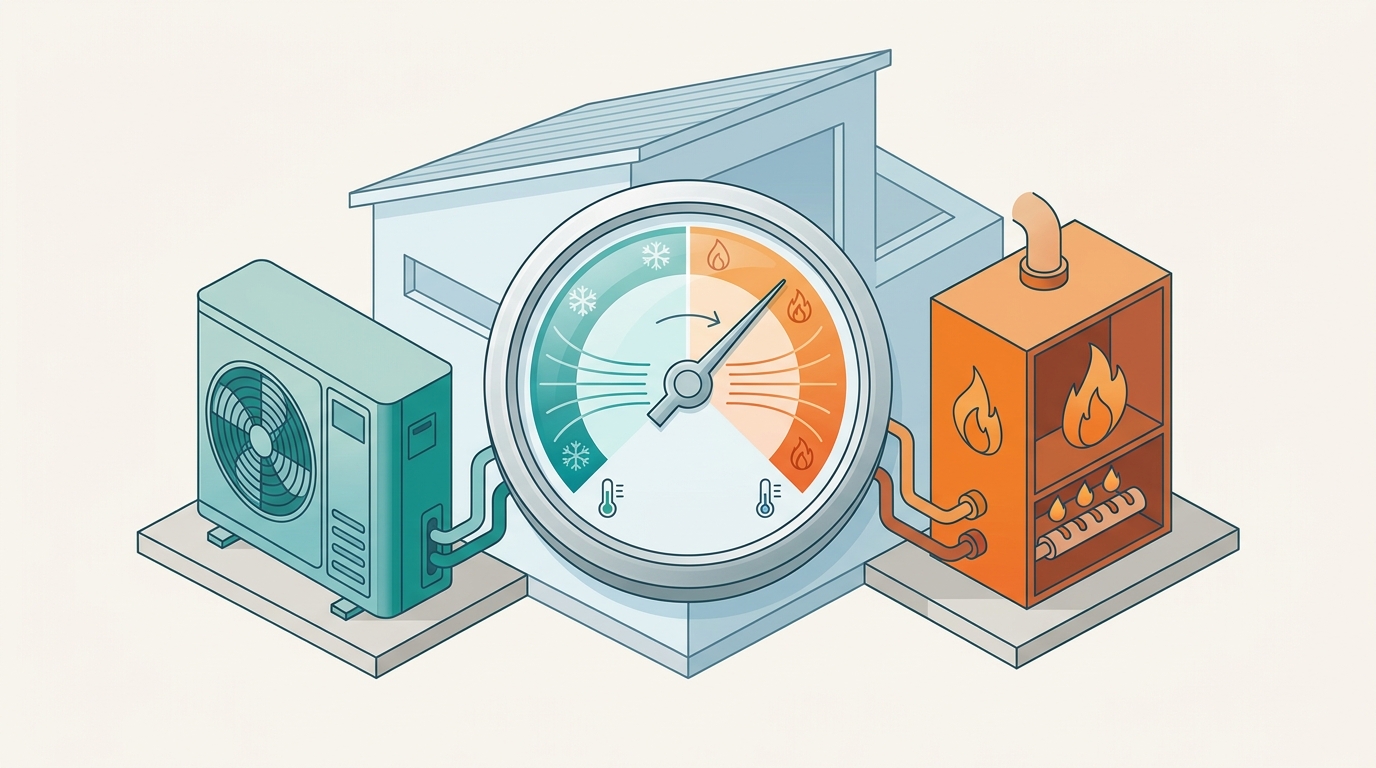
25–40°F
Typical switchover range
Set by your rates, not a fixed rule
$2k–$5k
Install premium
vs a plain furnace + AC swap
COP 1
What you avoid
No electric strip heat in deep cold
One-minute setup (do this first)
- Open the Heat Pump vs Furnace Calculator and enter your electricity rate, gas price, and climate.
- Optional: open the Upgrade Timing Planner if you want to stage ductwork, insulation, and HVAC work without rework.
On this page
- Quick answer: who dual-fuel is for
- What "dual-fuel" means (in plain English)
- The two balance points (this is the part most guides skip)
- Thermal balance point
- Economic balance point
- How to set the switchover temperature from your own rates
- Step 1: cost of heat-pump heat
- Step 2: cost of gas heat
- Step 3: find where they cross
- What the switchover usually lands at
- Comfort: why supply air temperature matters
- Where dual-fuel wins
- Shoulder seasons
- You want two ways to heat the house
- Your existing furnace still has life
- Where dual-fuel disappoints (and what to do instead)
- When the house leaks heat fast
- When the controls are set wrong
- Thermostat and controls
- Maintaining two systems
- Cost in 2026
- Dual-fuel vs all-electric vs all-gas
- How to use our calculator for a dual-fuel decision
- Practical questions to ask your installer
- Next steps
Quick answer: who dual-fuel is for
Dual-fuel usually makes sense when these are true:
- You have (or want) a ducted system and you like the idea of two independent heat sources.
- Your furnace is in decent shape, or you are replacing it anyway and want a lower-risk path into a heat pump.
- Your winters include cold stretches, but you still get long shoulder seasons where a heat pump runs cheaply.
- Your electricity is expensive relative to gas, so the furnace genuinely wins on the coldest days.
Dual-fuel is often a poor fit when these are true:
- Your ducts are leaky, undersized, or badly designed. Fix the delivery system first.
- You have a properly sized cold-climate heat pump and cheap electricity, in which case the furnace rarely earns its keep.
- You are planning a major envelope upgrade soon (attic insulation, air sealing). Do that first or your HVAC sizing may change.
If you are unsure whether envelope work should come first, read Insulation before a heat pump and keep the insulation ROI calculator open.
Reviewer note
I have set dual-fuel switchovers all over the map depending on the rate pair in front of me. One client in a high-electric-rate territory, paired with cheap piped gas, I set at 35°F and the furnace did real work most of January. A second client two zip codes away, on a discounted electrification rate, I set at 22°F and the furnace barely ran. Same equipment, very different numbers. The rate sheet decides, not the brochure. — Marcus
What "dual-fuel" means (in plain English)
A dual-fuel system, also called a hybrid system, is three things working together:
- A heat pump that handles cooling in summer and heating for most of the year.
- A gas, propane, or oil furnace sharing the same ductwork, used as backup heat in cold weather or when the heat pump is down.
- A dual-fuel thermostat that decides which one runs based on the outdoor temperature.
The key detail people miss: in a properly wired dual-fuel system, only one heat source runs at a time. Below the switchover temperature, the controls shut the heat pump off completely and fire the furnace. They do not run together.
That is the whole point of the design. In an all-electric heat pump, the backup is usually electric resistance strip heat, which delivers about one unit of heat per unit of electricity (COP 1) and roughly triples your cost per unit of heat in a cold snap. Dual-fuel replaces those expensive strip-heat hours with gas. You never pay COP-1 prices.
Aux heat vs the gas furnace
Some thermostats label the backup "aux heat" or "emergency heat." In an all-electric system that backup is resistance strips. In a dual-fuel home it is the gas furnace. The labels get muddled, and a contractor who leaves the system on "emergency heat" can lock the heat pump out entirely. I have walked into homes where the heat pump never ran all winter because of exactly this. Confirm the mode before you blame the equipment.
The two balance points (this is the part most guides skip)
People throw around "balance point" as if it is one number. There are actually two, and they answer different questions.
Thermal balance point
The thermal balance point is the outdoor temperature where the heat pump can no longer keep up with the home's heat loss on its own. Above it, the heat pump alone holds the setpoint. Below it, the home loses heat faster than the heat pump can supply, so it needs help.
This number depends entirely on your home's heat loss (a Manual J load calculation) and the unit's capacity curve (Manual S). It can be as high as the 50s in a leaky house with an undersized unit, or down near 0°F or below with a well-sized cold-climate heat pump in a tight home. It has nothing to do with fuel prices.
Economic balance point
The economic balance point is the outdoor temperature where it becomes cheaper to burn gas than to keep running the heat pump. This one depends on your fuel prices, not your house. An all-electric home has no economic balance point at all, because even a struggling heat pump still moves more heat per kWh than resistance strips.
These are usually different numbers, and the economic balance point is normally the warmer of the two. That is the one most dual-fuel systems should switch at. And because it is set by rates, it moves every time your electric or gas price changes.
Why this matters
If your installer sets the switchover at the thermal balance point (where the heat pump physically gives up), you may be paying more than you need to on every cold day between the economic and thermal points. If they pick a default like 35°F without doing the math, it is luck whether that matches your rates. Make them show their work.
How to set the switchover temperature from your own rates
Here is the homeowner-friendly version of the math. The goal is to find the outdoor temperature where heat-pump heat and gas heat cost the same per unit of delivered heat. Above it, run the heat pump. Below it, run the furnace.
Step 1: cost of heat-pump heat
A heat pump's COP tells you how many units of heat it delivers per unit of electricity. The cost of delivered heat is:
electricity price ÷ COP
At $0.18/kWh and a mild-weather COP of 3, that is $0.18 ÷ 3 = $0.06 per kWh of delivered heat. As it gets colder and COP slides toward 2, the same electricity buys less heat: $0.18 ÷ 2 = $0.09 per kWh. This is why the heat pump loses its edge in deep cold.
Step 2: cost of gas heat
A therm holds about 100,000 BTU, or 29.3 kWh of energy. Your furnace converts only its AFUE share of that into usable heat. The cost of delivered heat is:
(gas price per therm ÷ 29.3) ÷ AFUE
At $1.60/therm and 95% AFUE, that is ($1.60 ÷ 29.3) ÷ 0.95 = about $0.057 per kWh of delivered heat. An 80% furnace at the same gas price costs about $0.068.
Step 3: find where they cross
The economic balance point is the outdoor temperature where the heat pump's COP has fallen far enough that step 1 equals step 2. In the example above, gas heat costs about 5.7¢ per kWh. The heat pump matches that when its COP is around 3.1 (0.18 ÷ 3.1 ≈ 0.058). On most spec sheets, COP 3 lands somewhere in the 30s outdoors, so this rate pair points to a switchover around 35°F.
The calculator does this comparison across the whole temperature range using realistic performance curves, so you do not have to build a spreadsheet. But knowing the formula lets you sanity-check whatever number a contractor proposes.
Cost per unit of delivered heat (illustrative)
Notice the bottom bar. Electric resistance backup costs three times the heat pump's mild-weather rate. Avoiding that bar is the financial case for dual-fuel over an all-electric system with strip backup.
What the switchover usually lands at
For natural-gas homes, most economic balance points fall between 25°F and 40°F. The exact spot depends on the rate pair:
- High electric rate, cheap gas (much of the Northeast): switchover sits higher, around 35-40°F. The furnace does real work for several weeks.
- Moderate rates (a lot of the Midwest and mid-Atlantic): somewhere around 30-35°F.
- Cheap electricity, time-of-use, or an electrification rate: switchover drops to 25°F or lower, and the furnace becomes mostly an emergency backup.
- Propane or oil backup: because delivered propane near $3.00-$3.50/gallon and oil are expensive per BTU, the heat pump often wins well below freezing. The switchover can land in the teens or single digits, and the furnace may run only a handful of days a year.
The furnace that earned its keep two weeks a winter
One homeowner I worked with fixated on the fact that their gas furnace sat idle most of the year and felt like wasted money. We pulled the runtime data after one winter: the furnace ran meaningfully on about fourteen days, all in the coldest two-week stretch of January and February. On those days it was both cheaper and more comfortable than the heat pump would have been. The rest of the year the heat pump carried everything. That is dual-fuel working exactly as designed, not a furnace going to waste.
Comfort: why supply air temperature matters
Cost is not the only reason to switch to the furnace. Comfort is the other.
A gas furnace delivers supply air around 120-140°F. A heat pump delivers air around 90-110°F, which is above body temperature but can feel cool if you are standing near a vent. Both will heat a room to 70°F, but the furnace feels warmer at the register and recovers faster from a deep overnight setback.
In a tight, well-insulated home this rarely matters. In an older, draftier house, some homeowners set the switchover a few degrees warmer than pure economics would suggest, trading a little money for warmer-feeling air and quicker recovery. That is a legitimate choice. Just make it on purpose, not by accident.
Where dual-fuel wins
Shoulder seasons
Fall and spring are long and mild in most climates, and that is exactly where heat pumps are most efficient. A dual-fuel system set to favor the heat pump above the switchover runs on the cheap heat source for most of the heating season.
You want two ways to heat the house
Backup heat is not a luxury if you live where cold snaps last multiple days, you have kids or older family members at home, or you have lived through a mid-winter furnace failure and want a calmer plan next time. Two independent heat sources means a single failure rarely leaves you cold.
Your existing furnace still has life
If your furnace is safe and reliable, pairing it with a heat pump stretches its remaining life because it runs far fewer hours each season. You get into a heat pump without scrapping working equipment. If you are weighing whether that furnace is worth keeping, Repair or replace your HVAC walks through the decision.
Where dual-fuel disappoints (and what to do instead)
When the house leaks heat fast
Drafty rooms, thin attic insulation, or major duct leakage make any heating system work harder. Dual-fuel will feel underwhelming because the house needs more heat than it should, and the thermal balance point climbs.
Start with Air sealing weekend checklist and Duct sealing: when it pays back, then rerun the calculator with a lower heat load.
When the controls are set wrong
This is the most common dual-fuel failure, and it is settings, not hardware. The usual faults:
- The lockout is too high, so the furnace fires during mild weather and you never see heat-pump savings.
- The lockout is too low, so the heat pump grinds away in deep cold and comfort drops.
- The system is left on emergency or auxiliary heat, which locks the heat pump out entirely.
- The thermostat is a standard heat-pump model that treats the furnace like electric strip heat and stages it wrong.
Ask your installer to document the outdoor lockout temperature, the staging behavior (when the furnace takes over), and any comfort settings like ramp rates and temperature swing. Save those notes in My Plan so you can adjust later without guessing.
Thermostat and controls
A dual-fuel system needs a thermostat that explicitly supports dual-fuel or heat-pump-with-gas-backup staging. Common options include Ecobee, Nest, the Honeywell T6 Pro, and the equipment maker's own communicating control. A plain heat-pump thermostat that assumes electric strip backup will mismanage the furnace.
The installer programs the outdoor balance-point lockout and confirms, with the system running, that the heat pump and furnace never fire at the same time. Most modern thermostats expose the lockout temperature in an installer or advanced menu, so you can fine-tune it yourself later. Change it in small steps, 2-3 degrees at a time, and watch your bills and comfort for a couple of weeks before moving it again.
Recompute the economic balance point at least once a year. Fuel prices drift, and a switchover that was right last winter can be a few degrees off after a rate change.
Maintaining two systems
A dual-fuel home has both a heat pump and a furnace to keep up, which is slightly more maintenance than a single system but not double the work since they share ducts.
- Heat pump: keep the outdoor coil clear of leaves and snow, change filters on schedule, and have refrigerant charge and defrost operation checked annually. A poorly charged unit quietly loses COP, which pushes your economic balance point the wrong way.
- Furnace: annual combustion check, flue and heat-exchanger inspection, and a carbon-monoxide detector are non-negotiable for any gas appliance, even one that only runs two weeks a year.
- Both: confirm the changeover still works each fall before the first cold snap. A furnace that sat idle for ten months can have a fouled igniter or a stuck valve you would rather find in October than at 2°F in January.
Cost in 2026
Adding a heat pump to a furnace-and-AC project typically runs about $2,000 to $5,000 more than a like-for-like furnace-plus-AC replacement, because you are buying an inverter outdoor unit and a dual-fuel thermostat instead of a plain condenser. A full new dual-fuel system commonly lands around $12,000 to $18,000 installed before incentives, with wide variation by region, capacity, and ductwork.
The cheapest path is usually keeping a healthy existing furnace and adding only the heat pump and a compatible thermostat, which keeps the premium near the low end. For a deeper breakdown of the operating side, see What does a heat pump cost to run?.
The federal 25C credit and many utility and state rebates reward the heat pump portion, and some programs specifically favor dual-fuel because it shaves peak electric demand. Eligibility usually hinges on the heat pump's efficiency rating, not the furnace.
Dual-fuel vs all-electric vs all-gas
| Setup | Best when | Watch out for |
|---|---|---|
| Dual-fuel | Expensive electricity, cheap gas, cold snaps, you want redundancy | Two systems to maintain; controls must be set right |
| All-electric (ccASHP) | Cheap electricity, tight home, milder or mixed climate, no gas service | Strip-heat backup spikes bills in deep cold if undersized |
| All-gas | Very cheap gas, no cooling needed, low upfront budget | No cooling, no efficiency upside, full exposure to gas prices |
If your climate is the deciding factor, two city-specific reads help: Heat pump vs furnace in winter for the general cold-weather picture, and Heat pump vs furnace in Minneapolis for a genuinely cold case study. For the bigger plan, the heating and cooling upgrade hub ties these decisions together.
How to use our calculator for a dual-fuel decision
Open the Heat Pump vs Furnace Calculator and focus on three outputs:
- Operating cost comparison across a cold-to-mild temperature range, which shows you roughly where your economic balance point lands.
- Sensitivity to rates: run your current rates, then a plausible higher-electric scenario, to see how far the switchover moves.
- Comfort risk flags: if the calculator suggests cold-weather performance is marginal, do not ignore it.
Then sanity-check the inputs. If your ducts are in an attic or crawlspace, fix leakage before sizing new equipment. If your attic insulation is thin, run the attic insulation calculator and see whether the payback beats the HVAC upgrade.
Practical questions to ask your installer
Bring these to your quote call. Short answers are fine; you want clarity.
- "What outdoor temperature will the system switch from heat pump to furnace, and how did you calculate it from my rates?"
- "Will the heat pump ever run at the same time as the furnace, or does the furnace take over fully?"
- "Do we need a dual-fuel-specific thermostat, and which one?"
- "What duct changes do you recommend before installing higher-capacity equipment?"
- "What happens if the heat pump fails in January? Can the furnace carry the whole load alone?"
If answers are vague, use My Plan to compare bids and note what each contractor is proposing.
Next steps
- Run your numbers in the Heat Pump vs Furnace Calculator and save the outputs you care about.
- If you want a staged plan that avoids rework, draft it in the Upgrade Timing Planner and store contractor notes in My Plan.
Sources & further reading
- Heat Pump Systems — U.S. Department of Energy
- Cold Climate Air-Source Heat Pump Specification & Product List — NEEP
- Air-Source Heat Pumps — ENERGY STAR
- Thermal Balance Point vs. Economic Balance Point — HVAC School
Frequently asked questions
What is a dual-fuel heat pump?+
A dual-fuel (or hybrid) heat pump is a heat pump paired with a gas, propane, or oil furnace that share the same ductwork and one dual-fuel thermostat. The heat pump handles heating and cooling most of the year, and the furnace takes over below a set outdoor temperature called the switchover or balance point. Only one runs at a time: the controls shut the heat pump off and fire the furnace, so you get heat-pump efficiency in mild weather and furnace output in deep cold without ever paying for electric resistance strip heat.
What temperature should a dual-fuel heat pump switch to the furnace?+
Most homes land between 25°F and 40°F, but there is no universal number. The right switchover is your economic balance point: the outdoor temperature where the furnace costs the same per unit of heat as the heat pump at your specific rates. Compute it from electricity price divided by heat-pump COP versus gas price per therm divided by 29.3 then by furnace AFUE. Where electricity is expensive and gas is cheap, the switchover sits higher (35-40°F); where electricity is cheap or gas is dear, it drops to 25-30°F or lower.
What is the difference between the thermal and economic balance point?+
The thermal balance point is the outdoor temperature where the heat pump can no longer keep up with the home's heat loss on its own, set by your Manual J load and the unit's capacity curve. The economic balance point is the temperature where it becomes cheaper to burn gas than to keep running the heat pump, set by your fuel prices. They are different numbers. Most dual-fuel systems should switch at the economic balance point, which is usually warmer than the thermal one, and it shifts whenever rates change.
Does a dual-fuel heat pump cost more to install?+
Yes, modestly. A heat pump added to a furnace-and-AC project typically runs about $2,000 to $5,000 more than a like-for-like furnace-plus-AC replacement, because you are buying an inverter outdoor unit and a dual-fuel-capable thermostat instead of a plain condenser. A fresh full dual-fuel system commonly lands around $12,000 to $18,000 installed before incentives, varying widely by region, capacity, and ductwork. If you keep a healthy existing furnace and add only the heat pump, the premium is smaller.
Is a dual-fuel heat pump cheaper to run than gas?+
Above the economic balance point, yes; below it, no. At about $0.18/kWh and a real-world COP near 3, heat-pump heat costs roughly 6¢ per kWh of delivered heat, beating a 95% gas furnace at $1.60/therm (about 5.7¢). As the temperature drops and COP slides toward 2, heat-pump heat rises past 9¢ and gas wins. Dual-fuel captures the cheap side of that crossover automatically. Cheap gas or expensive electricity moves the crossover warmer; the reverse moves it colder.
Do I need dual-fuel if I have a cold-climate heat pump?+
No. A properly sized cold-climate heat pump (ccASHP) can carry the full winter load in many homes without any gas backup, holding 70-100% of its rated capacity down to 5°F. Dual-fuel is a choice driven by economics (expensive electricity, cheap gas), redundancy, or comfort, not a technical requirement. Keep gas backup when gas is cheap and likely to stay that way, when deep multi-day cold is common, or when you want a second heat source while you electrify in stages.
Can dual-fuel work with propane or oil instead of natural gas?+
Yes, the hardware works the same, but the economics shift because propane and oil cost more per delivered BTU and their prices swing harder. With propane near $3.00 to $3.50/gallon, the heat pump often wins down to much colder temperatures, so the economic balance point drops well below freezing and the furnace may rarely run. Recompute the balance point with your actual delivered fuel price, and redo it each season since propane and oil move more than piped gas.
What thermostat do I need for a dual-fuel heat pump?+
You need a thermostat that explicitly supports dual-fuel or heat-pump-with-gas-backup staging, such as an Ecobee, Nest, Honeywell T6 Pro, or the equipment maker's communicating control. A standard heat-pump thermostat that treats backup as electric strip heat will mismanage the furnace. The installer sets the outdoor balance-point lockout and confirms the heat pump and furnace never fire at the same time. Many homeowners can adjust the lockout themselves later in the installer or advanced settings menu.
Why is my dual-fuel furnace running so much?+
Almost always a settings problem, not hardware. A lockout set too high (say 45°F) forces the furnace on during mild weather, erasing heat-pump savings. The other common fault is the system left on emergency or auxiliary heat, which locks out the heat pump entirely. Check the thermostat's dual-fuel lockout temperature and make sure it is not in emergency-heat mode. If the heat pump itself struggles well above the lockout, the unit may be undersized or the house may be losing heat faster than expected.
Does a dual-fuel heat pump qualify for tax credits and rebates?+
Often yes for the heat pump portion, but rules vary by program and change over time. The federal 25C credit and many utility and state rebates reward installing a qualifying high-efficiency heat pump, and some programs specifically encourage dual-fuel configurations because they cut peak electric demand. Eligibility usually hinges on the heat pump's efficiency rating and a qualifying-model list, not on the furnace. Confirm current requirements with ENERGY STAR and your utility before assuming you qualify.
Try the companion tool
This post links to an interactive tool built for this topic. Open it to see numbers tailored to your home.
Open the toolGet practical energy tips
Join homeowners getting practical tips on cutting energy bills and staying comfortable.
Practical tips only. Unsubscribe anytime.
Read this next
Related guides selected by topic overlap and upgrade path.

Should you repair or replace your furnace, AC, or heat pump? Use the $5,000 rule, equipment age, real 2026 repair costs, and the R-410A refrigerant phase-down to decide with confidence.
A buyer-intent guide for Phoenix homeowners with hot rooms and high summer bills. Learn what duct sealing and balancing includes, typical cost drivers, and how to compare quotes.
A Minneapolis-focused guide to choosing a heat pump, gas furnace, or dual-fuel setup using your own rates, plus a quote checklist.

Air duct replacement costs $1,400–$7,000 (avg ~$3,500), or about $9–$25 per linear foot. See pricing by home size, material, and when sealing beats replacing.