Blog
Repair or Replace HVAC in 2026: The $5,000 Rule and a Calmer Decision Framework
Should you repair or replace your furnace, AC, or heat pump? Use the $5,000 rule, equipment age, real 2026 repair costs, and the R-410A refrigerant phase-down to decide with confidence.
When HVAC breaks, the decision rarely happens in a calm moment.
It happens when it is 15°F outside, the house is cold, and someone hands you a quote with the words: "You really should think about a whole new system."
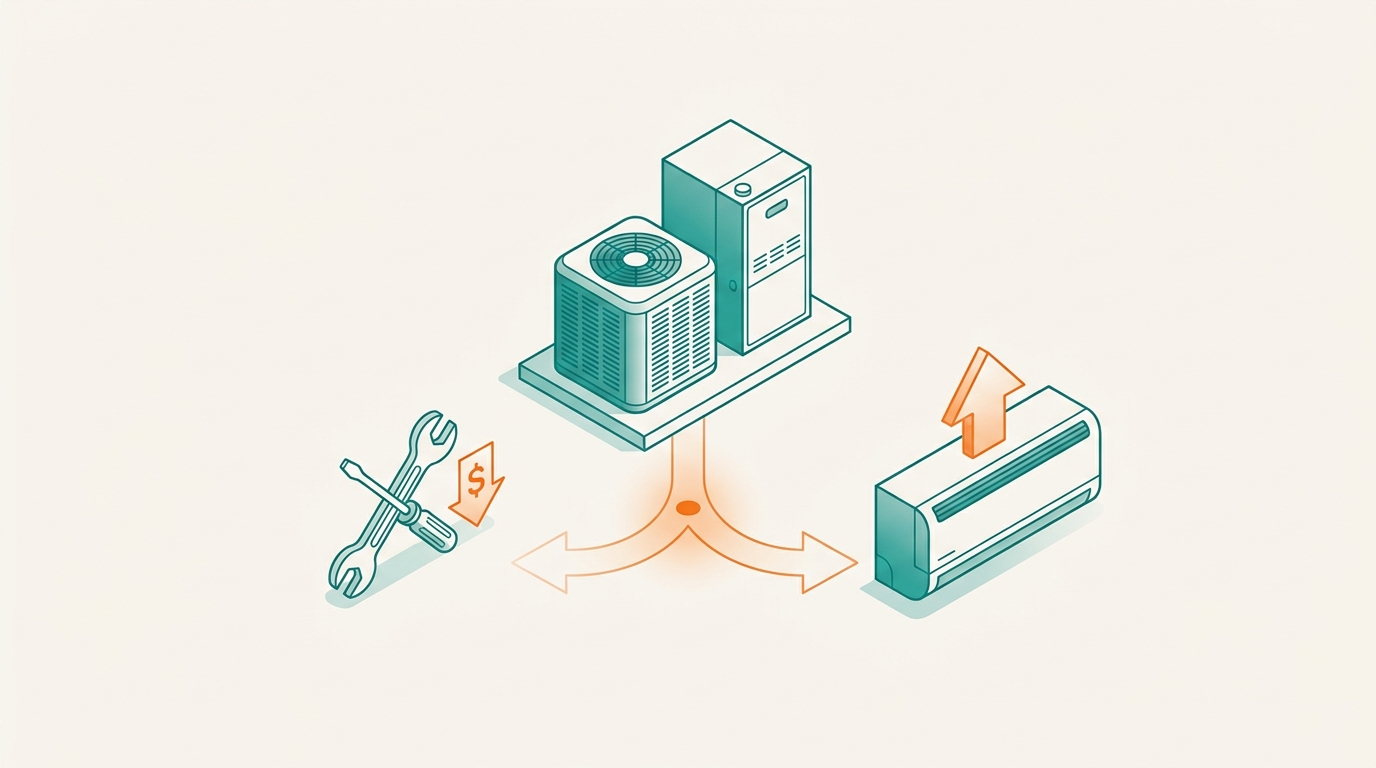
This guide gives you a framework to decide repair or replace without panic. We will walk through the $5,000 rule and where it breaks down, realistic 2026 age thresholds and repair costs, what the R-410A refrigerant phase-down actually means for an aging AC, and how to plan so the next failure becomes a scheduled project instead of an emergency.
One-minute setup (do this first)
- Open the Upgrade Timing Planner and enter your equipment ages and climate.
- If a heat pump is on the table, also open the Heat Pump vs Furnace Calculator and put in your electricity and gas rates.
- Keep both tabs open. The right answer depends on your timeline and your rates more than on internet averages.
On this page
- Quick answer: when to repair vs when to replace
- Replace now if any of these are true
- Repair (and keep planning) if most of these are true
- The $5,000 rule (and where it falls apart)
- Step 1: separate a "minor repair" from a "major failure"
- Minor repairs (often worth doing)
- Major failures (often the turning point)
- What common repairs actually cost in 2026
- Step 2: weigh age and what "end of life" really means
- Step 3: the R-410A refrigerant phase-down and your old AC
- Step 4: don't replace the box and ignore the root cause
- Leaky ducts and poor airflow
- A leaky, under-insulated house
- Bad sizing, especially oversizing
- Step 5: if you replace, choose the right path (not the default)
- Option A: like-for-like replacement
- Option B: upgrade to a heat pump (or hybrid)
- Option C: repair now, plan the upgrade later
- Watch: the $5,000 rule explained
- Two realistic scenarios
- Scenario 1: 18-year-old furnace fails in winter
- Scenario 2: 10-year-old AC needs a moderate repair
- Questions to ask any contractor (repair or replace)
- Next steps
Quick answer: when to repair vs when to replace
Here is the short version most homeowners need.
$5,000
The rule's threshold
age × repair cost
10–20 yrs
Typical end-of-life window
AC/HP 10–15, furnace 15–20
~30%
Repair-cost tipping point
share of a new system
Replace now if any of these are true
- Safety issue: gas smell, CO concerns, a confirmed cracked heat exchanger, repeated burner rollout, or anything a tech red-tags as unsafe.
- Repeated major failures in the last one or two seasons.
- The system is at or past its typical end-of-life and the repair is a big chunk of replacement cost (see the test below).
- Your AC uses R-22 refrigerant and needs a refrigerant-related repair. R-22 is no longer produced, so a recharge is both expensive and a sign of borrowed time.
Repair (and keep planning) if most of these are true
- The system is relatively young, or the issue is a minor, common part.
- The repair restores reliable operation and buys you a season or two to replace on your own schedule.
- Replacement would force rushed decisions you are not ready for yet, like ductwork, electrical readiness, or insulation gaps.
The $5,000 rule (and where it falls apart)
The most popular shortcut online is the $5,000 rule:
Multiply the age of the system in years by the repair quote. If the number is over $5,000, replace. If it is under, repair.
So a $400 repair on a 6-year-old AC scores 2,400, an easy repair. A $900 repair on a 16-year-old AC scores 14,400, a clear replace. A $1,200 repair on a 9-year-old furnace lands at 10,800, also pointing to replace.
It is a genuinely useful first filter. But Marcus, who reviews these calls in the field, warns against leaning on it too hard.
Where the $5,000 rule misleads you
The threshold was set when new systems were cheaper. With 2026 install prices higher, a flat $5,000 line can flag a perfectly healthy 12-year-old system that just needs a $450 part. The rule also ignores two things that should dominate the decision: safety and refrigerant type. A cracked heat exchanger is a replace no matter what the multiplication says, and a major R-410A leak on a 14-year-old AC is a different problem than the same leak on a 4-year-old one.
That is why many techs prefer the 50% rule as a cross-check: if a repair costs more than half the price of a comparable new system, replace. It scales with today's prices instead of a fixed dollar figure. The cleanest approach is to use both. Run the $5,000 rule for fast triage, then sanity-check against a real replacement quote: if a major repair is roughly 30% or more of replacement cost on older equipment, replacement deserves serious thought.
The point of all three framings is the same: avoid spending $2,500 on a 20-year-old system that is likely to need another $2,000 repair next year.
Step 1: separate a "minor repair" from a "major failure"
Most HVAC problems fall into one of two buckets, and the bucket matters more than the exact dollar figure.
Minor repairs (often worth doing)
- Capacitors, contactors, and relays
- Furnace igniters, flame sensors, and pressure switches
- Dirty sensors or flame-rectification issues
- Control board or minor wiring problems
- A blower or condenser fan motor that is still a stocked, standard part
These are annoying, but they rarely mean the system is finished.
Major failures (often the turning point)
- Compressor failure on an aging AC or heat pump
- A significant refrigerant leak in an older system (especially R-22 or R-410A)
- A cracked heat exchanger or unsafe combustion problem
- Ductwork so compromised that the real fix is a redesign
Major failures are where replacement starts to win, especially once the equipment is already old.
What common repairs actually cost in 2026
Here are realistic 2026 ranges so you can place a quote in context before you decide.
Common HVAC repair costs (2026, parts + labor)
higher on R-410A as supply tightens
often replace the furnace instead
often a third of a new system
From the field: the compressor that wasn't worth it
Marcus took a call on a 13-year-old AC with a failed compressor. The repair quote, with the compressor, labor, refrigerant, and a new line dryer, came to about $2,600. A new, properly sized system was roughly $6,800. That repair was nearly 40% of replacement on a system already past the middle of its life, with the same old coil and refrigerant lines staying in place. He told the homeowner what he tells everyone in that spot: you can spend $2,600 to keep a tired system limping, or put it toward a new one with a fresh warranty. They replaced.
Step 2: weigh age and what "end of life" really means
Age alone is not destiny, but it is a strong risk signal. Typical service lives:
- Gas furnace: 15 to 20 years
- Central air conditioner: 10 to 15 years
- Air-source heat pump: 10 to 15 years (runs year-round, so it ages faster than an AC)
- Boiler: 20 to 30 years
The useful question is not "how old is it" but:
"If I repair this, what are the odds I am writing another big check soon?"
Once equipment passes the midpoint of its range, every repair should be judged by how much reliable time it buys. A $300 igniter on a 9-year-old furnace buys years. A $1,400 repair on a 19-year-old furnace buys maybe a season, on a unit that is one cold snap away from the next failure.
The Upgrade Timing Planner flags older equipment so you can treat replacement as an upcoming project, not a 15°F surprise.
Step 3: the R-410A refrigerant phase-down and your old AC
This is the part most older guides miss, and in 2026 it changes the math on AC and heat pump repairs.
Here is what is actually happening. Under the federal AIM Act, the EPA is phasing down production of high-GWP HFC refrigerants in steps, targeting an 85% cut from baseline by 2036. Starting January 1, 2025, new residential AC and heat pump systems generally can't use refrigerants at or above a 700 GWP threshold, which rules out R-410A in new equipment. New systems are now built around lower-GWP A2L refrigerants, mainly R-454B and R-32.
What this does not mean:
R-410A is not banned from your home
If your system runs on R-410A, it is legal to own, operate, and service in 2026. The EPA has been clear that you can run existing equipment to the end of its useful life. The phase-down restricts what can be installed new, not what you already have. If a contractor says "it's illegal now, you have to replace it," that is a sales line, not the law.
What it does mean for the repair-or-replace call:
- Refrigerant leak repairs are getting pricier. As R-410A supply tightens, the refrigerant line on a leak repair becomes more expensive and less predictable. R-22, phased out years ago, is worse still.
- There is no drop-in conversion. You can't pour R-454B or R-32 into an R-410A system. The pressures, compressor design, metering, and oil are matched to the refrigerant. Anyone offering a "simple conversion" on a home AC is a red flag.
- A big recharge on a tired system is the worst-value move. A small top-off after a minor leak is one thing. A multi-pound recharge on a 14-year-old leaker is throwing money at a platform that is already on the way out.
Marcus's rule of thumb: on an AC or heat pump past about 12 years that needs more than a couple pounds of refrigerant, treat the leak repair as a strong replace signal rather than a routine fix. He once watched a homeowner pay close to $1,300 to chase a leak on an old R-410A condenser, only to have it leak again the following summer. That money would have been a down payment on a new system.
Step 4: don't replace the box and ignore the root cause
Sometimes people replace equipment and stay disappointed, because the real problem was never the unit.
Leaky ducts and poor airflow
Ducts running through a vented attic or crawlspace can leak away a large share of heating and cooling and create comfort problems that look like "bad HVAC." If you have uneven rooms, weak airflow, or dusty returns, start here:
A leaky, under-insulated house
If your attic leaks air like an open window, the HVAC works harder, cycles longer, and may be oversized just to keep up. Do the fastest top-of-house fixes before you lock in new equipment sizing:
Bad sizing, especially oversizing
Oversized systems short-cycle, which hurts comfort, reduces dehumidification, and can increase wear. If you replace, insist that sizing be based on a load calculation for your home and planned improvements, not "match what you had before."
Step 5: if you replace, choose the right path (not the default)
Replacement goes better when you treat it as a short project, not a panic purchase.
Option A: like-for-like replacement
Makes sense when you need the fastest path back to reliable comfort, you are not changing fuels, and you want minimal electrical changes. A new gas furnace runs roughly $4,500 to $9,000 installed in 2026; a central AC about $5,500 to $10,000; a full furnace-plus-AC system $9,000 to $16,000+, depending on size, efficiency, and your market.
Option B: upgrade to a heat pump (or hybrid)
A failing AC is often the cheapest moment to switch, because you are already buying new outdoor equipment. A heat pump replaces your AC and some or all of your heating in one box. Whether it pays off depends on:
- your electricity rate,
- your gas, oil, or propane rate,
- your climate and seasonal efficiency, and
- your backup-heat plan for cold snaps.
The gains are real when you are leaving behind electric resistance, oil, or propane. Modern systems are rated by SEER2 (cooling), HSPF2 (heat pump heating), and AFUE (furnace efficiency); jumping from an old 10 SEER AC to a 16+ SEER2 unit, or an 80% AFUE furnace to 95%+, is a meaningful efficiency step.
Run the Heat Pump vs Furnace Calculator against your own rates, then read the deeper discussions: Heat pump vs gas furnace in winter, what a heat pump actually costs to run, and installed cost in 2026. If you want to keep the furnace as backup for deep cold, the dual-fuel heat pump plus furnace setup is worth a look. For the full sequencing (envelope first, HVAC second), see the heating and cooling hub.
Option C: repair now, plan the upgrade later
If you can repair safely and buy one season, you usually can replace on your own timeline:
- get multiple bids,
- do duct and insulation prep work,
- avoid peak-season pricing, and
- make a calmer decision.
That staged approach is exactly what the Upgrade Timing Planner is built to support.
Financing and incentives (2026 reality)
The federal 25C tax credit that paid up to $2,000 toward a qualifying heat pump ended for systems placed in service after December 31, 2025. For 2026 installs, look to state energy-office rebates (IRA Home Energy Rebates) and utility heat pump rebates, which still run from a few hundred to a couple thousand dollars in many areas. Many contractors also offer financing; just make sure the monthly payment plus running cost beats what you are spending now.
Watch: the $5,000 rule explained
A clear walkthrough of the same math we covered above, with examples. Use it as a sanity check, then anchor your own numbers in the planner.
Two realistic scenarios
Scenario 1: 18-year-old furnace fails in winter
You get a quote for a major repair. Ask:
- Is there any safety concern (heat exchanger, CO, combustion)?
- How much is the repair relative to replacement?
- What is the next likely failure if we repair?
Run the $5,000 rule: 18 years × a $1,400 repair is 25,200, deep in replace territory. If the furnace is also at the end of its service life, replacement is the calmer long-term move even though it stings now. If you replace, pair it with fast attic air sealing and basic duct fixes so the new system isn't sized for a leaky house you plan to fix next year.
Scenario 2: 10-year-old AC needs a moderate repair
Say it needs a $450 capacitor and fan motor combo. The $5,000 rule gives 10 × 450 = 4,500, under the line, and the part is minor, so repair is reasonable. Use the repaired season to:
- schedule a replacement plan for two to five years out,
- fix the comfort problems that made you run the system hard, and
- get quotes in shoulder season when you can compare calmly.
If that same 10-year-old AC instead needed a $2,000 refrigerant leak repair with a big recharge, the answer flips. The score is 20,000, the refrigerant adds future risk, and replacement wins.
Questions to ask any contractor (repair or replace)
These push the conversation from "sales" to "engineering."
- What failed, and why did it fail?
- Is this a minor part or a major component?
- If we repair, what else is likely to fail soon?
- If a leak is involved, how many pounds of refrigerant are you adding, and what is the total including refrigerant?
- What is the safe, code-compliant path here, especially for gas equipment?
- If we replace, will you size with a load calculation for my house and planned improvements, not just match the old tonnage?
- Are my ducts and return paths supporting good airflow?
- For a heat pump: what is the plan for backup heat and cold snaps?
Red flags in a repair-or-replace quote
Be skeptical of a cracked-heat-exchanger claim with no photo, video, or combustion-analyzer reading. Push back on same-day pressure to sign for a full replacement. And treat "R-410A is illegal now" as a scare tactic. Whenever a job tops about $1,500, get a second quote. Honest techs expect it.
If electrification is part of your plan, sanity-check electrical readiness with Do you need a panel upgrade? A checklist.
Next steps
- Put your equipment ages into the Upgrade Timing Planner and see whether replacement is a now, next, or later project.
- If a heat pump is on the table, run the Heat Pump vs Furnace Calculator with your real rates.
- If comfort problems are part of the story, start with Cold rooms, hot rooms so you fix the cause, not just the box.
Sources & further reading
- Phasedown of Hydrofluorocarbons (HFCs) under the AIM Act — U.S. EPA
- Technology Transitions Program: HFC restrictions in new equipment — U.S. EPA
- Central air conditioning: sizing, efficiency, and when to replace — U.S. Department of Energy
- Furnaces and boilers: AFUE and replacement guidance — U.S. Department of Energy
- Heating and cooling with a heat pump (SEER2 / HSPF2) — ENERGY STAR
Frequently asked questions
What is the $5,000 rule for HVAC?+
Multiply your system's age in years by the repair quote. If the result is over $5,000, replacement is usually the smarter call; if it is under, repairing is often fine. A $400 repair on a 6-year-old AC scores 2,400 (repair), while a $900 repair on a 16-year-old AC scores 14,400 (replace). It is a quick triage tool, not a hard rule, and it ignores safety problems and refrigerant type, which can override the math on their own.
Should I replace my furnace or just repair it?+
Replace a furnace if it has a confirmed cracked heat exchanger (a safety red-tag), is past 15 to 20 years old and needs a major part, or has failed repeatedly in one or two seasons. Repair it if it is under about 12 years old and the problem is a common part like an igniter, flame sensor, or control board. A new gas furnace runs roughly $4,500 to $9,000 installed in 2026, so a $300 igniter on a 9-year-old unit is an easy repair.
When should I replace my air conditioner instead of repairing it?+
Replace an AC when it is past 10 to 15 years old and needs a compressor or has a significant refrigerant leak, especially if it uses R-22 or R-410A. Compressor replacement on an aging system often runs $1,500 to $2,800 and frequently equals a third of a new system's price. Repair the AC when it is under about 10 years old and the failure is a capacitor, contactor, or fan motor, which are routine parts costing a few hundred dollars.
How much do common HVAC repairs cost in 2026?+
A run capacitor runs about $150 to $400, a contactor $150 to $350, a furnace igniter or flame sensor $150 to $400, a blower or fan motor $400 to $900, a control board $300 to $700, a refrigerant leak repair plus recharge $400 to $1,500, a furnace heat exchanger $1,500 to $3,500, and an AC or heat pump compressor $1,500 to $2,800. Prices vary by region, brand, and how much refrigerant a leak requires.
Does the R-410A phase-down mean I have to replace my AC in 2026?+
No. R-410A systems are legal to own and service in 2026, and the EPA allows you to run existing equipment to the end of its useful life. The rules restrict installing new systems above a 700 GWP refrigerant threshold starting January 1, 2025, not retiring what you already have. The real impact is cost: refrigerant leak repairs on R-410A and older R-22 systems are getting pricier as supply tightens, which tilts the math toward replacement when a big leak hits an aging unit.
What is the difference between the $5,000 rule and the 50% rule?+
The $5,000 rule multiplies age by repair cost and replaces above $5,000; the 50% rule replaces when a repair costs more than half the price of a comparable new system. The 50% rule adapts better to today's prices because replacement costs have risen, while the $5,000 threshold can flag mid-life systems too early. Many homeowners use both: the $5,000 rule for fast triage, the 50% rule as a sanity check against a real replacement quote.
How long do HVAC systems last?+
A gas furnace typically lasts 15 to 20 years, a central air conditioner 10 to 15 years, and an air-source heat pump 10 to 15 years because it runs year-round. Boilers often reach 20 to 30 years. Maintenance, climate, run hours, and install quality move these ranges. Once a unit passes the midpoint of its range, judge any repair by how much reliable time it actually buys before the next failure.
Can I switch from a furnace to a heat pump when my AC dies?+
Yes, and a failing AC is often the best moment to do it because you are already paying for new outdoor equipment. A heat pump replaces both your AC and some or all of your heating, and it can lower running costs sharply if you currently heat with electric resistance, oil, or propane. The math depends on your electricity and gas rates, your climate, and your backup-heat plan, so run your own numbers before committing.
How do I get an honest repair-or-replace quote?+
Ask the technician what failed and why, whether it is a minor part or a major component, and what else is likely to fail soon if you repair. Get the refrigerant amount in writing if a leak is involved, and ask for the total including refrigerant before approving. Red flags include a cracked-heat-exchanger claim with no photo or combustion test, pressure to decide same-day, and 'it's illegal now' scare lines about R-410A. Get a second quote whenever a job tops about $1,500.
Should I replace my furnace and AC at the same time?+
Replace both together when they are similar ages, when matching a new high-efficiency outdoor unit to an old indoor coil would hurt performance, or when you are switching to a heat pump. Replacing one at a time can make sense if the systems are far apart in age. Doing both at once saves on duplicated labor and refrigerant-line work and avoids a known mismatch, but it raises the upfront cost, so weigh it against your budget and timeline.
Try the companion tool
This post links to an interactive tool built for this topic. Open it to see numbers tailored to your home.
Open the toolGet practical energy tips
Join homeowners getting practical tips on cutting energy bills and staying comfortable.
Practical tips only. Unsubscribe anytime.
Read this next
Related guides selected by topic overlap and upgrade path.
How a dual-fuel (hybrid) heat pump and gas furnace work together, how to set the switchover temperature from your electric and gas rates, the install cost premium, and when dual-fuel beats all-electric or all-gas. Updated for 2026.
A Minneapolis-focused guide to choosing a heat pump, gas furnace, or dual-fuel setup using your own rates, plus a quote checklist.
A buyer-intent guide for Phoenix homeowners with hot rooms and high summer bills. Learn what duct sealing and balancing includes, typical cost drivers, and how to compare quotes.
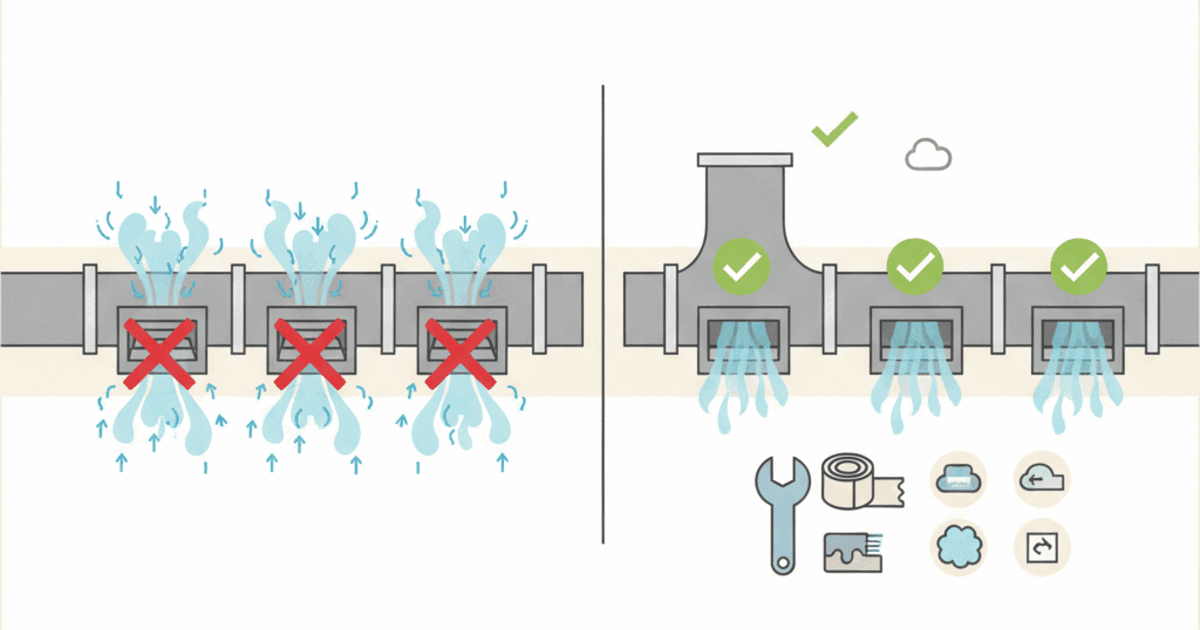
Closing supply vents feels like it should cut your bill, but it often increases duct leakage, reduces comfort, and can stress HVAC equipment. Here is what to do instead.