Blog
Electrical Panel Upgrade Checklist (2026): Do You Actually Need One?
A 2026 panel upgrade checklist: read your service size, count spaces, spot problem panels, run a load calc, and tell when a $1,300–$4,000+ upgrade is real versus an upsell you can skip.
If a contractor told you "you need a 200 amp panel" the moment you mentioned a heat pump or an EV charger, here is the honest version: sometimes that is true, and a fair number of times it is not. The deciding factor is not the size of the new appliance. It is how much power your home actually draws at the same time, which an electrician proves with a load calculation, not a glance at your panel.
This checklist covers what you can safely check yourself (from labels, your bill, and photos taken from a safe distance), where the real money goes, and the three different projects that all get called a "panel upgrade." The goal is simple: help you tell a real safety or capacity problem apart from an upsell before you spend $1,300 to $4,000 or more.
Safety first: do not open the panel
Everything in this guide is meant to be checked from the panel label, your utility bill, and photos from a safe distance. Do not remove the panel deadfront cover unless you are trained and equipped. The bus bars behind it stay energized even with the main off. For the final answer, get a licensed electrician to run the load calculation.
$1,300–$3,000
Panel replacement
Same service size, box + breakers
$2,500–$5,000
100→200A service upgrade
Adds meter, mast, conductors
$400–$1,200
Load-management device
Often avoids a service upgrade
$100–$300
Standalone load calc
The number that settles the debate
Before you collect quotes, get your future loads on paper. Open My Plan and list every electric upgrade you expect in the next 3 to 5 years (heat pump, heat pump water heater, EV charger, induction range, electric dryer), then mark which are "soon" and which are "maybe later." That list is what an electrician needs to run an accurate load calculation, and it keeps you from sizing the service around appliances you will never install.
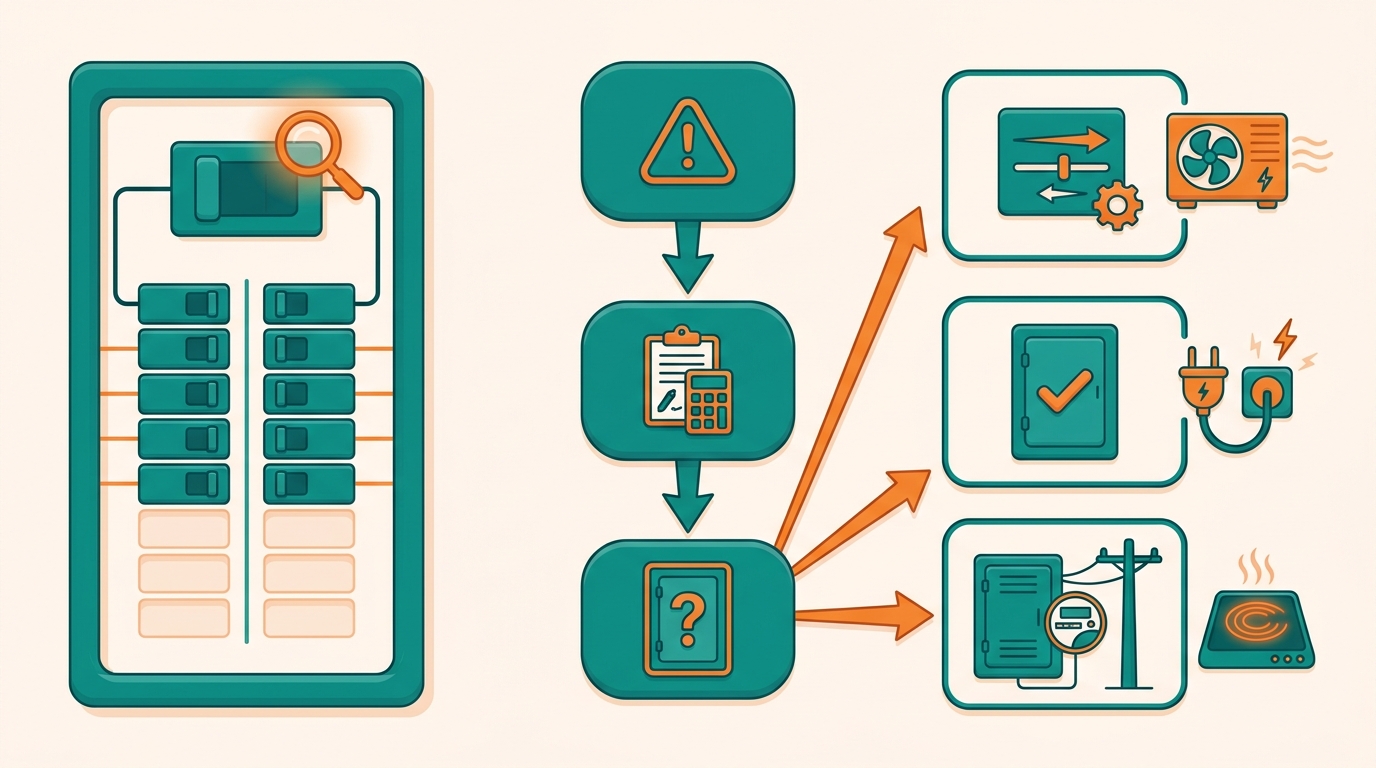
On this page
- The 10-minute self-check (before any electrician visit)
- Step 1: read your service size from the main breaker
- Step 2: count your open breaker spaces
- Step 3: write down your big existing loads
- Step 4: check for safety red flags (these do not wait)
- Step 5: get the load calculation
- Three projects people lump together
- 1. Panel replacement (same service size)
- 2. Service upgrade (more amps from the utility)
- 3. Load management (avoid the upgrade)
- What a panel upgrade actually costs in 2026
- The load calculation, in plain English
- How to electrify without a service upgrade (often)
- When a service upgrade is worth it anyway
- Permits, inspection, and the utility timeline
- Tax credits and rebates in 2026
- Red flags in contractor bids
- What to ask your electrician
- Frequently asked questions
- Next steps
The 10-minute self-check (before any electrician visit)
You can answer most of the "do I need an upgrade?" question with your phone camera and your power bill. None of this requires opening the panel.
Step 1: read your service size from the main breaker
Look at the panel cover. The main breaker at the top (the big double switch that kills everything) is stamped with a number: 60, 100, 125, 150, or 200. That number is your service size in amps. Do not guess from the physical size of the box. A small box can be 200 amps and a large one can be 100. If you only have fuses and no breakers, treat that as a near-automatic replacement candidate.
Step 2: count your open breaker spaces
Look at how many circuit slots are filled versus empty. A panel can be at its amperage limit but out of physical space, or have plenty of amps and no slots. If it is full, your options are a subpanel, tandem ("slimline") breakers where allowed, breaker consolidation, or a replacement panel with more spaces. A full bus, where every slot is used and the bus bar is rated to its limit, is one of the most common honest reasons to replace a panel even when the amperage is fine.
Step 3: write down your big existing loads
The point is to estimate how much you already draw. Note the 240-volt appliances: electric range, electric dryer, central air conditioning, electric water heater, hot tub, pool pump, well pump. A house with gas heat and a gas water heater has modest electrical demand and lots of headroom. Electrify both of those and the math changes fast. This list feeds directly into the load calculation in Step 5.
Step 4: check for safety red flags (these do not wait)
If you see any of these, stop researching electrification and call an electrician about safety first:
- Rust, corrosion, or water staining in or around the panel
- A burnt smell, scorch marks, or melted insulation at the breakers
- A panel cover or individual breakers that feel warm to the touch
- Breakers that trip during normal use, especially if it is new behavior
- A buzzing or crackling sound from the panel
- A brand on the label that reads Federal Pacific (FPE/Stab-Lok), Zinsco/GTE-Sylvania, or Challenger
Step 5: get the load calculation
This is the step everything else feeds into, and it is the one you cannot do from a photo. A licensed electrician adds up your demand under NEC Article 220 and tells you, with a real number, whether your service has room for the loads you want to add. A standalone calc runs about $100 to $300, or it gets folded into a quote. Insist on seeing it. More on what it actually involves below.
Field note: the FPE panel that changed the priority list
On a 1970s split-level I assessed for a homeowner who wanted a heat pump and an EV charger, the conversation started as a capacity question. Then I read the label: Federal Pacific Stab-Lok. The panel only had 100 amps, but the real issue was that those breakers have a documented history of not tripping on a fault. The right move was not "add 200 amps so you can electrify." It was "replace this panel because it is a fire risk, and while it is open, size the new one for the heat pump and EV you already want." Same dollars, completely different reason, and the homeowner's insurer had actually flagged the FPE box the year before.
Three projects people lump together
When anyone says "panel upgrade," make them tell you which of these three they mean, because the price and the reason are different.
1. Panel replacement (same service size)
You swap the box and breakers but keep the same amps from the utility. Typical reasons: the panel is unsafe (a problem brand, scorching), it is full with no spaces, or it needs a clean modern layout for new circuits. This is the cheapest of the three, roughly $1,300 to $3,000, because the utility's service and meter usually stay put.
2. Service upgrade (more amps from the utility)
This raises the amperage coming into the home, and it is what most people actually mean by "going from 100 to 200 amps." It usually bundles a larger meter base, a new mast or service entrance conductors, a new main disconnect, the new panel, and coordination plus inspection with the utility. Budget $2,500 to $4,500 for a straightforward overhead job, $3,000 to $5,000 once the meter and service wire are part of it, and far more if your service is underground and needs trenching.
3. Load management (avoid the upgrade)
A load-management device limits or pauses one load (usually EV charging, sometimes a dryer or range) when the house is already drawing heavily, so total demand never exceeds your service rating. A DCC-style controller or a smart panel lets many 100 amp homes add an EV or a heat pump without a service upgrade at all. Hardware runs roughly $400 to $1,200 plus install, which is a fraction of a service upgrade. This is the option contractors selling you a bigger panel rarely mention first.
| Project | What changes | Typical 2026 cost | When it is the right call |
|---|---|---|---|
| Panel replacement | Box + breakers, same amps | $1,300 – $3,000 | Problem-brand panel, full bus, scorching, no open spaces |
| Service upgrade (100→200A) | Meter, mast, conductors, panel | $2,500 – $5,000 | Multiple big new loads, fuses/60A service, solar + EV |
| Full service upgrade w/ trenching | All of the above + underground run | $5,000 – $30,000 | Underground service, long runs, utility-side work |
| Load management | Adds a controller, no new amps | $400 – $1,200 | 100A service in good shape, one big new load |
What a panel upgrade actually costs in 2026
The single number people quote ("about $4,000") hides a lot. Here is how it breaks down, and why two homes get quotes that differ by thousands for the same amperage.
Panel & service upgrade cost by scenario (2026)
avoids a service upgrade
box + breakers
meter + mast + conductors
full overhead rebuild
underground run, utility work
The cost drivers, roughly in order of impact:
- Service size jump. A like-for-like replacement is the cheapest. Going from 100 to 200 amps adds the meter base, often a new mast and service entrance cable, and a heavier main disconnect.
- Overhead vs underground. Overhead service is straightforward. Underground (a buried service lateral) can mean trenching across a yard or under a driveway, which alone adds $1,000 to $5,000 or more and is the most common reason a quote balloons.
- Meter and mast condition. If the weatherhead, mast, or meter base is old or undersized, it gets replaced as part of the job. On older homes this is often where the surprise line item lives.
- Permits and utility coordination. A permit typically runs $50 to $500 depending on jurisdiction, and the inspection is mandatory. The utility has to disconnect and reconnect, and on a service upgrade they may need to verify or upsize their own equipment, which you cannot control and cannot rush.
- Panel location and access. A panel in a finished basement, a tight closet, or far from the meter costs more in labor and conduit than one on an open garage wall.
For the deeper cost breakdowns, see electrical panel upgrade cost and the focused 100 amp to 200 amp upgrade cost guide.
Where the quote really blooms
Two homeowners both asked me for "a 200 amp upgrade." One had overhead service on a garage wall, ~$3,200. The other had underground service and the utility wanted the run re-pulled with a new lateral and a yard trench, which turned a $3,000 job into roughly $9,000. The panel itself was the same price in both. If a quote shocks you, it is almost always the service entrance, trenching, or utility-side work, not the breaker box, so ask for those broken out.
The load calculation, in plain English
This is the part that decides whether you upgrade, and it is less mysterious than it sounds. An electrician follows NEC Article 220 to total up your home's electrical demand, then compares it to your service size.
There are two methods. The Standard method (NEC 220.82) adds general lighting and receptacle loads by square footage, plus the nameplate ratings of your appliances, with a set of demand factors that account for the fact that you never run everything at once. The Optional method (NEC 220.83) is the one that helps existing homes the most. It takes your largest realistic loads at full value and applies a generous demand factor to the rest, which frequently shows that a 100 or 150 amp service has more headroom than a quick guess suggests. A lot of "you need 200 amps" claims fall apart once an Optional calc is actually run.
The thing to understand for electrification: the question is not "how many amps does each new appliance add?" It is "which loads peak at the same time, and does the total exceed my service with margin?" Your EV does not charge while you bake, and your heat pump's compressor and your dryer rarely max out together. That is why a load calc, and load management, can keep a smaller service viable. For planning conversations, here are common circuit sizes (your specific equipment can vary):
| New load | Common circuit size | What changes the math |
|---|---|---|
| EV charger (Level 2) | 20 to 60 amp | Charge rate is adjustable; 16–32 amps refills most daily commutes overnight |
| Ducted heat pump | 20 to 60 amp | Depends on capacity and whether electric backup strip heat is added |
| Heat pump water heater | 15 to 30 amp | Often a dedicated 240V circuit; some 120V models plug into a standard outlet |
| Induction range | 40 to 50 amp | Some models install on a smaller circuit; verify the spec before wiring |
| Heat pump (condensing) dryer | 15 amp / 120V | Often a standard 120V outlet, no 240V circuit or panel space needed |
How to electrify without a service upgrade (often)
If your service is 100 amps and the panel itself is safe and has room, you have more options than "spend $4,000 on 200 amps."
Dial down the EV charging. Most households do not need a charger running at its full 40 to 48 amps every night. Setting it to 16 to 32 amps still refills a normal daily commute by morning and shrinks the overlap with other loads. This single setting change makes many EVs fit existing service.
Choose efficient equipment. A heat pump water heater uses a fraction of the power of a resistance electric tank, and a 120V model (covered in our 120V heat pump water heater guide) may avoid a new 240V circuit and panel space entirely. A condensing (ventless) heat pump dryer often runs on a standard 120V outlet instead of a 240V circuit. Skipping electric backup strip heat on a heat pump removes one of the largest single draws from the calc.
Add load management instead of amps. A DCC-style load controller or a smart panel watches total demand and pauses the EV (or another managed load) during peaks, so you never exceed your service. At $400 to $1,200 of hardware, it is the cheapest path to electrification on a 100 amp service that is otherwise healthy. It will not fit every home, but it belongs on the table before anyone quotes a service upgrade.
When a service upgrade is worth it anyway
Sometimes the upgrade is the right move even when you could squeak by without it:
- You are already opening up the service for a safety replacement, so the marginal cost of 200 amps is small.
- You plan multiple large loads (heat pump plus EV plus induction plus HPWH) over a few years and do not want to manage tight margins forever.
- You want solar plus a battery, where a clean 200 amp service and modern busbar make the interconnection simpler.
- Your meter, mast, or service entrance is aging and due for replacement regardless.
The trap is buying 200 amps as a reflex. If a load calc plus load management makes 100 or 150 amps work for your real plan, that money is usually better spent on the heat pump itself or other upgrades.
Permits, inspection, and the utility timeline
A panel or service upgrade is permitted, inspected work in nearly every jurisdiction. The rough sequence:
- Load calc and quote. The electrician sizes the job and pulls the permit (confirm they pull it, not you).
- Schedule the utility disconnect. For a service upgrade, the utility must cut power at the meter so the electrician can work, then reconnect. This is the step you do not control.
- The physical work. Usually one day, with power off for 4 to 8 hours.
- Inspection. The local authority inspects before the utility energizes the new service.
- Reconnection. The utility restores power and, on a service upgrade, may swap or verify the meter.
Timeline reality: a like-for-like panel swap is often 1 to 3 weeks start to finish, gated mostly by permitting and scheduling. A full service upgrade can run 1 to 6 months, because the utility's queue, and any work on their side, sets the pace. Underground trenching adds time and weather risk. Plan around this so a dead panel never becomes an emergency.
Tax credits and rebates in 2026
This is the part that changed. The federal 25C Energy Efficient Home Improvement Credit used to cover a qualifying panelboard at 30% of cost, up to $600, but only when the panel was rated 200 amps or more and was installed to support other qualifying energy property (like a heat pump). Under the 2025 budget law, that entire 25C credit ended for property placed in service after December 31, 2025. So for a 2026 panel job, there is no federal panel credit to claim.
If your panel was completed and energized in 2025, you may still be able to claim it on your 2025 return. Keep the permit, the itemized invoice, proof of payment, and the "placed in service" date. For 2026 work, your incentives now live at the state and utility level. Many electrification and EV-charging programs still help with panel or service costs when they are tied to a qualifying upgrade, so check your utility's rebate page before you sign. For the full picture and the documentation checklist, see electric panel upgrade tax credit.
Red flags in contractor bids
- A "200 amp" quote with no load calculation attached. If they cannot show the calc, they are guessing or upselling.
- One bundled number with no line items. Ask for the panel, meter/mast, service conductors, permit, and any trenching broken out so you can compare bids fairly.
- No mention of load management. If you only want one new big load on a healthy 100 amp service, a controller should at least be discussed.
- "We'll handle the permit later" or no permit at all. Unpermitted electrical work fails home inspections and can void insurance.
- Pressure to replace a panel that has no safety issue and passes the load calc. Capacity you will never use is not a deal.
- Vague answers on who does the utility coordination and who is liable for the disconnect window.
What to ask your electrician
Bring your "next 3 to 5 years" list from My Plan and ask:
- Will you run a load calculation, and can I see it before I approve anything?
- Do I need more amps, or just more circuit spaces?
- Are there safety issues (problem-brand panel, scorching, grounding/bonding) I should fix regardless of electrification?
- For EV charging, what rate fits my current service without an upgrade?
- Would a load-management device avoid the service upgrade here?
- Which parts are utility-driven vs your work, and who pulls the permit?
- Can you break the bid into panel, meter/mast, conductors, permit, and trenching?
Frequently asked questions
How do I know if I need an electrical panel upgrade? You likely do if you have fuses or 60–100 amp service plus several new big loads, a full panel with no spaces, breakers tripping in normal use, or a problem-brand panel (FPE, Zinsco, Challenger). You likely do not if you have 150–200 amp service with open spaces and a load calc shows headroom. The calc is the real answer.
Do I need a 200 amp panel for a heat pump? Not always. A typical heat pump draws a 20–60 amp circuit, and many homes run one on 100–150 amp service when a load calc shows room, especially without electric backup strip heat. Total simultaneous demand decides, not the heat pump alone.
Can I add an EV charger without upgrading? Often yes. Dial the charge rate to 16–32 amps to refill a daily commute overnight, or add a $400–$900 load-management device that pauses charging during peaks. A load calc confirms the headroom.
Does a panel upgrade qualify for a tax credit in 2026? No. The federal 25C credit covering a qualifying panelboard (up to $600) ended for work placed in service after December 31, 2025. A 2025 install may still be claimable on a 2025 return. For 2026, check state and utility rebates.
What is the difference between a panel replacement and a service upgrade? A replacement swaps the box and breakers at the same amperage ($1,300–$3,000). A service upgrade raises the amps from the utility and adds a meter, mast, conductors, and coordination ($2,500–$5,000, more with trenching).
Next steps
- Do the 10-minute self-check. Read your service size, count open spaces, and look for safety red flags. If you see fuses, a problem-brand panel, or scorching, that is a safety project first.
- List your real loads. Put your planned heat pump, EV, HPWH, and induction into My Plan so your electrician can run an accurate load calculation.
- Sequence the whole plan. If your bigger question is the order of upgrades, use the Upgrade Timing Planner, read how to plan home energy upgrades without wasting money, and start at the electrification hub to tie the loads together.
Sources & further reading
- Energy Efficient Home Improvement Credit (25C) — IRS
- FAQs: Modification of Sections 25C, 25D and others under the One Big Beautiful Bill — IRS
- What to Know About Expiring Energy Tax Credits — NAHB
- 100-Amp to 200-Amp Panel Upgrade: Process and Requirements — Electrical Panel Upgrade Authority
- Electrical Panel Upgrade Cost Guide (2026) — Caudills Electric
- How to Upgrade an Electrical Panel to 200-Amp Service — This Old House
Frequently asked questions
How do I know if I need an electrical panel upgrade?+
You likely need one if you have fuses or 60–100 amp service and want to add multiple large loads, your panel is full with no open spaces, you trip breakers under normal use, or you see safety red flags like rust, burnt smells, or a problem-brand panel (Federal Pacific, Zinsco, Challenger). You likely do not need one if you have 150–200 amp service with open spaces and your electrician's NEC 220 load calculation shows headroom. The load calc is the real answer, not a guess.
How much does a panel upgrade cost in 2026?+
A like-for-like panel replacement (same service size) runs about $1,300 to $3,000. A 100-to-200 amp service upgrade typically runs $2,500 to $4,500, and $3,000 to $5,000 once the meter base, mast, and service conductors are replaced. Underground trenching, long runs, or utility-side work can push a full service upgrade to $5,000 to $30,000.
Do I need a 200 amp panel for a heat pump?+
Not always. A typical ducted heat pump draws a 20–60 amp circuit, and many homes run one on 100 or 150 amp service if a load calculation shows headroom. The deciding factor is total simultaneous demand, not the heat pump alone. Skipping electric backup strip heat and using a load-management device often keeps a 100 amp service workable.
Can I add an EV charger without upgrading my panel?+
Often yes. Most daily commutes refill overnight at 16–32 amps, well below a charger's max. You can dial down the charge rate, or add a $400–$900 circuit-sharing device (like a DCC load controller) that pauses EV charging when the house is already drawing heavily. A load calc tells you whether your existing service has room.
What is a load calculation and why does it matter?+
A load calculation, done per NEC Article 220, adds up your home's electrical demand to see if your service has capacity for new loads. Electricians use the Standard method or the Optional method (NEC 220.83), which often shows existing 100–150 amp services have more headroom than people assume. It frequently proves you can electrify without a service upgrade. Expect to pay $100 to $300 for a standalone calc, or it is bundled into a quote.
Is a Federal Pacific, Zinsco, or Challenger panel dangerous?+
These panels have a documented history of breakers that fail to trip on overload, a fire risk. Most electricians and insurers recommend replacing them regardless of capacity, and some insurers refuse coverage or charge more until you do. If you have one of these (or a fuse box), treat replacement as a safety project first and bundle any electrification capacity into the same job.
Does a panel upgrade qualify for a tax credit in 2026?+
No. The federal 25C credit that covered a qualifying panelboard (up to $600 when tied to other energy property and rated 200 amps or more) ended for anything placed in service after December 31, 2025, under the 2025 budget law. If your panel was completed and energized in 2025, you may still claim it on your 2025 return. For 2026 work, check state and utility rebates instead, since some still help with electrification-driven panel work.
What is the difference between a panel replacement and a service upgrade?+
A panel replacement swaps the box and breakers but keeps the same amperage from the utility (about $1,300–$3,000). A service upgrade increases the amps coming into the home and usually adds a new meter base, mast or service conductors, and a new main disconnect, plus utility coordination and inspection (about $2,500–$5,000, more with trenching). People often say panel upgrade when they mean service upgrade.
How long does a panel upgrade take?+
The physical work is usually one day, with power off for 4 to 8 hours. The whole project takes longer: 1 to 3 weeks for permitting and scheduling on a like-for-like swap, and 1 to 6 months for a full service upgrade because the utility has to disconnect, reconnect, and sometimes upgrade their side. Trenching for underground service adds time.
What questions should I ask before approving a panel upgrade bid?+
Ask: Did you run a load calculation, and can I see it? Do I need more amps or just more circuit spaces? Are there safety issues to fix regardless of electrification? Would a load-management device avoid the upgrade? Which parts are utility-driven vs electrician-driven, and who pulls the permit? Get the panel, meter/mast, conductors, permit, and any trenching broken out as separate line items.
Should I upgrade to 200 amps even if I do not need it yet?+
Sometimes. If you are already opening up the service, plan multiple large loads over the next 5 years, or want clean capacity for solar and an EV, paying once for 200 amps can be cheaper than two trips. But do not buy 200 amps as a default. A load calc plus load management often makes 100 or 150 amp service work, and the money is better spent elsewhere.
Try the companion tool
This post links to an interactive tool built for this topic. Open it to see numbers tailored to your home.
Open the toolGet practical energy tips
Join homeowners getting practical tips on cutting energy bills and staying comfortable.
Practical tips only. Unsubscribe anytime.
Read this next
Related guides selected by topic overlap and upgrade path.
A Denver-focused buyer guide for heat pumps and EV charging. Learn when a 200A upgrade is needed, when you can avoid it, and what to ask electricians before you sign.

A heat pump water heater costs about $2,800–$6,500 installed in 2026. Real prices by tank size, the add-ons that move the number, and operating-cost math.

A 120V plug-in heat pump water heater runs on a normal outlet and skips $300–$4,000 of electrical work. The catch is ~12 GPH recovery, so you size up. Specs, costs, and who it fits in 2026.
Electrical panel upgrade cost depends on more than the panel. Use this homeowner checklist to understand scope, avoid surprises, and compare quotes.