Blog
Heat Pump Water Heater ROI: The Real 2026 Payback Math
Are heat pump water heaters worth it? Run the real ROI math for 2026 with installed costs, UEF efficiency, energy savings, payback examples, and the post-tax-credit reality.
Heat pump water heaters get sold as magic. Swap one in, your bill drops, everyone wins.
The reality is more interesting, and the math changed in 2026. In some homes a heat pump water heater pays for itself in three to five years and keeps saving money for a decade. In others, the payback stretches past the expected life of the unit. And the 30 percent federal tax credit that used to do a lot of the heavy lifting expired at the end of 2025, so this year the upfront premium is bigger than it was.
I am Erin, and I run the numbers on these for a living. I also have one in my own basement, which is how I know the floor down there sits about 6°F cooler in July than it used to. This guide strips the ROI question down to what actually matters.
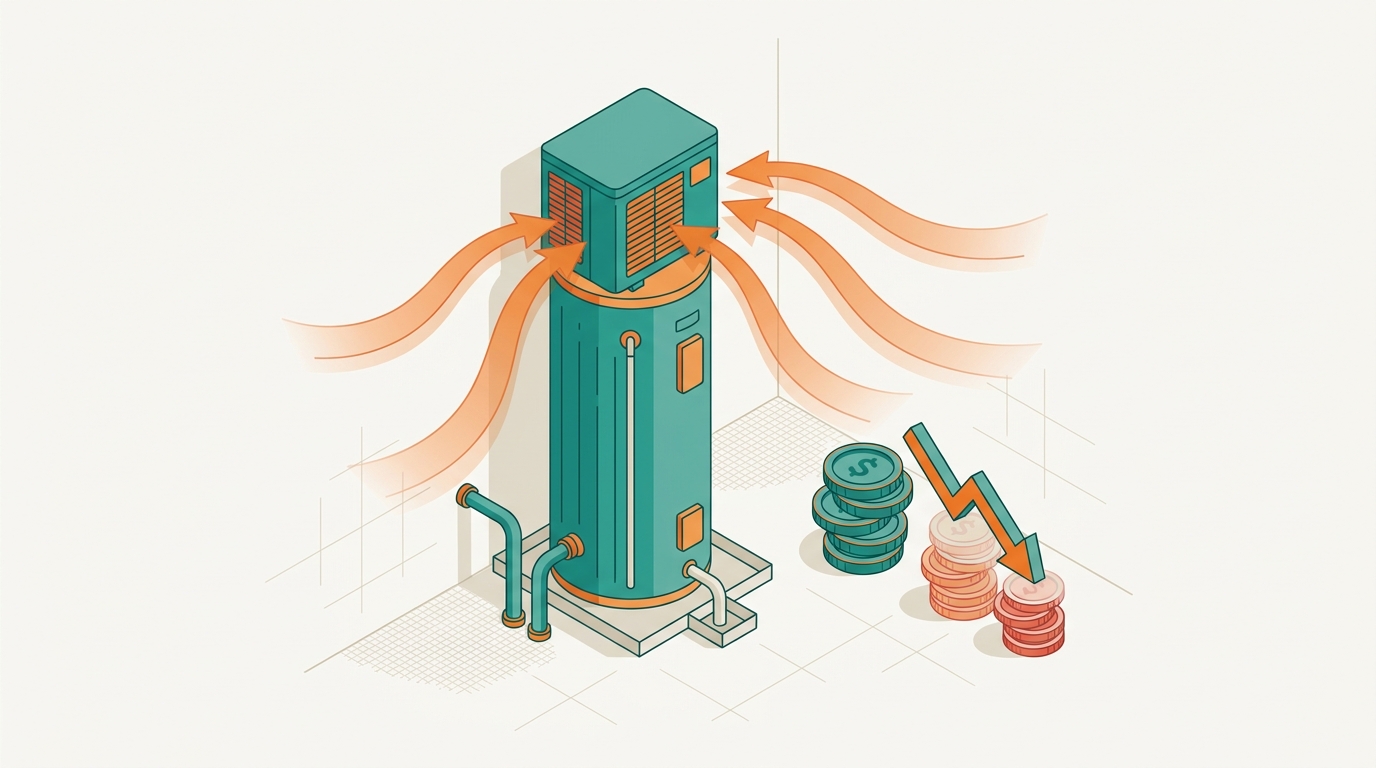
By the end you will know when a heat pump water heater is a slam dunk, when the ROI is marginal, and how to run the numbers for your own home with real ranges instead of marketing claims.
60–70%
Less energy used
vs a standard electric tank, per ENERGY STAR
$400–550
Typical annual savings
family of four replacing electric resistance
3–8 yrs
Common payback
shorter with a rebate, longer with low usage
$0
2026 federal credit
25C ended for installs after Dec 31, 2025
On this page
- Quick answer: who wins, who waits
- What "ROI" actually means here
- How heat pump water heaters save money
- What your water heating costs now
- If you have an electric resistance water heater
- If you have gas, propane, or oil
- Annual operating cost, side by side
- Worked example: family of four on electric
- Worked example: small household, cheap power
- Worked example: propane conversion
- A real-world look before you buy
- Factors that move your ROI
- Hot-water use
- Electricity price and rate structure
- Incentives in 2026
- Install complexity
- Location and side effects
- 120V vs 240V, and capacity
- The 2026 federal tax credit reality
- How to run your own numbers
- When it makes sense right now
- The bottom line
Quick answer: who wins, who waits
You are likely to see strong ROI if you have a standard electric resistance water heater now, you use a fair amount of hot water, your electricity rates sit at or above the U.S. average, and you can land a state or utility rebate to shrink the premium.
You will see slow or marginal payback if you already have efficient gas water heating with cheap gas, your hot-water use is low, or the install is complicated by a panel upgrade, long pipe runs, or a difficult location.
The one number that decides it
ROI is driven by the extra cost over a standard replacement, not the full sticker price. A heat pump tank that costs $4,000 against an $1,800 standard electric tank is really a $2,200 decision. Compare premiums, not totals, or you will scare yourself out of a good investment.
What "ROI" actually means here
Return on investment for a water heater is simple arithmetic: the upfront premium over a standard replacement, divided by the annual bill savings over the life of the unit.
If a heat pump water heater costs $2,000 more than a standard electric unit after any rebates, and it saves $450 a year in energy, payback is about 4.4 years. After that, it is pure savings until the tank dies. You do not need perfect precision. You need a range that tells you whether you are closer to 4 years or 14.
How heat pump water heaters save money
A heat pump water heater moves heat instead of creating it with a hot electric element. The U.S. Department of Energy notes that they can be two to three times more energy efficient than conventional electric resistance water heaters.
The efficiency rating tells the story. Standard electric resistance tanks have a Uniform Energy Factor (UEF) around 0.90, meaning almost all the electricity becomes heat at a 1-to-1 ratio. A heat pump model has a UEF of roughly 3.5 to 4.0, because it harvests free heat from the surrounding air and uses electricity only to move it. That is where the "three to four times more efficient" framing comes from.
ENERGY STAR puts it in dollar terms: a certified unit can use up to 70 percent less energy than a standard electric water heater and save a typical household several hundred dollars a year. Field studies in real homes back the basic story with more modest averages. Work in the Northeast and Northwest has found energy savings in the 40 to 65 percent range once placement and cold-air interactions are counted.
So the honest range is this:
- Heat pump water heaters often cut hot-water energy use by roughly half to two-thirds compared with standard electric tanks.
- The dollar savings depend heavily on how much hot water you use and what you pay per kWh.
What your water heating costs now
Start with your current situation, because the baseline sets the size of the prize.
If you have an electric resistance water heater
Standard electric tanks send current through a metal element to heat water. Simple, and expensive to run. A typical family burns 3,500 to 4,800 kWh a year on water heating, more with heavy use. At the U.S. average residential rate of about $0.17 per kWh, that is roughly $600 to $800 a year.
A heat pump water heater that cuts that energy use by 60 to 70 percent saves around 2,200 to 3,400 kWh per year, which is $375 to $580 at $0.17. That lines up with ENERGY STAR's own estimates and with field summaries that report savings in the $300 to $550 range depending on use and rates.
If you have gas, propane, or oil
Here the picture splits. Studies show the largest operating-cost savings when switching from propane or fuel oil, because those fuels are expensive per unit of useful heat. Savings shrink, and can even go negative, when switching from efficient natural gas in regions with cheap gas and high electricity rates.
If gas is cheap where you live and electricity is dear, the ROI may rely more on emissions reduction, safety (no combustion in the house), and a long-term electrification plan than on quick payback from bill savings alone. The full picture of upfront and operating cost is in our heat pump water heater cost guide.
Annual operating cost, side by side
This is the gap that funds your payback.
Annual hot-water energy cost (50-gal, family of four)
UEF ~3.5–4.0
depends heavily on gas price
UEF ~0.90
expensive delivered fuel
Worked example: family of four on electric
Here is the full math, the way I would run it for a client.
- Current heater: 50-gallon standard electric tank.
- Annual water-heating use: 4,200 kWh.
- Electricity rate: $0.17 per kWh.
- Annual cost now: about $714.
Install an ENERGY STAR heat pump water heater and assume a 65 percent energy reduction (between the field-study average and the marketing best case):
- New annual use: about 1,470 kWh.
- New annual cost: about $250.
- Annual savings: about $464.
Now the costs, in 2026 terms with no federal credit:
- Standard electric replacement quote: $1,800 installed.
- Heat pump water heater quote: $4,000 installed.
- Premium over standard: $2,200.
- State or utility rebate: assume $500 (many Northeast and West programs offer this or more).
- Net premium after rebate: $1,700.
Payback: $1,700 divided by $464 a year is about 3.7 years. After that you are banking roughly $460 a year for the rest of a 10-to-15-year life, so the lifetime net benefit lands in the low thousands.
What 2026 changed
In 2025, a 30 percent federal credit (up to $2,000, counted inside the heat-pump category cap) would have knocked roughly $1,200 off that $4,000 unit, pushing the net premium near $300 and the payback under a year. That credit is gone for 2026 installs. The savings still flow at $464 a year, but the upfront math is less forgiving, which makes a state or utility rebate the most valuable lever you have this year.
Worked example: small household, cheap power
Now the case that often does not pencil out.
- Two-person household, 1,900 kWh a year on water heating.
- Electricity rate: $0.12 per kWh.
- Annual cost now: about $228.
Heat pump water heater at a 60 percent reduction: new use about 760 kWh, cost about $91, savings about $137 a year.
- Standard electric quote: $1,500.
- Heat pump quote: $3,600.
- Premium, no rebate: $2,100.
- Payback: $2,100 divided by $137 is roughly 15 years.
That is longer than the warranty. With low usage and cheap electricity and no incentive, a heat pump water heater can be the wrong financial call, and waiting for a rebate program or the next natural replacement is reasonable.
Worked example: propane conversion
- Current heater: propane tank, about $850 a year in fuel.
- Heat pump water heater drops that to roughly $300 a year. Savings about $550.
- Net premium over a new propane unit: about $1,600.
- Payback: about 2.9 years.
For many propane and oil households the ROI case is as strong as or stronger than for standard electric, because the fuel you are replacing is so expensive.
A real-world look before you buy
Spec sheets are clean. Basements are not. This long-term owner review covers the things the brochure skips: actual energy use, how loud the unit really is, and what it does to room temperature.
Factors that move your ROI
A few levers have outsized impact.
Hot-water use
Higher use means higher savings for a given efficiency gain. Long showers, frequent laundry, big tubs, and teenagers all push payback shorter. A frugal one-person home pushes it longer.
Electricity price and rate structure
The value of each kWh saved changes the math. High rates plus a standard electric tank yield strong ROI. Low rates, cheap gas, and low usage yield weak ROI. Time-of-use rates can help or hurt depending on when the unit runs and whether its controls can shift heating to off-peak hours. The U.S. average sits near $0.17 per kWh in 2026, but state-level rates run from roughly $0.11 in parts of the South to over $0.30 in California and the Northeast, and that spread alone can double or halve your payback.
Incentives in 2026
The federal 25C credit is gone for new installs (more on that below), so this year incentives mean state and utility rebates. These vary widely. Many utility and state programs still offer $300 to $1,000 or more for a qualifying ENERGY STAR heat pump water heater, and some low-income programs cover most of the cost. Stack what you can find, because after the loss of the federal credit, a local rebate is often the single biggest swing factor in 2026 ROI.
Install complexity
Some installs are simple. Others are not. Cost triggers include a panel upgrade, long new plumbing runs, condensate management, and structural work to fit the unit in a tight space. Two homes across the street from each other can have identical usage and rates but very different installed costs because of layout. A 120V plug-in heat pump water heater can sidestep the priciest of these: I have specced retrofits where the 120V unit ran on the existing outlet and skipped a $2,500 panel upgrade, which by itself flipped the project from "marginal" to "clear yes."
Location and side effects
Heat pump water heaters pull heat from the air around them, which has real consequences:
- In a warm basement or garage they cool and dehumidify the space, often by a few degrees. My basement runs about 6°F cooler in summer, which I count as a free comfort upgrade.
- In a small, already-cold room in a cold climate, they can raise your main heating load in winter and chip away at net savings.
- They need air to work, roughly 700 to 1,000 cubic feet, or a duct kit. Sealed in a tiny closet, efficiency and recovery suffer.
- They are not silent. Expect a steady fan-and-compressor hum around 45 to 55 dB, similar to a window AC or dishwasher. Fine for a basement, worth thinking about next to a bedroom.
120V vs 240V, and capacity
Two specs decide whether the unit fits your house and your showers.
120V vs 240V. Plug-in 120V models run on a standard outlet and avoid the dedicated 240V circuit a resistance tank needs, which can dodge a panel upgrade entirely. They recover hot water more slowly and usually have no backup element. A 240V hybrid recovers faster and includes an electric element that fires on high-demand days, at the cost of needing that 240V circuit.
Capacity and first-hour rating. Tank gallons matter less than the first-hour rating (FHR), the gallons of hot water the unit can deliver in a busy hour. Because heat pump mode heats more slowly than a resistance element, the standard advice is to size up: a household that ran a 50-gallon electric tank is often happier with a 65- or 80-gallon heat pump model, or one set to lean on heat pump mode with the element as backup. A bigger tank also lets you stay in efficient heat-pump-only mode more of the time, which protects your savings. Compare models and ratings side by side with our water heater comparison tool.
The 2026 federal tax credit reality
This is the part most older guides get wrong now, so be careful.
Heat pump water heaters fell under the 25C Energy Efficient Home Improvement Credit: 30 percent of project cost, counted inside the $2,000 per year heat-pump category cap shared with other heat-pump equipment. You may still see articles saying it runs "through 2032." It does not.
The One Big Beautiful Bill Act ended the 25C credit for property placed in service after December 31, 2025. In plain terms:
- A heat pump water heater installed and running in 2025 can still be claimed on the federal return you file in 2026, using IRS Form 5695.
- A unit placed in service in 2026 gets no federal tax credit.
- State and utility rebates are separate programs and may still apply in 2026, so check those before assuming you have no help.
Verify before you claim
If your unit went in during 2025, confirm the in-service date and keep the manufacturer's certification statement and receipts for Form 5695. If you are buying in 2026, build your ROI without a federal credit and lean on state and utility rebates instead. The dedicated heat pump water heater tax credit guide walks through the paperwork.
How to run your own numbers
A calculator can clarify or mislead. Use it as a tool, not the final word.
- Use your real annual usage if you have it. Some utility dashboards break out water-heating kWh; if not, estimate from family size.
- Set electricity rates to your full all-in rate, including delivery and fees, not just the supply line.
- Enter realistic savings: start at 50 to 65 percent for electric-to-heat-pump, not a flat 70 percent.
- Use actual quotes for both a standard replacement and a heat pump unit, not list prices.
Then run three versions: a conservative case (lower savings, higher install), a middle case with your best estimates, and an optimistic case (higher savings, full rebate). If all three cluster under 7 to 8 years and you plan to stay in the home, the upgrade is strong. If the conservative case runs into the mid-teens, the decision turns on your risk tolerance and how much you value the non-financial benefits.
When it makes sense right now
It is usually worth moving now if your current electric or propane heater is near end of life, you can land a state or utility rebate that brings the premium into a manageable range, you can place the unit where its cooling and dehumidifying effect helps rather than hurts, and your conservative case shows payback under 8 years.
It can be smart to wait and plan if you have an efficient gas heater with cheap gas and low usage, your installed quotes are far above typical ranges for your region, or no rebate is available this year but a program is expected to launch. Waiting does not mean giving up. It means scheduling the switch for the next natural replacement and designing the rest of your water-heating plan so the transition is smooth.
If you are weighing a heat pump tank against an on-demand option, our tankless vs tank comparison covers that fork.
The bottom line
A heat pump water heater earns its keep in the right house. The win comes from matching it to a home where the math, the comfort, and the long-term plan line up.
Sources & further reading
- Heat Pump Water Heaters — U.S. Department of Energy
- ENERGY STAR Certified Heat Pump Water Heaters — ENERGY STAR
- Energy Efficient Home Improvement Credit (25C) — Internal Revenue Service
- Electricity Data: Average Price by State — U.S. Energy Information Administration
Frequently asked questions
Are heat pump water heaters worth it in 2026?+
For most homes replacing an electric resistance tank, yes. A heat pump water heater cuts water-heating energy use by roughly 60 to 70 percent, which typically saves a family of four about $400 to $550 a year at average U.S. electricity prices. The catch in 2026 is that the 30 percent federal tax credit ended for systems placed in service after December 31, 2025, so the upfront premium over a standard tank is larger this year. With a state or utility rebate, payback usually lands in the 4 to 8 year range; without any incentive and with low usage, it can stretch past 10 years.
What is the payback period on a heat pump water heater?+
Typical payback is 3 to 8 years for a household replacing electric resistance, and it can be under 3 years for propane or oil conversions. The math is the extra cost over a standard replacement divided by annual energy savings. Example: a $4,000 installed heat pump unit versus a $1,800 standard electric tank is a $2,200 premium; at $450 a year in savings that is a 4.9 year payback. Higher electricity prices, heavier hot-water use, and any rebate shorten it. Low usage, cheap electricity, or an expensive install lengthen it.
How much does a heat pump water heater cost to run per year?+
A 50-gallon heat pump water heater uses roughly 1,200 to 1,800 kWh a year for a typical family, which is about $200 to $300 at the U.S. average rate near $0.17 per kWh. A standard electric tank doing the same job uses 3,500 to 4,800 kWh, or roughly $600 to $800. That $300 to $500 annual gap is the engine behind the ROI.
Do heat pump water heaters really use 70 percent less energy?+
The 70 percent figure comes from ENERGY STAR's comparison of a high-efficiency unit against a standard electric tank, and it reflects the difference in efficiency rating: a heat pump model has a Uniform Energy Factor (UEF) around 3.5 to 4.0 versus about 0.90 for resistance. Independent field studies in real homes more often show 40 to 65 percent savings once placement, cold air, and recovery behavior are counted. Use 50 to 65 percent for planning if you want a realistic number rather than a best case.
How does the 2026 federal tax credit work for heat pump water heaters?+
It does not for 2026 installs. Heat pump water heaters qualified under the 25C Energy Efficient Home Improvement Credit for 30 percent of project cost, counted inside the $2,000 per year heat-pump category cap. The One Big Beautiful Bill Act ended 25C for property placed in service after December 31, 2025. So a unit installed and running in 2025 can still be claimed on the return you file in 2026 using IRS Form 5695, but a unit placed in service in 2026 gets no federal credit. State and utility rebates are separate and may still apply.
Will a heat pump water heater make my basement cold?+
Yes, a little. It pulls heat from surrounding air, so it cools and dehumidifies the space, often by a few degrees Fahrenheit. In a warm or humid basement that is a comfort bonus in summer. In a small, already-cold room in winter it can nudge up your main heating load, which trims net savings. Give the unit roughly 700 to 1,000 cubic feet of air or duct it, and avoid sealing it in a tiny closet.
Can I install a 120V heat pump water heater without upgrading my panel?+
Often yes. Plug-in 120V heat pump water heaters run on a standard household outlet and skip the 240V circuit a resistance tank needs, which can avoid a panel upgrade that would otherwise cost $1,500 to $4,000. The tradeoff is slower recovery and no backup resistance element, so they suit smaller households or homes that can step up tank size. A 240V hybrid recovers faster and adds an electric element for high-demand days.
How long do heat pump water heaters last?+
Most carry 10-year warranties and commonly run 10 to 15 years, similar to or longer than a standard electric tank. Because the payback is usually well inside that window, the unit spends several years past breakeven returning pure savings. Annual air-filter cleaning and condensate-drain checks help it reach the long end of that range.
Do heat pump water heaters save money over gas?+
Sometimes. Switching from propane or fuel oil almost always saves money, often with payback under 3 years, because those fuels are expensive per unit of useful heat. Against cheap natural gas in a region with high electricity prices, the operating-cost savings can be small or even negative, so the case there leans more on emissions, safety, and a long-term electrification plan than on quick payback.
Get practical energy tips
Join homeowners getting practical tips on cutting energy bills and staying comfortable.
Practical tips only. Unsubscribe anytime.
Read this next
Related guides selected by topic overlap and upgrade path.
Heat pump water heaters run $3,000–$6,500 installed in Austin. Austin Energy pays an $800 rebate, but the federal 25C credit ended in 2025. Here's the real 2026 math.
Tankless vs tank water heater, compared for 2026: installed cost ranges, lifespan, efficiency (UEF), sizing, venting and gas-line upcharges, descaling, rebates, and who each one fits, plus heat pump water heaters as a third option.

Window replacement tax credits can be real—but only if you can document what qualifies. Here’s a practical checklist for homeowners to reduce uncertainty.

A practical, documentation-first guide to electric panel upgrade tax credits: what to confirm before work starts, what receipts to keep, and how to reduce uncertainty.