Blog
Tankless vs Tank Water Heaters: Costs and Comfort
Tankless vs tank water heater, compared for 2026: installed cost ranges, lifespan, efficiency (UEF), sizing, venting and gas-line upcharges, descaling, rebates, and who each one fits, plus heat pump water heaters as a third option.
If your water heater is leaking, rusting, or you keep running out of hot water, the tankless vs tank decision lands on you fast. I have watched homeowners pay a 2x install premium for tankless expecting a smaller bill, then see almost no change. Tankless is a great fit in the right house. It is not an automatic savings upgrade.
The right answer depends on three things: your fuel (gas or electric), your hot-water pattern, and what your house can physically support without expensive upgrades. This guide gives you the 2026 cost ranges, lifespan, efficiency numbers, sizing math, and the gotchas installers do not always volunteer, then points you to the calculator to check it against your own bill.
$1,200–$2,500
Gas tank, installed
vs $3,000–$6,000 for gas tankless
~20 yrs
Tankless lifespan
vs 8–15 yrs for a storage tank
24–34%
Tankless efficiency gain
DOE, for homes under 41 gal/day
~20%
Of home energy is water heating
EIA, so whole-bill savings stay modest
One-minute setup (do this first)
- Open the Tankless vs Tank Water Heater Calculator and enter your rates and household size.
- If you do not know your rates, open the Bill Breakdown Estimator and pull them from your bills.
- If you want to keep notes on quotes, add a draft in My Plan.
On this page
- Quick answer: which is usually the better choice?
- What you are buying: storage vs on-demand heat
- Tank (storage) water heater
- Tankless (on-demand) water heater
- Cost comparison: installed cost is the number that matters
- Lifespan: where tankless earns its premium
- Efficiency and operating cost: will tankless lower your bill?
- Sizing and capacity: gallons vs gallons per minute
- Comfort details that decide the day-to-day experience
- Hot-water wait and recirculation
- The cold-water sandwich
- Hard water
- Maintenance: the ownership task people forget
- Gas tankless vs electric tankless: very different products
- Gas tankless (the common whole-home choice)
- Electric tankless (easy to misunderstand)
- Condensing vs non-condensing tankless (why gas quotes vary)
- The third option: heat pump water heaters
- Rebates and incentives (2026)
- Quote checklist for a tankless install (avoid surprise add-ons)
- A decision path that avoids regret
- Next steps
Quick answer: which is usually the better choice?
A storage tank is usually right when:
- You want the lowest installed cost and the simplest job.
- Your hot-water demand is moderate and your household runs on a normal schedule.
- You are replacing a failed unit fast and do not want venting or gas-line surprises.
A tankless is usually right when:
- You run out of hot water with a tank, or want back-to-back showers without limit.
- You have natural gas and a home that can take the venting and gas-line work.
- You plan to stay long enough (10-plus years) for the longer lifespan to matter, and you value the reclaimed floor space.
A heat pump water heater is the quiet third option that often wins on operating cost in electric homes. It uses 60 to 70 percent less electricity than a standard electric tank, so if your goal is the lowest bill, read Heat pump water heater ROI without the hype before you commit to either tank or tankless. More on it below.
What you are buying: storage vs on-demand heat
Tank (storage) water heater
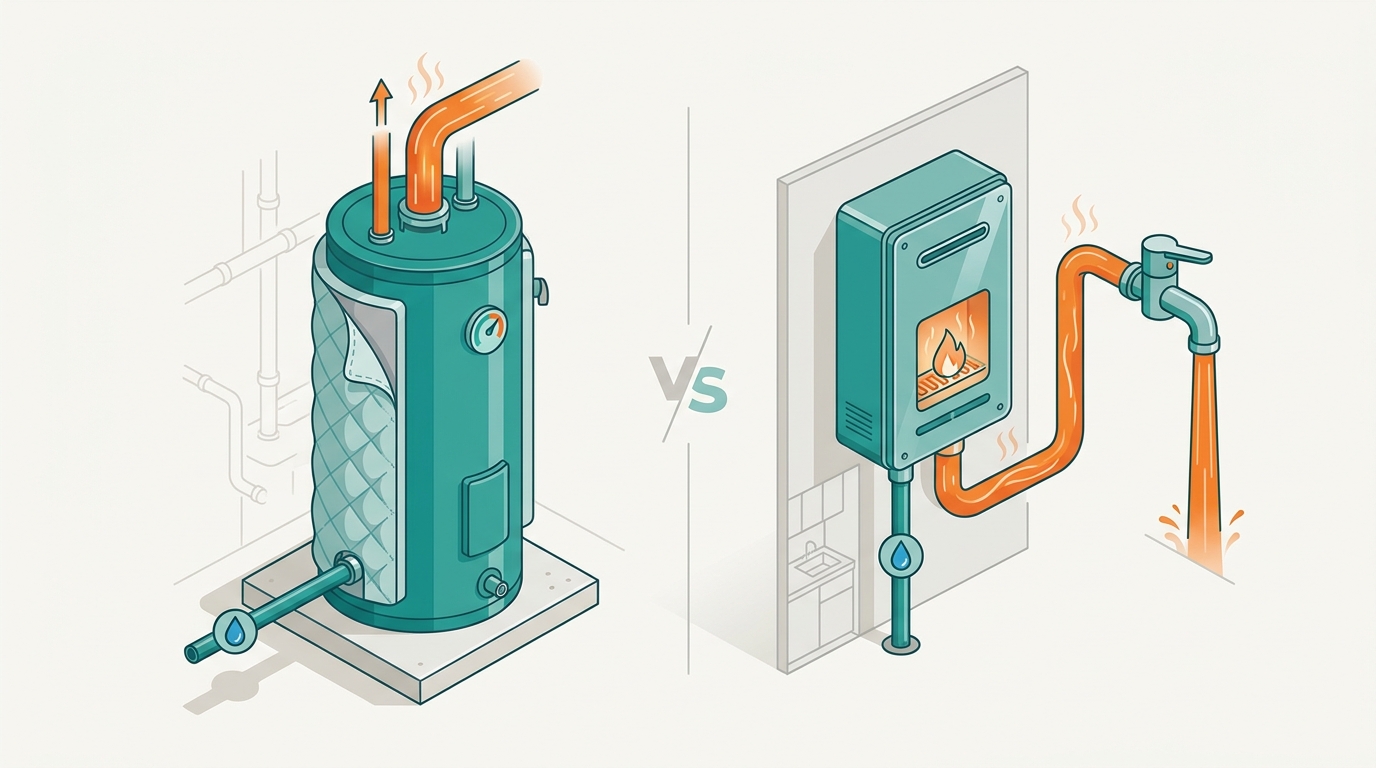
A tank keeps 40 to 50 gallons hot and ready around the clock. It is cheap, simple, and any plumber can service it. The downsides are standby heat loss (it reheats whether you use it or not), a finite supply that runs dry during heavy use, and a 30-to-60-minute recovery before the tank is hot again. When it fails, it usually fails wet, which means a flooded utility closet.
Tankless (on-demand) water heater
A tankless fires a gas burner or electric element only when you open a tap, heating water as it passes through a heat exchanger. No tank means no standby loss and, in principle, endless hot water. The catch is that output is capped by flow rate and temperature rise, not by a stored gallon count, and the install is more involved.
One myth worth killing early: tankless does not mean instant hot water at the faucet. The water still has to travel through your pipes. Pipe length and recirculation decide your wait, not the heater type.
Cost comparison: installed cost is the number that matters
Equipment price is the small part. The spread between a tank and a tankless quote is driven by what the install touches: a bigger gas line, new venting, a condensate drain, electrical work, sometimes a water softener. Here is where 2026 numbers land for a straightforward replacement, before rebates.
Installed cost by type (2026, before rebates)
before 30% federal tax credit
often + $1,500–$4,000 panel upgrade
includes venting + gas line
A useful gut check: a plumber I trust quotes around $1,600 for a like-for-like gas tank swap and around $4,400 for a gas tankless in the same house, because the tankless needs new stainless venting, a gas-line upsize, and a condensate drain. That roughly 2.5x gap is normal, and a tankless quote that is suspiciously close to the tank price is usually missing the venting line items.
| Cost factor | Gas tank | Gas tankless | Electric tank | Heat pump water heater |
|---|---|---|---|---|
| Unit only | $400–$1,000 | $1,000–$2,500 | $400–$900 | $1,200–$2,500 |
| Installed | $1,200–$2,500 | $3,000–$6,000 | $1,000–$2,200 | $1,800–$4,500 |
| Likely add-ons | Venting check | Gas line, venting, condensate | Usually none | Condensate drain, space |
| Lifespan | 8–12 yrs | ~20 yrs | 10–15 yrs | 10–15 yrs |
| Annual maintenance | Low | Descale yearly | Low | Filter + occasional service |
If your budget is tight and you want a plan that sequences upgrades, Energy upgrades by budget helps you prioritize.
Lifespan: where tankless earns its premium
This is the clearest win for tankless. The Department of Energy puts most tankless units past 20 years, with replaceable parts that can stretch them further. Storage tanks last 8 to 12 years (gas) or 10 to 15 (electric) before the tank corrodes through and leaks.
The asterisk is maintenance. A tankless heat exchanger that never gets descaled in hard water can scale up and fail well short of 20 years, sometimes inside a decade. The lifespan advantage is real, but it is conditional on the yearly flush. A neglected tankless and a neglected tank end up closer than the brochure suggests.
Efficiency and operating cost: will tankless lower your bill?
Sometimes, modestly. The DOE finds tankless is 24 to 34 percent more efficient than a storage tank for homes using 41 gallons a day or less, and 8 to 14 percent more efficient for high-use homes near 86 gallons. That sounds large until you remember water heating is only about 20 percent of a typical home energy bill (EIA). Twenty-some percent off a fifth of your bill is real money but rarely dramatic, often $80 to $200 a year.
The efficiency spec to compare is UEF (Uniform Energy Factor). Higher is better. Rough 2026 benchmarks:
- Gas storage tank: UEF around 0.60 to 0.70.
- Condensing gas tankless: UEF around 0.90 to 0.96.
- Electric storage tank: UEF around 0.90 to 0.95.
- Heat pump water heater: UEF around 3.0 to 4.0 (it moves heat instead of making it).
Notice the heat pump number is in a different league. That is why an electric home chasing the lowest bill should price a heat pump unit, not just tank vs tankless. Before any swap, use the Bill Breakdown Estimator to answer one question: is water heating a big enough slice of your bill to chase? If it is small, pick on comfort and reliability, not payback.
For efficiency criteria and qualifying products, ENERGY STAR is a solid reference: https://www.energystar.gov/products/water_heaters
Sizing and capacity: gallons vs gallons per minute
Tanks and tankless are sized differently, and mixing them up causes most of the regret.
Tanks are sized by stored gallons and by first-hour rating (how much hot water you get in the first hour of heavy use). A family of four usually wants a 50-gallon gas tank or a 50-to-66-gallon electric. Recovery matters too: gas tanks reheat faster than electric.
Tankless is sized by peak flow in gallons per minute (GPM) and by temperature rise. Add up what runs at once:
- Shower: 1.5 to 2.5 GPM depending on the head.
- Kitchen faucet: 1 to 2 GPM.
- Dishwasher and clothes washer: bursty, not zero.
Two showers at once is roughly 4 to 5 GPM. The trap is temperature rise. A unit rated at 9 GPM with 70-degree incoming water might deliver only 5 GPM when winter groundwater drops to 40 degrees, because it has to raise each gallon further. That is why a whole-home gas tankless is usually rated 7 to 11 GPM, and why cold-climate homes need to oversize. Ask the installer for the flow rate at your winter incoming temperature, not the headline number on the box.
Comfort details that decide the day-to-day experience
Hot-water wait and recirculation
If your real complaint is "it takes forever to get hot water at the far bathroom," neither heater type fixes that on its own. The fix is a recirculation loop or an on-demand recirc pump, which adds roughly $200 to $1,000. Some tankless units pair with a built-in recirc pump and a small buffer tank to cut the wait.
The cold-water sandwich
A quirk worth knowing: with some tankless units, if you shut the hot tap and reopen it a few seconds later, you get a short blast of cold water before hot returns. That is the cold-water sandwich, caused by the brief gap before the burner refires. Newer models with buffer tanks largely solve it, but ask.
Hard water
In hard-water areas, scale is the enemy of a tankless heat exchanger. Many warranties require annual descaling, and a softener or scale filter is often recommended to protect the unit. A tank tolerates hard water better but still benefits from a periodic flush and an anode rod check.
Maintenance: the ownership task people forget
Tankless needs descaling (a vinegar or descaler flush through the heat exchanger) about once a year, or every 6 to 9 months on hard water. A plumber quotes $100 to $200 per flush; a DIY pump-and-bucket kit runs around $150 once. Skip it for years and the warranty can be void and the unit scales shut.
A storage tank is lower-touch: drain a few gallons of sediment yearly and check the sacrificial anode rod every 3 to 5 years (a $30 part that protects the tank from corrosion). Most people never do either, which is part of why tanks fail at the low end of their range.
Gas tankless vs electric tankless: very different products
Gas tankless (the common whole-home choice)
Gas units handle higher flow rates and work across climates if venting and gas supply are right. Confirm in the quote:
- gas-line sizing (a tankless often needs more BTU than your old tank, so the existing line may be undersized),
- venting route, materials, and termination (condensing units use sealed stainless or PVC),
- a condensate drain for condensing models,
- combustion-air supply in tight, airtight homes.
Electric tankless (easy to misunderstand)
Whole-home electric tankless units draw enormous power, frequently 100-plus amps across multiple double-pole breakers. In a lot of homes that means a panel or even a service upgrade, which can add $1,500 to $4,000 and erase the appeal. Ask the installer to state the unit's amperage and whether your service and panel can carry it. Before assuming you need an upgrade, read Panel upgrade checklist: when you need it (and when you do not). For an electric home, a heat pump water heater is usually the smarter electric play than electric tankless.
Condensing vs non-condensing tankless (why gas quotes vary)
Many gas tankless models are condensing, meaning they pull extra heat out of the exhaust to reach UEF in the low-to-mid 0.90s. The trade-off is a condensate drain and different (often cheaper PVC) venting. Non-condensing units are slightly less efficient and need pricier stainless venting that runs hotter. You do not need to memorize the categories; you need the quote to spell out the venting and drainage so the price is complete. A dramatically cheaper quote that never mentions venting is a starting number, not a finished one.
The third option: heat pump water heaters
If your home is electric or going electric, a heat pump water heater (also called a hybrid) deserves a seat at the table. It pulls heat from the surrounding air and dumps it into a storage tank, so it uses 60 to 70 percent less electricity than a standard electric tank and lands near $100 to $200 a year to run. That usually beats both a tank and a tankless on operating cost.
The catches: it needs roughly 700 to 1,000 cubic feet of air or a louvered/vented closet, it gently cools and dehumidifies that space (fine for a basement, less so for a bedroom closet), and it can be louder than a tank. On incentives, the federal 25C credit that paid 30 percent up to $2,000 ended for units placed in service after December 31, 2025, so a 2026 install does not qualify federally. State energy-office rebates and utility rebates still apply in many areas, so check both before you buy.
- See the full numbers in Heat pump water heater cost.
- Check what is left of the incentives in Heat pump water heater tax credit.
- Sanity-check payback in Heat pump water heater ROI without the hype.
Rebates and incentives (2026)
The federal picture changed in 2025. As of 2026:
- The federal 25C tax credit (30 percent up to $2,000 for a qualifying heat pump water heater) ended for property placed in service after December 31, 2025, under the One Big Beautiful Bill Act signed in July 2025. A 2025 install that was energized by the cutoff can still claim it on a 2025 return; a 2026 install cannot.
- State energy-office rebates (the IRA Home Energy Rebates) remain available for 2026 installs in states that have launched them, often largest for income-qualified households.
- Many gas and electric utilities still pay $100 to $600 rebates for high-UEF units; check your utility before you buy.
Incentives change, so verify current terms on the Department of Energy water heating pages and with your utility.
Quote checklist for a tankless install (avoid surprise add-ons)
Make the installer put these line items in writing:
- venting path, materials, and termination,
- whether the gas line must be upsized,
- whether a condensate drain is required and where it goes,
- whether a softener or scale filter is recommended for warranty and scaling,
- whether recirculation is included or optional,
- a maintenance plan: who descales, how often, and what it costs.
If a quote is missing most of this, it is not a complete quote.
A decision path that avoids regret
- Confirm how much water heating costs you with the Bill Breakdown Estimator. If it is a small slice, decide on comfort, not payback.
- Pick your priority: endless hot water (favors tankless), lowest first cost (favors tank), or lowest running cost in an electric home (favors a heat pump unit).
- Compare scenarios side by side in the Tankless vs Tank Water Heater Calculator.
- Get two quotes and require venting, gas-line, electrical, and maintenance details in writing.
- Capture the plan and constraints in My Plan. For the broader picture, the water heating upgrade hub ties these options together.
If your unit is on borrowed time and you want to plan before an emergency, the Upgrade Timing Planner helps you replace on your schedule, not the failure's.
Sources & further reading
- Tankless or Demand-Type Water Heaters — U.S. Department of Energy
- Estimating Costs and Efficiency of Storage, Demand, and Heat Pump Water Heaters — U.S. Department of Energy
- ENERGY STAR Water Heaters — ENERGY STAR
- Residential Energy Consumption Survey (RECS) — U.S. Energy Information Administration
Next steps
- Use the Tankless vs Tank Water Heater Calculator to compare tank, tankless, and heat pump side by side with your own rates.
- Keep venting, gas-line, electrical, and maintenance notes in My Plan so no quote slips a hidden cost past you.
Frequently asked questions
Is a tankless water heater worth it in 2026?+
Tankless is worth it when you run out of hot water with a tank, you have natural gas, and you plan to stay 10-plus years. A gas tankless runs about $3,000 to $6,000 installed versus $1,200 to $2,500 for a gas tank, and the payback on energy alone is slow because water heating is only about 20 percent of a typical home energy bill. The stronger reasons are endless hot water, a 20-year lifespan, and freeing up floor space.
How much does a tankless water heater cost installed vs a tank?+
A gas tank water heater runs about $1,200 to $2,500 installed; a gas tankless runs about $3,000 to $6,000 because of larger gas lines, new stainless venting, and a condensate drain. Electric tank runs about $1,000 to $2,200 installed. Whole-home electric tankless runs about $1,500 to $4,000 for the unit and labor but often triggers a $1,500 to $4,000 panel or service upgrade. Heat pump water heaters run about $1,800 to $4,500 installed before rebates.
How long does a tankless water heater last compared to a tank?+
Tankless units last about 20 years, and many makers rate them for 20-plus with annual descaling. Storage tanks last about 8 to 12 years for gas and 10 to 15 for electric, limited by tank corrosion. In hard water without descaling, a tankless heat exchanger can scale up and fail much sooner, so the lifespan edge depends on maintenance.
Do tankless water heaters really save money on energy bills?+
The Department of Energy estimates tankless is 24 to 34 percent more efficient than a storage tank for homes using 41 gallons a day or less, and 8 to 14 percent more efficient for high-use homes near 86 gallons a day. In dollars that is often $80 to $200 a year, because water heating is roughly 20 percent of home energy use. Real savings shrink if people take longer showers once the hot water is endless.
What size tankless water heater do I need?+
Size a tankless by peak flow in gallons per minute and by temperature rise, not by gallons. Add up fixtures that run at once: a shower is 1.5 to 2.5 GPM and a kitchen faucet is 1 to 2 GPM, so two showers at once needs roughly 4 to 5 GPM. In cold-climate winters with 40-degree incoming water, the same unit delivers less, so a whole-home gas unit is usually 7 to 11 GPM rated.
Do tankless water heaters need maintenance?+
Yes. Tankless units need descaling (flushing with vinegar or descaler) about once a year, or every 6 to 9 months on hard water, and many warranties require it. Plumbers quote $100 to $200 per flush, or a homeowner can do it with a $150 pump kit. Storage tanks only need an occasional drain and an anode rod check every few years.
Does a tankless water heater give instant hot water?+
No. Tankless heats on demand, but water still travels through the pipes, so a far bathroom can wait 20 to 60 seconds. A recirculation loop or a built-in recirc pump fixes the wait, adding roughly $200 to $1,000. Some tankless models cause a cold-water sandwich, a short cold burst when hot water restarts mid-use.
Will a tankless water heater work during a power outage?+
No, even gas tankless units need electricity for the controls, igniter, and fan, so they stop in an outage. A gas storage tank with a standing pilot keeps delivering hot water until the stored volume runs out. If outages are common, a small battery backup or a generator circuit keeps a gas tankless running.
Is a heat pump water heater better than tankless?+
For operating cost in an electric home, usually yes. A heat pump water heater uses about 60 to 70 percent less electricity than a standard electric tank and runs roughly $100 to $200 a year, beating both tank and most tankless. It needs about 700 to 1,000 cubic feet of space or a vented closet, and while the federal 25C credit ended for installs after December 31, 2025, state and utility rebates remain in many areas for 2026.
Can I replace a tank with a tankless without other upgrades?+
Rarely a clean swap. A gas tankless usually needs a larger gas line, new stainless or PVC venting, and a condensate drain, adding $500 to $2,000 over the unit. A whole-home electric tankless typically needs 100-plus amps of dedicated capacity, which often means a panel or service upgrade. Always get the venting, gas, and electrical line items in writing before signing.
Try the companion tool
This post links to an interactive tool built for this topic. Open it to see numbers tailored to your home.
Open the toolGet practical energy tips
Join homeowners getting practical tips on cutting energy bills and staying comfortable.
Practical tips only. Unsubscribe anytime.
Read this next
Related guides selected by topic overlap and upgrade path.
Heat pump water heaters run $3,000–$6,500 installed in Austin. Austin Energy pays an $800 rebate, but the federal 25C credit ended in 2025. Here's the real 2026 math.

Heat pump installation costs $6,000 to $18,000 in 2026, about $12,000 to $14,000 for a typical ducted home. See costs by size and type, and how to compare bids.
Tesla Powerwall 3 installed cost in 2026 is about $13,000 to $16,500 all-in (battery, Gateway, labor, permits). The 30% federal credit is gone. Full breakdown.

Air duct cleaning costs $300 to $700 for a typical home (about $35 per vent). Honest 2026 guide: what gets upcharged, and why most homes do not need it.