Blog
Heat Pump Water Heater Cost in Austin (2026): $3,000–$6,500 Installed, Minus the $800 Rebate
Heat pump water heaters run $3,000–$6,500 installed in Austin. Austin Energy pays an $800 rebate, but the federal 25C credit ended in 2025. Here's the real 2026 math.
If you are pricing a heat pump water heater in Austin, here is the short version: expect $3,000 to $6,500 installed for a 50- to 65-gallon hybrid unit, before incentives. Austin Energy knocks $800 off that with its rebate. The federal tax credit that used to add up to $2,000 is gone for 2026, so the rebate math matters more than it did a year ago.
The good news for Central Texas is that this is about the ideal climate for the technology. A heat pump water heater steals heat from the air around it, and Austin gives it plenty of warm air to work with, especially in the garage where most of these units live. Below is the 2026 breakdown: the all-in installed cost line by line, what Austin Energy actually pays, why the dead federal credit changes the math, and the local permit, electrical, and condensate details that decide whether your quote is fair.
$3,000–$6,500
Installed cost, Austin
50–65 gal hybrid, before rebate
$800
Austin Energy rebate
Qualifying ENERGY STAR unit
$0
Federal 25C credit in 2026
Ended Dec 31, 2025
$200–$400/yr
Savings vs electric resistance
Typical 3–4 person household
Before you collect bids, run your own numbers. Our Tankless vs Tank Water Heater Calculator lets you put a heat pump unit, a gas tank, and a tankless side by side on installed cost and operating cost so you can see what actually pays back at Austin rates. Use it to pressure-test any quote that bundles the unit, electrical, and condensate into one round number.
On this page
- What it actually costs in Austin, line by line
- Why Austin's climate suits these units
- The Austin Energy rebate (and the credit you no longer get)
- Permits, plumbers, and inspections in Austin
- Electrical and condensate: the Texas slab details
- The 240V circuit
- Condensate on a slab
- Sizing and real model recommendations
- What it costs to run, at Austin Energy rates
- Vetting an Austin contractor
- How it compares to tankless and standard tanks
- Frequently asked questions
- Next steps
What it actually costs in Austin, line by line
The unit is only part of the bill. In the Austin metro, the spread between a clean swap and a complicated one comes down to electrical, condensate, and access. Here is how a typical 2026 quote breaks out.
| Line item | Typical Austin range | Notes |
|---|---|---|
| Hybrid unit (50–65 gal) | $1,400 – $2,500 | Rheem ProTerra, A.O. Smith, Rheem Gen 5; 80 gal runs higher |
| Plumbing labor | $800 – $1,800 | Licensed plumber; like-for-like swap at the low end |
| City of Austin permit | $50 – $150 | Required; pulled by the plumber |
| Condensate drain or pump | $0 – $400 | $0 with a nearby floor drain; pump if none |
| New 240V circuit / breaker | $0 – $1,200 | $0 if reusing an existing electric-tank circuit |
| Panel upgrade (if needed) | $0 – $3,000+ | Only if the panel has no capacity or space |
| Haul-away + misc. (pan, expansion tank) | $100 – $400 | Old unit disposal, drain pan, code parts |
Ranges reflect 2026 Austin-area pricing from local plumbing companies and national cost data (Angi, HomeGuide), cross-checked against Austin labor rates. A straightforward electric-to-heat-pump swap in a garage lands near the bottom of the installed range; fuel changes, long electrical runs, and panel work push toward the top.
The biggest swing factor is your starting point. If you are replacing an existing electric tank in the garage, the 240V circuit is already there and the swap is cheap. If you are coming off gas, you have no 240V circuit at the water heater, so add an electrician, and possibly panel work, to the bill.
Heat pump water heater installed cost by Austin scenario (2026)
existing 240V circuit, easy drain
short run from panel
new circuit, no gas cost savings
airflow + condensate work
panel at capacity
The number that surprises Austin buyers
A clean garage swap and a gas-to-heat-pump conversion can differ by $2,000 to $3,000 for the same tank. The unit costs the same; the gap is almost entirely electrical. Coming off gas means a new 240V circuit, and if your panel is full, an upgrade. When a quote looks high, that is usually where it lives, not in the water heater itself.
Why Austin's climate suits these units
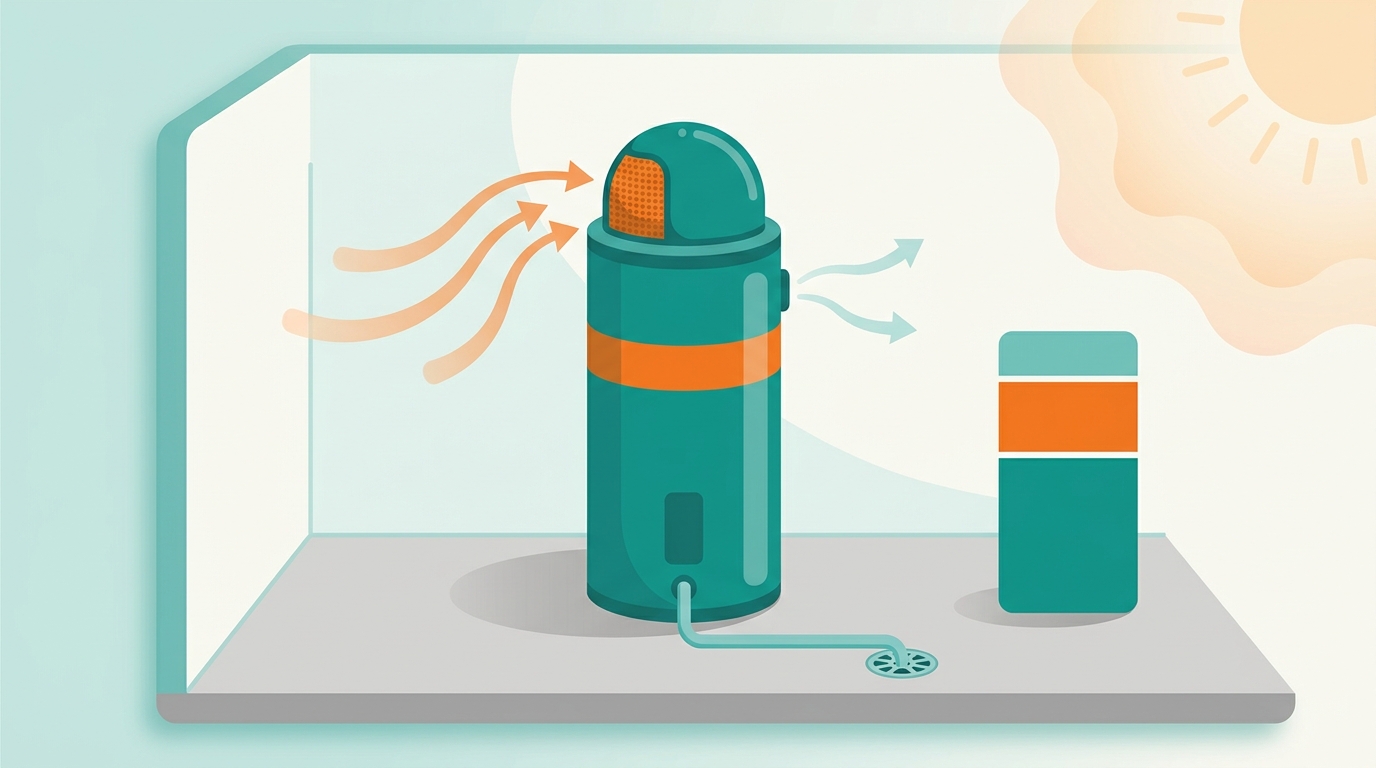
A heat pump water heater is a refrigerator running in reverse: a small compressor and fan pull heat out of the surrounding air and dump it into the tank. The warmer and more humid that air is, the less work the compressor does and the higher the efficiency. That is the air an Austin garage delivers for most of the year.
A unit sitting in a Central Texas garage that hovers in the 80s and 90s from spring through fall runs near its rated UEF (uniform energy factor) of 3.5 to 4.0. That means it delivers roughly three to four units of hot water energy for every unit of electricity. A standard electric resistance tank sits at a UEF around 0.9, so the hybrid uses a fraction of the electricity for the same hot water.
The usual knock on these units, cold-climate underperformance, barely applies here. In Minneapolis or Denver, a garage unit can drop into resistance mode all winter when the air gets too cold to harvest heat. Austin's mild winters mean that happens rarely, if at all. Our few genuinely cold mornings are short, and most units ride through them on hybrid mode without a meaningful efficiency hit.
One bonus: the unit exhausts cooler, dehumidified air. In a humid Austin garage, that takes a small edge off the summer heat in the space. It will not replace a mini-split, but homeowners notice it.
Field note: the garage is the easy win in Central Texas
On a swap I looked at in a Round Rock garage, the homeowner worried the unit would struggle in winter the way the online reviews from northern states warned. It never came up. The garage sat at 78 to 95 degrees nine months of the year, the unit almost never touched its resistance elements, and the homeowner's water heating draw on their Austin Energy bill dropped by more than half. The cold intake air that northern buyers fight is a non-issue in this climate. If your tank is in the garage here, you are starting in a good spot.
The Austin Energy rebate (and the credit you no longer get)
This is where the 2026 math has changed, so get it right.
Austin Energy pays an $800 rebate when you install a qualifying ENERGY STAR certified hybrid or heat pump water heater. The fine print is worth knowing because it is friendlier than most rebates:
- You need permanent Austin Energy electric service at the home (gas water heaters are not eligible).
- The unit must be ENERGY STAR certified, store at least 40 gallons, have an Energy Factor of 2.0 or better, be installed new, and carry at least a 6-year warranty.
- You apply online within 90 days of purchase. Miss that window and it is denied.
- There is no participating-contractor requirement for the water heater, so a homeowner can apply directly (unlike the Austin Energy AC rebate, which does require a registered contractor).
- The $800 is also offered as instant point-of-sale savings at participating stores, so you may get it at checkout instead of by mail.
- Funding is first-come, first-served and limited, so do not sit on it.
You still have to meet City of Austin permitting and code requirements, and Austin Energy may run a post-installation inspection. Confirm the current qualifying-model list and application steps on Austin Energy's site before you buy, since programs and amounts get adjusted.
The federal 25C tax credit is gone. Through 2025, the Energy Efficient Home Improvement Credit gave 30% of the cost, up to $2,000, for a heat pump water heater. The One Big Beautiful Bill Act terminated that credit for any property placed in service after December 31, 2025. A water heater installed in Austin in 2026 does not qualify. If you read an older guide promising "$800 rebate plus $2,000 tax credit," that stacking no longer exists.
So the realistic 2026 incentive picture is the Austin Energy rebate alone. Here is what that does to a typical job.
| Garage swap | Gas conversion | |
|---|---|---|
| Installed cost (before incentives) | $4,000 | $6,000 |
| Austin Energy rebate | −$800 | −$800 |
| Federal 25C credit (2026) | $0 | $0 |
| Net cost | $3,200 | $5,200 |
That net number is what you compare against a like-for-like electric tank (roughly $1,500 to $2,500 installed in Austin) or a gas tank. The premium over a plain electric tank is real, but the operating savings and rebate close a good chunk of it. For the full national picture on incentives, see heat pump water heater tax credit and the broader heat pump water heater cost breakdown.
Don't bank on the dead credit
Several contractor flyers and big-box displays still show the old $2,000 federal credit. It expired at the end of 2025. Budget your 2026 Austin project on the $800 Austin Energy rebate only. If a salesperson quotes you a net price that includes a federal credit, ask them to put the credit basis in writing, then verify it. There isn't one for 2026 installs.
Permits, plumbers, and inspections in Austin
Texas and the City of Austin do not treat a water heater as a casual DIY swap. A plumbing permit is required for a replacement, and the work has to be done or pulled by a Texas-licensed master plumber who is registered with the City. The permit itself usually runs $50 to $150, and an inspection follows the install.
A like-for-like replacement, same location, same fuel, is the simplest case and moves fast. The permit and inspection still apply, but the scope is small. Things get more involved when you change fuel (gas to electric), relocate the unit, or need electrical work, because that can pull in additional trades and inspection points.
There is a practical reason to keep it permitted beyond legality: the Austin Energy rebate requires you to meet all applicable permitting and code requirements, and the utility can run a post-install inspection. Skipping the permit to save $100 can put the $800 rebate at risk and create headaches when you sell the house. For how panel and electrical permits intersect with this, see electrical panel upgrade cost.
Electrical and condensate: the Texas slab details
Two technical items decide whether your install is clean or complicated, and both are specific to how Austin homes are built.
The 240V circuit
A heat pump water heater needs a 240V circuit, usually on a 30-amp breaker (a few hybrids draw less in heat-pump-only mode, but plan for the standard circuit). If you are replacing an electric tank, that circuit already exists and you are set. If you are coming off gas, there is no 240V circuit at the water heater location, so you need an electrician to run one from the panel.
The cost of that run depends on distance and whether your panel has a free slot. A short run to a panel with space is a few hundred dollars. A long run, or a panel that is full and needs a new breaker arrangement, costs more. If the panel is undersized or out of slots entirely, you are looking at a panel upgrade, which is the line item that can blow past $3,000. Check your panel before you assume a gas conversion is cheap.
One newer option: some manufacturers now sell 120V plug-in heat pump water heaters that run on a standard outlet, with no new circuit needed. They recover hot water more slowly, but for the right household they sidestep the electrical cost entirely. See 120V heat pump water heater to decide if that fits.
Condensate on a slab
Because the unit pulls moisture from the air, it produces condensate, often a few gallons a day in humid Austin summers, that has to drain somewhere. In a slab garage, the cleanest setup is gravity drainage: a line running to a nearby floor drain or out through a side wall. Many Austin garages do not have a floor drain, though.
When there is no gravity drain, the installer adds a small condensate pump, typically $150 to $400 installed, that collects the water and pushes it to a drain or outside. It is a minor cost, but it has to be in the plan. If a quote does not say where the condensate goes, the bid is incomplete. Ask directly.
For units installed above finished space, attics or a closet over a living area, you also want a drain pan with overflow protection. That is less common in garage installs but standard practice where a leak could damage the home.
Sizing and real model recommendations
Heat pump recovery is slower than gas, so the rule of thumb is to size up one notch from the gas tank you might otherwise pick. Running short on hot water is what makes people resent these units, and a slightly larger tank fixes it.
| Household | Recommended size | Typical fit |
|---|---|---|
| 1–2 people | 50 gallon | Most condos, small homes |
| 3–4 people | 65 gallon | The common Austin choice |
| 5+ people | 80 gallon | Larger households, big tubs |
On models, the field standards in Austin are the Rheem ProTerra (50-gallon UEF up to 4.07, smart controls, leak detection, 10-year warranty) and the A.O. Smith Voltex line. Both are ENERGY STAR certified and widely stocked, which matters for warranty service and for landing on the Austin Energy rebate's qualifying list. The newer Rinnai and Rheem Gen 5 units are also good. Whatever you choose, confirm the exact model number appears on Austin Energy's current qualifying list before you buy. Then verify the dimensions fit your space. Hybrid units are taller than the electric tank they replace, and that trips up tight closets.
For a structured way to weigh size, fuel, and operating cost together, run your setup through the Tankless vs Tank Water Heater Calculator.
What it costs to run, at Austin Energy rates
The operating savings are where the heat pump earns back its premium, but the size of the win depends on what you are replacing.
Versus electric resistance: This is the clear win. A heat pump uses roughly 60 to 70 percent less electricity for the same hot water. At Austin Energy's tiered residential rates (energy charges plus the Power Supply Adjustment and other riders land most households in the low-to-mid teens of cents per kWh), that typically saves a three- to four-person household $200 to $400 per year. If your old tank's energy use was pushing you into Austin Energy's higher pricing tiers, the savings can be larger because you drop out of the expensive tier.
Versus natural gas: This is closer and depends on gas prices. A heat pump's efficiency advantage is huge against electric resistance but more modest against gas, since gas is often cheaper per unit of energy. You may still come out ahead, especially once you factor the monthly gas meter fee you can drop if the water heater was your last gas appliance, but do not assume a dramatic win. Model it.
To separate your water heating cost from the rest of your bill, the Bill Breakdown tool helps. Water heating is fairly steady month to month, unlike Austin's summer-dominated cooling load, so it is easier to isolate. For the payback analysis, heat pump water heater ROI walks through the full method.
Vetting an Austin contractor
The quality of the install matters as much as the unit. Use this as your buyer checklist when you collect bids.
- Licensed and registered. Confirm the company holds a Texas master plumber license and is registered with the City of Austin, and that they will pull the permit. Do not accept "we skip the permit, it's faster."
- Rebate-aware. Ask whether they install Austin Energy qualifying models and whether they help with the rebate paperwork. Good local shops do this routinely.
- Condensate plan in writing. The bid should state exactly where condensate drains, and include a pump if there is no floor drain.
- Electrical scope spelled out. New circuit or reuse? Any panel constraints? If a panel upgrade might be needed, you want that flagged before you sign, not discovered mid-job.
- Right-sized unit. They should ask how many people live in the home before recommending a size, not just match your old tank.
- Itemized quote. Unit, labor, permit, condensate, electrical, and haul-away as separate lines. A single bundled number hides where your money goes and makes bids impossible to compare.
Get at least three quotes. The spread on identical scopes in Austin is wide, and the itemized bids are the ones you can actually trust.
How it compares to tankless and standard tanks
If you are still deciding on technology, the short version for Austin:
- Heat pump (hybrid) tank: lowest operating cost on electricity, qualifies for the $800 rebate, ideal in a warm garage. Higher upfront, needs condensate and a 240V circuit. Best all-around electric choice here.
- Tankless (gas): endless hot water, compact, no standby loss. But install costs climb with venting and a larger gas line, and you stay on gas. No Austin Energy heat pump rebate. Compare full installed cost.
- Standard electric tank: cheapest upfront ($1,500 to $2,500 installed), simplest emergency replacement, but the highest operating cost. Often the wrong long-term choice once you see the bill difference.
The full face-off lives in tankless vs tank water heater. The water heating decision also sits inside the bigger electrification picture, which the water heating upgrade hub ties together.
Frequently asked questions
How much does a heat pump water heater cost installed in Austin? $3,000 to $6,500 for a 50- to 65-gallon hybrid, covering unit, labor, permit, and condensate. New electrical or a panel upgrade pushes it past $7,000.
Does Austin Energy give a rebate? Yes, $800 for a qualifying ENERGY STAR certified hybrid water heater, for residential electric customers, applied after install.
Is the federal tax credit still available in 2026? No. The 25C credit (up to $2,000) ended December 31, 2025. A 2026 Austin install gets the $800 rebate only.
Do I need a permit? Yes. A City of Austin plumbing permit ($50 to $150) is required, and a Texas-licensed master plumber registered with the City must do or pull the work.
Will it cool my garage? Slightly, and it dehumidifies the surrounding air. In a hot Austin garage that is a minor benefit, not a drawback.
Next steps
- Check your starting point. If you have an electric tank in the garage, you are in the cheapest scenario. Coming off gas, budget for an electrician and possibly a panel.
- Run the numbers. Use the Tankless vs Tank Water Heater Calculator to put the heat pump, gas, and tankless options side by side at Austin rates, including the $800 rebate.
- Get three itemized quotes from licensed, rebate-aware Austin plumbers, and confirm your chosen model is on Austin Energy's qualifying list before you buy.
Sources & further reading
- Heat Pump Water Heaters Rebate — Austin Energy
- Residential Electric Rates — Austin Energy
- Energy Efficient Home Improvement Credit (25C) — IRS
- Heat Pump Water Heaters — ENERGY STAR / EPA
- Water Heating — U.S. Department of Energy
- Water Heater Replacement Austin TX: 2026 Cost Guide — Mr. Rooter Plumbing (Austin)
Frequently asked questions
How much does a heat pump water heater cost to install in Austin?+
Most Austin homeowners pay $3,000 to $6,500 installed for a 50- to 65-gallon hybrid heat pump water heater. That covers the unit ($1,400 to $2,500), labor ($800 to $1,800), a City of Austin permit ($50 to $150), and condensate work. Adding a new 240V circuit or panel space pushes jobs toward $7,000 or more.
Does Austin Energy give a rebate for heat pump water heaters?+
Yes. Austin Energy pays an $800 rebate when you install a qualifying ENERGY STAR certified hybrid or heat pump water heater. You must have Austin Energy electric service, the unit must store at least 40 gallons with an Energy Factor of 2.0 or better and a 6-year warranty, and you apply online within 90 days of purchase. There is no participating-contractor requirement, and the $800 is also offered as point-of-sale savings at participating stores. Estimated annual energy savings are up to $350.
Is the federal 25C tax credit still available for heat pump water heaters in 2026?+
No. The federal 25C Energy Efficient Home Improvement Credit, which gave up to $2,000 (30% of cost) for a heat pump water heater, was terminated for any unit placed in service after December 31, 2025 under the One Big Beautiful Bill Act. A 2026 Austin install does not qualify. The Austin Energy $800 rebate still applies.
Why do heat pump water heaters work so well in Austin?+
Heat pump water heaters pull heat from surrounding air, and they get more efficient as that air gets warmer. Austin garages routinely sit in the 80s and 90s for much of the year, which is close to the sweet spot. A unit in a hot Austin garage rarely needs its backup resistance elements, so it runs near its rated efficiency (UEF around 3.5 to 4.0) most of the year.
Do I need a permit and a licensed plumber in Austin?+
Yes. The City of Austin requires a plumbing permit for a water heater replacement, typically $50 to $150, and the work must be done or pulled by a Texas-licensed master plumber registered with the City. An inspection follows. A like-for-like swap is straightforward; changing fuel type or location can add scope and inspection steps.
What size heat pump water heater do I need?+
For 1 to 2 people, a 50-gallon hybrid is usually enough. For 3 to 4 people, choose 65 gallons. For 5 or more, go 80 gallons. Heat pump recovery is slower than gas, so sizing up one notch from a comparable gas tank protects against running out during back-to-back showers.
Will it make my Austin garage cooler?+
Slightly, and in Austin that is usually a feature. The unit exhausts cooler, drier air as a byproduct, which takes a small edge off a hot garage. It will not air-condition the space, but it does dehumidify the air around it, which helps in Central Texas humidity.
How much will a heat pump water heater save me in Austin?+
Switching from electric resistance to a heat pump typically cuts water heating energy use by roughly 60 to 70 percent. At Austin Energy rates, that is often $200 to $400 per year for a household of three to four. Savings versus natural gas are smaller and depend on gas prices, so run your own numbers before assuming a big win over gas.
What about condensate in a Texas slab home?+
Heat pump water heaters pull moisture from the air and produce condensate that must drain. In an Austin garage on a slab, the cleanest path is gravity drainage to a nearby floor drain or out a side wall. If there is no drain, the installer adds a small condensate pump ($150 to $400 installed) that pushes the water to a drain or outside.
Heat pump water heater or tankless in Austin?+
If your goal is the lowest operating cost on electricity, a heat pump water heater usually wins. Tankless makes more sense if you are staying on gas and want endless hot water, but gas tankless adds venting and larger gas line costs. Compare full installed cost plus the $800 Austin Energy rebate, not just the sticker price.
Can I install a heat pump water heater myself in Austin?+
The Austin Energy $800 rebate has no participating-contractor requirement, so a homeowner who installs their own unit can still apply within 90 days of purchase. But the City of Austin requires the plumbing work to be permitted and done or pulled by a licensed master plumber, and most homes also need an electrician for the 240V circuit. Between code, the permit, and the electrical, true DIY rarely pays off here.
Try the companion tool
This post links to an interactive tool built for this topic. Open it to see numbers tailored to your home.
Open the toolGet practical energy tips
Join homeowners getting practical tips on cutting energy bills and staying comfortable.
Practical tips only. Unsubscribe anytime.
Read this next
Related guides selected by topic overlap and upgrade path.
Tankless vs tank water heater, compared for 2026: installed cost ranges, lifespan, efficiency (UEF), sizing, venting and gas-line upcharges, descaling, rebates, and who each one fits, plus heat pump water heaters as a third option.

A heat pump water heater costs about $2,800–$6,500 installed in 2026. Real prices by tank size, the add-ons that move the number, and operating-cost math.

Electrical panel upgrade cost depends on more than the panel. Use this homeowner checklist to understand scope, avoid surprises, and compare quotes.
A Denver-focused buyer guide for heat pumps and EV charging. Learn when a 200A upgrade is needed, when you can avoid it, and what to ask electricians before you sign.