Blog
Attic insulation and air sealing cost in Boston, MA: what a good quote includes
What attic air sealing and blown-in insulation cost in Boston in 2026, how to read a quote, plus Mass Save rebates and the 0% HEAT Loan. Sanity-check pricing before you sign.
If you are shopping for attic insulation and air sealing around Boston, you have probably collected quotes that make no sense next to each other. One contractor says $3,200. Another says $11,500. Both call it "the same job."
It usually is not. Attic work is scope-heavy, and the air sealing details are where comfort and savings are won. They are also where weak quotes go quiet.
I have crawled a lot of Boston attics. Triple-deckers with open stud bays running straight up from the basement. Balloon-framed Victorians where the wall cavities are a chimney for warm air. Capes with kneewall attics nobody has touched since the Truman administration. The numbers below are 2026 planning ranges, not promises. Use them to read a quote, then estimate payback with your own bills.
One-minute setup (do this first)
- Open the attic insulation calculator and enter your attic details.
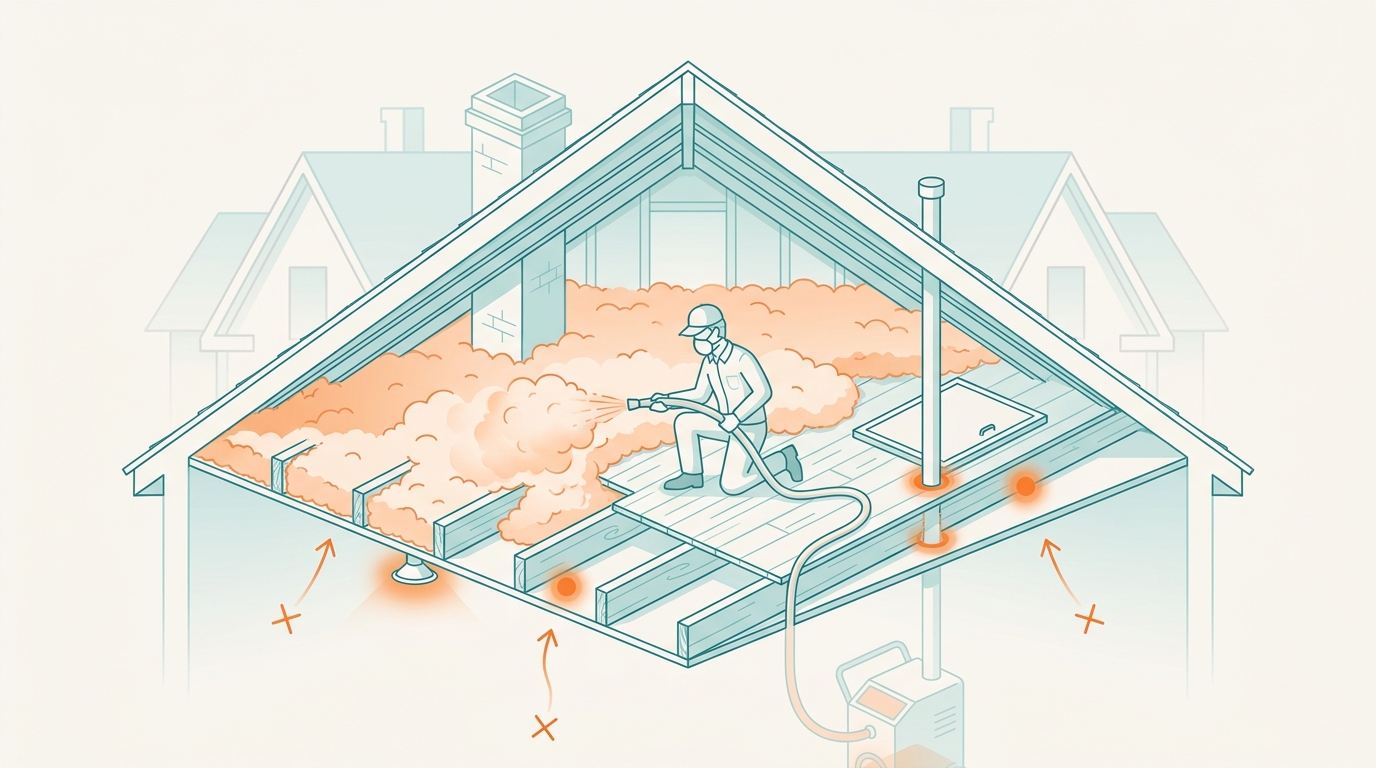
- Take 10 photos in your attic: existing insulation depth, the attic hatch, any can lights, plumbing stacks, bath fan ducts, and the chimney or flue chase.
- Write down three facts:
- Your house age (rough decade is fine).
- Whether you have an unfinished attic, kneewalls, or a finished attic.
- Any known wiring issues (knob-and-tube, old splices, mystery junction boxes).
If you want the full sequence, start with the insulation upgrade hub.
On this page
- Quick answer: what attic work costs in the Boston area in 2026
- Boston-specific gotchas that change scope and price
- Knob-and-tube wiring
- Open stud bays and balloon framing
- Chimneys and old flues
- Ice dams and roof moisture
- Cape and kneewall geometry
- What a good quote includes (copy this into your notes)
- Air sealing scope (must be specific)
- Insulation scope (must name the target and the method)
- Ventilation and moisture checks
- Proof and quality checks
- How to compare two bids without getting steamrolled
- Step 1: force an apples-to-apples table
- Step 2: ask one clarifying question per missing line
- How to estimate payback without lying to yourself
- When DIY is smart (and when it is not)
- Massachusetts / Mass Save rebates and incentives
- Start with the no-cost Home Energy Assessment
- Insulation and air sealing incentives
- The 0% HEAT Loan
- Pre-weatherization barriers can stall the work
- Finding a Boston-area contractor
- Next steps
Quick answer: what attic work costs in the Boston area in 2026
Pricing depends on complexity more than square footage. A 900-square-foot attic with a dozen penetrations and a chimney chase can cost more to seal than a clean 1,400-square-foot one.
$350–$1,200
Attic air sealing
penetrations + chimney chase, varies by access
$1.50–$3.50/sq ft
Blown-in attic insulation
installed, varies by target R-value
$2,000–$5,500
Air seal + insulate (typical)
combined project, single-family
$0
Mass Save assessment
no-cost Home Energy Assessment
Boston attic project costs (2026 planning ranges)
Treat the table below as sanity-check buckets, not promises. Get quotes and compare scope line by line.
| Scope bucket | What it usually includes | When it fits | Planning range (before incentives) |
|---|---|---|---|
| Simple open attic top-up | Minimal air sealing, add blown insulation | Newer homes with few penetrations | $2,000 to $4,500 |
| Typical air seal + blown cellulose | Detailed top-of-house air sealing, baffles, insulation to target depth | Many 1950s to 2000s homes | $4,500 to $9,000 |
| Complex attic / kneewall / remediation | Dense scope, hard access, fixes before insulating | Capes, finished attics, knob-and-tube, moisture or venting problems | $9,000 to $18,000+ |
If a quote sits far outside these ranges, do not panic, ask why. A low quote often means the air sealing is missing or vague. A high quote can be honest if there is remediation, hard access, or a bigger boundary change like kneewalls or the roof deck. For a deeper breakdown of just the sealing side, see the attic air sealing cost guide.
Boston-specific gotchas that change scope and price
This is why location matters. The housing stock here skews old, and old attics come with constraints that a generic national price never captures.
Knob-and-tube wiring
Plenty of pre-1950 Boston homes still have live knob-and-tube in the attic. You cannot bury active knob-and-tube in insulation. The conductors rely on open air to shed heat, so packing cellulose around them is a fire risk, and most reputable contractors will refuse until it is dealt with. Getting a licensed electrician to evaluate and, where needed, replace those circuits can add real cost. It is a safety issue, not a sales tactic, and it is one of the most common reasons a Boston insulation job stalls.
Open stud bays and balloon framing
Triple-deckers and balloon-framed Victorians often have stud cavities that run uninterrupted from the basement to the attic. That open path is a chimney for warm air. If a contractor blows insulation across the attic floor without plugging those bays first, you have insulated the lid and left the flue wide open. Ask specifically how they will block the tops of open stud bays and balloon-framed walls.
Chimneys and old flues
Masonry chimneys and old flue runs are everywhere in this housing stock. Air sealing around them needs non-combustible material (sheet metal and high-temp sealant), not spray foam jammed against the brick. Clearances matter. This is one of the most common spots where a scope goes vague, so make sure the chimney chase shows up as a named line item.
Ice dams and roof moisture
Ice dams form when warm air leaking into the attic melts snow at the ridge, the meltwater runs down to the cold eaves, and refreezes into a dam that backs water up under the shingles. New England winters punish this. Air sealing helps, insulation to a consistent depth helps, and so does keeping soffit-to-ridge ventilation open and making sure bath fans vent outdoors instead of dumping moist air into the attic. A bid that only "adds R-value" and ignores air leakage, venting, and moisture is not complete.
Cape and kneewall geometry
Many homes around here are Capes with sloped ceilings and kneewall attics. The boundary decision drives the price:
- Insulate the roof deck and bring the whole attic inside the envelope (more expensive, often spray foam), or
- Air seal and insulate the attic floor, the kneewalls, and the sloped sections behind them (often cheaper, but detail-heavy).
Two honest bids can be $6,000 apart here because they are solving different boundaries. Neither is wrong; they are just different scopes.
Marcus's rule: seal the plane before you build the pile
In a 1900s attic, the depth of insulation you can see is the part homeowners fixate on. The part that actually moves your bill is the continuity of the air barrier underneath it. Seal the ceiling plane at every top plate, penetration, and chase first. Then build R-value all the way out to the eaves. Insulation blown over unsealed leaks just hides the problem.
What a good quote includes (copy this into your notes)
Ask for these line items in writing. If the contractor will not itemize, keep shopping.
Air sealing scope (must be specific)
- Attic hatch: weatherstripping and insulation on the lid.
- Top plates and major penetrations: plumbing stacks, wiring holes, bath fan housings, chimney chases.
- Recessed lights: either rated covers or a clear safety plan.
- Duct and vent penetrations sealed at the ceiling plane.
Insulation scope (must name the target and the method)
- Type (blown cellulose, blown fiberglass, batts, spray foam).
- Target R-value or final depth.
- Baffles at soffits to keep ventilation paths clear (where applicable).
- Coverage details for eaves and tight corners.
Ventilation and moisture checks
- Confirmation that bath fans vent outdoors (not into the attic).
- Any blocked soffit or ridge vents noted, with a plan.
- A plan for attic access and protecting recessed fixtures.
Proof and quality checks
- Photos before and after, or a walkthrough.
- If they offer it, a blower door test is a strong quality check. It puts a number on your leakage before and after, so the air sealing is verified rather than assumed. If they do not offer one, you can still get good work, but ask how they confirm the sealing is complete.
For a homeowner-friendly DIY checklist (even if you hire out the rest), read the air sealing weekend checklist.
How to compare two bids without getting steamrolled
Do this on one sheet of paper (or a notes app).
Step 1: force an apples-to-apples table
Fill this in for each contractor.
| Item | Bid A | Bid B | Notes |
|---|---|---|---|
| Air sealing: attic hatch | Yes / no | Yes / no | Weatherstrip + insulated lid? |
| Air sealing: top plates + penetrations | Light / detailed | Light / detailed | What gets sealed, with what material? |
| Recessed lights | Covered / excluded | Covered / excluded | Safety plan matters |
| Bath fans | Verified / ignored | Verified / ignored | Vent outdoors |
| Insulation type | Cellulose vs fiberglass vs foam | ||
| Target depth / R-value | Final number, not "add some" | ||
| Baffles at soffits | Yes / no | Yes / no | Prevent blocked vents |
| Knee walls / slopes | Included / excluded | Included / excluded | Major price driver |
| Cleanup and disposal | Included / extra | Included / extra | Bagging and protection |
| Warranty | Settling, gaps, callbacks |
If you cannot fill the table because the bid is vague, you already learned something.
Step 2: ask one clarifying question per missing line
Do not ask "Why are you expensive?" Ask something concrete:
- "What air sealing work is included at the chimney chase and top plates?"
- "What final R-value are you targeting?"
- "Are you installing baffles at soffits so vents stay open?"
How to estimate payback without lying to yourself
Attic work can be worth it for comfort even when the payback is slow. The key is running the numbers honestly.
Use the attic insulation calculator with a conservative savings range, then check what happens if savings are lower than hoped.
Example (illustrative):
- Heating + cooling spend: $1,800 per year (from bills or the Bill Breakdown tool)
- Expected reduction in heating and cooling energy: 10% to 20%
- Savings: $180 to $360 per year
If your quote is $6,000:
- Payback range: about 17 to 33 years
That sounds long. But comfort improves immediately, the upstairs stops baking in July, and a tighter envelope can shrink the size of the next heating and cooling system you buy. The payback math also looks very different once Mass Save incentives knock down the upfront cost (more on that below). To run your own numbers, try the attic insulation calculator, and if you are planning HVAC replacement soon, read insulation before a heat pump.
When DIY is smart (and when it is not)
DIY can be a good move for low-risk tasks:
- weatherstripping the attic hatch,
- sealing small penetrations away from chimneys,
- fixing obvious disconnected bath fan ducts (if safe and accessible),
- adding a basic attic hatch cover.
DIY is not a good move when safety is uncertain:
- knob-and-tube wiring,
- old chimney and flue clearances,
- spray foam without experience,
- any work that risks blocking vents or trapping moisture.
If you want a cautious plan you can follow in a weekend, start with Air sealing weekend checklist.
Massachusetts / Mass Save rebates and incentives
This is the part that changes the whole calculation for a Boston homeowner. Massachusetts runs a statewide, utility-ratepayer-funded efficiency program called Mass Save, and insulation and air sealing are among the things it covers most generously. Rules and amounts change, so treat the specifics below as a starting point and confirm current offers at masssave.com before you sign anything.
Start with the no-cost Home Energy Assessment
Almost everything flows from the Mass Save Home Energy Assessment. It is offered at no cost, in person or virtually, and a trained assessor walks your house, looks in the attic, and builds a report on where you are losing energy. That visit is what unlocks the rebates and identifies any barriers. Book it before you pay a contractor out of pocket for air sealing, because some of that work is frequently bundled into the assessment process.
Insulation and air sealing incentives
Through Mass Save, many homeowners qualify for 75 to 100 percent off approved insulation and for targeted air sealing at little or no cost, subject to eligibility and what the assessment finds. Income-eligible households may qualify for up to 100 percent off approved insulation and additional weatherization at no cost. Because the incentive can cover a large share of approved costs, a project that would otherwise run several thousand dollars can land far lower. The exact percentage depends on your situation and the current program terms, so confirm the details for your home.
The 0% HEAT Loan
For the part you do pay, Massachusetts offers the Mass Save HEAT Loan: 0% financing up to $25,000 for qualifying energy-efficiency improvements, including insulation and air sealing, contingent on loan approval from a participating lender. It lets you spread the out-of-pocket cost interest-free rather than paying it all at once.
Pre-weatherization barriers can stall the work
The catch every older Boston home runs into: insulation work cannot proceed over certain hazards. Knob-and-tube wiring, mold, asbestos, and inadequate ventilation are pre-weatherization barriers that typically have to be remediated first. The assessment will flag them. Some barrier fixes have their own assistance, but plan for the possibility that an electrician or remediation step comes before any insulation goes in.
Verify before you assume
Mass Save incentive percentages, the HEAT Loan cap, and eligibility rules are updated periodically. The figures here reflect what Mass Save published as of mid-2026. Confirm the current numbers for your address and fuel type at masssave.com, and have your contractor confirm the work qualifies before it starts.
For broader official guidance, ENERGY STAR seal and insulate and DOE insulation basics are useful neutral references.
Finding a Boston-area contractor
Once you know your scope, you need installers who actually work in this housing stock. Browse vetted insulation contractors in Boston, MA, widen the search to insulation contractors across Massachusetts, or start from the national insulation contractors directory. Mass Save also maintains its own list of participating contractors, which is worth cross-checking if you want the incentives applied.
Sources & further reading
- Home Energy Assessments — Mass Save
- Insulation & Air Sealing rebates — Mass Save
- HEAT Loan 0% financing — Mass Save
- Seal and Insulate with ENERGY STAR — ENERGY STAR
- Insulation — U.S. Department of Energy
Next steps
- Book the no-cost Mass Save Home Energy Assessment so you know your incentives before you collect bids.
- Open the attic insulation calculator and sanity-check payback with your bills.
- Read the insulation upgrade hub for the full sequence and related fixes.
- Line up quotes from insulation contractors in Boston, MA and keep the comparison table above so each contractor fills the same gaps.
Frequently asked questions
How much does attic air sealing cost in Boston?+
Attic air sealing alone runs $350–$1,200 for a typical single-family attic, set by penetration count and access difficulty more than floor area. Cost drivers are can lights, plumbing and wiring chases, the masonry chimney chase (which needs sheet metal and high-temp sealant, not foam), and redirecting bath fans outdoors. A 1900s attic with open stud bays or balloon framing runs higher because those cavities must be capped first. Mass Save frequently bundles targeted air sealing into its no-cost Home Energy Assessment, so book that before paying out of pocket.
How much does attic insulation cost in Boston?+
Blown-in insulation runs $1,500–$4,000 installed for most Boston single-family attics, and a combined air-seal-plus-insulate project lands around $2,000–$5,500. Complex jobs with kneewalls, sloped Cape ceilings, knob-and-tube remediation, or moisture problems run $9,000–$18,000 and up. The number of penetrations to seal and how easy the attic is to work in drive price more than square footage, and Mass Save often covers a large portion of approved insulation subject to eligibility.
What does blown-in insulation cost per square foot?+
Blown-in attic insulation costs $1.50–$3.50 per square foot installed, rising toward the top of the range as you target R-49 to R-60 because deeper coverage means more material. Blown cellulose and blown fiberglass sit in the same range; cellulose is denser and slows air movement slightly better, fiberglass is lighter and absorbs less moisture. Treat the per-square-foot figure as valid only when air sealing is priced as a separate line, since insulation blown over unsealed leaks underperforms.
How much does whole-house air sealing cost?+
Whole-house air sealing covering the attic plane, the basement or crawlspace rim joist, and major penetrations runs $1,000–$3,500, with the attic the highest-value zone. A blower door test that measures leakage and verifies the work adds $150–$400 and gives you a before-and-after number rather than an assumption. Mass Save often covers a large portion of this subject to eligibility, so get the no-cost Home Energy Assessment before paying out of pocket.
Should I air seal or insulate first?+
Air seal first, then insulate, because insulation slows heat conduction but barely stops air moving through and around it. Sealing the attic floor at top plates, penetrations, and the chimney chase shuts down the stack effect that pushes heated air out the top of the house all winter. In triple-deckers and balloon-framed Victorians the open stud bays running basement-to-attic must be capped, or you have insulated the lid and left the flue open. A quote that names an R-value but no air sealing scope is skipping the highest-value part of the job.
Does Mass Save pay for attic insulation and air sealing?+
Mass Save often covers a large portion through its no-cost Home Energy Assessment: many homeowners qualify for 75–100% off approved insulation and targeted air sealing at little or no cost, subject to eligibility and what the assessment finds. Income-eligible households may reach 100% off approved insulation plus additional weatherization at no cost. A 0% HEAT Loan covers what you do pay, up to $25,000 for qualifying improvements, contingent on lender approval. Verify current offers at masssave.com, since percentages, the loan cap, and rules change.
What R-value should a Boston attic have?+
Boston attics are targeted at R-49 to R-60, which translates to roughly 16–22 inches of blown insulation depending on material. If your floor joists are still visible above the existing insulation, you are well under that and under-insulated. Insist the quote name a final R-value or finished depth, plus full coverage to the eaves, rather than a vague add some more.
Can I insulate an attic with knob-and-tube wiring?+
Not until the wiring is addressed: active knob-and-tube relies on open air to shed heat, so burying it in insulation is a fire risk and most reputable contractors refuse the job. It is common in pre-1950 Boston homes and stalls work until a licensed electrician evaluates and, where needed, replaces the circuits, which adds real cost. Knob-and-tube, mold, asbestos, and inadequate ventilation are pre-weatherization barriers Mass Save requires remediated before insulation goes in, and the assessment will flag them.
Is blown cellulose or blown fiberglass better for an old attic?+
Both perform in a 1900s Boston attic at the same $1.50–$3.50 per square foot. Dense-pack and blown cellulose resist air movement through the layer slightly better and conform around odd framing; blown fiberglass is lighter and absorbs less moisture. Install quality and the air sealing underneath move your bill far more than which material is in the bag. Pick the contractor who seals the ceiling plane first and hits the R-49 to R-60 target all the way into the eaves and corners.
Will adding insulation stop ice dams?+
Insulation alone rarely stops ice dams, which form when attic heat melts ridge snow that refreezes at the cold eaves and backs water under the shingles. The reliable fix is three parts together: air seal the warm-air leaks, insulate to a consistent R-49 to R-60 depth all the way to the eaves, and keep soffit-to-ridge ventilation open with baffles while confirming bath fans vent outdoors, not into the attic. A quote that only adds R-value and ignores air leakage and venting will not hold.
Try the companion tool
This post links to an interactive tool built for this topic. Open it to see numbers tailored to your home.
Open the toolGet practical energy tips
Join homeowners getting practical tips on cutting energy bills and staying comfortable.
Practical tips only. Unsubscribe anytime.
Read this next
Related guides selected by topic overlap and upgrade path.

Attic air sealing cost in 2026: $350–$1,200 for a typical pro job, $50–$300 for DIY materials. What's included, why you seal before insulating, and how to compare quotes.
Attic insulation costs about $1,500 to $3,500 for a typical home, or $1.50 to $4 per sq ft. See 2026 prices by material, attic size, and tax credit.

Compare attic insulation, air sealing, and a heat pump using your rates and comfort goals so you spend on what moves the needle.

Blown-in insulation costs $1.50 to $3.50 per sq ft installed in 2026 ($0.90 to $1.80 DIY). Cellulose vs fiberglass by R-value, attic vs walls, bags needed.