Blog
Attic Insulation ROI (2026): 2–8 Year Payback, ~15% Bill Cut
Attic insulation typically pays back in 2–8 years and trims heating and cooling bills ~15%. Real 2026 install costs, R-value targets, and a worked payback example.
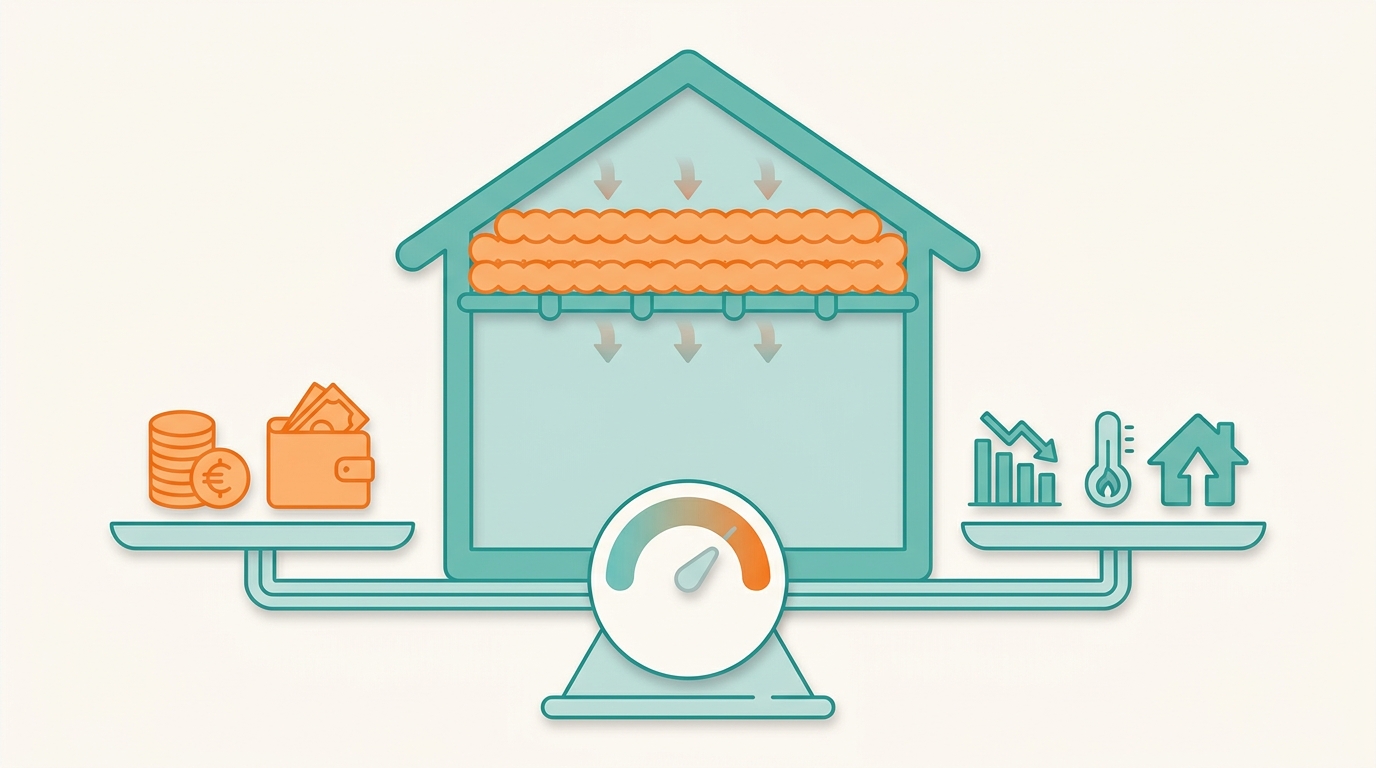
If you are weighing attic insulation, here is the straight 2026 answer: a typical top-up costs about $1,500 to $3,500 installed, cuts heating and cooling bills by roughly 15%, and pays for itself in about 2 to 8 years. The payback swings on three things: your climate, your energy prices, and how thin your attic is to start. The thinner the attic and the harsher the weather, the faster the math works.
The reason "attic insulation ROI" is so hard to pin to one number is that it is really several returns stacked together: the bill savings you can model, the comfort you can feel but not invoice, and a small resale bump at sale time. This guide separates those out, puts current cost and savings data behind each, and walks a full payback example. It is also blunt about the homes where insulation is the wrong place to spend. Then you can run your own attic in the calculator.
2–8 yrs
Typical payback
4–6 years for most under-insulated attics
~15%
Heating & cooling savings
Air sealing + insulation, per EPA/ENERGY STAR
$1,500–$3,500
Typical install cost
Blown-in, 1,000–1,500 sq ft attic
$180–$400
Annual bill savings
Most homes; higher with expensive fuel
Before you trust any contractor's payback claim, run your own numbers. Our Attic Insulation ROI tool takes your attic size, climate zone, current R-value, and energy rates and returns a payback range you can defend. Use it to pressure-test the "pays for itself in two years" line every insulation salesperson uses.
On this page
- How attic insulation ROI actually works
- Typical payback ranges, and what swings them
- What the install actually costs in 2026
- Why air sealing first changes the ROI
- R-value targets by climate zone
- When the ROI is weak (the honest part)
- A worked payback example
- Does it add resale value?
- A real homeowner's before-and-after
- Tax credits and rebates in 2026
- Frequently asked questions
- Next steps
How attic insulation ROI actually works
ROI on an attic upgrade is not one figure. It is the sum of three returns, and only one of them shows up on a calculator.
The first is bill savings, the part you can model. Insulation slows heat moving through your ceiling, so your furnace and AC run less. The EPA and ENERGY STAR put the combined savings from air sealing plus insulating at about 15% of heating and cooling costs, or roughly 11% of a total energy bill. For a typical home that lands around $180 to $400 a year, more if you heat with expensive fuel like propane or electric resistance, less if you have cheap natural gas and a mild climate.
The second is comfort, which is real money you cannot put on a spreadsheet. A well-insulated, sealed attic kills the cold upstairs bedroom in January and the bake-oven second floor in July. People who do this project rarely talk about the dollars first. They talk about the rooms that finally hold temperature.
The third is resale. Remodeling's Cost vs. Value report has repeatedly placed attic insulation near the top for cost recouped, in some years above 100% of what it cost to install. Treat that as a tailwind, not the main case. The bill and comfort returns are what justify the project; the resale bump is a bonus at closing.
Payback is simply install cost divided by annual savings. Spend $2,500, save $350 a year, and you are looking at roughly seven years to break even, then free money after that against an insulation life measured in decades.
Typical payback ranges, and what swings them
Across the homes and quotes we see, attic insulation payback clusters between 2 and 8 years, with 4 to 6 years being the honest middle. Where you land inside that band depends on a few levers.
| Your situation | Likely payback | Why |
|---|---|---|
| Thin attic (R-11 to R-19), cold or hot climate, expensive energy | 2 to 4 years | Big R-value gap to close, high runtime, costly fuel |
| Under-insulated attic, moderate climate, average rates | 4 to 6 years | Solid savings, nothing extreme either way |
| Decent attic (R-30+), mild climate, cheap gas | 8 to 12+ years | Small gap to target, low bills to begin with |
| Already at target R-value for your zone | Rarely pays back | Diminishing returns; spend elsewhere |
The single biggest swing factor is how far your attic sits below target. Going from almost nothing to a full blanket is a large jump in savings. Going from already-good to slightly-better barely moves the needle, and that is where over-eager upgraders waste money on diminishing returns.
What the install actually costs in 2026
Your payback math is only as good as your cost input, so anchor it in current numbers rather than a salesperson's round figure.
Blown-in insulation, the most common attic top-up, runs about $1.00 to $2.80 per square foot installed. Home Depot's own service pricing puts the range at $1.50 to $2.45 per square foot with an average near $1.80. Batts and rolls land a bit lower per foot but cost more to reach a high R-value because you stack layers. Spray foam is the priciest at $1.50 to $5.00 per square foot and is usually overkill for a vented attic floor.
Here is what that means by attic size for a straightforward blown-in job.
| Attic size | Blown-in install (≈$1.00–$2.80/sq ft) | Add air sealing first | Realistic project total |
|---|---|---|---|
| 600 sq ft | $600 – $1,680 | + $350 – $1,000 | $950 – $2,680 |
| 1,000 sq ft | $1,000 – $2,800 | + $400 – $1,500 | $1,400 – $4,300 |
| 1,500 sq ft | $1,500 – $4,200 | + $500 – $2,000 | $2,000 – $6,200 |
| 2,000 sq ft | $2,000 – $5,600 | + $700 – $3,000 | $2,700 – $8,600 |
Assumes a vented attic with normal access, topping up to your climate-zone target. The U.S. average attic is 1,600 to 1,800 sq ft. Air sealing is listed separately because it should be a line item, not buried in the blown-in price. Sources: Home Depot, Angi, and ENERGY STAR 2026 cost data.
For deeper cost detail by material and method, see attic insulation cost and blown-in insulation cost per sq ft. If your old insulation is contaminated or in the way, factor in attic insulation removal cost before you run the payback.
Why air sealing first changes the ROI
This is the part most ROI guides skip, and it is the most important. Insulation slows heat conduction. It does almost nothing about air leaks. A thick blanket over an unsealed ceiling is a thicker coat worn with the zipper open.
The high-leak spots are predictable: the attic hatch or pull-down stairs, recessed can lights, top plates above interior walls, plumbing and chimney chases, and the bath fan boot. Sealing those runs $350 to $3,000 depending on attic size and how much is open. That is why EPA and ENERGY STAR pair the two when they quote about 15% savings. The 15% is for sealing plus insulating, not insulation alone.
Sequence matters too. Air seal while the attic is open and before you blow in new material, or you bury the leaks under a foot of cellulose and make them far harder to reach later. The cheapest version of a strong-ROI project is targeted: pull insulation back from the penetrations, seal them, then blow new insulation over everything.
Field note: the sealing did the work, not the depth
On a 1990s split-level I diagnosed in a mixed climate, the homeowner had a quote to blow the attic from R-19 up to R-49 and assumed the extra depth would fix the cold back bedroom. A blower-door test told a different story. The room was bleeding air through an open wiring chase and the attic hatch, not losing it through the ceiling. We sealed the chase, weatherstripped the hatch, and topped the insulation to R-38, not R-49. The comfort complaint was gone, and the bill drop was bigger than the extra ten R-values would have bought. Sealing is the lever; depth is the follow-through.
If you want to know where your house is actually leaking before you spend, a blower door test or a full home energy audit finds the leaks first. The detail on the sealing job itself is in attic air sealing cost.
R-value targets by climate zone
The ROI on insulation comes from closing the gap between what you have and what your climate needs. ENERGY STAR's recommended levels for an attic that starts uninsulated or shallow:
| Climate zone | Recommended attic R-value | Roughly where |
|---|---|---|
| Zone 1 (warmest) | R-30 | Southern FL, HI |
| Zones 2–3 | R-49 | Gulf Coast, much of the South and Southwest |
| Zones 4–8 (coldest) | R-60 | Most of the Midwest, Northeast, mountains |
Many older attics sit far below this. Homes built in the 1970s often have R-11 to R-19, 1990s homes around R-38, and only post-2011 code pushed R-49 and above. If you measure six to eight inches of settled fiberglass up there, you are likely at R-19 or less, which is exactly the gap where insulation pays back fast. If you measure 16 to 18 inches of even, fluffy material, you are probably near target, and adding more is the slow-payback move.
When the ROI is weak (the honest part)
Insulation is not always the answer. The payback stretches past 10 years, or never lands, when:
- Your attic already meets the recommended R-value for your zone. Going from R-49 to R-60 is real diminishing returns.
- You live somewhere mild with cheap energy. Small heating and cooling loads mean small savings to capture.
- The real problem is the mechanical system, not the envelope. Leaky ducts in the attic, an oversized furnace, or a failing AC will not be fixed by ceiling insulation. Diagnose first.
- You are about to remodel in a way that opens the ceilings. Wait and do it once.
If you are sorting upgrade order across the whole house, how to plan home energy upgrades without wasting money lays out the sequence that avoids paying for the same access twice.
The mistake that wrecks the payback
The fastest way to ruin attic insulation ROI is to skip the air sealing to save a few hundred dollars. A cheap insulation-only quote looks great on the spreadsheet and disappoints in the house, because the drafts are still there. The second-fastest way is over-insulating an attic that already meets code, chasing R-values your climate does not need. Match the spend to the gap.
A worked payback example
Numbers make this concrete. Take a 1,200 sq ft attic on a single-story home in a cold-ish climate, currently at about R-13, heating with natural gas and cooling with central AC.
- Current state: thin, uneven insulation; a leaky attic hatch and unsealed can lights.
- The work: air seal the hatch, can lights, and top plates ($800), then blow cellulose to R-49 ($1,800). Project total about $2,600.
- Annual heating and cooling spend before: roughly $1,900.
- Savings at 15%: about $285 a year.
- Simple payback: $2,600 / $285 = about 9 years on paper.
Now look at why that headline number understates it. The 15% figure is a national average. A home starting at R-13 in a cold climate often beats it because the R-value gap is so large, so real savings may land closer to $350 to $450, pulling payback to 6 to 7 years. The comfort fix, a back bedroom that finally holds heat, lands on day one and never shows in the math. And the insulation will still be working in 30 years. That is the case for attic insulation: a single-digit payback, comfort you feel immediately, and decades of free savings once you break even.
Attic insulation ROI by scenario (years to payback)
big R-value gap, high runtime
the common case
diminishing returns
comfort only, weak dollar case
Does it add resale value?
Some, and it is more reliable than most home improvements. Remodeling's annual Cost vs. Value report has placed attic insulation among the strongest projects for cost recouped, in certain years above 100% of the install cost, which is rare. Practically, the value is indirect: a buyer touring a comfortable house with documented low utility bills makes a better offer than one standing in a drafty upstairs. Keep the receipts and a note of the R-value you reached; it is a clean line on a disclosure and a real talking point at sale.
A real homeowner's before-and-after
Spreadsheets are one thing; a homeowner tracking actual bills after the work is another. This homeowner added attic insulation and then measured the difference across seasons. That kind of before-and-after is worth more than any contractor's projection.
Tax credits and rebates in 2026
Get this right, because the rules changed. The federal 25C Energy Efficient Home Improvement Credit, which returned 30% of insulation and air-sealing material costs up to $1,200 a year, ended for any property placed in service after December 31, 2025. The 2025 budget law moved up that end date. So insulation you install in 2026 does not qualify for the federal credit, and your payback math should not lean on it.
What still exists: many states and utilities run their own insulation and air-sealing rebates, and some Home Energy Rebate programs continue. Those can knock real money off the install and shorten the payback, so check your local utility and state energy office before you sign. Just do not assume the old federal 30% is still there. It is not.
Frequently asked questions
Is attic insulation worth it? Usually yes if your attic is under-insulated. A top-up costs about $1,500 to $3,500 installed, saves roughly $180 to $400 a year, and pays back in 2 to 8 years. It is weak only if you already meet your climate's R-value target or energy is cheap.
What is the payback period? Most projects pay back in 2 to 8 years, typically 4 to 6. A thin attic in a harsh climate with expensive energy can hit 2 to 3 years; an already-decent attic in a mild climate may take 10-plus.
How much does it save per year? Air sealing plus insulation saves about 15% on heating and cooling per EPA/ENERGY STAR, roughly $180 to $400 for most homes, more with expensive fuel.
Should I air seal first? Yes, always. Sealing the hatch, can lights, top plates, and chases is what stops drafts and is the biggest lever on the return. Insulation does little against air leaks.
Does it qualify for a tax credit in 2026? No. The federal 25C credit ended for work placed in service after December 31, 2025. Check state and utility rebates instead.
Next steps
- Measure what you have. Six to eight inches of settled insulation is roughly R-19 or less, which is prime payback territory. Sixteen-plus even inches means you are near target.
- Run your own numbers in the Attic Insulation ROI tool with your attic size, climate zone, current R-value, and energy rates. Try a conservative and an optimistic case.
- Sequence it right: find the leaks with a home energy audit, air seal, then insulate to your zone's target. Start at the insulation upgrades hub to plan the whole job.
Sources & further reading
- Seal and Insulate with ENERGY STAR — ENERGY STAR / EPA
- Recommended Home Insulation R-Values — ENERGY STAR / EPA
- Insulation — U.S. Department of Energy
- Energy Efficient Home Improvement Credit (25C) — IRS
- FAQs for OBBB modification of sections 25C, 25D and others — IRS
- Attic Insulation Installation Cost Guide — The Home Depot
- What is the ROI of Attic Insulation? — Insulation Institute (NAIMA)
Frequently asked questions
Is attic insulation worth it?+
Usually yes if your attic is under-insulated. Topping up a thin attic costs about $1,500 to $3,500 installed, saves roughly $180 to $400 a year on heating and cooling, and pays back in about 2 to 8 years. It is weak ROI only when you already sit at the recommended R-value for your climate, energy is cheap, or your climate is mild.
What is the payback period for attic insulation?+
Most attic insulation projects pay back in 2 to 8 years, with 4 to 6 years being typical. A shallow attic in a cold or hot climate with expensive energy can pay back in 2 to 3 years. An already-decent attic in a mild climate may take 10-plus years, which is the point at which the comfort gain matters more than the math.
How much does attic insulation save per year?+
Adding insulation plus air sealing saves an average of about 15% on heating and cooling costs, per EPA/ENERGY STAR, which works out to roughly $180 to $400 a year for a typical home. The savings are largest when you are starting from a thin or uneven attic and you seal air leaks at the same time.
Does attic insulation actually save money?+
Yes, when the attic starts under-insulated. The DOE and EPA put combined air-sealing-plus-insulation savings near 15% of heating and cooling costs. The catch is diminishing returns: going from R-11 to R-38 saves real money, while going from R-49 to R-60 barely moves the bill.
How much does it cost to add attic insulation in 2026?+
Blown-in insulation runs about $1.00 to $2.80 per square foot installed, so a typical 1,000 to 1,500 sq ft attic is roughly $1,500 to $3,500. Home Depot pegs the average at about $1.80 per square foot. Add $350 to $3,000 for air sealing, which should happen first.
What R-value should my attic be?+
ENERGY STAR recommends R-30 for the warmest climate (zone 1), R-49 for zones 2-3, and R-60 for most of zones 4 through 8. An uninsulated or shallow attic getting topped up to these targets is where the ROI lives. Many older attics sit at R-11 to R-19, far below code.
Should I air seal before adding insulation?+
Yes, always. Air sealing the attic hatch, top plates, recessed lights, and chases costs $350 to $3,000 and is what actually stops drafts. Insulation slows heat conduction but does little against air leaks. Sealing first is the single biggest lever on attic insulation ROI.
Does attic insulation qualify for a tax credit in 2026?+
No. The federal 25C Energy Efficient Home Improvement Credit, which gave 30% back on insulation and air-sealing materials up to $1,200 a year, ended for any work placed in service after December 31, 2025. Insulation installed in 2026 no longer qualifies federally, though some state and utility rebates continue.
Does attic insulation add resale value?+
Modestly, yes. Remodeling's Cost vs. Value report has shown fiberglass attic insulation among the highest-recouping projects, historically over 100% of cost in some years. More practically, a well-insulated, comfortable home with lower utility bills shows better and appraises better than a drafty one.
When is attic insulation not worth it?+
When your attic already meets the recommended R-value for your climate, when you live somewhere mild with cheap energy, or when the real problem is leaky ducts or failing HVAC rather than the ceiling plane. In those cases the payback stretches past 10 years and the money is better spent elsewhere.
Is attic insulation worth it if I'm replacing my HVAC soon?+
Often yes, and you should do the insulation first. Air sealing and insulating reduce the heating and cooling load, which lets you size the new system smaller and cheaper. Insulate, then size the HVAC to the improved house, not the old leaky one.
Try the companion tool
This post links to an interactive tool built for this topic. Open it to see numbers tailored to your home.
Open the toolGet practical energy tips
Join homeowners getting practical tips on cutting energy bills and staying comfortable.
Practical tips only. Unsubscribe anytime.
Read this next
Related guides selected by topic overlap and upgrade path.
Attic air sealing cost in 2026: $350–$1,200 for a typical pro job, $50–$300 for DIY materials. What's included, why you seal before insulating, and how to compare quotes.

Attic insulation costs about $1,500 to $3,500 for a typical home, or $1.50 to $4 per sq ft. See 2026 prices by material, attic size, and tax credit.

Blown-in insulation costs $1.50 to $3.50 per sq ft installed in 2026 ($0.90 to $1.80 DIY). Cellulose vs fiberglass by R-value, attic vs walls, bags needed.
Attic insulation removal costs $1–$2 per sq ft, or about $1,600–$3,600 for a typical attic. Rodents, mold, or asbestos push it far higher. Here's the honest 2026 breakdown.