Blog
Heat Pump Installation Cost (2026): $6,000–$18,000 Installed
Heat pump installation costs $6,000 to $18,000 in 2026, about $12,000 to $14,000 for a typical ducted home. See costs by size and type, and how to compare bids.
If you are searching "heat pump installation cost," here is the short answer: a whole-home air-source heat pump runs $6,000 to $18,000 installed in 2026, and a typical ducted system lands near $12,000 to $14,000. A single-zone ductless mini-split is $3,500 to $6,500. Cold-climate and geothermal systems can reach $20,000 to $35,000.
That range is wide because "installation" can mean a one-day swap onto healthy ducts or a small construction project with electrical work, duct repairs, and permits. The equipment itself is only about 40% of the bill. This guide breaks the price down by home size, system type, and line item, explains why the big published averages disagree with each other, and shows you how to compare bids so the cheapest quote does not turn out to be the one missing half the scope.
$6,000–$18,000
Whole-home installed
Air-source, 2026; typical ducted job $12,000–$14,000
$3,500–$6,500
Single-zone mini-split
One outdoor unit, one indoor head, no ducts
$3,000–$5,000
Per ton installed
Standard ducted air-source, equipment plus labor
$0
Federal credit in 2026
25C ended Dec 31, 2025; use state and utility rebates
Before you collect a single bid, run your own numbers. Our Heat Pump vs Furnace Calculator takes your square footage, climate, and energy rates and shows what a heat pump would cost to buy and run against your current system. Ten minutes there tells you whether a $14,000 quote is reasonable for your house or padded.
On this page
Heat pump installation cost by home size
Size is the first lever. Contractors size heat pumps in tons (one ton moves 12,000 BTU per hour), and bigger homes need more tons. The table below shows realistic 2026 installed ranges for a standard ducted air-source system, assuming a reasonably straightforward replacement.
| Home size | Typical capacity | Installed cost (2026) |
|---|---|---|
| 1,000 sq ft | 1.5 – 2 tons | $6,000 – $9,000 |
| 1,500 sq ft | 2.5 – 3 tons | $7,000 – $12,000 |
| 2,000 sq ft | 3 – 3.5 tons | $9,000 – $15,000 |
| 2,500 sq ft | 3.5 – 4 tons | $10,000 – $17,000 |
| 3,000+ sq ft | 4 – 5 tons | $12,000 – $20,000 |
Assumes existing ductwork in usable condition and no major electrical surprises. Cold-climate equipment, duct repairs, or a panel upgrade can add $3,000 to $6,000 to any row. Cross-checked against HomeGuide and Homewyse 2026 cost data.
Two cautions on this table. First, square footage is a starting point, not a sizing method; a leaky 1,800 sq ft house can need more capacity than a tight 2,400 sq ft one. That is what a Manual J load calculation is for, and it is the single line item you should never let a contractor skip. Second, the per-ton math ($3,000 to $5,000 installed per ton) breaks down at the extremes: small jobs carry fixed costs that push the per-ton figure up, and premium variable-speed equipment pushes it up from the other direction.
Cost by system type
The kind of heat pump matters more than the brand on the badge. Here is where each type landed in 2026:
Heat pump installed cost by system type (2026)
one room or zone, no ducts
the standard swap onto existing ducts
holds capacity below 0F
whole home without ducts
buried loop field, decades of life
A few notes on picking between them. Ducted air-source is the default if your ducts are in decent shape; it replaces both the furnace and the AC with one system. A single-zone mini-split is the right tool for an addition, a garage conversion, or one room that never behaves, but covering a whole house with four or five heads usually costs as much as ducted or more. Cold-climate models use inverter-driven compressors that keep producing heat well below zero; if you live north of roughly the Ohio River and want the heat pump as your primary heat, that is the tier to price. And a dual-fuel setup that keeps a gas furnace as backup can trim the upfront cost in cold regions because the heat pump no longer has to cover the coldest ten days of the year.
What is actually in the quote
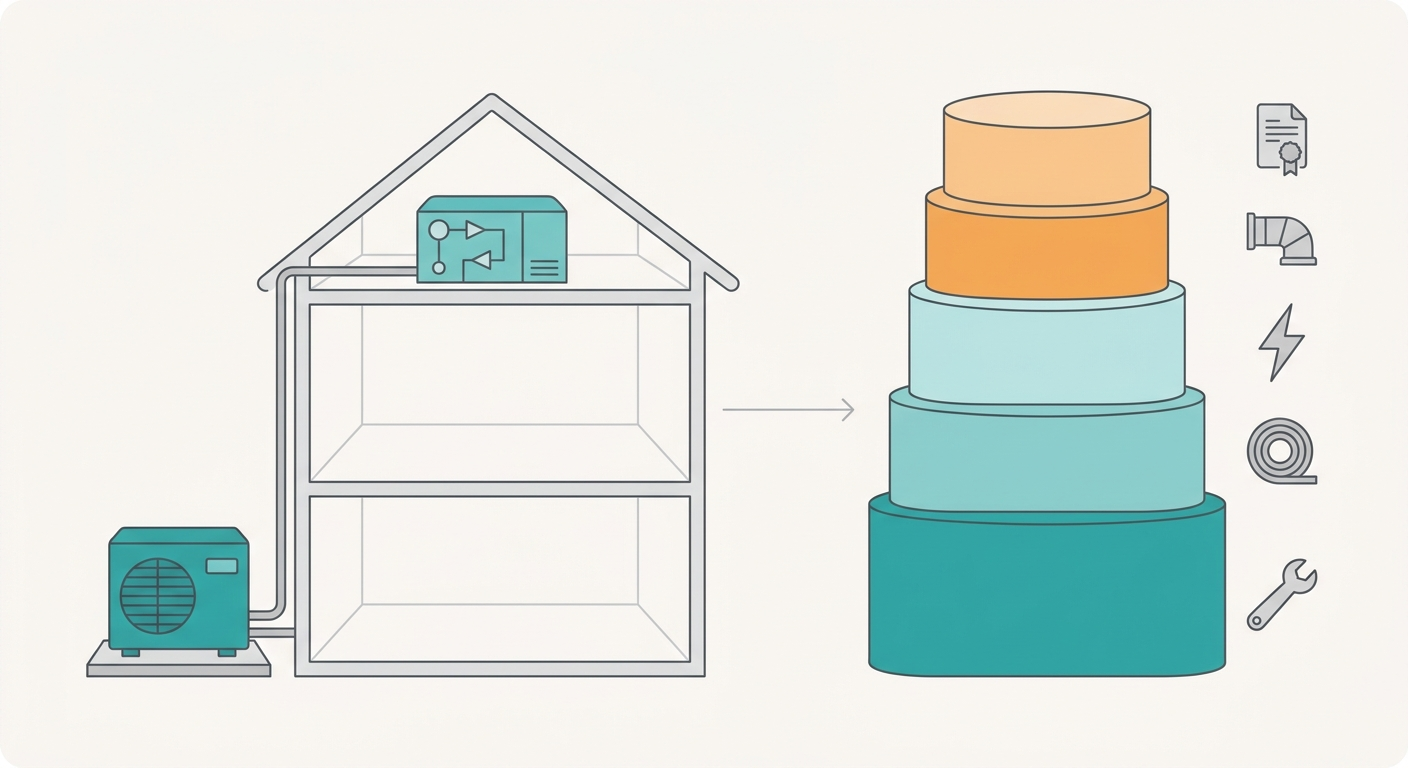
Every heat pump bid is a stack of line items, whether the contractor shows them to you or not. Here is the stack for a typical ducted job:
| Line item | 2026 range | When it applies |
|---|---|---|
| Equipment (condenser + air handler) | $3,000 – $8,000 | Always; varies with tonnage and efficiency tier |
| Labor | $1,800 – $5,000 | Always; roughly 12–20 hours at $100–$250/hr |
| Refrigerant line set | $15 – $25 per foot | New installs, or when the old set fails inspection |
| Electrical work | $500 – $4,000 | New circuit or disconnect on the low end, panel upgrade on the high end |
| Duct sealing or repairs | $1,500 – $6,000 | Leaky, undersized, or damaged ducts |
| Permits and inspection | $50 – $300 | Almost always required; who pulls them should be in writing |
| Old unit removal and disposal | $200 – $500 | Replacements |
| Pad, thermostat, small materials | $300 – $900 | Most jobs |
Labor deserves a comment because it surprises people: it is usually 40% to 60% of the total. A clean condenser-and-air-handler swap sits at the low end. New line set routing, duct modifications, or coordination with an electrician push it up fast.
Why 2026 quotes look higher than your neighbor's 2024 install
The industry switched refrigerants. As of January 2025, new residential systems ship with lower-global-warming refrigerants like R-454B instead of R-410A, and manufacturers priced the changeover in: early estimates put the equipment premium around 10% to 15%, and some homeowners re-quoting the same system saw jumps of several thousand dollars. If your neighbor paid $11,000 in 2024 and your nearly identical quote says $13,500, the refrigerant transition, not contractor greed, is likely most of the gap.
Why the big published averages disagree
Search this topic and you will find numbers that seem to describe different planets. They mostly measure different jobs, and knowing which job each number describes tells you where your own project sits.
- HomeGuide says $10,000 to $25,000 installed. That is a marketplace average across all scopes, including complex installs, skewing toward full projects.
- Rewiring America reports a median of $19,500 for a 1,500 to 2,500 sq ft home ($17,000 to $23,000 for the middle of the pack). That comes from real completed-project data, heavy on the Northeast, where cold-climate equipment, high labor rates, and whole-home electrification scopes dominate.
- Homewyse prices a basic 2.5-ton ducted swap at $6,638 to $7,837, but its own fine print excludes permits, sales tax, and a 13% to 22% general-contractor markup, and it assumes nothing is wrong with your ducts or panel.
- Carrier, a manufacturer, publishes $6,000 to $25,000, wide enough to cover nearly everyone.
Reading across them: the floor (~$6,000 to $8,000) is a like-for-like swap on good ducts in a moderate-cost market. The median real project in an expensive cold market is honestly around $19,000 to $20,000. Most homes in most of the country land between those poles, which is exactly the $9,000 to $15,000 band in the size table above.
Field note: three bids, one house, $6,500 apart
Last fall I sat with a homeowner in a 1,700 sq ft seventies ranch comparing three bids: $8,900, $12,600, and $15,400. The cheap bid reused a 19-year-old line set, said nothing about permits, and listed no commissioning checks. The high bid was the same equipment as the middle bid plus a vaguely worded comfort package. The middle bid itemized everything, included a duct static-pressure test, and was the only one built on an actual Manual J. Ranked by usefulness, the numbers were in exactly the reverse order of price. The homeowner took the middle bid, and the install passed inspection first try.
The five things that swing your quote
After size and type, five factors move the number more than anything else.
-
Sizing, and whether they prove it. A Manual J load calculation sizes the system to your house instead of guessing from the old equipment label. Oversized units short-cycle, dehumidify poorly, and die young. Ask every bidder: "Will you do a Manual J and share the results?" A no is disqualifying.
-
Ductwork reality. Great equipment on leaky or undersized ducts feels like bad equipment. Sealing and repairs run $1,500 to $6,000; full replacement runs $40 to $65 per linear foot. If a bid includes duct work, it should say what, where, and how the fix gets verified.
-
Electrical capacity. A heat pump plus air handler plus backup heat strips can need 40 to 60 amps of new capacity. Many homes just need a circuit and disconnect ($500 to $1,500). Older 100-amp panels may need an upgrade at $1,500 to $4,000, and that scope should be coordinated before install day, not discovered during it. Our upgrade planner helps you sequence panel work against the rest of your electrification plans.
-
Cold-climate performance. If winter design temperatures in your area dip below about 15°F and you want the heat pump as primary heat, you are shopping the cold-climate tier ($10,000 to $22,000). The NEEP cold-climate product list is the neutral reference for which models hold capacity at 5°F. For the full cold-weather analysis, see our Minneapolis heat pump vs furnace breakdown.
-
The line set question. Reusing an existing refrigerant line set saves $500 to $1,500, and with the new R-454B refrigerant it must be verified compatible, pressure-tested, and flushed. Ask: "Are you replacing the line set, and if not, how are you verifying it?" A shrug here predicts callbacks later.
Here is a working contractor's honest walkthrough of what lands installs at the low versus high end of the range:
What it costs to run
Purchase price is half the decision; the other half is the monthly bill. Rough planning number: $40 to $160 per month during heating season for a typical home, driven by your electric rate, climate, and the system efficiency. The direction of savings depends on what you are replacing. Rewiring America's data puts average savings near $900 per year for homes switching off electric resistance heat, propane, or heating oil. Switching off cheap natural gas is closer to a wash in many markets. We break down the math, climate by climate, in how much a heat pump costs to run, and the calculator will run it against your actual utility rates.
One more lever that beats equipment shopping: a tighter house needs a smaller, cheaper heat pump. If your home is leaky or under-insulated, sealing and insulating first can drop you a full size class. That sequencing argument is the whole point of insulation before heat pump.
Tax credits and rebates in 2026
Get this part right, because a lot of pages have not caught up.
The federal 25C credit is gone for 2026 installs. The One Big Beautiful Bill Act (Public Law 119-21, July 2025) terminated the Energy Efficient Home Improvement Credit for property placed in service after December 31, 2025. The old 30%-up-to-$2,000 heat pump credit no longer applies to new work, and the separate 25D credit for geothermal ended the same day. If your heat pump was placed in service during 2025, you can still claim it on your 2025 return with IRS Form 5695, so keep the invoice.
For 2026, the real money is at the state and utility level. Utility rebates of $500 to $2,000 for efficient heat pumps are common, several states run their own programs, and the IRA-funded Home Energy Rebate programs, administered by state energy offices, offer income-qualified households up to $8,000 toward a heat pump where the state program is live. Search the DSIRE database for your state before you sign anything, and get the rebate paperwork responsibility written into the contract. Full details in the 2026 heat pump tax credit guide.
Repair, replace, or wait
If your current system still runs, use the $5,000 screening rule: multiply the system's age by the repair estimate, and if the product tops $5,000, replacement usually wins. A $600 repair on a 15-year-old unit scores 9,000; do not spend it. A $400 repair on a 6-year-old unit scores 2,400; fix it and revisit in a few years. The fuller decision framework, including efficiency drift and refrigerant availability for old R-410A systems, is in repair or replace your HVAC.
Timing matters too. Spring and fall are the cheap seasons: crews are hungrier, some shops discount 5% to 10%, and you can compare bids calmly instead of buying whatever is in stock during a July heat wave. The most expensive heat pump is the one bought as an emergency.
How to compare the bids
Print this, and check every quote against it:
- Manual J load calculation included, with results shared
- Equipment model numbers listed for both outdoor and indoor units, with SEER2 and HSPF2 ratings
- Line set: replaced or verified, stated explicitly
- Electrical scope: circuit, disconnect, breakers, any panel work, and who does it
- Duct work described specifically, with a verification method
- Backup heat plan and control strategy, if applicable
- Permits: included in price, and who pulls them
- Commissioning: refrigerant charge verification, airflow measurement, thermostat setup
- Warranty: equipment years, labor years, and who services the unit
- Rebate paperwork: who files, and what happens if it is denied
Red flags that predict a bad install
A bid priced without anyone measuring anything. A contractor who sizes "by the old unit" or by square footage alone. A quote that is thousands cheaper but silent on permits, line set, and commissioning; that is not a better deal, it is less scope. And any pressure to sign today for a discount that expires tonight. Good shops do not need that trick.
Frequently asked questions
How much does heat pump installation cost? $6,000 to $18,000 installed for a whole-home air-source system in 2026, with a typical ducted job near $12,000 to $14,000. Single-zone mini-splits run $3,500 to $6,500; geothermal runs $18,000 to $35,000.
How much for a 2,000 sq ft house? Usually $9,000 to $15,000 for a 3 to 3.5-ton system. A clean swap onto good ducts lands near $10,000 to $13,000; duct or panel work pushes it toward $18,000.
Is there a federal tax credit in 2026? No. The 25C credit ended for equipment placed in service after December 31, 2025. A 2025 install can still be claimed on your 2025 return. Use state and utility rebates for 2026 work.
Why do quotes for the same house differ by thousands? Scope. Duct fixes, electrical work, line set replacement, permits, and commissioning are included in some bids and quietly missing from others. Compare line items, not bottom numbers.
How long does a heat pump last? 10 to 15 years for air-source, up to 20 with good maintenance. Geothermal loops last 40+ years.
What does it cost to run per month? Roughly $40 to $160 in heating season for a typical home. Savings are largest when replacing electric resistance, propane, or oil heat, and smallest against cheap natural gas.
Next steps
- Run your own numbers first. Ten minutes in the Heat Pump vs Furnace Calculator gives you a purchase and operating baseline for your actual house, before any salesperson frames the conversation.
- Fix the envelope math. If your home is leaky, read insulation before heat pump; a tighter house buys a smaller system.
- Collect three itemized bids in the shoulder season and score them against the checklist above. The heating and cooling hub ties the whole decision together.
Sources & further reading
- Heat Pumps — U.S. Department of Energy
- Energy Efficient Home Improvement Credit (25C) — IRS
- How much heat pumps cost to install — Rewiring America
- How Much Does a Heat Pump Cost? (2026) — HomeGuide
- Cost to Install Heat Pump — Homewyse
- Everything You Need to Know About the 2025 Refrigerant Transition — Lennox
- Cold-Climate Air-Source Heat Pump Product List — NEEP
- Database of State Incentives for Renewables and Efficiency — DSIRE / NC Clean Energy Technology Center
Frequently asked questions
How much does heat pump installation cost?+
Most U.S. homeowners pay $6,000 to $18,000 installed for a whole-home air-source heat pump in 2026, and a typical ducted system lands near $12,000 to $14,000. A single-zone ductless mini-split runs $3,500 to $6,500. Cold-climate systems run $10,000 to $22,000, and geothermal runs $18,000 to $35,000. Equipment is only about 40% of the bill; labor, ductwork, electrical work, and permits make up the rest.
How much does a heat pump cost for a 2,000 sq ft house?+
A 2,000 sq ft house usually needs a 3 to 3.5-ton system and costs $9,000 to $15,000 installed in 2026. A straightforward swap onto good existing ducts lands near $10,000 to $13,000. Add $3,000 to $6,000 if the job needs duct sealing, an electrical panel upgrade, or a cold-climate unit, which can push the total toward $18,000.
Is there a federal tax credit for installing a heat pump in 2026?+
No. The 25C Energy Efficient Home Improvement Credit, which paid 30% up to $2,000 for qualifying heat pumps, was terminated for property placed in service after December 31, 2025 under the One Big Beautiful Bill Act. A heat pump placed in service in 2025 can still be claimed on your 2025 return using IRS Form 5695. For 2026 installs, look to state and utility rebates and the IRA Home Energy Rebate programs instead.
Why do heat pump quotes vary so much?+
Because the equipment badge is only about 40% of the price. Scope is the rest: duct sealing or replacement ($1,500 to $6,000), an electrical panel upgrade ($1,500 to $4,000), a new refrigerant line set, permits, old-unit removal, and the efficiency tier you choose can swing a quote by $5,000 or more for the same house. Compare bids line by line, not by the bottom number.
What is the downside of a heat pump?+
Higher upfront cost than a like-for-like furnace or AC swap, and heating output that drops in extreme cold unless you buy a cold-climate model or keep backup heat. Homes with cheap natural gas and expensive electricity may also see little or no operating savings. An undersized duct system or a skipped load calculation can leave rooms uncomfortable regardless of the equipment quality.
How long does a heat pump last?+
Most air-source heat pumps last 10 to 15 years, and well-maintained units reach 15 to 20. Geothermal indoor units last 20 to 25 years and the buried ground loops last 40 or more. Because a heat pump runs year-round for both heating and cooling, annual maintenance matters more than it does for a furnace that rests half the year.
How much does a heat pump cost to run per month?+
Plan on roughly $40 to $160 per month during the heating season for a typical home, depending on your climate, electric rate, and the system efficiency. Homeowners switching from electric baseboard, propane, or heating oil save an average of about $900 per year, per Rewiring America. Switching from cheap natural gas can be closer to break-even.
What is the $5,000 rule for HVAC?+
Multiply the age of your current system by the estimated repair cost. If the result is over $5,000, replacement is usually the better spend. Example: a $700 repair on a 12-year-old unit scores 8,400, which argues for replacing rather than repairing. It is a screening rule, not a law; pair it with a real quote and your comfort history.
When is the cheapest time to install a heat pump?+
Spring and fall. HVAC crews are slammed during summer heat waves and winter cold snaps, and some contractors discount 5% to 10% or waive fees during shoulder seasons to keep crews busy. You also get better scheduling and more time to compare bids when your old system has not just died on the hottest day of the year.
Try the companion tool
This post links to an interactive tool built for this topic. Open it to see numbers tailored to your home.
Open the toolGet practical energy tips
Join homeowners getting practical tips on cutting energy bills and staying comfortable.
Practical tips only. Unsubscribe anytime.
Read this next
Related guides selected by topic overlap and upgrade path.
Most homes pay $6,000–$18,000 to install a heat pump in 2026. Estimate yours by tonnage and system type, then run your own numbers before you call anyone.
Mini split cost installed: about $3,000–$6,000 for one zone, $8,000–$18,000+ whole-home in 2026. Real 2026 prices by zone count and BTU.

What a ductless mini split actually costs installed in 2026, broken down by zone count, equipment vs labor, cold-climate options, sizing, and the rebate and tax-credit reality after 25C ended.

Air duct replacement costs $1,400–$7,000 (avg ~$3,500), or about $9–$25 per linear foot. See pricing by home size, material, and when sealing beats replacing.