Blog
Heat Pump Installation Cost Calculator: Estimate Your 2026 Price Before You Get Quotes
Most homes pay $6,000–$18,000 to install a heat pump in 2026. Estimate yours by tonnage and system type, then run your own numbers before you call anyone.
Here is the short answer most homeowners are looking for: a whole-home air-source heat pump runs $6,000 to $18,000 installed in 2026, and the national average for a ducted system sits near $12,000 to $14,000. A single-zone ductless mini-split runs $3,500 to $6,500. Geothermal and the harder cold-climate jobs can reach $20,000 to $35,000.
Those ranges are wide for a reason: the equipment is maybe 40% of your bill. The rest is labor, ductwork, electrical, permits, and the efficiency tier you pick. Below I walk through every line item, give you cost-by-tonnage and cost-by-system tables with 2026 numbers, work a full example including rebates, and point you to a calculator so you can plug in your own home before a single salesperson knocks on the door.
To estimate the running cost and savings against your current furnace or AC, start here: Heat Pump vs Furnace Calculator. Use it after you have a rough install budget from this page, so you can weigh the upfront price against the monthly savings together.
$12,000
Typical ducted install
National average, whole-home air-source, 2026
$3,000–$5,000
Per ton installed
Standard ducted air-source, equipment + labor
$0
Federal 25C tax credit
Federal 25C ended Dec 31, 2025; use state/utility rebates
12–15 yr
Typical lifespan
Air-source heat pump, with maintenance
On this page
- What a heat pump install actually costs in 2026
- Cost by tonnage (system size)
- Cost by system type
- The line items inside your quote
- A worked example: 2,000 sq ft house in a mixed climate
- Tax credits and rebates: what's real in 2026
- DIY vs hiring a pro
- When a heat pump install is NOT worth it
- Red flags and common mistakes
- Quick FAQ
- Next steps
What a heat pump install actually costs in 2026
Let me ground the numbers before we slice them up. Here is what the major cost guides published this spring:
- Carrier puts heat pump installation and replacement at $6,000 to $25,000 or more.
- Homewyse prices a basic 2.5-ton, 14-SEER ducted swap on favorable site conditions at $6,638 to $7,837 per unit, before permits, sales tax, or general-contractor markup.
- Inch Calculator lists $2,500 to $10,000 with a $6,500 national average, climbing to $9,000–$35,000 for geothermal.
- For a 2,000 sq ft home, manufacturer guidance commonly cites $6,000 to $15,000.
Reading across all of them: the rock-bottom figures (~$2,500–$6,600) assume a like-for-like replacement on good existing ducts with no surprises. The high figures ($20,000+) involve geothermal, full duct replacement, or premium variable-speed cold-climate equipment. Most real projects land in the middle.
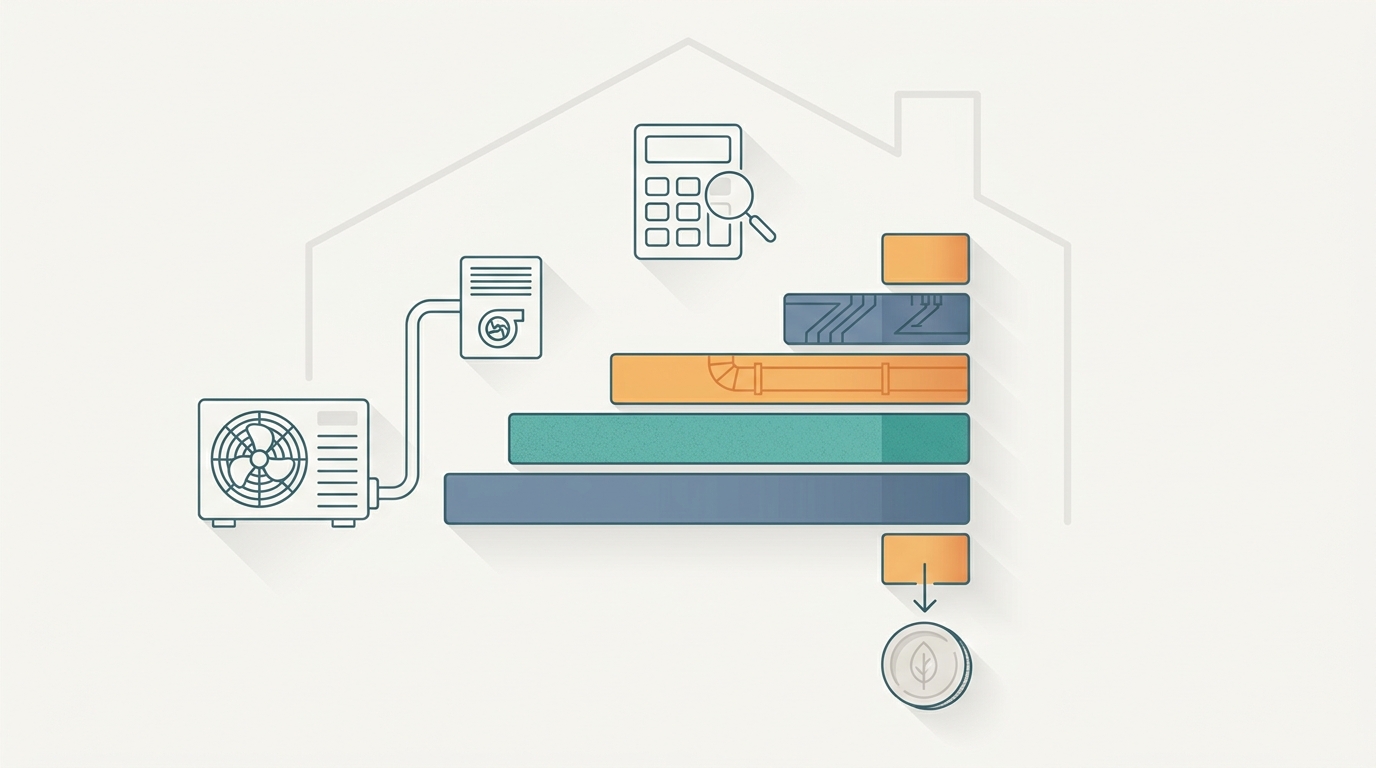
The number most calculators hide
Online calculators love to quote the equipment-plus-basic-labor figure ($6,000–$8,000) because it looks cheap. But Homewyse's own fine print excludes permits, sales tax, and a 13%–22% general-contractor markup, and it assumes nothing is wrong with your ducts or panel. Add those back and a "$7,000" quote becomes a $10,000–$13,000 job fast. Build your budget from the all-in number, not the teaser.
Cost by tonnage (system size)
Heat pumps are sized in tons (one ton = 12,000 BTU/hour of capacity). A rough rule of thumb is one ton per 400–600 sq ft, but that is only a starting sanity check, not a sizing method. Below is a realistic 2026 installed-cost range by size for a standard ducted air-source system, assuming a straightforward replacement with minor scope.
| Size | Roughly fits | Installed cost (2026) | Notes |
|---|---|---|---|
| 2 ton (24,000 BTU) | ~1,000–1,200 sq ft | $6,000–$9,000 | Small home, condo, or single story |
| 2.5 ton (30,000 BTU) | ~1,200–1,500 sq ft | $7,000–$11,000 | Most common swap size |
| 3 ton (36,000 BTU) | ~1,500–1,800 sq ft | $8,500–$13,000 | Typical mid-size home |
| 3.5 ton (42,000 BTU) | ~1,800–2,100 sq ft | $10,000–$15,000 | Larger 2,000 sq ft house |
| 4 ton (48,000 BTU) | ~2,000–2,400 sq ft | $11,000–$17,000 | Big or leaky home |
| 5 ton (60,000 BTU) | ~2,400–3,000 sq ft | $13,000–$20,000 | Large home, usually max single unit |
Assuming standard air-source equipment, existing ducts in usable shape, and one outdoor unit. Variable-speed or cold-climate models add 20%–40%. Ductwork, electrical, or geothermal change the math entirely (see below).
Bigger is not better
The single most common field mistake I see is an oversized unit. A 4-ton heat pump dropped on a house that needs 2.5 tons short-cycles, never dehumidifies well, and wears out early. On a 1980s ranch I looked at outside Columbus, the homeowner had been sold a 5-ton because "the old furnace was 5-ton." A proper Manual J load came back at 2.5 tons. The oversized unit was the reason the rooms felt clammy in summer. Pay for the load calculation; it is the cheapest line on the quote and protects every dollar after it.
Cost by system type
A bigger lever than tonnage is which kind of heat pump you install. Here are the 2026 installed ranges by type, with the efficiency specs that matter.
Installed cost by heat pump system type (2026)
One indoor head, no ducts
Whole home, existing ducts
Rated for sub-freezing heating
Whole-home, no ducts
Includes ground loop excavation
Ducted air-source ($6,000–$15,000) is the default whole-home choice if you already have ductwork. It pairs an outdoor condenser with an indoor air handler. Look for SEER2 of at least 14.3 (the federal minimum for split systems in the South; 15.2 in some regions) and HSPF2 of 7.5 or higher for heating efficiency. ENERGY STAR models start around SEER2 15.2 / HSPF2 7.8.
A ductless mini-split ($3,500–$6,500 single zone) has no ducts, which means lower install cost and less efficiency loss. A single outdoor unit feeds one wall- or ceiling-mounted head. It works well for additions, a converted garage, or one stubborn room. For whole-home coverage you need multiple zones, and the price climbs toward ducted-system territory. See our mini-split cost installed guide for the per-zone breakdown.
Cold-climate and variable-speed systems ($10,000–$22,000) use inverter-driven compressors that hold capacity below freezing, often down to -5°F or colder. If you are north of roughly the Mason-Dixon line and want the heat pump to be your primary heat, this is the tier that actually works in January. It costs more up front but qualifies for the best state and utility rebates.
Geothermal, or ground-source ($18,000–$35,000), is the most efficient option and the most expensive, because of the buried loop field. Inch Calculator pegs the average near $22,000. Payback is long, but the equipment lasts decades. The federal 25D credit that used to cover 30% of geothermal for homeowner-owned systems ended December 31, 2025.
For a deeper look at the whole-home ducted number specifically, see heat pump installation cost.
The line items inside your quote
This is where the "calculator" really lives. Your total is the sum of these pieces, so once you know each one you can read any quote and spot what is missing or padded.
| Line item | Typical 2026 cost | When it applies |
|---|---|---|
| Equipment (condenser + air handler) | $3,000–$8,000 | Always; varies by tonnage and efficiency tier |
| Labor (12–20 hrs) | $1,800–$5,000 | Always; $100–$250/hr per tech |
| New refrigerant line set | $300–$1,200 | If old set is undersized or damaged |
| Ductwork repair / sealing | $1,500–$4,000 | Leaky, undersized, or dirty ducts |
| Full duct replacement | $3,000–$8,000 | Old or badly sized duct system |
| Electrical (new circuit/disconnect) | $300–$1,200 | Most installs need a dedicated 240V circuit |
| Electrical panel upgrade | $1,500–$4,000 | Panel full or service too small |
| Old unit removal + disposal | $130–$400 | Almost always |
| Permit + inspection | $100–$500 | Required in most jurisdictions |
| Commissioning / startup | Included (should be) | Airflow, charge, controls verification |
Two of these deserve a flag. Electrical is the sleeper cost. Older homes often have a 100-amp panel with no spare capacity, and a heat pump plus its backup heat strips can need real headroom. On a 1990s split-level near Denver I walked through, the crew spent the first morning not on the heat pump at all but adding a subpanel because the main was maxed out. That added about $2,200 nobody had budgeted for.
Ductwork is the other one. Carrier and Homewyse both call it out, and for good reason: if your ducts leak 25%, a new high-efficiency heat pump will underperform and the comfort complaints you had before will not go away. A blower-door and duct-leakage test before the install is worth asking for.
Ask for the scope in writing
The fastest way to compare three wildly different quotes is to make every contractor answer the same questions: What sizing method (Manual J)? What model numbers, indoor and outdoor? What SEER2 and HSPF2? What duct and electrical work is included, and what would trigger more? Are permits and commissioning included? A bid that dodges these is the one that turns into change orders.
A worked example: 2,000 sq ft house in a mixed climate
Let me run real numbers so you can see how the math comes together.
The home: 2,000 sq ft, two-story, built 1995, existing ducts in decent shape, gas furnace and 12-year-old AC both at end of life. Climate zone 4 (mixed). The owner wants a heat pump as primary heat with the existing furnace kept as backup (a dual-fuel setup).
The Manual J load comes back at 3 tons heating-dominant. Good, because the old "3.5 ton because the AC was 3.5 ton" instinct was a touch high.
| Line item | Estimate |
|---|---|
| 3-ton cold-climate heat pump (variable speed, SEER2 ~17, HSPF2 ~9) | $7,500 |
| Labor, ~16 hrs | $3,800 |
| New line set + pad + electrical disconnect | $900 |
| Duct sealing (minor) | $1,200 |
| Permit + inspection | $300 |
| Old AC removal + disposal | $300 |
| Subtotal installed | $14,000 |
Now the incentives. For a 2026 install there is no federal credit to subtract: the 25C Energy Efficient Home Improvement Credit (the old 30% up to $2,000 heat pump credit) was terminated for property placed in service after December 31, 2025. So the starting net for a 2026 install is the full subtotal, $14,000. (If this exact system had been placed in service in 2025 instead, the owner could still claim the 25C credit on their 2025 return using IRS Form 5695.)
The lever in 2026 is state and utility rebates. Say this homeowner's state offers a $1,500 rebate for a cold-climate heat pump and the local utility adds $1,000. That is $2,500 off, bringing the net to about $11,500. Check the DSIRE database for what is available where you live; income-qualified households can sometimes layer more.
Net cost for a 2026 install: $14,000 with no federal credit, or roughly $11,500 after the example state and utility rebates above. Rebates vary widely by location, so confirm yours before you bank on them.
If the same homeowner skipped the cold-climate tier and the dual-fuel backup and did a basic 3-ton swap on good ducts, the subtotal might be closer to $9,500. But the cheaper unit may not qualify for the richest rebates, so the net could land near the same place. That trade-off, cheaper equipment versus stronger rebates plus better cold-weather performance, is exactly what to model in the Heat Pump vs Furnace Calculator using your real electricity and gas rates.
Tax credits and rebates: what's real in 2026
This is the part competitors get stale on fastest, so here is the current picture.
The 25C Energy Efficient Home Improvement Credit ended after December 31, 2025. The One Big Beautiful Bill Act (Public Law 119-21, signed July 4, 2025) terminated the credit for property placed in service after that date, including the 30% up to $2,000 heat pump category. So a heat pump installed in 2026 gets no federal tax credit. If your system was placed in service on or before December 31, 2025, you can still claim it on your 2025 return using IRS Form 5695; confirm the qualifying model with your installer and the ENERGY STAR federal tax credit page. For any 2026 install, plan on the full price and look to rebates instead.
The 25D Residential Clean Energy Credit has ended for homeowners. The 30% credit that covered geothermal heat pumps for homeowner-owned systems was terminated for anything placed in service after December 31, 2025, under the One Big Beautiful Bill Act. If a guide tells you geothermal still gets 30% with no cap, it is out of date. See tax credit for heat pump for the full breakdown.
State and utility rebates are the main lever now that the federal credit is gone. Many states and utilities offer upfront rebates of $500 to $8,000 for qualifying heat pumps, and some income-qualified households can layer more on top. These are not federal and did not end with the bill. The best single index is the DSIRE database. Stack a state rebate, a utility rebate, and any IRA Home Energy Rebate program your state has launched, and a $14,000 job can net out closer to $9,000–$11,000.
No federal credit in 2026: rebates are the lever
With the 25C credit terminated after December 31, 2025, there is no federal tax credit to recover on a 2026 install. Budget for the full price. The savings now come from state and utility rebates, which are usually applied upfront or paid out separately, not from the IRS. Check the DSIRE database for your area and confirm rebate amounts in writing before you sign. (If your system was placed in service in 2025, you can still claim the old 25C credit on your 2025 return.)
DIY vs hiring a pro
DIY heat pump kits (the MRCOOL-style pre-charged mini-splits) are real and can cut a single-zone job from $4,500 to roughly $1,500–$2,500 in parts. The line sets come pre-charged so you do not need EPA refrigerant certification to connect them.
The trade-offs are real, though. A DIY install usually will not qualify for state or utility rebates, since most programs require a licensed contractor and qualifying equipment. It can void the manufacturer warranty if it is not done to spec. And a botched vacuum or flare lets moisture into the system and can kill the compressor in a season. For a whole-home ducted system, DIY is not realistic; the refrigerant work, electrical, and commissioning need a licensed pro. DIY makes the most sense for a single accessory room where you would otherwise use a window unit.
When a heat pump install is NOT worth it
A good guide tells you when to walk away. Skip or delay if:
- Your current furnace and AC are only a few years old and working. Ripping out functional equipment rarely pencils out. Wait until replacement is due anyway.
- You have very cheap natural gas, a high electricity rate, and no rebates. In a few markets the running-cost math favors keeping gas heat. Model it in the heat pump vs furnace calculator before committing. Also see heat pump cost to run.
- The contractor refuses to do a Manual J load calculation. That is the tell of a rule-of-thumb shop that will oversize the unit and erase your comfort and efficiency gains.
- Your panel and budget cannot absorb the electrical work and you are not ready for a dual-fuel or staged approach.
Red flags and common mistakes
- A quote with no model numbers. "A 3-ton heat pump system" is not a quote; you cannot compare it.
- Sizing by square footage alone. Demand the load calculation.
- Permits or commissioning quietly excluded. These show up later as "time and materials," and an uncommissioned system (wrong refrigerant charge, unverified airflow) runs inefficiently from day one.
- "The old unit was X tons, so we'll match it." Older systems were routinely oversized; matching them repeats the mistake.
- Ignoring the envelope. If the house is leaky and under-insulated, fixing that first can let you buy a smaller, cheaper heat pump and get more comfort. Air sealing is often the best dollar you spend before HVAC.
Quick FAQ
How much does heat pump installation cost in 2026? Most homes pay $6,000–$18,000 installed; the typical ducted job averages $12,000–$14,000. Mini-splits start near $3,500; geothermal can reach $35,000.
How much for a 2,000 sq ft house? Usually a 3–4 ton system at $9,000–$18,000, depending on efficiency, ducts, and electrical work.
Is there a tax credit? Not a federal one for 2026 installs. The 25C heat pump credit (30% up to $2,000) and the 25D geothermal credit both ended December 31, 2025. A 2025 install can still be claimed on your 2025 return; for 2026, use state and utility rebates (see DSIRE).
Cost per ton? Roughly $3,000–$5,000 per ton installed for a standard ducted air-source system.
Why are quotes so different? Scope, not the equipment badge. Ducts, electrical, permits, and efficiency tier can swing a bid by $5,000+.
Is ductless cheaper? A single zone is ($3,500–$6,500). A whole-home multi-zone system often costs as much as ducted.
When is it not worth it? When your current system is new and working, when cheap gas plus a high power rate plus no rebates flip the math, or when the contractor won't run a load calc.
Next steps
- Get a rough budget from this page using the tonnage and system-type tables, then add the line items that apply to your home (ducts, electrical, permits).
- Model the running cost and savings against your current system with your real rates in the Heat Pump vs Furnace Calculator.
- Collect 3 quotes on the same scope, save them side by side in My Plan, and confirm your model qualifies for any state or utility rebate (check DSIRE), since the federal 25C credit ended after 2025.
Ready to see how a heat pump fits your whole upgrade plan? Start at the heating and cooling hub.
Sources & further reading
- Energy Efficient Home Improvement Credit (Section 25C) — IRS
- Air Source Heat Pumps Tax Credit — ENERGY STAR / EPA
- Heat Pump Systems — U.S. Department of Energy
- 2026 Heat Pump Cost Guide: Purchase, Installation & Repair — Carrier
- Cost to Install a Heat Pump — Homewyse
- Database of State Incentives for Renewables & Efficiency (DSIRE) — NC Clean Energy Technology Center
About this post: We wrote this to help homeowners build a realistic heat pump install budget and compare quotes with clear scope. Use licensed HVAC professionals, insist on a Manual J load calculation, and follow permitting requirements in your area. Tax credit eligibility depends on the specific model and your tax situation; confirm with your installer and a tax professional.
Frequently asked questions
How much does heat pump installation cost in 2026?+
Most U.S. homeowners pay $6,000 to $18,000 installed for a whole-home air-source heat pump in 2026, with a national average near $12,000 to $14,000 for a ducted system. A single-zone mini-split runs $3,500 to $6,500, a basic 2.5-ton ducted swap with good existing ducts starts around $6,600 to $8,000, and cold-climate or geothermal systems can reach $20,000 to $35,000.
How much is a heat pump for a 2,000 sq ft house?+
A 2,000 sq ft home usually needs a 3 to 4-ton system and costs $9,000 to $18,000 installed in 2026, depending on efficiency, ductwork, and electrical work. A straightforward swap onto good ducts lands near $10,000 to $13,000; add $3,000 to $6,000 if ducts need sealing, a panel upgrade, or a cold-climate unit.
Is there a heat pump tax credit in 2026?+
No federal one. The 25C Energy Efficient Home Improvement Credit (the 30% up to $2,000 heat pump credit) was terminated for property placed in service after December 31, 2025 under the One Big Beautiful Bill Act, and the separate 25D geothermal credit ended on the same date. A heat pump placed in service in 2025 can still be claimed on your 2025 return (IRS Form 5695). For 2026 installs, plan on the full price and use state and utility rebates as the lever; the DSIRE database is the best index.
How much does a heat pump cost per ton installed?+
Installed cost runs roughly $3,000 to $5,000 per ton for a standard air-source ducted system in 2026, including equipment and labor. Most homes need 2 to 5 tons. A 2-ton unit lands near $6,000 to $9,000 installed; a 4-ton near $11,000 to $17,000. Variable-speed and cold-climate models push the per-ton figure higher.
What is the labor cost to install a heat pump?+
Labor alone typically runs $1,800 to $5,000 for a heat pump install, based on roughly 12 to 20 hours of work at $100 to $250 per hour per technician. A simple condenser-and-air-handler swap is on the low end; new line sets, duct modifications, or electrical work push it higher. Labor is usually 40% to 60% of the total project.
Why are heat pump quotes so different?+
Most of the price gap comes from scope, not the equipment badge. Ductwork sealing or replacement ($1,500–$6,000), an electrical panel upgrade ($1,500–$4,000), a new line set, permits, old-unit removal, and the efficiency tier you choose can swing a quote by $5,000 or more. Always compare bids line by line, not just the bottom number.
Is a ductless mini-split cheaper than a ducted heat pump?+
A single-zone mini-split is cheaper at $3,500 to $6,500 because there is no ductwork. But a multi-zone system covering a whole house ($12,000 to $30,000 for 4 to 5 zones) often costs as much as or more than a ducted heat pump. Ductless wins when you have no ducts or want to heat and cool specific rooms.
How long does a heat pump installation take?+
A straight replacement onto existing ducts takes one day, about 4 to 8 hours. A new ducted system, a multi-zone mini-split, or a job that needs duct or electrical work runs 2 to 3 days. Geothermal takes a week or more because of the ground loop excavation. Heat pumps last 12 to 15 years on average.
When is a heat pump NOT worth the cost?+
Skip or delay if your existing furnace and AC are only a few years old and working, if your electricity rate is very high relative to cheap natural gas with no incentives, or if a contractor refuses to do a Manual J load calculation. An oversized or poorly commissioned heat pump can cost more to run and fail early, erasing the upfront savings.
Try the companion tool
This post links to an interactive tool built for this topic. Open it to see numbers tailored to your home.
Open the toolGet practical energy tips
Join homeowners getting practical tips on cutting energy bills and staying comfortable.
Practical tips only. Unsubscribe anytime.
Read this next
Related guides selected by topic overlap and upgrade path.

Heat pump installation costs $6,000 to $18,000 in 2026, about $12,000 to $14,000 for a typical ducted home. See costs by size and type, and how to compare bids.
Mini split cost installed: about $3,000–$6,000 for one zone, $8,000–$18,000+ whole-home in 2026. Real 2026 prices by zone count and BTU.

What a ductless mini split actually costs installed in 2026, broken down by zone count, equipment vs labor, cold-climate options, sizing, and the rebate and tax-credit reality after 25C ended.

Air duct replacement costs $1,400–$7,000 (avg ~$3,500), or about $9–$25 per linear foot. See pricing by home size, material, and when sealing beats replacing.