Blog
Air Duct Replacement Cost in 2026: By Foot, By Home Size, and When to Seal Instead
Air duct replacement costs $1,400–$7,000 (avg ~$3,500), or about $9–$25 per linear foot. See pricing by home size, material, and when sealing beats replacing.
If you are pricing air duct replacement, here is the short answer: most homes pay about $1,400 to $7,000 for a full job, with a national average near $3,500. By the foot, that is roughly $9 to $25 per linear foot installed for flex or spiral duct, and $20 to $60+ per foot for custom sheet metal. Large, hard-to-reach homes can run $10,000 to $20,000.
But cost is only half the question. The bigger one is whether you should replace at all. The Department of Energy estimates that 20 to 30 percent of the air moving through a typical duct system is lost to leaks. Sealing that for a few hundred dollars often gets back most of the comfort you are chasing, without tearing out a single run. This guide gives you real 2026 numbers, then helps you decide between sealing and replacing.
Before you collect bids, it helps to know what your ducts are actually costing you in wasted energy. Run your last few utility bills through our Bill Breakdown tool to see how much of your bill is heating and cooling. That share is the part leaky or undersized ducts inflate, and it tells you how much a fix could realistically save.
$3,500
Average full replacement
Typical range $1,400–$7,000
$9–$25
Per linear foot (flex/spiral)
$20–$60+ for sheet metal
20–30%
Air lost to duct leaks
DOE estimate for typical homes
$350–$1,000
Pro duct sealing
Often beats replacement
On this page
- What you are actually paying for
- Air duct replacement cost by home size
- Cost by material: flex vs. spiral vs. sheet metal
- What drives the price up
- Regional variation
- The decision that saves the most money: seal vs. replace
- When sealing wins
- When replacement is the right call
- DIY vs. professional
- The "2 foot rule" and other quote questions
- Tax credits and rebates in 2026
- When duct replacement is NOT worth it
- Red flags and common mistakes
- A worked example
- In the body FAQ
- Next steps
What you are actually paying for
Duct replacement is a small construction project, not a parts purchase. A complete scope usually includes:
- Removal and disposal of old duct sections (where feasible)
- New trunk and branch runs, supply and often return
- Boots and register connections at each vent
- Sealing with mastic or UL-181 foil tape at every joint
- Insulation on ducts in unconditioned space, typically R-6 to R-8
- Airflow or static-pressure checks and basic balancing
What is often not included unless you ask: drywall and ceiling repair, repainting, moving stored items or platforms, mold remediation, and asbestos abatement on pre-1980s duct wrap. Each of those can add hundreds to thousands of dollars.
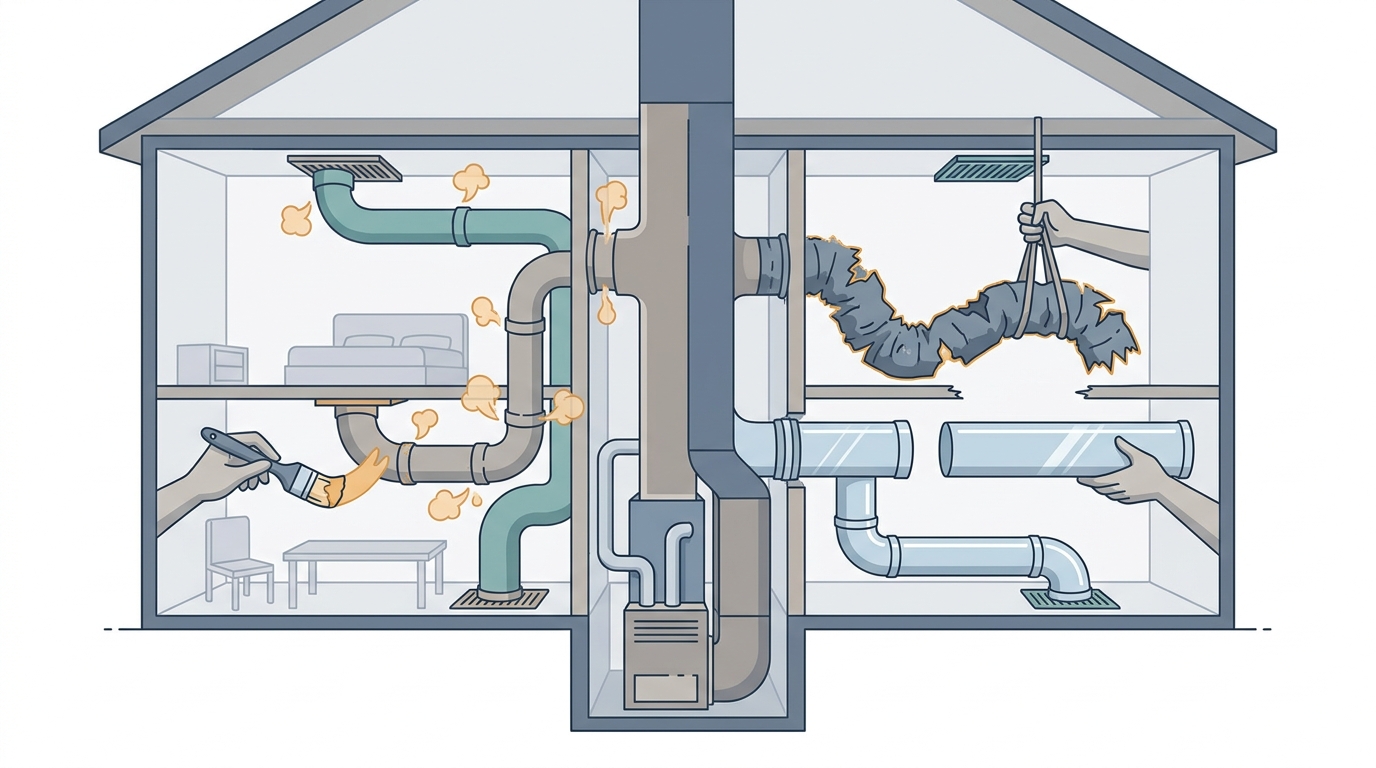
Cost reality: the quote is mostly labor
On most duct jobs, labor is 40–60% of the bill and HVAC crews charge roughly $83 to $151 per hour. Material is cheap; access is expensive. The same 200 feet of flex costs far more in a tight crawl space than in a stand-up basement, because the crew spends the day on their backs.
Air duct replacement cost by home size
Square footage is a rough guide. What really drives the number is linear feet of duct and how hard those runs are to reach. A long, single-story ranch can need more duct than a compact two-story of the same size.
| Home size | Typical full replacement | Notes |
|---|---|---|
| 1,000–1,500 sq ft | $1,500–$4,500 | Often partial; small attic or basement |
| 1,500–2,000 sq ft | $2,500–$5,500 | Most common range |
| 2,000–2,500 sq ft | $3,500–$6,700 | ~200–275 linear feet of duct |
| 2,500–3,000 sq ft | $4,500–$7,800 | More runs, more registers |
| 3,000–4,000+ sq ft | $6,000–$15,000+ | Multi-story, between-floor runs |
Assuming flex or spiral duct, accessible runs, new boots and registers, sealing, and basic verification. Sheet metal throughout, crawl-space access, or wall/ceiling demolition push every row higher.
Air duct replacement cost by scenario (2026)
Replace a crushed or leaking section
Most common project
High end
Cost by material: flex vs. spiral vs. sheet metal
Material choice changes both price and lifespan. Here are real 2026 installed prices per linear foot.
| Material | Installed cost / linear foot | Lifespan | Best for |
|---|---|---|---|
| Insulated flexible (flex) | $7–$34 | ~15–25 yrs | Tight spaces, complex runs, lowest cost |
| Galvanized spiral | $9–$37 | 25–30+ yrs | Good airflow, lighter than rigid |
| Rigid sheet metal (galvanized) | $21–$62 | 30+ yrs | Durability, main trunks, exposed runs |
| Fiberglass duct board | $10–$25 | 15–20 yrs | Quiet runs; vulnerable to moisture/mold |
A few field notes:
- Flex is cheapest and fastest, but it sags, kinks, and crushes if it is not supported every few feet. Bad flex installs are the single most common cause of weak airflow I see in attics.
- Sheet metal moves air with the least resistance and lasts the longest, but it must be fabricated and sealed on site, which is why it costs two to three times more.
- Spiral is a sweet spot: round and smooth, durable, and lighter to handle than rectangular sheet metal.
- Duct board is quiet but can grow mold if it ever gets wet, so I steer clients away from it in humid climates.
Replacement runs ~25% more than a fresh install
Fixr's data shows that replacing existing ducts costs about 25% more than retrofitting ducts into a home that never had them, because someone has to demo and haul out the old system first. If a contractor's "replacement" quote looks suspiciously like a new-construction price, ask what they budgeted for removal and disposal.
What drives the price up
Five things move a duct quote more than anything else:
- Access. Stand-up basement is cheapest. Open attic is moderate. Tight crawl space and inside-wall runs are the most expensive, sometimes double. One contractor's table put crawl-space jobs at $3,000–$7,300 versus $1,800–$3,100 for basements.
- Full vs. partial. Replacing one crushed run might be $600–$2,000. A whole-home redo is a different animal.
- Material and insulation. Sheet metal and R-8 insulation cost more than bare flex.
- Returns and redesign. Adding return-air capacity or resizing for a new system adds duct, registers, and labor, but it is often the actual fix for comfort problems.
- Surprises. Asbestos abatement, mold remediation, and drywall repair are the line items that blow budgets. Set aside 10–15% contingency.
Regional variation
Labor is the swing factor. High-cost metros (Bay Area, NYC, Seattle) often run 20–40% above the national average, partly because of wages and partly because of codes like California Title 24, which can require specific duct sealing and insulation levels plus permit fees. Lower-cost regions in the South and Midwest sit below the national average. Always price locally.
The decision that saves the most money: seal vs. replace
This is where most homeowners overspend. Before you replace anything, understand what sealing can do.
The DOE puts typical duct losses at 20 to 30 percent of the conditioned air your system produces. ENERGY STAR lists duct sealing among the highest-value efficiency improvements for that reason. And sealing is cheap next to replacement:
| Fix | Typical cost | What it solves |
|---|---|---|
| Manual sealing (mastic at joints) | $350–$1,000 | Accessible leaks, loose connections |
| Aeroseal (internal aerosol seal) | $1,500–$4,000 | Hidden leaks in inaccessible ducts |
| Re-insulating exposed ducts | $1–$3 / sq ft | Heat gain/loss in attics and crawl spaces |
| Full duct replacement | $1,400–$7,000+ | Damaged, undersized, or contaminated ducts |
Seal vs. replace: cost to fix leaky ducts (2026)
Accessible joints
Hidden leaks
Only if damaged/undersized
A real example from the field: on a 1990s Denver attic I walked, the homeowner had a $9,000 replacement quote. The ducts were intact, just leaking at every taped joint and uninsulated where they crossed the attic. The crew spent two hours sealing top plates and duct joints with mastic and adding R-8 sleeves. Total: under $1,200. The back bedroom that "never got warm" was fine by that afternoon. Replacement would have fixed it too, for seven times the price.
When sealing wins
Ducts are intact but leaky. Comfort and dust problems trace to gaps, not damage. You want minimal disruption. Related reading: Duct sealing payback: when it's worth it.
When replacement is the right call
- Ducts are crushed, torn, or collapsed (common with old flex)
- Water damage or mold inside the ducts
- Ducts are badly undersized and choke airflow (high static pressure)
- Asbestos duct wrap that must be removed anyway
- You are installing a new, higher-airflow system the old ducts can't support
DIY vs. professional
A handy homeowner can replace an accessible flex run and save the $83–$151/hour labor. But whole-system work is a different job. The risks:
- Sizing. Ducts sized by "what fits in the attic" instead of a Manual D calculation choke airflow and strain the blower.
- Sealing and balancing. Poorly sealed DIY ducts can leak worse than what you replaced.
- Hazards. Pre-1980s ducts may contain asbestos; old ducts can harbor mold. Both require licensed handling.
For a single bad run in a reachable spot, DIY can make sense. For a whole home, the design and verification are where pros earn their fee.
The "2 foot rule" and other quote questions
You will see the "2 foot rule" in People Also Ask. It is an HVAC sizing shorthand: branch ducts should generally not exceed about 2 feet of length per inch of diameter before airflow suffers, and supply boots should sit within roughly 2 feet of the conditioned space they serve. The practical takeaway for you: long, skinny, droopy duct runs are a red flag that the system was never designed for airflow, and a sign that replacement (done right) might actually help.
Ask every contractor:
- Is this full or partial? Which runs, exactly?
- Are you adding or improving return air?
- What material and R-value of insulation?
- How will you seal (mastic, UL-181 tape) and verify airflow?
- What finishes (drywall, paint) are you responsible for?
- Are permits included, and what is the labor warranty?
Tax credits and rebates in 2026
Be careful with outdated advice here.
- The 25D Residential Clean Energy Credit ended December 31, 2025. It never covered ducts anyway, but if a guide cites it, the guide is stale.
- The 25C Energy Efficient Home Improvement Credit ended under the same bill for property placed in service after December 31, 2025. Through 2025 it covered up to 30% of qualifying insulation and air-sealing materials (capped at $1,200 per year, with new duct runs and labor excluded), so a 2025 project can still be claimed on the 2025 return via Form 5695. For 2026 work there is no federal credit, so do not budget for one. See the IRS guidance on the 25C credit.
- State and utility rebates are separate and often more valuable for ducts. Many utilities pay for verified duct sealing, sometimes after a duct blaster test shows the leakage reduction.
Get the leak test: your utility may pay for it
A duct-blaster or pressure-pan test measures actual leakage and gives you a number to act on. Some utilities offer it for $50 or less, and several rebate the sealing work afterward. It is the cheapest way to know whether you have a sealing problem or a replacement problem.
When duct replacement is NOT worth it
Skip or delay a full replacement when:
- Your ducts test tight and deliver even airflow. You are buying disruption for little gain.
- The real problem is return air or a clogged filter, not the supply ducts.
- A leak test shows the issue is sealable for a few hundred dollars.
- You are about to renovate or change HVAC type within a year or two. Wait and do it once.
- The quote is whole-home but the contractor can't show a layout or explain sizing.
Red flags and common mistakes
- Replacing supplies while ignoring returns and air sealing in the home envelope.
- Accepting "new ducts will fix it" with no design or verification plan.
- Comparing quotes that don't define finishes, cleanup, and access.
- Paying for duct cleaning as a substitute for sealing, a different problem (see air duct cleaning cost).
- Skipping the leak test, then over-replacing.
A worked example
A 2,100 sq ft two-story home in the Midwest. Upstairs bedrooms run hot, the bill is creeping up, and a contractor proposes a full $8,500 replacement.
- Leak test: ducts leaking ~28%, near the top of the DOE range.
- Inspection: runs are intact flex, but uninsulated in the attic and unsealed at boots. One return is undersized.
- Smart scope: seal all joints with mastic ($700), add R-8 sleeves on attic runs ($900), and upsize the one weak return ($600). Total ~$2,200.
- Result: even temperatures, lower static pressure, and an estimated 10–15% cut in heating and cooling load, for about a quarter of the replacement price.
Full replacement would have worked too. It just wasn't the cheapest path to the same comfort. To estimate your own savings, see how much of your bill is heating and cooling in Bill Breakdown, and compare bids in My Plan.
In the body FAQ
How much does air duct replacement cost? About $1,400–$7,000 for a typical full job (avg ~$3,500); $9–$25 per foot for flex/spiral, $20–$60+ for sheet metal.
Is sealing cheaper than replacing? Almost always: $350–$1,000 manual or $1,500–$4,000 Aeroseal, versus $1,400+ to replace.
Should I replace 20-year-old ductwork? Only if it leaks heavily, is undersized, or is damaged. Tight, even-airflow ducts are better sealed than replaced.
Does it qualify for a tax credit? Not in 2026. Duct runs never qualified, and both federal credits (25C and 25D) ended for anything placed in service after December 31, 2025. A 2025 install can still be claimed on the 2025 return; otherwise look to state and utility rebates.
Next steps
- Get a duct leak test before any replacement quote. It tells you whether to seal or replace.
- Run your bills through Bill Breakdown to size the potential savings, then compare bids in My Plan.
- Read the related guides: duct sealing payback, ductwork replacement cost, and air duct cleaning cost. For the bigger picture, start at our heating and cooling upgrade hub.
Sources & further reading
- Duct Sealing — U.S. Department of Energy
- Minimize Energy Losses in Ducts — U.S. Department of Energy
- Duct Sealing (Seal and Insulate) — ENERGY STAR
- Energy Efficient Home Improvement Credit (Section 25C) — IRS
- How Much Does It Cost to Install Ductwork? — Fixr
Frequently asked questions
How much does air duct replacement cost in 2026?+
For a typical home, full duct replacement runs about $1,400 to $7,000, with a national average near $3,500. By the foot, expect roughly $9 to $25 per linear foot installed for flex or spiral, and $20 to $60+ per linear foot for custom sheet metal. Whole-home jobs on large, hard-to-access houses can reach $10,000 to $20,000.
What is the cost to replace ductwork per linear foot?+
Installed cost by material in 2026: insulated flex duct runs about $7 to $34 per linear foot, galvanized spiral about $9 to $37, and rigid sheet metal about $21 to $62. A 2,000–2,500 sq ft home usually needs 200 to 300 linear feet of duct, which is why total projects land in the low thousands.
How much does it cost to replace ductwork in a 2,000 sq ft house?+
Plan on roughly $2,500 to $5,500 for a 2,000 sq ft home with accessible attic or basement runs, more if the ducts are in a crawl space or buried in walls. That assumes flex or spiral duct, new boots and registers, sealing, and basic airflow checks. Sheet metal throughout pushes the high end past $8,000.
Is it cheaper to seal ducts than replace them?+
Almost always. Professional duct sealing costs about $350 to $1,000 for accessible joints, or roughly $1,500 to $4,000 for an Aeroseal-style internal seal. The DOE estimates 20–30% of conditioned air is lost to duct leaks, so sealing usually buys back most of the comfort and efficiency at a fraction of replacement cost.
When should you replace ductwork instead of sealing it?+
Replace when ducts are crushed, water-damaged, mold-contaminated, badly undersized, or contain asbestos that must be removed. Replace if a new, higher-airflow HVAC system can't run on the old duct sizing without high static pressure. Seal or repair when ducts are intact but leaky.
Does duct replacement qualify for a tax credit in 2026?+
Not in 2026. Ductwork never qualified on its own, and both federal home-energy credits are now gone: the One Big Beautiful Bill ended the 25C Energy Efficient Home Improvement Credit and the 25D Residential Clean Energy Credit for anything placed in service after December 31, 2025. A 2025 project can still be claimed on the 2025 return via Form 5695. For 2026 work, look to state and utility rebates, which are separate and often pay for verified duct sealing.
Should I replace 20-year-old ductwork?+
Not automatically. Sheet metal can last 30+ years; flex duct often degrades in 15 to 25. If 20-year-old ducts test tight, deliver even airflow, and have no mold or damage, sealing and re-insulating is usually the better spend. Replace if they leak heavily, are undersized, or are failing.
Can I replace air ducts myself?+
Accessible flex runs can be DIY for a handy owner, saving the $83 to $151 per hour labor rate. But proper sizing (Manual D), sealing, balancing, and code compliance are easy to get wrong, and mistakes cut airflow and efficiency. Asbestos or mold in older ducts must be handled by licensed pros.
What does an air duct replacement quote include?+
A complete quote covers removal/disposal of old ducts, new trunk and branch runs, boots and register connections, sealing with mastic or UL-181 tape, duct insulation (typically R-6 to R-8), and basic airflow or static-pressure verification. Drywall repair, painting, mold remediation, and asbestos abatement are usually extra.
How long does duct replacement take and how long does new ductwork last?+
A whole-home duct replacement typically takes 1 to 3 days depending on access and home size. New sheet metal ducts can last 30 years or more; quality insulated flex duct lasts roughly 15 to 25 years. Good sealing and proper support extend the life of either.
Try the companion tool
This post links to an interactive tool built for this topic. Open it to see numbers tailored to your home.
Open the toolGet practical energy tips
Join homeowners getting practical tips on cutting energy bills and staying comfortable.
Practical tips only. Unsubscribe anytime.
Read this next
Related guides selected by topic overlap and upgrade path.
Heat pump cost to install runs $6,000–$18,000 in 2026, with a typical ducted home near $12,000–$14,000. Compare prices by size, type, and quote scope.
Air duct cleaning costs $300 to $700 for a typical home (about $35 per vent). Honest 2026 guide: what gets upcharged, and why most homes do not need it.
Mini split installation cost runs about $3,000–$6,000 for one zone and $8,000–$18,000+ for a whole-home system. Compare prices by zone count and BTU.
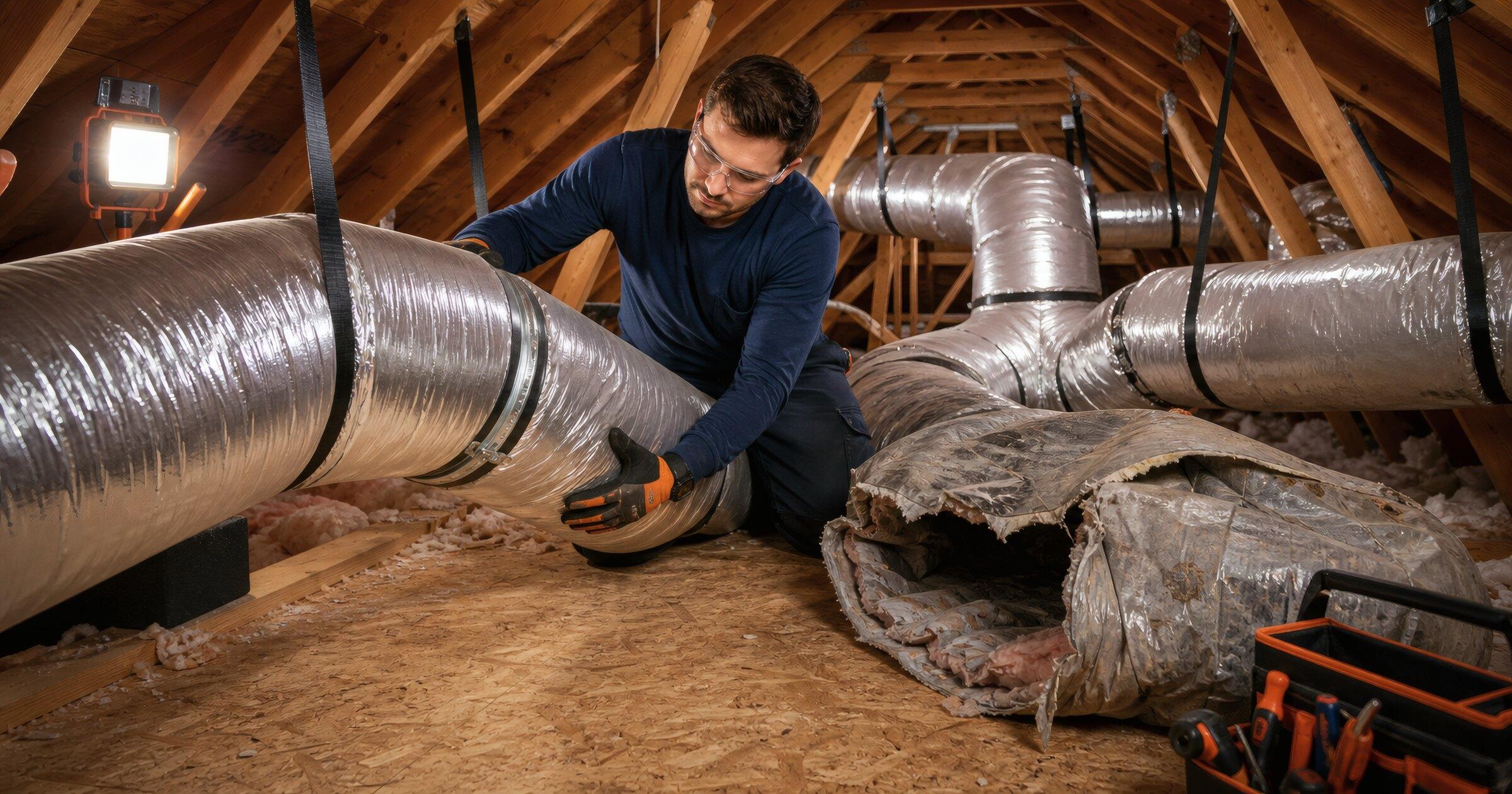
Ductwork replacement cost runs about $1,400–$7,000 for most homes. Estimate your HVAC ductwork price by home size, access, material, and project scope.