Blog
Mini Split Cost Installed (2026): Real Prices by Zone and BTU
Mini split cost installed: about $3,000–$6,000 for one zone, $8,000–$18,000+ whole-home in 2026. Real 2026 prices by zone count and BTU.
If you are searching "mini split cost installed," here is the short answer: in 2026 a single-zone ductless mini split runs about $3,000 to $6,000 installed, a two-zone system about $6,000 to $11,000, and a whole-home three- to five-zone setup roughly $8,000 to $18,000 or more. The single biggest lever on that number is how many indoor heads you put in, not the BTU rating.
This page frames the total installed price by zones (heads) and capacity (BTU), with real ranges and worked examples. For the deeper explainer on the ductless category itself, including equipment tiers and brand differences, our sibling guide ductless mini split cost installed goes further. Use that one for "what am I buying"; use this one to estimate your bottom-line number.
$3k–$6k
One zone, installed
9,000–24,000 BTU single head
$1.5k–$3.5k
Per extra head
Added zone: unit, line set, drain, labor
$8k–$18k+
Whole-home multi-zone
3–5 heads on one outdoor unit
$0
Federal credit in 2026
25C ended Dec 31, 2025
Before you call anyone, sketch your zones and capture quotes in one place so you can compare them line by line. Our heat pump calculator helps you estimate the BTU each space needs and roughly what the system should cost, so you walk into bids with a number instead of a blank stare. Then keep every contractor's scope, model numbers, and price in My Plan so a missing $1,200 electrical line doesn't ambush you later.
On this page
- What "installed" actually buys you
- Mini split cost by number of zones (2026)
- Mini split cost by capacity (BTU)
- Single-zone vs. multi-zone vs. ducted: which fits
- What drives the price up or down
- DIY vs. pro: the real math
- Tax credits and rebates in 2026
- Worked examples
- When a mini split is NOT worth it
- Red flags and common mistakes
- Quick FAQ
- Next steps
What "installed" actually buys you
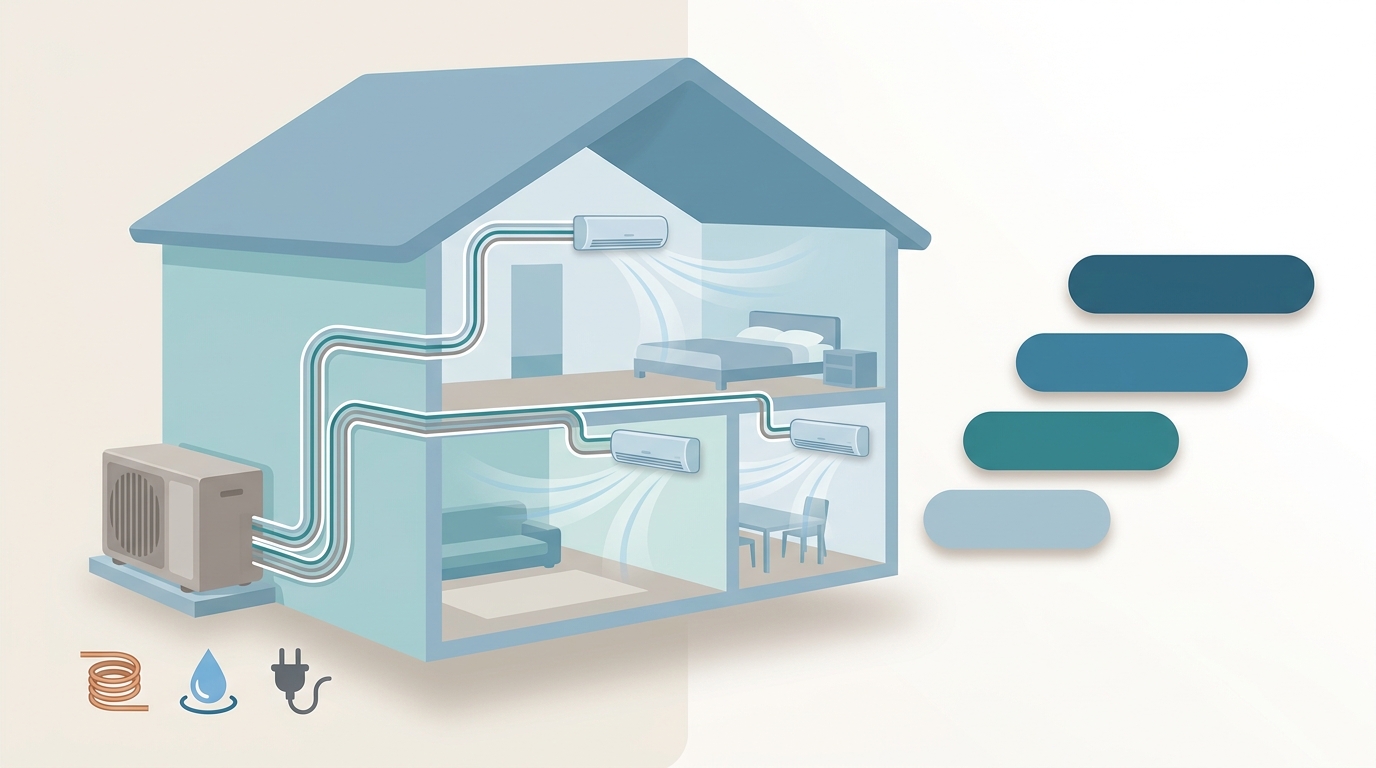
When a contractor quotes a mini split "installed," a complete price should include all of this:
- The outdoor unit (the condenser/compressor) and one or more indoor heads (air handlers)
- Refrigerant line sets, flare fittings, insulation, line covers, and wall penetrations
- Condensate drainage (a gravity drain or a small pump)
- Electrical: a disconnect, breaker, and wiring from the panel within normal limits
- Mounting: a wall bracket or ground pad, plus a snow stand or wall bracket in cold climates
- Commissioning: vacuum the lines, verify the refrigerant charge, set up controls, check airflow
Carrier and Bryant publish nearly identical "included vs. excluded" lists, and they agree on what falls outside a base quote: panel or service upgrades, long line-set runs, drywall and paint repair, structural carpentry, and permits where they apply. Those items turn a "$4,000" job into a $6,500 one.
The cheap quote trap
The lowest bid is often the one that quietly leaves out the dedicated circuit, the condensate pump, or the permit. When you normalize bids to the same scope, the spread usually shrinks a lot. Force every contractor to write the electrical, drainage, and finish work into the quote before you compare prices.
Mini split cost by number of zones (2026)
The cleanest way to budget is by head count, because each indoor unit brings its own line set, drain, and labor. Here are typical installed ranges nationwide.
| Configuration | Typical BTU range | Installed cost (2026) | Best for |
|---|---|---|---|
| 1 zone (single head) | 9,000–24,000 | $3,000–$6,000 | One bedroom, addition, garage, office |
| 2 zones | 18,000–30,000 total | $6,000–$11,000 | Two rooms, or main floor + bonus room |
| 3 zones | 24,000–42,000 total | $8,000–$14,000 | Small home, upstairs bedrooms |
| 4–5 zones (whole-home) | 36,000–60,000 total | $12,000–$22,000 | Whole house with no ductwork |
| Ducted mini split (1 air handler) | 18,000–36,000 | $6,000–$12,000 | Several nearby rooms, hidden vents |
These line up with the manufacturers. Bryant pegs single-zone at $2,000–$6,000 and multi-zone at $2,000–$7,000 per zone; Carrier cites a broad $2,000–$10,500. Cost services run higher per unit: Homewyse lists about $4,086–$4,838 per installed unit. The ranges above blend equipment plus labor for a typical pro install in a moderate-cost region.
Mini split cost installed by zone count (2026)
9k–24k BTU
small home
no ductwork
hidden vents
Why zones cost more than BTU
A single outdoor unit can serve one head or five. Adding a head means another indoor unit, another line set drilled and routed, another condensate path, and more labor and commissioning time, roughly $1,500–$3,500 each. Bumping a single head from 9,000 to 24,000 BTU usually adds only a few hundred dollars in equipment. So if your budget is tight, the lever to pull is zone count, not capacity.
Mini split cost by capacity (BTU)
BTU (British Thermal Units) measure how much heating or cooling a unit delivers per hour. One ton equals 12,000 BTU. Sizing matters for comfort and efficiency, but it is a minor cost driver compared with how many heads you install.
| Capacity | Rough area served | Typical use | Single-zone installed |
|---|---|---|---|
| 9,000 BTU (¾ ton) | up to ~350 sq ft | Bedroom, small office | $3,000–$4,500 |
| 12,000 BTU (1 ton) | ~350–550 sq ft | Bedroom, small living room | $3,300–$5,000 |
| 18,000 BTU (1.5 ton) | ~550–800 sq ft | Open living area | $3,800–$5,800 |
| 24,000 BTU (2 ton) | ~800–1,100 sq ft | Great room, small floor | $4,200–$6,500 |
| 36,000 BTU (3 ton) | ~1,100–1,500 sq ft | Large open space, small home | $5,000–$8,000 |
Rules of thumb (roughly 20–30 BTU per square foot) get you in the ballpark but ignore ceiling height, insulation, windows, and sun. A proper Manual J load calculation is the right way to size and your best protection against an oversized unit that short-cycles, runs humid, and wears out early.
Bigger is not better
Oversizing is the most common mini split mistake I see in the field. An oversized head blasts cold air, satisfies the thermostat in a few minutes, shuts off, and leaves the room clammy because it never ran long enough to pull moisture out. Right-sizing usually means a smaller unit than a homeowner expects, and it costs less, not more.
Single-zone vs. multi-zone vs. ducted: which fits
Think in outcomes first, then pick the gear that fits.
Single-zone (one outdoor + one indoor) is the right call when you are solving one comfort problem: a hot bedroom, a finished attic, a garage gym, an addition. It is the simplest path, the fewest penetrations, and the lowest price.
Multi-zone (one outdoor + several indoors) earns its cost when rooms genuinely need independent control and there's a clean routing path for multiple line sets and drains. The trade-off is more complexity, and one outdoor-unit failure can take several rooms offline. Add heads where doors stay closed and loads truly differ, not to "solve everything."
Ducted mini split (outdoor + slim air handler) gives you mini-split efficiency with hidden vents and even temperatures across several nearby rooms, as long as the duct design is real, with a proper return-air path and filter access.
For a side-by-side of these against a conventional system, see our heat pump installation cost guide, and for the monthly bill side, heat pump cost to run.
What drives the price up or down
Beyond zone count and capacity, these are the levers that move a quote:
- Routing distance and difficulty. A clean exterior path is cheap. When the crew has to fish a line set across a finished room, up two stories, or through brick, copper, labor, and finish work all climb.
- Condensate drainage. Gravity drain is free and reliable. If gravity isn't possible, a condensate pump adds a part that can fail and needs power: small cost, but ongoing maintenance.
- Electrical scope. Many installs just need a new dedicated circuit and disconnect. Some trigger a subpanel or service upgrade, which can add $1,500–$4,000+ on its own. If your panel is full or old, flag it early.
- Indoor unit style. Standard wall heads are cheapest. Ceiling cassettes and concealed ducted air handlers cost more in hardware and labor.
- Efficiency tier (SEER2 / HSPF2). A 20 SEER2 base unit is cheaper upfront; a 30+ SEER2 hyper-heat model costs more but cuts running cost and performs better in deep cold. SEER2 measures cooling efficiency; HSPF2 measures heating efficiency.
- Brand and region. Premium brands (Mitsubishi, Daikin) cost more but carry longer warranties; value brands cost less. Labor rates swing the total widely, and booking in spring or fall often beats peak summer pricing.
From the field
On a 1960s Cape I walked in coastal New England, the homeowner had a $3,900 single-zone quote and a $6,800 one for the same bedroom. The gap wasn't markup. The cheaper crew planned a 4-foot exterior line run to a ground pad; the pricier bid fished the line set inside a finished wall to hide it, plus a condensate pump because the wall had no gravity drain path. Same head, same BTU, totally different labor. Neither was wrong; they quoted different scopes. That is why apples-to-apples comparison beats chasing the headline price.
DIY vs. pro: the real math
DIY-friendly kits (MrCool and similar) ship with pre-charged line sets so you can connect them without EPA refrigerant certification. A 1-zone DIY kit often runs $1,200–$2,500 for equipment, and people online report saving roughly $3,000–$4,500 versus a pro install.
The honest trade-offs:
- Warranty. Many manufacturer warranties require professional installation; DIY can void the compressor coverage. Read the fine print before you save the labor.
- Skill. A pro vacuums the lines, verifies the charge, and pressure-tests for leaks. A bad flare or skipped vacuum is exactly the kind of thing that fails in year two.
- Electrical and permits. You still need a proper circuit and, in many towns, a permit and inspection.
DIY can genuinely work for a handy owner on a simple single-zone garage or shop. For whole-home multi-zone, the complexity and warranty stakes usually point to a pro.
Tax credits and rebates in 2026
Here is the part most older articles get wrong. The federal 25C Energy Efficient Home Improvement Credit (up to $2,000 for a qualifying ENERGY STAR ductless heat pump) ended December 31, 2025 under the One Big Beautiful Bill Act. To have claimed it, the system had to be installed and placed in service on or before that date. For 2026, plan on no federal mini split tax credit.
What's still on the table:
- State tax credits and rebates. Many states run their own efficiency programs; these vary widely and change often.
- Utility rebates. Local utilities frequently offer $500–$2,000+ for qualifying high-efficiency ductless heat pumps. These are separate from anything federal.
- HEAR/HOMES rebates. Where your state has launched its federally funded home-energy rebate programs, income-qualified households may still get point-of-sale discounts on heat pumps.
To qualify for most utility programs, the unit usually has to meet ENERGY STAR ductless guidance on SEER2/HSPF2. Check eligibility before you sign, and see our tax credit for heat pump guide for the current details. For the official rules, the ENERGY STAR ductless heating and cooling page and the IRS Energy Efficient Home Improvement Credit page are the sources to trust.
Worked examples
These are patterns, not quotes. They show why two installs land in different budget bands.
One hot bedroom (single zone). A 12,000 BTU wall head, an easy exterior line run to a ground pad, gravity drain, simple new circuit: about $3,500–$4,800 installed.
1,000 sq ft of closed rooms (two to three zones). Three upstairs bedrooms with closed doors need separate heads, and routing three line sets and drains cleanly is the hard part: about $8,000–$12,000, driven by head count, not BTU.
Whole 1,800 sq ft home, no ducts (four to five zones). One outdoor unit feeds heads across the living area and bedrooms, plus a panel upgrade. A 1–3 day job, commonly $14,000–$20,000+.
Several rooms, hidden vents (ducted). A slim ducted air handler in the attic serves three nearby bedrooms through short ducts: often $7,000–$11,000 if the duct design and return path are done right.
When a mini split is NOT worth it
Be willing to walk away. A mini split is often the wrong tool when:
- You already have good ductwork. A central or ducted heat pump usually conditions the whole home for less than a five-head ductless system.
- You only need to fix one room. A $300 window or portable unit may be all a rarely-used room needs.
- The room is barely insulated. Air-sealing and insulation first shrink the BTU you need. Buying a bigger head to overcome leaky walls is money wasted.
- You want it truly invisible. Wall heads are visible; if that's a dealbreaker, price the ducted or cassette option first.
For a broader plan that sequences insulation, electrical, and HVAC, start at the heating and cooling hub.
Red flags and common mistakes
- A quote that can't describe the line-set path in writing. "We'll figure out the routing on install day" is how surprise costs happen.
- "We'll sort the drain later." Condensate strategy should be decided up front.
- Too many heads. Salespeople sometimes put a head in every room; you often need fewer than you think.
- No load calculation. A guess-sized system is the road to an oversized, short-cycling, humid install.
- No commissioning detail. "We'll test it" is not the same as vacuum, leak check, and verified charge.
- No labor warranty or service plan. Ask who handles warranty calls and what the lead time is.
Quick FAQ
How much does a mini split cost installed in 2026? About $3,000–$6,000 for one zone, $6,000–$11,000 for two zones, and $8,000–$18,000+ for a 3–5 zone whole-home system.
How much for a 1,000 sq ft space? Roughly $5,000–$10,000, depending on whether it's one open room (single head) or several closed rooms (two to three heads).
Is there a tax credit in 2026? No federal one. The 25C heat pump credit ended Dec 31, 2025. State and utility rebates of $500–$2,000+ still apply in many areas.
How much does each extra head add? About $1,500–$3,500 installed.
Does higher BTU cost much more? No. Zone count drives price; going from 9k to 24k BTU on one head adds only a few hundred dollars.
How long do they last? About 15–20 years with annual filter and coil cleaning.
Next steps
- Size it honestly. Use the heat pump calculator to estimate BTU per room and a realistic installed range before you call anyone.
- Get apples-to-apples bids. Make every contractor write the electrical, drainage, routing, and permit scope into the quote, then compare in My Plan.
- Sequence the whole project. If insulation or electrical work comes first, map the order at the heating and cooling hub so you don't pay twice.
Sources & further reading
- Ductless Heating and Cooling (product guidance and specs) — ENERGY STAR
- Energy Efficient Home Improvement Credit (Section 25C) — IRS
- Ductless Mini-Split Heat Pumps — U.S. Department of Energy
- Ductless Mini Split Installation Costs in 2026 — Carrier
- Ductless Mini Split Cost (2026): Prices, Installation & Factors — Bryant
Frequently asked questions
How much does a mini split cost installed in 2026?+
A single-zone mini split costs about $3,000 to $6,000 installed in 2026. A two-zone system runs roughly $6,000 to $11,000, and a three- to five-zone whole-home setup typically lands between $8,000 and $18,000 or more. The biggest swing is the number of indoor heads, not the BTU rating.
How much does a mini split cost for a 1,000 square foot space?+
Plan on roughly $5,000 to $10,000 installed for about 1,000 square feet, depending on layout. One open room often needs a single 18,000–24,000 BTU head near $4,000 to $7,000. Several closed rooms usually need a two- or three-zone system, which pushes the total toward $8,000 to $12,000.
Is there a tax credit for a mini split in 2026?+
The federal 25C credit (up to $2,000 for a qualifying ENERGY STAR ductless heat pump) ended December 31, 2025 under the One Big Beautiful Bill Act, so there is no federal mini split credit in 2026. State and utility rebates are separate, still run in many areas, and can cut $500 to $2,000 or more off a qualifying high-efficiency system.
What does 'installed' actually include in a mini split quote?+
A standard installed price covers the outdoor unit, the indoor head(s), refrigerant line sets, line covers, wall penetrations, condensate drainage, a disconnect and basic wiring, mounting hardware, and commissioning (vacuum, charge, test). It usually excludes panel upgrades, long line-set runs, drywall or paint repair, and permits unless written in.
How much does each extra zone or head add?+
Each additional indoor head usually adds about $1,500 to $3,500 installed, covering the unit, its own line set, drain, and labor. That is why a four-head system can cost three to four times a single-zone install even though the outdoor unit is shared.
Is a mini split cheaper than central air?+
For a home with no existing ductwork, a mini split is usually cheaper because you skip duct installation, which can add $3,000 to $8,000. If your home already has good ducts, a central system or ducted heat pump is often the better value for whole-home conditioning.
How many BTU do I need, and does higher BTU cost a lot more?+
Sizing runs about 9,000 BTU for a small bedroom (roughly 350 sq ft) up to 24,000–36,000 BTU for a large open area. Moving from a 9,000 to a 24,000 BTU single-zone head usually adds only a few hundred dollars in equipment, so capacity is a minor cost driver compared with zone count.
How long does a mini split installation take?+
A straightforward single-zone install takes about 4 to 8 hours. Multi-zone systems, panel upgrades, or long line runs commonly take 1 to 3 days. Most of the time goes to running line sets and drains cleanly, not bolting up the units.
How long do mini splits last?+
A well-maintained ductless mini split lasts about 15 to 20 years, similar to or longer than central AC. Compressors are typically warrantied 10 to 12 years and parts 5 to 10 years, but those warranties usually require professional installation and annual filter and coil cleaning.
Try the companion tool
This post links to an interactive tool built for this topic. Open it to see numbers tailored to your home.
Open the toolGet practical energy tips
Join homeowners getting practical tips on cutting energy bills and staying comfortable.
Practical tips only. Unsubscribe anytime.
Read this next
Related guides selected by topic overlap and upgrade path.

What a ductless mini split actually costs installed in 2026, broken down by zone count, equipment vs labor, cold-climate options, sizing, and the rebate and tax-credit reality after 25C ended.

Most homes pay $6,000–$18,000 to install a heat pump in 2026. Estimate yours by tonnage and system type, then run your own numbers before you call anyone.

A practical, homeowner-first way to estimate heat pump install cost, understand what’s included, and compare bids without getting upsold.

Air duct replacement costs $1,400–$7,000 (avg ~$3,500), or about $9–$25 per linear foot. See pricing by home size, material, and when sealing beats replacing.