Blog
Ductless Mini Split Cost Installed (2026): Real Prices by Zone, What Drives Them, and Where to Save
What a ductless mini split actually costs installed in 2026, broken down by zone count, equipment vs labor, cold-climate options, sizing, and the rebate and tax-credit reality after 25C ended.
If you are searching "ductless mini split cost installed," you usually want two answers: a realistic budget for your house, and why one quote looks half the price of another. Both come down to the same thing. Installed cost is not the equipment on the box. It is the heads, the line sets, the drains, the electrical, and the careful work that makes the system run quietly and last.
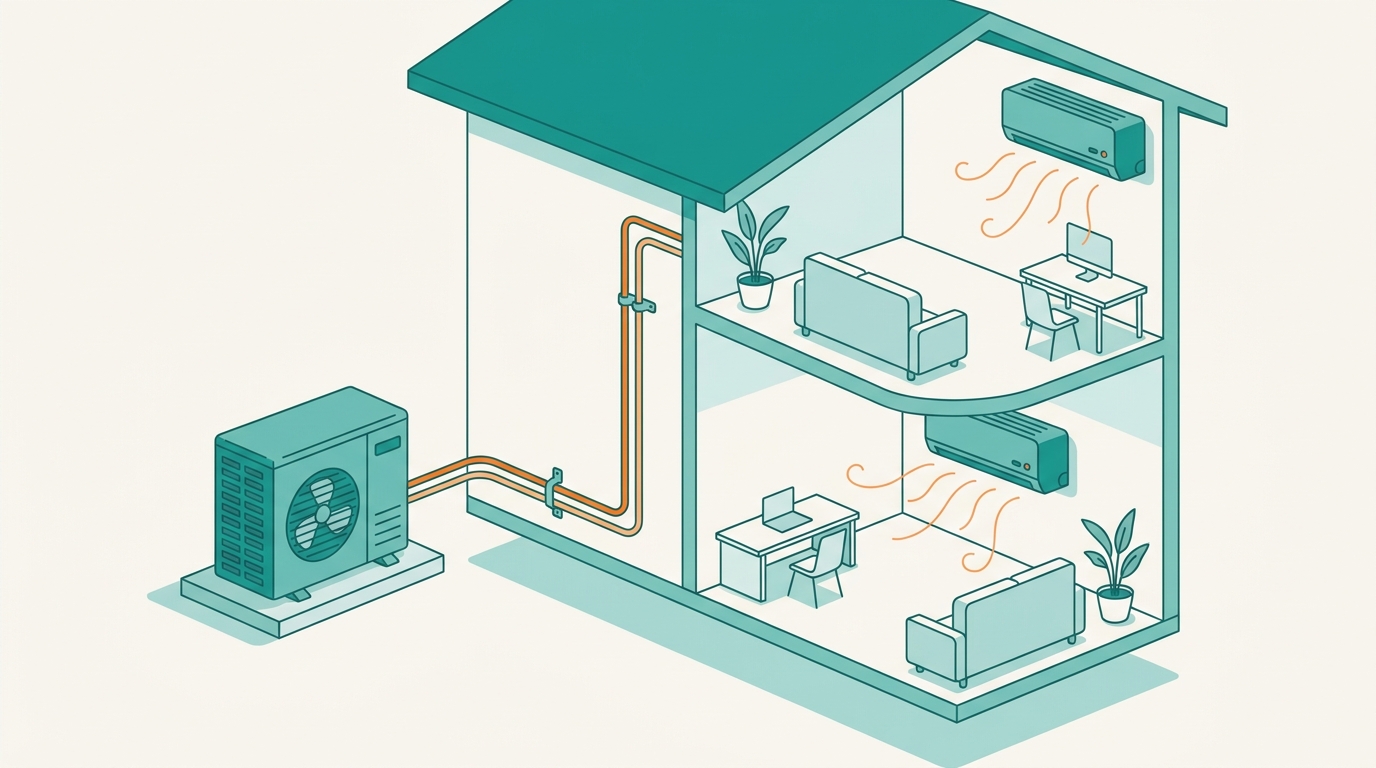
Here are concrete 2026 numbers, what moves them, and where homeowners overspend. If you want a place to keep quotes and scope notes so you can compare apples to apples, start a draft in My Plan.
On this page
- What a ductless mini split costs installed in 2026
- Equipment vs labor split
- What drives mini split cost (and how to spot it on a quote)
- 1) Number of heads and zones
- 2) Line-set length and routing difficulty
- 3) Electrical and panel capacity
- 4) Cold-climate (ccASHP) model
- 5) Brand and efficiency tier (SEER2 / HSPF2)
- 6) Indoor unit type and finish quality
- Single-zone vs multi-zone vs ducted
- Single-zone ductless
- Multi-zone ductless
- Ducted vs ductless mini split
- Cold-climate options that actually hold up
- Sizing: Manual J and the oversizing trap
- Operating cost and efficiency
- Rebates and the 2026 tax-credit reality
- DIY and precharged kits: the real caveats
- Maintenance
- Who a ductless mini split is best for
- Quote checklist (printable)
- If you only do three things
- Next steps
What a ductless mini split costs installed in 2026
The single biggest factor is how many indoor heads (zones) you need. A single-zone system carries the full cost of the outdoor unit, so it rarely drops below about $3,500 installed. After that, each added head costs less on equipment but not much less on labor, because every head needs its own line set, drain, wall penetration, and commissioning.
$3,500–$6,000
Single-zone, installed
one indoor head, simple run
$6,000–$15,000+
Multi-zone, installed
two to five heads, whole sections of a home
$2,000–$4,000
Per added zone
incremental cost once the outdoor unit is set
A rough way to think about it: the first zone is expensive because it buys the outdoor unit. Zones two through four are each cheaper than the first, but they are not free, and they stack up.
Installed cost by zone count (2026)
one head
common upgrade
whole-home
Another way contractors quote: roughly $2,000 to $4,000 per ton of cooling capacity installed, where a ton is 12,000 BTU. A single 12,000 BTU head in an easy room lands near the bottom of that. A multi-zone job with cassettes, long runs, and a panel touch lands well above it.
Equipment vs labor split
For a typical job, equipment is usually 50 to 70 percent of the total and labor is 30 to 50 percent. Licensed HVAC techs charge roughly $75 to $150 an hour, and a clean single-zone install takes most of a day. Multi-zone work runs into multiple days, which is why labor climbs faster than the equipment list suggests. When a bid looks unusually cheap, the gap is almost always in labor scope: a shorter line-set allowance, no permit, or a vague drain plan.
What drives mini split cost (and how to spot it on a quote)
These are the levers that move a budget, in rough order of impact.
1) Number of heads and zones
This is the dominant cost. Every head is a small project: mount, line set, drain, penetration, commissioning. I once reviewed a three-head job where the homeowner assumed three heads would cost about three times one head. It did not, and the reason was good news: the second and third heads shared the outdoor unit and the crew was already on site. The bad news on a different job: a fourth head sat on the far side of the house, and the line-set run alone added about $800 in materials and labor over the closer heads. Distance to the outdoor unit matters per head, not just overall.
2) Line-set length and routing difficulty
The refrigerant line set, drain, and wiring all have to find a clean path from each head to the outdoor unit. A short run through an exterior wall is cheap. A long run that has to climb an attic, cross the house, or hide inside a chase is where labor and material stack up. Long runs can also need extra refrigerant and can shave a little capacity. Ask the contractor to mark the route on a photo of your house. If they can sketch it, they have thought it through.
3) Electrical and panel capacity
Many installs are a single new 240V circuit and a disconnect. Some trigger a subpanel or a full service upgrade, which can add well over a thousand dollars on its own. If your panel is near capacity or you are adding several heads plus other electric loads, get the electrical scope priced explicitly, not assumed.
4) Cold-climate (ccASHP) model
A true cold-climate unit has a variable-speed (inverter) compressor engineered to hold output in deep cold. It costs somewhat more than a standard model. It is worth it where winters bite: the payoff is fewer hours on expensive backup heat, not a lower sticker. More on this below.
5) Brand and efficiency tier (SEER2 / HSPF2)
Premium brands (Mitsubishi, Fujitsu, Daikin) cost more than value brands, and within any brand, higher efficiency costs more. Ductless mini splits can reach SEER2 ratings as high as 35 and HSPF2 in the 11 to 14 range at the top of the market. You rarely need the absolute top tier; you need the efficiency that pays back in your climate and at your electric rate.
6) Indoor unit type and finish quality
Wall-mounted heads are the simplest and cheapest. Ceiling cassettes and floor consoles solve layout problems but add labor and finish work. Line-hide covers, clean penetrations, and proper sealing are not just cosmetic: sloppy exterior work invites water and pests. If a contractor shrugs at finish details, you will live with them.
Single-zone vs multi-zone vs ducted
Single-zone ductless
Best value when you are fixing one specific problem: a bedroom that never gets comfortable, a finished attic, a sunroom, or a home office that needs its own control. One line set, one drain, one location. This is also the easiest case for a DIY-curious owner.
Multi-zone ductless
Right when you genuinely need independent control in several closed-door rooms. The tradeoff: one outdoor unit feeds multiple heads, so a single condenser failure takes every connected head offline, and the install is more complex to commission and balance. Many homes do fine with fewer heads than the first sales sheet shows, if interior doors stay open most of the time and rooms share sun exposure and usage. You can buy comfort without buying a head in every room.
Ducted vs ductless mini split
A ducted (short-run or concealed) mini split uses a compact air handler feeding several rooms through small ducts. It looks cleaner than heads on every wall and distributes air more evenly, but it costs more in labor and needs space for the ductwork. A common, sensible hybrid: a ducted air handler for a cluster of bedrooms upstairs, plus a ductless head or two where running duct is impractical. If you are weighing whole-home heating approaches, our heat pump vs furnace in winter guide and the broader heating and cooling upgrade hub walk through the bigger decision.
Cold-climate options that actually hold up
If you heat with a mini split where it gets cold, the spec sheet column that matters is capacity at 5°F, not the 47°F headline. NEEP's cold-climate spec requires a qualifying unit to hold roughly 70 to 100 percent of rated capacity at 5°F, with an HSPF2 around 8.5 or higher; a standard unit may keep only 50 to 60 percent. Two units with the same 47°F rating can perform very differently in a cold snap.
I had a cold-climate single-zone install in a New England bedroom that held its rated output down to about 5°F without the home's resistance backup ever firing on a normal winter night. The variable-speed compressor spins up to compensate as it gets colder, so you skip the COP-1 resistance hours that drive scary deep-cold bills. Size to your design temperature and the 5°F capacity, and check the model against NEEP's free product list.
Sizing: Manual J and the oversizing trap
The most expensive sizing mistake is buying too much. The right method is a Manual J load calculation for each space, not a square-footage rule of thumb.
Oversizing feels safe and is not. An oversized head short-cycles: it blasts to temperature, shuts off, and never runs long enough to wring humidity out of the air. In a humid summer that leaves rooms cool but clammy, and an oversized unit can run 5 to 20 percent less efficiently in cooling than a right-sized inverter. I have seen an oversized single head in a small bedroom that short-cycled so badly the owner complained it felt drafty and damp despite hitting the setpoint. The fix was a smaller head, which also cost less.
Inverter compressors modulate across a range, so right-sizing to the actual load gives steadier temperatures, better dehumidification, and longer equipment life. Ask each contractor to show the load numbers behind every head. To sanity-check capacity and operating cost for your own rates and climate, run the Heat Pump Calculator.
Operating cost and efficiency
Running cost depends on your electric rate and the unit's efficiency. A high-SEER2 inverter mini split delivers more cooling per kWh than older central AC, and a high-HSPF2 model delivers more heat per kWh than resistance heat. As a rough heating benchmark, a heat pump running at a seasonal COP near 2.5 delivers heat at roughly a third of the cost of electric resistance strips at the same electricity price. Where mini splits get expensive to run is when an undersized or non-cold-climate unit leans on resistance backup in deep cold. Pick the right efficiency tier for your climate and rate rather than the highest number on the shelf.
Rebates and the 2026 tax-credit reality
This changed recently, so be precise.
The federal 25C credit ended after 2025
The federal 25C Energy Efficient Home Improvement Credit covered qualifying heat pumps and mini splits at 30 percent of cost, up to a $2,000 annual cap. Under the One Big Beautiful Bill Act, that credit ended after December 31, 2025. Installs completed in 2026 do not qualify for the federal credit. If your system was placed in service (fully installed and running, not just contracted or deposited) by the end of 2025, you can still claim it on the tax return you file in 2026.
State and utility rebates are separate and still available. Depending on where you live, mini split and heat pump rebates commonly range from a few hundred dollars to several thousand, and some state programs funded through the federal Home Energy Rebates can be larger for income-qualified households. Check your state energy office and your electric utility before you sign, and keep the paperwork requirements in your plan so a rebate is not lost to a missing form. For a fuller breakdown of which rooms and approaches qualify, our mini split cost installed guide goes deeper on scope, and the dual-fuel heat pump and furnace guide covers pairing with gas backup.
DIY and precharged kits: the real caveats
Precharged DIY mini split kits are real and tempting. A single-zone kit runs roughly $1,500 to $3,500, which looks like a bargain against an installed quote. Before you buy one, weigh the caveats:
- Warranty. Many manufacturer warranties require professional installation. A self-install can void coverage on a unit you will own for 15 years.
- Refrigerant and vacuum. Even precharged kits need correct flares and, ideally, a proper vacuum and leak check. A bad flare leaks slowly and kills the compressor early.
- Electrical code. A 240V circuit and disconnect must meet code and, in most places, be permitted and inspected.
- Condensate. A drain that pitches the wrong way floods a wall cavity months later.
DIY can work for a handy owner on a simple single-zone run with an easy line-set path. Multi-zone, cold-climate, or anything that touches the panel is usually a job for a licensed installer.
Maintenance
Mini splits are low-maintenance, not no-maintenance. Plan to rinse or wash the indoor filters every month or two during heavy use, keep the outdoor unit clear of leaves and snow, and have a tech do a deeper coil and drain cleaning every year or two. If your install uses a condensate pump, that pump is the most likely thing to fail and the most likely to get noisy, so know where it is and how it gets serviced. Neglected filters and blocked coils quietly erode the efficiency you paid for.
Who a ductless mini split is best for
- Homes without ductwork that want efficient heating and cooling without tearing into walls.
- Specific problem rooms: additions, attics, sunrooms, bonus rooms, offices.
- Owners who want room-by-room control and quiet operation.
- Cold-climate homes, with a true ccASHP model sized to design temperature.
It is a weaker fit when you already have good ductwork and want whole-home conditioning from one system, where a ducted heat pump may be cheaper per square foot, or when you want heads in many rooms but doors stay open anyway.
Quote checklist (printable)
Bring this to every bid so you compare without guessing.
Scope and sizing
- Which rooms are served by which head? (locations shown)
- Manual J or equivalent load numbers behind each head
- Exact model numbers (outdoor + each indoor head), with 5°F capacity if cold-climate
- How backup heat is handled, if relevant
Routing and drainage
- Where do the line sets run? (photo markup or sketch)
- Gravity drain or pump? If pump, where and how is it serviced?
- Who is responsible for patching and finish work?
Electrical and permits
- Disconnect and circuit included? Any panel or subpanel work anticipated?
- Permits and inspection included? Who pulls them?
Commissioning and warranty
- Commissioning steps (vacuum, leak check, charge verification)
- Labor warranty length and who handles service calls
- Maintenance needed to keep the warranty valid
If you only do three things
- Force routing clarity: line-set path and drain plan in writing.
- Challenge zone count: heads should match real needs, not a sales script.
- Track scope consistently across bids so missing items do not surprise you later. Keep it in My Plan.
Next steps
- Compare central and ducted approaches: heat pump installation cost
- Size and price for your own rates: Heat Pump Calculator
- Decide heat pump vs furnace for winter: heat pump vs furnace in winter
- See the broader options: heating and cooling upgrades
Sources & further reading
- Ductless Mini-Split Air Conditioners — U.S. Department of Energy
- Ductless Minisplit Heat Pumps — U.S. Department of Energy
- Ductless Heating & Cooling — ENERGY STAR
- Cold Climate Air Source Heat Pump Specification & Product List — Northeast Energy Efficiency Partnerships (NEEP)
- Energy Efficient Home Improvement Credit (25C) — Internal Revenue Service
Frequently asked questions
How much does a ductless mini split cost installed in 2026?+
A single-zone ductless mini split runs about $3,500 to $6,000 installed in 2026, and most multi-zone systems land between $6,000 and $15,000 or more. Price scales with the number of indoor heads, not just system size: budget roughly $2,000 to $4,000 per added zone once the outdoor unit is in place. A 2-3 zone system typically costs $6,000 to $11,000, and whole-home setups of four or more heads commonly reach $11,000 to $18,000. Cold-climate (ccASHP) models, long line-set runs, and electrical panel work push you toward the top of each range.
What is the cost per zone or per head for a mini split?+
Expect about $2,000 to $4,000 per indoor head once the outdoor condenser is installed, because each head adds its own line set, condensate drain, wall penetration, and commissioning time. The first zone carries the cost of the outdoor unit, so a single-zone system rarely drops below $3,500 installed. Adding heads gets cheaper per zone on equipment but not on labor, which is why a 4-head job is not simply four times a 1-head job.
What drives the price of a mini split installation?+
The biggest cost drivers are the number of indoor heads and zones, line-set run length and routing difficulty, electrical and panel capacity, whether you need a cold-climate model, and brand plus efficiency tier (higher SEER2 and HSPF2 cost more). Long or hidden line sets, condensate pumps, a service or panel upgrade, and ceiling cassettes versus simple wall heads all add cost. Labor is typically 30 to 50 percent of the total.
Is a single-zone or multi-zone mini split better?+
Single-zone is the better value when you are solving one comfort problem, like a hot bedroom, addition, or office, because you pay for one line set and one drain. Multi-zone makes sense when you genuinely need independent control in several closed-door rooms. Multi-zone trades one outdoor unit for far more complexity, and a single outdoor-unit failure takes every connected head offline. Many homes do well with fewer heads than a salesperson proposes if doors stay open and rooms share sun and usage.
Do mini splits work in cold climates?+
Yes, if you choose a cold-climate (ccASHP) model. NEEP's cold-climate spec requires holding at least 70 to 100 percent of rated capacity at 5°F and an HSPF2 around 8.5 or higher, where a standard unit may keep only 50 to 60 percent. Size to the 5°F capacity column and your design temperature, not the 47°F headline rating. Cold-climate units cost somewhat more upfront but run resistance backup far fewer hours, which is where deep-cold electric bills come from.
Can I install a mini split myself with a DIY kit?+
Precharged DIY kits exist and can run $1,500 to $3,500 for a single zone, which looks cheap against an installed quote. The catch is that warranty validity, refrigerant handling, electrical code, condensate routing, and proper vacuum and leak-checking still apply. Many manufacturer warranties require professional installation, and a bad flare or skipped vacuum causes leaks and short equipment life. DIY can work for a handy owner on a simple single-zone run; most multi-zone, cold-climate, or panel-touching jobs should be professional.
Is there a federal tax credit for a mini split in 2026?+
No. The federal 25C credit that covered heat pumps and mini splits at 30 percent up to a $2,000 annual cap ended after December 31, 2025 under the One Big Beautiful Bill Act. Installs completed in 2026 do not qualify for the federal credit. If your system was placed in service (fully installed and running) by the end of 2025, you can still claim it on the tax return you file in 2026. State and utility rebates are separate and still available, often $500 to several thousand dollars.
How is a mini split sized, and why does oversizing matter?+
Proper sizing uses a Manual J load calculation for each space, not a square-footage rule of thumb. Oversizing is the common mistake: an oversized head short-cycles, dehumidifies poorly, and can run 5 to 20 percent less efficiently in cooling while feeling less comfortable. Inverter compressors handle a range of output, so right-sizing to the actual load gives steadier temperatures, better humidity control, and longer equipment life. Ask the contractor to show the load numbers behind each head.
What does a mini split cost to run?+
Operating cost depends on your electric rate and the unit's efficiency. A high-SEER2 inverter mini split in cooling and a high-HSPF2 model in heating both deliver more output per kWh than older central systems or resistance heat. As a rough heating comparison, a heat pump at COP 2.5 delivers heat at about a third of the cost of electric resistance strips at the same rate. Run your own electric and gas numbers rather than a national average.
Ducted or ductless mini split, which should I choose?+
Ductless puts a head in each room with no ductwork and is simplest to retrofit. A ducted (short-run or concealed) mini split air handler serves several rooms through compact ducts, which looks cleaner and distributes air more evenly but costs more in labor and needs space for the ducts. Many homes mix the two: ducted for a cluster of bedrooms, ductless heads where running duct is impractical.
Try the companion tool
This post links to an interactive tool built for this topic. Open it to see numbers tailored to your home.
Open the toolGet practical energy tips
Join homeowners getting practical tips on cutting energy bills and staying comfortable.
Practical tips only. Unsubscribe anytime.
Read this next
Related guides selected by topic overlap and upgrade path.
Mini split cost installed: about $3,000–$6,000 for one zone, $8,000–$18,000+ whole-home in 2026. Real 2026 prices by zone count and BTU.
Heat pump installation costs $6,000 to $18,000 in 2026, about $12,000 to $14,000 for a typical ducted home. See costs by size and type, and how to compare bids.
Most homes pay $6,000–$18,000 to install a heat pump in 2026. Estimate yours by tonnage and system type, then run your own numbers before you call anyone.

Air duct replacement costs $1,400–$7,000 (avg ~$3,500), or about $9–$25 per linear foot. See pricing by home size, material, and when sealing beats replacing.