Mini-Split Sizing Calculator
This tool helps you find a mini-split BTU size to compare. Floor area is only the starting point. The tool also considers ceiling height, sun, insulation, air leaks, people, kitchen use, and winter heating needs.
1Describe the zone
2Add internal and winter loads
Check the maker's heating output at your local winter design temperature.
Starting size to compare
15,000 BTU/h
This equals about 1.25 rated tons for an early product search.
Estimated cooling load
12,000 BTU/h
Estimated heating load
13,200 BTU/h
Next step
Get a full Manual J
Check heating output at the local winter design temperature.
Mini-splits can change their output, so rated size is only part of the choice. Also compare minimum output, cold-weather capacity, defrost, indoor head location, condensate drainage, and the exact model data.
Inputs stay in this browser. No account or quote request is required.
Quick planning answer
A typical room of 450 to 550 square feet often starts near 12,000 BTU/h for cooling. Strong sun, high ceilings, weak insulation, a nearby kitchen, or cold-weather heating can raise the needed size. A tight, shaded bedroom may need less.
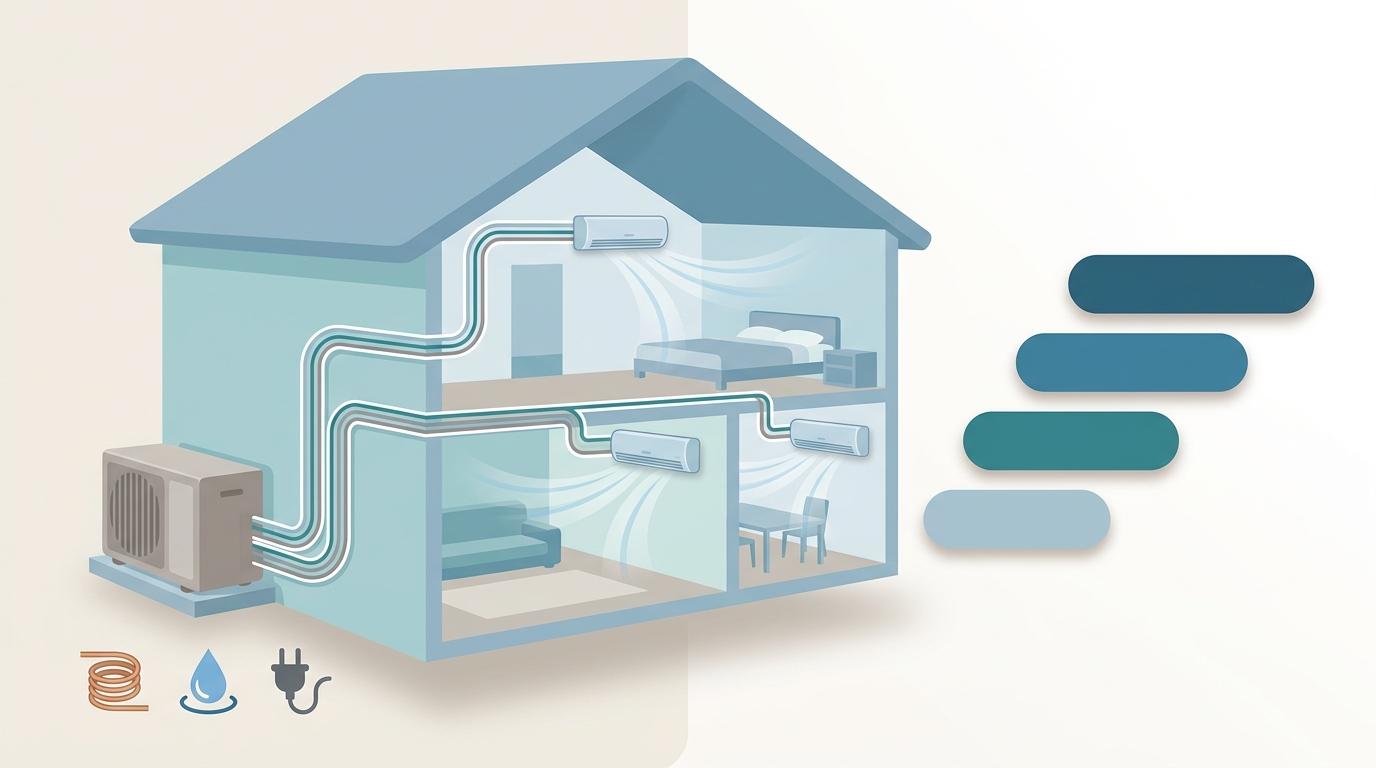
Treat closed rooms as separate spaces
An open living and dining area may work as one zone. A closed bedroom down the hall is different. Warm or cool air may not travel through a narrow doorway and around two corners. A multi-head system needs a load calculation for every room it serves. The outdoor unit must also support the full group of indoor heads.
Indoor head location affects comfort. A unit can have the right capacity but still cycle off too soon if nearby air returns to it before reaching the far side of the room.
Check how much heat it makes in cold weather
An 18,000 BTU label does not mean the unit will make 18,000 BTU at every outdoor temperature. Read the full capacity table at your area's winter design temperature. Include defrost and drain-pan heater power. ENERGY STAR's cold-climate label is a useful first check, but the exact model data matters most.
- Check heating output and COP at the local design temperature.
- Check the lowest output in mild weather. A unit that is too large may turn on and off too often.
- Plan a condensate drain with enough slope, freeze protection, and an end point that can be serviced.
- Check refrigerant-line length, height difference, charge changes, the disconnect, and surge protection.
Home improvements may lower the needed size
Air sealing and attic work can lower the heating and cooling load. Do that work before the Manual J calculation when possible. You may be able to use a smaller, quieter system with fewer indoor heads and wall openings.
Use this result to compare product lines. Before buying, use a room-by-room Manual J and the maker's performance data. If a contractor sizes only by floor area, ask what they assumed about windows, insulation, air leaks, and outdoor design temperatures.
Questions people ask before buying
How many BTU does a 500 sq ft room need?
About 12,000 BTU/h is a common cooling starting point for 450 to 550 square feet under normal room conditions. Ceiling height, sun, kitchen use, insulation, air leaks, people, and heating needs can change the size.
Is 18,000 BTU too large for 500 sq ft?
It may be too large for an average closed room. A high-load open area or a unit used as the main heat source in a cold climate may need more. Compare the room load with both the highest and lowest output of the exact model.
Can one mini-split heat several bedrooms?
One wall head works best in open, connected space. Closed bedrooms often need their own airflow path, a small ducted unit, another indoor head, or another heat source to stay comfortable with the doors shut.
Why does Manual J matter for variable-speed equipment?
Variable-speed equipment can adjust its output, but correct sizing still matters. A unit that is too large may remove less humidity, create drafts, cost more, and fail to serve far rooms well.
Method, sources and limits
The cooling starting point comes from ENERGY STAR's room air-conditioner size table. The tool adjusts for ceiling height and changes the result by 10% for heavy shade or strong sun. It adds 600 BTU/h for each regular person beyond two. It also adds 4,000 BTU/h for an open kitchen.
The tool makes a separate heating estimate from the insulation, air leakage, and climate choices. If the mini-split will be the main heat source, the larger heating or cooling load sets the next standard size. This is only a first check. It is not a Manual J calculation.
- Room air-conditioner capacity chart and adjustments (ENERGY STAR)
- Ductless heating and cooling (ENERGY STAR)
- Heat-pump systems, including minisplits (U.S. Department of Energy)