Blog
Are Solar Panels Worth It in 2026? An Honest Payback Check
Are solar panels worth it in 2026? The 30% federal credit ended Dec 31, 2025. Here is the payback math an engineer actually uses: real costs, net billing, batteries, and when to walk away.
If you are asking whether solar panels are worth it in 2026, you want a straight answer, not a sales pitch. Here is the honest version, and it starts with a change most articles still get wrong.
The big shift for 2026 is that the 30% federal solar tax credit is gone for homeowners. The Section 25D Residential Clean Energy Credit was terminated by the One Big Beautiful Bill Act for any system placed in service after December 31, 2025. If you read a guide that still says "30% through 2032," it is out of date. That one number drives the whole decision, and getting it wrong overstates your savings by a wide margin.
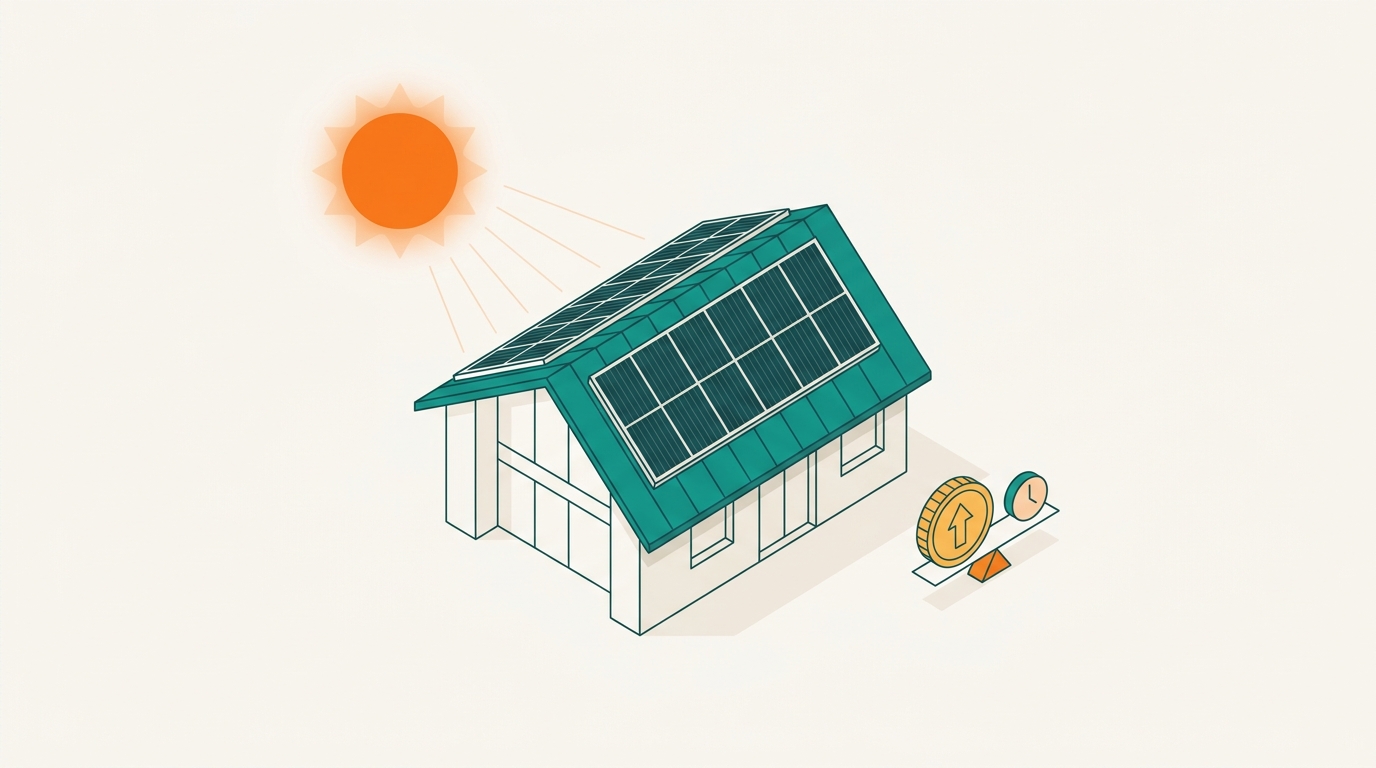
Solar still pays off for a lot of homes. It just pays off slower than it did last year, and the gap between a good install and a bad one is now wider. The way to decide hasn't changed: run the payback math with your numbers, then stress-test the assumptions.
$0
Federal tax credit in 2026
25D credit ended Dec 31, 2025 for homeowner-owned systems
~43%
Effective cost increase
From losing the 30% credit
9–14 yr
Typical payback now
Average markets, cash purchase
~0.5%/yr
Panel degradation
~85–90% output after 25 years
On this page
- The 2026 federal tax credit reality (read this first)
- The 60-second payback check
- The four levers that decide if it's worth it
- 1. Your electricity rate
- 2. Sun and production (roof orientation and shading)
- 3. Net metering vs net billing (what exports are worth)
- 4. Net system cost
- What you're actually buying: solar only vs solar plus battery
- When solar is NOT worth it in 2026
- Cash vs loan vs lease/PPA
- A decision table you can use
- Questions to ask every installer
- System scope
- Economics
- Roof, warranty, resale
- Red flags
- If you only do three things
- Frequently asked questions
The 2026 federal tax credit reality (read this first)
Through 2025, a homeowner who bought a $30,000 system could claim a $9,000 federal credit. That is over. The IRS guidance on the One Big Beautiful Bill is explicit: the credit "will not be allowed for any expenditures made after December 31, 2025," and "if installation is completed after December 31, 2025, the expenditure will be treated as made after December 31, 2025, which will prevent the taxpayer from claiming the section 25D credit." Paying a deposit in 2025 did not lock it in; the system had to be installed and in use by year end.
So for 2026, plan on no 30% federal credit on a system you own. Three things sit outside that credit and may still help:
- State tax credits and rebates. Several states run their own programs. These vary widely and change often.
- Utility incentives. Some utilities offer upfront rebates or performance payments.
- Net metering. The rules that decide what your exported power is worth are set by your state and utility, not the federal government, and they did not change with this bill.
For the full breakdown of what survived, see Solar Tax Credit 2026: what's still available.
Watch the lease loophole
The business credit (48E) that funds many third-party leases and PPAs runs on a different, shorter timeline than the homeowner credit. Some installers are leaning hard on leases now precisely because the homeowner credit is gone. A lease can still make sense, but read the section on financing before you assume "free solar" is free.
The 60-second payback check
Do this before you talk to any installer.
Payback (years) ≈ Net system cost ÷ Annual bill savings
- Net system cost is your real out-of-pocket price after any state or utility incentives. In 2026 there is no federal credit to subtract.
- Annual bill savings is what your electric bill drops by in a normal year.
To estimate annual savings without pretending to be precise, use one of these:
- Bill method (easiest): Pull your last 12 months of electric bills. If solar would offset about X% of your usage, savings are roughly X% of your annual electric spend, adjusted for what your utility pays for exports.
- Production method: Estimated annual kWh produced × the value of each kWh (your retail rate if you self-consume it, or your export rate if you send it back).
The slippery part is "value per kWh." Under full net metering it is close to your retail rate. Under net billing it can be a quarter of that. More on this below.
The four levers that decide if it's worth it
1. Your electricity rate
This matters more than your latitude. A homeowner in cloudy Massachusetts paying 30 cents per kWh often has a better case than one in sunny Texas paying 11 cents. Pull your all-in rate from a recent bill, including delivery and fees, not just the supply charge. If you are under about 12 cents per kWh all-in, the math gets hard fast.
Field note: the rate, not the sunshine, is the number I check first
When I model these, the first thing I ask for is the last full bill, then I divide total dollars by total kWh to get the real all-in rate. People are routinely off by a third because they quote me the supply charge and forget delivery, demand, and fixed fees. I have seen a homeowner convinced they paid "9 cents" who was actually paying closer to 17 once everything was added up, which flipped the whole project from marginal to a clear yes. I have also seen the reverse: a glossy proposal that assumed a 3% annual rate escalator forever, which quietly doubled the projected savings. Strip the escalator out, use your true blended rate, and the payback you get is the one you can defend.
2. Sun and production (roof orientation and shading)
Same house, two roofs, two completely different outcomes. I reviewed two installs on the same street: a south-facing array with clean sightlines paid back in about 7 years, while the neighbor's north-facing array behind a row of oaks was shaded for much of the day and produced so little it never caught up. South or southwest with minimal shade is the target. East and west work with a haircut. North-facing, in the Northern Hemisphere, rarely justifies the cost.
3. Net metering vs net billing (what exports are worth)
This is the lever that changed the industry. Under traditional net metering, a kWh you export is worth about what you pay, so the grid acts like a free battery. Under net billing, the model many utilities are moving to, exports pay a low wholesale-style rate. California's NEM 3.0 is the headline example: export credits dropped from roughly 30 cents toward about 8 cents, a cut near 75%. I watched a household model their payback at 6 years under the old rules, then redo it after NEM 3.0 and land past 10 unless they added a battery.
Ask your installer, in writing: "What export rate or net metering assumption are you using, and where is it documented?"
4. Net system cost
Roughly $2.50 to $3.50 per watt installed before incentives is a normal 2026 range. An 8 kW system lands near $20,000 to $28,000; a 12 kW system near $30,000 to $42,000. With no federal credit, that number is now your real cost, so compare the cash price against any financed price carefully.
Simple payback by scenario (illustrative)
most homes
often a no
What you're actually buying: solar only vs solar plus battery
Solar only is the right call when you have true net metering and your goal is bill savings. The grid stores your surplus at near-retail value, so a battery adds cost without adding much return.
Solar plus battery earns its keep in two cases: you want backup power during outages, or your utility uses net billing with low export rates and a battery lets you store midday production for evening use instead of exporting it cheaply. Batteries add roughly $10,000 to $20,000 installed. Size them to a goal, not to a brochure. For current numbers, see Tesla Powerwall 3 installed cost and whole-house battery backup cost.
If you want to see how the numbers shake out years after install rather than in a sales projection, this walkthrough of a real five-year-old system is a good gut check on production, degradation, and what "worth it" looks like once the array has been on the roof a while.
When solar is NOT worth it in 2026
Be willing to say no. Solar is usually a poor fit when:
- Your roof needs replacing within 5 to 10 years. Solve the roof first, or you will pay to remove and reinstall the array. Treat the roof as Step 0.
- Heavy shade covers the array for much of the day.
- Your all-in electricity rate is very low, under about 12 cents per kWh.
- You are likely to move before payback, and you would be selling an unpaid lease or PPA.
- The only offer on the table is a lease or PPA with a steep annual price escalator.
Cash vs loan vs lease/PPA
- Cash gives the shortest payback and the most lifetime savings. If you can swing it, this wins.
- Loan can work, but watch for dealer fees baked into "low-rate" or "$0 down" financing. The common trick is that the financed price quietly runs thousands above the cash price. Always ask for the cash-equivalent number.
- Lease or PPA means you own nothing and save the least. It can also trap you at closing. I know of a sale that nearly fell apart because the buyer refused to assume a 20-year solar lease and the seller had to negotiate a buyout under deadline pressure. With no federal credit for homeowners to monetize in 2026, the old argument for third-party ownership is weaker than it used to be.
Field note: ask for the cash-equivalent price in writing
The cleanest tell I have found for a fair loan is to ask one question: "What is the cash price, and what is the financed price?" On a loan deal I helped a friend pick apart, the "$0 down, low APR" quote ran about $4,000 above the same installer's cash number, which is a dealer fee dressed up as a low rate. That gap is real money that comes straight out of your payback. If an installer dodges the question or only shows you a monthly payment, treat that as your answer and get another bid. The monthly number is designed to feel small; the cash-equivalent total is the number that decides whether this pays off.
A decision table you can use
| Situation | Often worth it when… | Often not worth it when… |
|---|---|---|
| Electricity rate | High all-in rate, above ~20¢/kWh | Low rate, under ~12¢/kWh |
| Roof | 15+ years of life remaining, south/southwest | Replacement due soon, north-facing |
| Shading | Minimal shade most of the day | Heavy shade for hours daily |
| Export rules | Full net metering | Net billing with low export rate and no battery |
| Financing | Cash, or a fair loan with no hidden fees | Lease/PPA with steep escalator |
Questions to ask every installer
System scope
- Panel count and total system size in kW
- Inverter type (string vs microinverters) and why they chose it
- Estimated annual production in kWh and the assumptions behind it
Economics
- The electricity rate used in the savings estimate
- The export or net metering rate assumed, and where it is documented
- Any utility-rate escalator baked into the savings projection
- Cash price vs financed price, with dealer fees disclosed
Roof, warranty, resale
- Roof condition and any required roof work before install
- Equipment warranty plus a separate workmanship warranty
- What happens at sale: warranty transfer, and for leases, contract assumption or buyout
Red flags
- Pressure to "sign today," especially door-to-door
- A lease or PPA pitched as the only option, with the cash price hidden
- Savings claims with no stated assumptions about rate, production, or exports
- A quote that ignores your roof's age or obvious shading
If you only do three things
- Run the payback check with your last 12 months of bills and your real all-in rate.
- Make every installer put their rate, export, and production assumptions in writing.
- Sanity-check timing against roof, electrical, EV, and HVAC plans in Upgrade Timing, then compare quotes in My Plan.
Ready to compare specific systems? Start at our solar upgrade hub.
Frequently asked questions
Is there a federal solar tax credit in 2026? No. For homeowner-owned systems there is no 30% federal credit in 2026. The Section 25D Residential Clean Energy Credit was terminated for any system placed in service after December 31, 2025. State rebates, utility incentives, and net metering are separate and may still apply. See Solar Tax Credit 2026.
Are solar panels worth it in 2026 without the tax credit? Often yes, but tighter. Losing the 30% credit raises your effective cost by about 43%, pushing average-market payback from roughly 6 to 9 years up to 9 to 13. Solar still pencils out well in high-rate, sunny states with fair net metering.
How much do solar panels cost in 2026? Roughly $2.50 to $3.50 per watt installed before incentives. A typical 8 kW system runs $20,000 to $28,000; a 12 kW system $30,000 to $42,000. With the federal credit gone, that is your real out-of-pocket cost unless a state or utility program lowers it.
Do I need a battery with solar? Not for bill savings alone if you have true net metering. Add one for backup power during outages, or to fix weak export economics under net billing. Batteries run about $10,000 to $20,000 installed.
When are solar panels NOT worth it? Skip or delay if your roof needs replacing within 5 to 10 years, heavy shade covers the array, your all-in rate is under about 12 cents per kWh, you will move before payback, or the only offer is a lease or PPA with a steep escalator.
Sources & further reading
- Residential Clean Energy Credit (Section 25D) — IRS
- FAQs for modification of sections 25C, 25D and others under the One Big Beautiful Bill — IRS
- Homeowners Guide to Going Solar — U.S. Department of Energy, EERE
- Solar Photovoltaic Technology Basics and Research — NREL
- Electric Power Monthly: average retail price of electricity — U.S. Energy Information Administration
Frequently asked questions
Is there a federal solar tax credit in 2026?+
No. For homeowner-owned systems there is no 30% federal tax credit in 2026. The Section 25D Residential Clean Energy Credit was terminated by the One Big Beautiful Bill Act for any system placed in service after December 31, 2025. To have qualified, installation had to be fully completed and the system in use on or before that date. State rebates, utility incentives, and net metering are separate programs and may still apply where you live.
Are solar panels worth it in 2026 without the tax credit?+
Often yes, but the math is tighter than it was in 2025. Losing the 30% credit raises your effective cost by roughly 43%, so payback that used to land near 6 to 9 years now runs closer to 9 to 13 years in average markets. Solar still pencils out well in high-rate, sunny states with fair net metering. Skip it if your roof is shaded, your electricity rate is under about 12 cents per kWh, or the roof is near the end of its life.
How long do solar panels take to pay back in 2026?+
Payback is your net system cost divided by annual bill savings. In strong markets (high rates, good sun, full net metering, paying cash) expect roughly 8 to 12 years. In average markets, 10 to 14 years. On a shaded roof, a low-rate utility, or under a poor export rate like California's net billing, 15 to 25 years or never. Production losses of about 0.5% per year slightly lengthen real payback.
How much do solar panels cost in 2026?+
Installed residential solar runs roughly $2.50 to $3.50 per watt before any incentives. A typical 8 kW system lands near $20,000 to $28,000, and a 12 kW system near $30,000 to $42,000. With the 30% federal credit gone, that is now your real out-of-pocket number unless a state or utility incentive lowers it. Cash deals are cheapest; loans add interest and dealer fees; leases and PPAs cost the most over time.
What is net metering and net billing, and why does it matter?+
Net metering credits exported solar at or near the full retail rate, so every kWh you send back is worth about what you pay. Net billing (such as California's NEM 3.0) pays a much lower wholesale-style export rate, often around 8 cents versus a 30-plus-cent retail rate, a cut of roughly 75%. Under net billing, payback depends heavily on using power as you make it or storing it in a battery rather than exporting.
Do I need a battery with solar in 2026?+
Not for bill savings alone if you have true net metering. A battery makes sense for backup power during outages, or to capture value where your utility uses net billing with low export rates. Batteries add roughly $10,000 to $20,000 installed, so add one for resilience or to fix weak export economics, not by default. See our Tesla Powerwall 3 and whole-house battery cost guides for current numbers.
When are solar panels NOT worth it?+
Skip or delay solar if your roof needs replacement within 5 to 10 years, if heavy shade covers the array for much of the day, if your all-in electricity rate is very low (under about 12 cents per kWh), if you plan to move before payback, or if the only offer is a lease or PPA with a steep annual escalator. Renters generally cannot benefit from rooftop solar economics.
Should I buy, finance, or lease solar panels?+
Paying cash gives the shortest payback and the most lifetime savings. A fair-rate solar loan can work but watch for hidden dealer fees that inflate the cash-equivalent price. Leases and PPAs mean you own nothing, save the least, and can complicate a home sale because the buyer must assume or buy out the contract. With no tax credit to monetize in 2026, the old argument for third-party ownership is weaker than it was.
Do solar panels add value when I sell my home?+
Owned, paid-off systems generally add resale value because the buyer inherits lower bills. A leased or PPA system cuts the other way: it can stall a sale at closing if the buyer will not assume the contract and the seller cannot easily buy it out. If you may sell within a few years, factor that in before signing anything you do not own outright.
How long do solar panels last and how fast do they degrade?+
Quality panels are warrantied for 25 years and commonly produce for longer. Output fades slowly, around 0.5% per year, so a panel still makes roughly 85 to 90% of its original power after 25 years. Inverters typically need replacement once in that span. Build that gradual fade into your payback estimate from the start.
Try the companion tool
This post links to an interactive tool built for this topic. Open it to see numbers tailored to your home.
Open the toolGet practical energy tips
Join homeowners getting practical tips on cutting energy bills and staying comfortable.
Practical tips only. Unsubscribe anytime.
Read this next
Related guides selected by topic overlap and upgrade path.
Tesla Powerwall 3 installed cost in 2026 is about $13,000 to $16,500 all-in (battery, Gateway, labor, permits). The 30% federal credit is gone. Full breakdown.

Heat pump installation costs $6,000 to $18,000 in 2026, about $12,000 to $14,000 for a typical ducted home. See costs by size and type, and how to compare bids.

Air duct cleaning costs $300 to $700 for a typical home (about $35 per vent). Honest 2026 guide: what gets upcharged, and why most homes do not need it.
Attic insulation costs about $1,500 to $3,500 for a typical home, or $1.50 to $4 per sq ft. See 2026 prices by material, attic size, and tax credit.