Blog
Attic Insulation Removal Cost (2026): $1–$2/sq ft, Plus Contamination Surcharges
Attic insulation removal costs $1–$2 per sq ft, or about $1,600–$3,600 for a typical attic. Rodents, mold, or asbestos push it far higher. Here's the honest 2026 breakdown.
If you are searching "attic insulation removal cost," here is the short answer: removing clean, dry insulation runs about $1 to $2 per square foot, or roughly $1,600 to $3,600 for a typical 1,600 to 1,800 sq ft attic. The price jumps fast once contamination enters the picture, and a fair number of homeowners do not actually need removal at all.
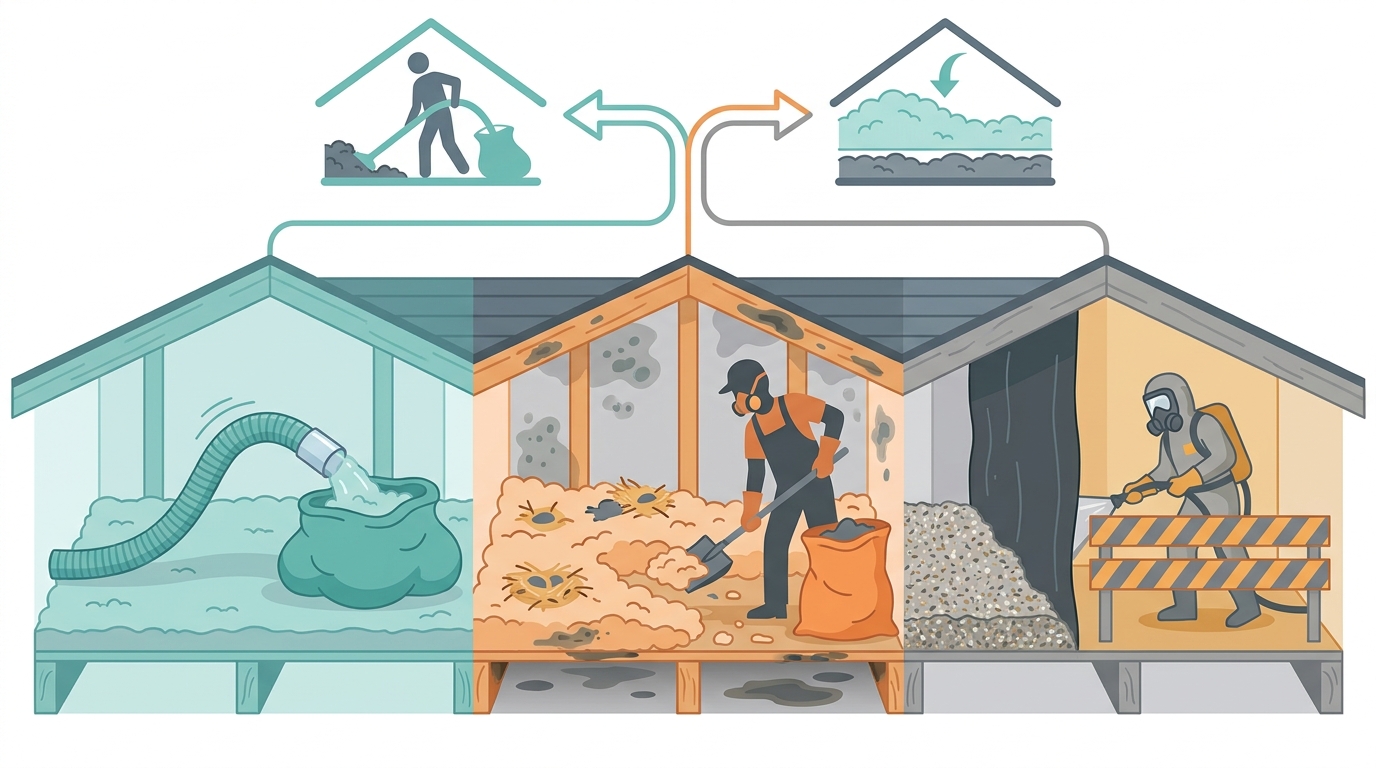
The range is wide because "removal" is really three different jobs wearing the same name: a clean vacuum-out, a contaminated cleanup, and a hazardous-material abatement. Each one has its own price floor. Below is the honest 2026 breakdown, the surcharges that catch people off guard, and a blunt section on when you can skip removal and save the money.
$1,600–$3,600
Typical clean removal
1,600–1,800 sq ft attic, no contamination
$1–$2/sq ft
Clean removal rate
Blown-in low end, batts/rigid high end
$10–$25/sq ft
Asbestos abatement
Licensed crew only; $1,000–$11,000+
$2–$6/sq ft
Remove + re-insulate
Roughly $3,200–$10,800 bundled
Before you book anyone, run your own numbers. Our attic insulation calculator lets you plug in your attic size, climate zone, and energy rates to see whether the full remove-and-replace project pays back in comfort and bills, or whether targeted work is the smarter spend. Use it to pressure-test any quote that bundles removal, air sealing, and new insulation into one number.
On this page
- The core cost: clean removal by attic size
- What drives the price
- The contamination surcharges, line by line
- Rodent droppings and nesting
- Mold and water damage
- Vermiculite and asbestos
- DIY vacuum rental vs hiring a pro
- The honest question: do you even need removal?
- Re-insulation cost (what comes after removal)
- Tax credits and rebates in 2026
- Red flags and common mistakes
- Frequently asked questions
- Next steps
The core cost: clean removal by attic size
For insulation that is dry, intact, and free of pests or mold, removal is priced per square foot of attic floor. Blown-in cellulose and fiberglass sit at the low end because a truck-mounted vacuum sucks them out fast. Batts, rolls, and rigid foam board sit higher because a crew pulls and bags them by hand.
| Attic size | Clean removal (≈$1–$2/sq ft) | Remove + re-insulate (≈$2–$6/sq ft) |
|---|---|---|
| 600 sq ft | $600 – $1,200 | $1,200 – $3,600 |
| 800 sq ft | $800 – $1,600 | $1,600 – $4,800 |
| 1,000 sq ft | $1,000 – $2,000 | $2,000 – $6,000 |
| 1,500 sq ft | $1,500 – $3,000 | $3,000 – $9,000 |
| 2,000 sq ft | $2,000 – $4,000 | $4,000 – $12,000 |
Assuming non-hazardous, non-contaminated insulation with normal attic access. The U.S. average attic is 1,600 to 1,800 sq ft. Disposal of clean material is usually folded into these figures; contamination, tough access, and hazardous materials are billed separately. Sources: HomeGuide and Angi 2026 cost data.
A note on the per-foot rate itself. National marketplaces quote $1 to $2 per square foot, but regional insulation companies often publish tighter numbers. Bird Family Insulation lists removal "starting at $1.50 and climbing to $1.75 per ft²," and Crawl Pros in the Pacific Northwest cites $1.50 to $3 per square foot once junk and debris are mixed in. Yelp's marketplace data runs lower, $0.75 to $2.25 per square foot. So $1.50/sq ft is a reasonable middle for a straightforward blown-in job. Labor alone tends to run $35 to $85 per hour, or $0.50 to $1.75 per square foot within that total.
Attic insulation removal cost by scenario (1,500 sq ft attic)
the baseline job
slower, more labor
adds sanitizing + sealing
$4.50–$6/sq ft and up
licensed crew, $10–$25/sq ft
What drives the price
Five things move the number more than anything else.
-
Insulation type and removal method. Loose blown-in material vacuums out through a 6-inch hose into a truck, which is fast and cheap. Batts, rolls, and rigid foam have to be cut, pulled, bagged, and carried out by hand. Rockwool (mineral wool) is abrasive and can chew up vacuum equipment, nudging the price up. Spray foam bonded to the deck or joists is the worst case; it often has to be scraped or cut and rarely comes out cleanly.
-
Attic access and geometry. A low-slope attic with a tiny scuttle hatch, knee-walls, ductwork, and stored junk slows a crew to a crawl. Hard-to-reach sections can add up to $1 per square foot on their own. The distance from the attic hatch to the truck matters too, since every foot of hose reduces vacuum power.
-
Contamination. This is the line item that turns a $2,000 job into a $7,000 one. More on the surcharges below.
-
Depth and climate. Northern attics are insulated thicker to hit R-49 to R-60, so there is simply more material to haul out than in a Southern R-38 attic. Expect a modest premium in cold climates, roughly $700 to $1,200 versus $600 to $1,000 for the same footprint down South.
-
Disposal. Clean fiberglass and cellulose go to a regular landfill and disposal is usually baked into the quote. But a dedicated dumpster or dump runs $100 to $500, and contaminated or hazardous material costs far more to dispose of legally. Always ask whether disposal is included and where the material is going.
The number that surprises people
A clean removal quote and a contaminated-attic quote can differ by 3x to 5x for the exact same square footage. Many contractors carry a $1,500 to $3,000 minimum fee just for attic sanitation work, separate from the removal itself. If your quote seems shockingly high, the contamination scope, not the removal, is almost always the reason.
The contamination surcharges, line by line
Here is what stacks on top of a clean removal, with current 2026 ranges.
Rodent droppings and nesting
Mice, rats, squirrels, and bats foul insulation with urine, droppings, and nesting debris. The contaminated material has to come out, the space gets sanitized, and the entry points get sealed or the pests just come back.
- Pest removal: $150 to $600
- Cleanup, disposal of contaminated material, and disinfecting: $600 to $1,000
- Sealing entry points to prevent reinfestation: $100 to $800
Rodent droppings are a real health hazard. Deer mouse droppings can carry hantavirus, which is why dry sweeping or shop-vac DIY is a genuine health risk. This is a job to mask up for, or hand off.
Mold and water damage
Wet insulation loses most of its R-value and becomes a mold host. Remediation is priced by severity:
- Mold inspection: $300 to $650 (skip it if mold is already visible)
- Mold remediation: $1,225 to $6,000, and $15,000+ with structural damage
- Per-foot, contaminated removal climbs to $4.50 to $6 per square foot
Fix the water source first, a roof leak, a bath fan venting into the attic, condensation, or the new insulation just gets ruined again.
Vermiculite and asbestos
This is the one to be careful with. Vermiculite insulation, sold from the 1940s to the 1980s under the brand Zonolite, can contain asbestos. It looks like small, pebbly, gray-brown or gold flakes.
- Asbestos testing and inspection: $250 to $850
- Licensed asbestos abatement: $10 to $25 per square foot, or $1,000 to $11,000+ total
- Zonolite (ZAI Trust): you may be reimbursed up to 55% of removal cost
The EPA's guidance is blunt and worth repeating: if you have vermiculite insulation, assume it contains asbestos and do not disturb it. Sealing it off or leaving it undisturbed is often safer and far cheaper than removal. Never sweep, vacuum, or disturb suspected vermiculite yourself; disturbing it is what makes asbestos dangerous.
Do not DIY suspected asbestos
If your attic has pebbly vermiculite or any insulation in a pre-1990 home you cannot identify, stop. Test before you touch it. Asbestos abatement is licensed work in nearly every state, and improperly disturbing it is both a health hazard and, in many jurisdictions, a code violation. The $250–$850 test is cheap insurance.
DIY vacuum rental vs hiring a pro
For clean, dry, non-hazardous blown-in insulation, DIY is genuinely an option, and one of the most-watched videos on this topic walks through exactly that with a rental machine.
Here is the honest DIY math:
- Insulation removal vacuum rental: $200 to $350 per day (some big-box stores waive the fee if you buy a minimum amount of new insulation)
- Disposal bags, dump or dumpster fee: $100 to $500
- PPE: respirator, goggles, Tyvek suit, gloves, roughly $50 to $100
- Your time: a full day or two of hot, itchy, cramped work
A skip-the-machine warning from the field: a household shop-vac clogs almost immediately on blown-in material. You need the rated insulation vacuum with the wide hose, or you will spend the day fighting jams. Batts are different, you can hand-bag those without a machine, but expect a slow, scratchy afternoon.
So DIY can cut a $1,500 job to a few hundred dollars in hard costs. But it makes sense only when three things are true: the material is clean and dry, access is decent, and there is zero chance of asbestos. If any of those is off, the pro's containment, disposal, and liability coverage are worth every dollar.
| DIY vacuum rental | Hire a pro | |
|---|---|---|
| Hard cost (1,500 sq ft) | ~$350–$950 | $1,500–$3,000 |
| Time | 1–2 full days, yourself | 4 hrs–1 day, crew |
| Disposal | You haul it | Usually included |
| Contamination handling | Not safe to DIY | Trained + insured |
| Best for | Clean, dry, easy-access blown-in | Anything contaminated, hazardous, or tight |
The honest question: do you even need removal?
This is where most cost guides stop short. A lot of homeowners pay to remove insulation that did not need to come out.
Both the DOE and ENERGY STAR are clear that you can add new insulation directly over old to reach a higher R-value, as long as the existing layer is in good shape. Removal is the right call only in specific cases:
Remove it when:
- Insulation is contaminated by rodent droppings, urine, or nesting
- It is wet, moldy, or mildew-damaged
- It is hazardous (vermiculite/asbestos), and abatement is required
- You need to air-seal the ceiling plane and the old material is blocking access to top plates, chases, and penetrations
- It is compressed, settled flat, or so old (30+ years) it has lost its R-value and an even 14 to 18 inch blanket is gone
Skip removal when:
- The existing insulation is clean, dry, and pest-free, and you simply want more R-value (add on top)
- Your real problem is air leaks, not insulation depth, and you can seal without removing
- The cost of removal plus re-insulation does not pencil out against the comfort and bill savings
The cheapest version of this project is often targeted removal: pull insulation back from the major penetrations and top plates, air-seal those spots, then blow new insulation over everything. You get the air-sealing benefit, which is what actually stops drafts, without paying to gut the whole attic.
Field note: where the money actually goes
On a 1990s attic I walked in a mixed-humid climate, the homeowner had a $6,000 "clean it out and re-insulate" quote and assumed removal was the big line. It wasn't. The crew spent the first two hours just air-sealing top plates, the bath fan boot, and a wiring chase before a single bag of new cellulose went in. Removal was the cheap part. The sealing was the part that fixed the comfort complaint, and it would have worked even if they had left most of the old insulation in place.
Re-insulation cost (what comes after removal)
Removal is almost never the end. Budget for the new insulation in the same project:
- Blown-in (cellulose or fiberglass): $1.00 to $2.80 per sq ft installed
- Batts and rolls: $0.80 to $2.60 per sq ft, up to $4.70 to hit code R-value
- Spray foam: $1.50 to $5.00 per sq ft (more for the underside of the roof deck)
- Air sealing the attic: $350 to $3,000, and it should happen with the attic open
Target R-values: ENERGY STAR recommends R-38 for most attics, and R-49 to R-60 in cold climates. That historical climb is real. Attics built in the 1970s often sit at R-19, 1990s homes around R-38, and post-2011 code pushed R-49. If yours is shallow, removal plus a fresh blanket can genuinely cut heating and cooling, where the EPA estimates effective air-sealing and insulation save homeowners around 15% on those bills.
For the full picture on what the new layer costs, see attic insulation cost, blown-in insulation cost per sq ft, and attic air sealing cost. The broader insulation upgrades hub ties the sequence together.
Tax credits and rebates in 2026
Two things to get right for this year:
The federal 25C credit is gone for 2026 work. The One Big Beautiful Bill (Public Law 119-21, July 2025) terminated the 25C Energy Efficient Home Improvement Credit for any property placed in service after December 31, 2025. So new insulation and air sealing installed in 2026 no longer earn the old 30 percent credit (which was capped at $1,200 per year, materials only). Removal never qualified on its own either.
If you completed the insulation work in 2025, you can still claim it on the federal return you file for tax year 2025 using IRS Form 5695, so keep your itemized receipts. For 2026 installs, your real levers are state and utility rebates and the IRA-funded Home Energy Rebate programs rolling out through state energy offices. Check those local incentives before you sign, because they are now the main way to offset the cost.
Red flags and common mistakes
- Removing without an air-sealing plan. If you pull the insulation and don't seal the ceiling plane while it's open, you've paid for access and wasted it.
- Ignoring the root cause. Re-insulating over an unfixed roof leak or unsealed rodent entry just resets the clock on the same problem.
- Treating removal as a comfort upgrade by itself. Removal removes a problem; new insulation and sealing deliver comfort. The first without the second changes nothing.
- Disturbing suspected asbestos. Test first. Always.
- Accepting one bundled number. Get the removal, contamination, disposal, air sealing, and new insulation broken out as separate line items so you can see what you're paying for and compare bids fairly.
- DIY-ing a contaminated attic. Hantavirus, mold spores, and asbestos fibers are not worth the savings.
Frequently asked questions
How much does attic insulation removal cost? Clean, dry insulation runs $1 to $2 per square foot, or about $1,600 to $3,600 for a typical 1,600 to 1,800 sq ft attic. Contamination can push it to $4 to $25+ per foot.
Is it worth removing old attic insulation? Often no. If it's clean, dry, and pest-free, add new insulation on top. Remove only for contamination, hazardous material, or to air-seal the ceiling.
What does contamination add? Rodent cleanup adds $600 to $1,000-plus, mold remediation $1,225 to $6,000+, and asbestos abatement $10 to $25 per square foot. Sanitation minimums often run $1,500 to $3,000.
Can I DIY it? Yes for clean, non-hazardous insulation, using a $200 to $350/day rental vacuum plus disposal fees. Never DIY around asbestos, heavy mold, or rodent droppings.
Does removal qualify for a tax credit in 2026? No. The federal 25C credit that used to cover new insulation (30%, up to $1,200/yr) ended for anything placed in service after December 31, 2025, and removal never qualified on its own. A 2025 install can still be claimed on your 2025 return; for 2026, look to state and utility rebates.
Next steps
- Decide if you even need removal. Inspect for contamination, moisture, and hazardous material. Clean and dry usually means add-on-top, not tear-out.
- Run the math. Use the attic insulation calculator to see whether removal plus re-insulation pays back, and get every quote broken into line items.
- Sequence it right. Removal, air sealing, then new insulation, in that order. Start at the insulation upgrades hub to plan the whole job.
Sources & further reading
- Vermiculite Insulation Containing Asbestos — U.S. EPA
- Add Insulation to an Existing Home — U.S. Department of Energy
- Seal and Insulate with ENERGY STAR — ENERGY STAR / EPA
- Energy Efficient Home Improvement Credit (25C) — IRS
- How Much Does Attic Insulation Removal Cost? (2026) — HomeGuide
Frequently asked questions
How much does attic insulation removal cost?+
Clean, dry attic insulation runs about $1 to $2 per square foot to remove, or roughly $1,600 to $3,600 for a typical 1,600 to 1,800 sq ft attic. A small 600 sq ft attic might be $600 to $1,200. Contamination from rodents, mold, or asbestos can push the per-foot price to $4 to $25 or more.
Is it worth removing old attic insulation?+
Often no. If the old insulation is clean, dry, and not rodent- or mold-damaged, you can usually add new insulation right on top and skip removal entirely. Removal is worth it when there's contamination (droppings, mold, water damage), when you need access to air-seal the ceiling plane, or when the material is hazardous, like vermiculite that may contain asbestos.
How much does it cost to remove and replace attic insulation?+
Removal plus new insulation runs about $2 to $6 per square foot, or roughly $3,200 to $10,800 for an average attic. That bundles removal ($1 to $2/sq ft), air sealing ($350 to $3,000), and new blown-in or batt insulation ($1 to $2.80/sq ft). Contamination cleanup is extra.
What does rodent or mold contamination add to the cost?+
Rodent cleanup and sanitizing typically adds $600 to $1,000 on top of removal, plus $150 to $600 for pest control and $100 to $800 to seal entry points. Mold remediation runs $1,225 to $6,000 and up. Many contractors set a $1,500 to $3,000 minimum fee for contaminated attic sanitation.
How much does it cost to remove vermiculite or asbestos insulation?+
Asbestos-containing insulation must be removed by a licensed abatement crew at roughly $10 to $25 per square foot, or about $1,000 to $11,000-plus total. Asbestos testing first costs $250 to $850. If it's Zonolite vermiculite, the ZAI Trust may reimburse up to 55% of your removal cost. Often the safest move is to leave undisturbed vermiculite in place.
Can I remove attic insulation myself to save money?+
Yes for clean, dry, non-hazardous insulation. An insulation removal vacuum rents for about $200 to $350 per day, plus disposal bags and dump or dumpster fees of $100 to $500. Budget a full day or two of hot, itchy work. Never DIY if there's any chance of asbestos, heavy mold, or rodent droppings (hantavirus risk).
Does insulation removal qualify for a tax credit in 2026?+
Not in 2026. The One Big Beautiful Bill terminated the federal 25C Energy Efficient Home Improvement Credit for property placed in service after December 31, 2025, so new insulation installed in 2026 no longer earns the old 30% (up to $1,200/yr) credit, and removal never qualified on its own. If you completed the work in 2025 you can still claim it on your 2025 return via Form 5695. For 2026, look to state and utility rebates instead.
How long does attic insulation removal take?+
Most clean removals take 4 hours to 2 days depending on attic size, access, and whether it's vacuumed or pulled by hand. A 1,500 sq ft attic of blown-in insulation is usually a one-day job for a two-person crew. Hand-removing batts, tight access, or contamination cleanup adds significant time.
Do I have to remove old insulation before adding new insulation?+
No, not if the existing layer is clean, dry, and pest-free. The DOE and ENERGY STAR both note you can add new insulation over old to reach a higher R-value. Remove first only when the old insulation is contaminated, wet, moldy, hazardous, or blocking the air-sealing work that actually fixes drafts.
Try the companion tool
This post links to an interactive tool built for this topic. Open it to see numbers tailored to your home.
Open the toolGet practical energy tips
Join homeowners getting practical tips on cutting energy bills and staying comfortable.
Practical tips only. Unsubscribe anytime.
Read this next
Related guides selected by topic overlap and upgrade path.

Attic insulation costs about $1,500 to $3,500 for a typical home, or $1.50 to $4 per sq ft. See 2026 prices by material, attic size, and tax credit.

Blown-in insulation costs $1.50 to $3.50 per sq ft installed in 2026 ($0.90 to $1.80 DIY). Cellulose vs fiberglass by R-value, attic vs walls, bags needed.
Spray foam insulation costs depend on strategy, not hype. Learn open vs closed cell tradeoffs, roofline vs attic floor choices, and how to compare quotes.

Attic air sealing cost in 2026: $350–$1,200 for a typical pro job, $50–$300 for DIY materials. What's included, why you seal before insulating, and how to compare quotes.