Blog
Blown-In Insulation Cost per Sq Ft (2026): Cellulose vs Fiberglass by R-Value
Blown-in insulation costs $1.50 to $3.50 per sq ft installed in 2026 ($0.90 to $1.80 DIY). Cellulose vs fiberglass by R-value, attic vs walls, bags needed.
Blown-in insulation cost per sq ft looks cheap until prep, removal, and wall patching enter the quote. A clean open-attic installation commonly runs $1.50 to $3.50 per square foot. DIY material and blower costs can land near $0.90 to $1.80, while dense-packed finished walls need a separate budget.
Material, target R-value, and location determine the useful number. Loose-fill settles across an open attic quickly. A finished wall requires holes, controlled density, and patching. Use the tables below to build the scope before asking a contractor for a final total.
$1.50–$3.50
Installed cost per sq ft
Open attic, pro install, 2026
$0.90–$1.80
DIY cost per sq ft
Bags plus a usually-free blower rental
26–32 bags
Per 1,000 sq ft at R-49 to R-60
Fiberglass or cellulose loose-fill
$0
Federal credit, 2026 installs
federal 25C ended Dec 31, 2025
Before collecting quotes, enter attic size, current R-value, and heating fuel in the attic insulation calculator. Test R-49 and R-60 as separate cases. The extra bags may be worthwhile in a cold climate and hard to justify where the attic is already close to its recommended level.
On this page
- Blown-in insulation cost per sq ft
- Cost by material: cellulose vs fiberglass vs mineral wool
- Total cost by attic size
- How depth and R-value change the price
- DIY or professional installation
- Walls vs attic: dense-pack is a different job
- Prep and add-on costs the headline number hides
- Tax credits and rebates in 2026
- When blown-in is NOT the right spend
- Red flags in a blown-in quote
- What to do next
Blown-in insulation cost per sq ft
Loose-fill is the industry term for blown-in material. Retail coverage prices describe the bags. Installed prices add the crew, equipment, containment, preparation, and cleanup.
The 2026 planning ranges below draw from Modernize, Angi, and current home-center pricing.
| Cost line | Per sq ft | Notes |
|---|---|---|
| Material only (any loose-fill) | $0.50 – $1.50 | What you pay for bags at the store |
| Pro labor | $1.00 – $2.00 | Crew, blower, setup, cleanup |
| Installed, open attic | $1.50 – $3.50 | National average ~$2.00 |
| Installed, closed walls (dense-pack) | $1.70 – $3.70 | Drilling, packing, patching |
| DIY (material + free/cheap blower) | $0.90 – $1.80 | You supply the labor |
Why one quote says $7/sq ft and another says $1.50
Some current cost databases show installed attic work above $7 per square foot. That can happen when the price bundles extensive air sealing, baffles, old-insulation removal, or a small attic with a contractor minimum. A clean 1,500 sq ft attic has enough area to spread fixed setup costs. Request the per-foot figure and the total; each reveals a different part of the bid.
Cost by material: cellulose vs fiberglass vs mineral wool
The material you choose moves the price and changes how thick the layer has to be. The higher the R-value per inch, the less depth (and fewer bags) you need to hit a target.
| Material | R-value per inch | Material cost/sq ft | Best for |
|---|---|---|---|
| Fiberglass loose-fill | 2.5 – 3.5 | $0.50 – $1.10 | Open attics, budget jobs, lightest weight |
| Cellulose (blown) | 3.2 – 3.7 | $0.60 – $1.80 | Better air resistance, recycled content |
| Dense-pack cellulose | 3.2 – 3.7 | $2.00 – $2.30 | Closed walls, sound control |
| Mineral wool (rock wool) | 3.0 – 3.7 | $1.40 – $2.10 | Fire resistance, sound, premium attics |
Compare installed cost at the same target R-value. Cellulose usually costs more per bag and reaches that target in less depth, so fiberglass and cellulose can finish closer in price than the shelf tags suggest. Mineral wool sits above both. Contractor skill and the assembly matter more than a small material-price gap.
Installed cost per square foot by scenario (2026)
you supply the labor
most common
drill + patch
heavy air seal + removal
Total cost by attic size
Per-square-foot pricing helps compare bids. The invoice still arrives as a total. These ranges bring an attic to roughly R-49 under ordinary access conditions.
| Attic floor area | Installed cost (to ~R-49) | Rough DIY material cost |
|---|---|---|
| 500 sq ft | $750 – $1,750 | $450 – $900 |
| 1,000 sq ft | $1,500 – $3,000 | $900 – $1,700 |
| 1,500 sq ft | $1,800 – $3,800 | $1,200 – $2,300 |
| 2,000 sq ft | $2,500 – $4,500 | $1,500 – $3,000 |
| 2,500 sq ft | $3,000 – $5,250 | $2,000 – $3,800 |
Assuming a clean attic with adequate access, light air sealing, and no old insulation to remove. Add the prep costs below if any of those do not apply.
Why small attics look expensive
Take a 500 sq ft attic quoted at $2,300. That is $4.60 per square foot, above the usual open-attic range, because mobilization, containment, blower setup, and cleanup barely shrink with the floor area. Ask whether the company has a minimum charge. Then judge the total against the listed work.
How depth and R-value change the price
Loose-fill is sold through a coverage chart at a target depth. More R-value requires more installed material. The ranges below are rough planning figures per 1,000 square feet; the chart printed on the selected bag governs the job.
| Target R-value | Bags per 1,000 sq ft | Approx. material price |
|---|---|---|
| R-13 to R-21 | 7 – 10 | $230 – $330 |
| R-30 to R-49 | 15 – 20 | $500 – $1,600 |
| R-38 to R-49 | 20 – 26 | $1,300 – $1,600 |
| R-49 to R-60 | 26 – 32 | $1,600 – $2,000 |
How much R you need depends on climate and existing insulation. Current ENERGY STAR retrofit guidance places many attic recommendations between R-30 and R-60. Cold zones tend toward the upper end. Test the relevant targets in the attic insulation calculator and stop when the added cost produces little additional savings.
DIY or professional installation
DIY removes roughly $1 to $2 per square foot of labor from many quotes. Major home centers often lend a blower after a minimum bag purchase. Check the current rental terms and bag price locally, because the free-machine threshold changes by store.
DIY makes sense when:
- The attic is a clean, walk-in space with decent headroom.
- You are simply adding depth over existing insulation, not removing it.
- There is no knob-and-tube wiring, moisture, or pest mess.
- You have a helper to feed bags while you run the hose (it is a two-person job).
Hire a pro when:
- You are dense-packing walls, which needs the right machine, pressure, and patching skill.
- The job needs serious air sealing or old insulation removal first.
- Access is tight, headroom is low, or there are ducts and obstructions everywhere.
- You suspect asbestos (old vermiculite) or knob-and-tube wiring. Stop and get a pro.
Picture two 1,100 sq ft attics. One is dry, open, already air-sealed, and needs only a measured top-off. A careful two-person DIY crew can handle that. The other has a bathroom fan leaking into the attic, open top plates, and rodent-contaminated material near the eaves. The second job needs diagnosis and preparation before anyone discusses bag count.
Walls vs attic: dense-pack is a different job
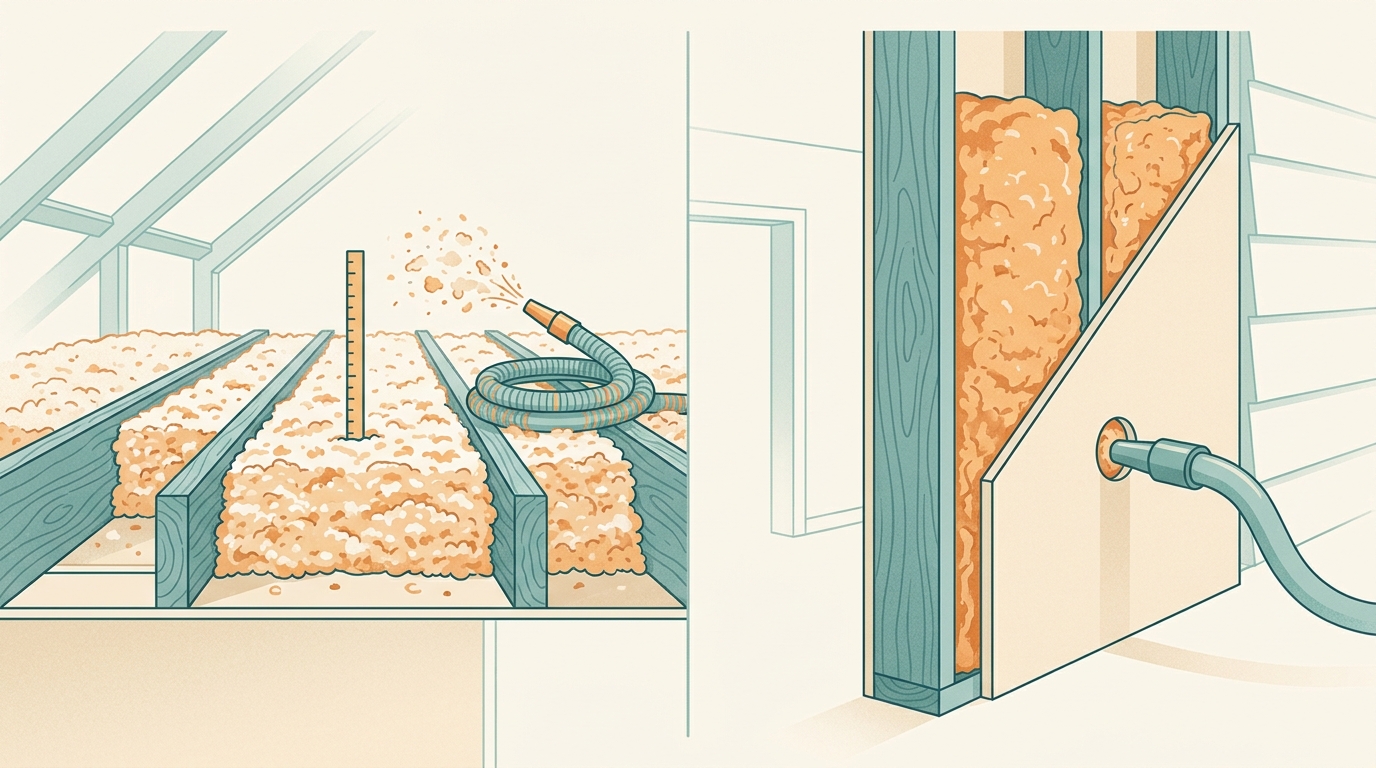
Blowing an open attic floor works with gravity: the material just piles up to depth. Closed walls are the opposite. To insulate a finished wall, the crew drills a row of access holes, blows material to a packed density (around 3.5 lb per cubic foot for dense-pack cellulose) so it will not settle and slump, then plugs and patches every hole. That extra labor is why walls run $1.70 to $3.70 per square foot of wall versus the cheaper attic number.
Dense-pack also doubles as an air-leakage control layer inside the cavity, which is why older homes with drafty walls often get it. It is almost never a DIY project. Under-packing leaves voids that settle into cold stripes a year later.
Prep and add-on costs the headline number hides
The base rate covers insulation. Preparation and remediation appear as separate lines.
| Add-on | Typical cost | When it applies |
|---|---|---|
| Air sealing | $300 – $1,500 | Almost always recommended; the comfort lever |
| Old insulation removal | $1.50 – $3.00 / sq ft | Wet, contaminated, or matted material |
| Ventilation baffles | $2 – $5 each | To keep soffit vents from getting buried |
| Mold remediation | $10 – $25 / sq ft | Moisture-damaged areas |
| Pest cleanup | $50 – $500 | Droppings, nests, contamination |
| Asbestos abatement | $1,200 – $3,300 | Old vermiculite; specialist only |
Air sealing should be visible in the scope. Loose-fill cannot close the gaps around compatible recessed lights, the attic hatch, plumbing stacks, and top plates. Have the crew document that work before it disappears. For attic-specific pricing and removal decisions, use our attic insulation cost guide and attic insulation removal cost guide.
Do not bury the problem
A deep, even layer can still leave the house drafty when open chases remain underneath. Write air sealing into the scope or complete it before delivery day. Baffles also need to remain above the new insulation so soffit air can travel toward the roof vents.
Tax credits and rebates in 2026
The federal credit for insulation is gone for new work. The One Big Beautiful Bill (Public Law 119-21, signed July 4, 2025) terminated the 25C Energy Efficient Home Improvement Credit for property placed in service after December 31, 2025, so insulation and air sealing installed in 2026 gets no federal credit. Plan your 2026 budget on the full price.
If your install happened in 2025, you can still claim it:
- The 2025 install still qualifies. Claim it on your 2025 return with IRS Form 5695: 30% of the material cost of insulation and air sealing, capped at $1,200 for the year.
- Labor does not count for insulation and air sealing, only the material. The product must meet the criteria the IRS references (generally IECC/ENERGY STAR levels), so keep receipts and the manufacturer's compliance statement.
For 2026 work, check state and utility programs. The residential 25D clean-energy credit also ended for expenditures after December 31, 2025. Search DSIRE and your utility, then verify any 2025 federal claim through the IRS home-energy credit guidance. The insulation upgrade hub can help pair this job with other enclosure work.
When blown-in is NOT the right spend
Delay the blower when water, wiring, or a different defect needs attention first.
- Your attic already meets the recommended R-value. Topping a healthy R-49 up to R-60 saves little. Run it through the calculator before you buy more bags.
- You have a moisture or roof-leak problem. Wet insulation loses R-value and grows mold. Fix the water first, always.
- The real problem is air leaks or ducts. If leaky attic ductwork or a giant unsealed hatch is the comfort issue, more insulation just blankets the symptom.
- You are dealing with vermiculite that may contain asbestos. Do not disturb it. Get it tested and abated by a specialist.
- The cavity needs an air or vapor strategy you cannot meet. Some closed assemblies want spray foam instead; compare in our spray foam insulation cost per sq ft guide.
Red flags in a blown-in quote
- No air-sealing line item, or a vague "we'll seal as needed" with no scope.
- No target R-value or depth-marker/coverage-verification plan.
- A per-square-foot price with no mention of removal when your attic clearly has old, matted insulation.
- Pressure to "buy more R" without any payback reasoning.
- A wall dense-pack quote that does not mention packed density or patching.
- For walls, a price that matches an open-attic rate (dense-pack is more work and should cost more).
What to do next
- Measure the attic and record current depth at several points. Put the numbers into the attic insulation calculator.
- Ask two or three contractors for a target R-value, exact product, bag count, installed depth, and the air-sealing scope. Removal should be justified separately.
- Use the insulation hub to sequence the work. Compare the broader attic insulation cost and spray foam cost guides before changing the roof assembly.
Sources & further reading
- Recommended Home Insulation R-Values — ENERGY STAR
- Home energy credit expirations — IRS
- 2026 Blown-In Insulation Cost Guide — Modernize
- How Much Does Blown-In Insulation Cost? [2026 Data] — Angi
- ENERGY STAR: Seal and Insulate Your Home — ENERGY STAR
About this post: The price tables combine current national cost reporting with DOE and ENERGY STAR guidance. Worked examples are labeled illustrations, and bag counts remain estimates until a specific manufacturer's coverage chart is selected. No insulation manufacturer or installer paid for inclusion.
Frequently asked questions
How much does blown-in insulation cost per square foot in 2026?+
Professionally installed blown-in insulation runs $1.50 to $3.50 per square foot for an open attic, with a national average near $2.00. Material alone is $0.50 to $1.50 per square foot, and pro labor adds about $1.00 to $2.00. Dense-packing closed walls costs more, roughly $1.70 to $3.70 per square foot, because of drilling and patching.
Is cellulose or fiberglass blown-in insulation cheaper?+
Fiberglass loose-fill is usually the cheapest material at about $0.50 to $1.10 per square foot, while blown cellulose runs $0.60 to $1.80. Cellulose has a higher R-value per inch (about 3.2 to 3.7 vs 2.5 to 3.5 for fiberglass), so it hits a target R-value in a thinner layer. On a per-R-value basis the two come out close. Pick based on air-movement performance and contractor skill, not the bag price.
How much does it cost to blow insulation into a 1,000 sq ft attic?+
Expect roughly $1,500 to $3,000 installed to bring a 1,000 sq ft attic up to R-49, or about $900 to $1,700 if you DIY with rented equipment. The spread depends on existing depth, air-sealing scope, and access. Adding to thin existing insulation costs less than a tear-out-and-replace job.
How many bags of blown insulation do I need per 1,000 sq ft?+
A rough planning range for R-49 to R-60 is 26 to 32 bags per 1,000 sq ft, but bag size, material, settled density, and target R-value change the count substantially. Use the coverage chart printed on the exact product. The installer should state both bag count and installed depth on the quote.
Is DIY blown-in insulation worth it versus hiring a pro?+
DIY can cut your cost to about $0.90 to $1.80 per square foot since many home centers lend the blower free with a minimum bag purchase. It works best in a clean, walk-in attic. Hire a pro when you need wall dense-packing, careful air sealing, old-insulation removal, or work around knob-and-tube wiring, where mistakes get expensive.
How much does it cost to blow insulation into existing walls?+
Dense-packing closed wall cavities costs about $1.70 to $3.70 per square foot of wall, more than an attic, because the crew drills access holes, blows to a packed density near 3.5 lb per cubic foot, then plugs and patches. Dense-pack cellulose material alone runs roughly $2.00 to $2.30 per square foot. It is rarely a DIY job.
Does blown-in insulation qualify for a tax credit in 2026?+
No, not for a 2026 install. The federal 25C Energy Efficient Home Improvement Credit was terminated for property placed in service after December 31, 2025, so insulation and air sealing installed in 2026 gets no federal credit. A 2025 install still qualifies and can be claimed on your 2025 return via IRS Form 5695 (30% of materials, up to $1,200 a year, labor excluded). For 2026 the levers are state and utility rebates; check DSIRE and your utility.
What R-value should blown-in attic insulation be?+
The U.S. Department of Energy recommends about R-30 to R-49 for southern attics, R-38 to R-60 for moderate climates, and R-49 to R-60 for cold northern climates. Most uninsulated or under-insulated attics target R-49 to R-60 today. Going above your zone's range adds cost with little extra savings.
Why is air sealing recommended before blowing in insulation?+
Insulation slows heat flow but does not close holes around plumbing, wiring, chases, and attic hatches. Air sealing the attic plane often costs $300 to $1,500. It must happen before loose-fill covers the ceiling plane, so ask for photos of the sealing work before the crew starts blowing.
Try the companion tool
This post links to an interactive tool built for this topic. Open it to see numbers tailored to your home.
Open the toolGet practical energy tips
Join homeowners getting practical tips on cutting energy bills and staying comfortable.
Practical tips only. Unsubscribe anytime.
Read this next
Related guides selected by topic overlap and upgrade path.
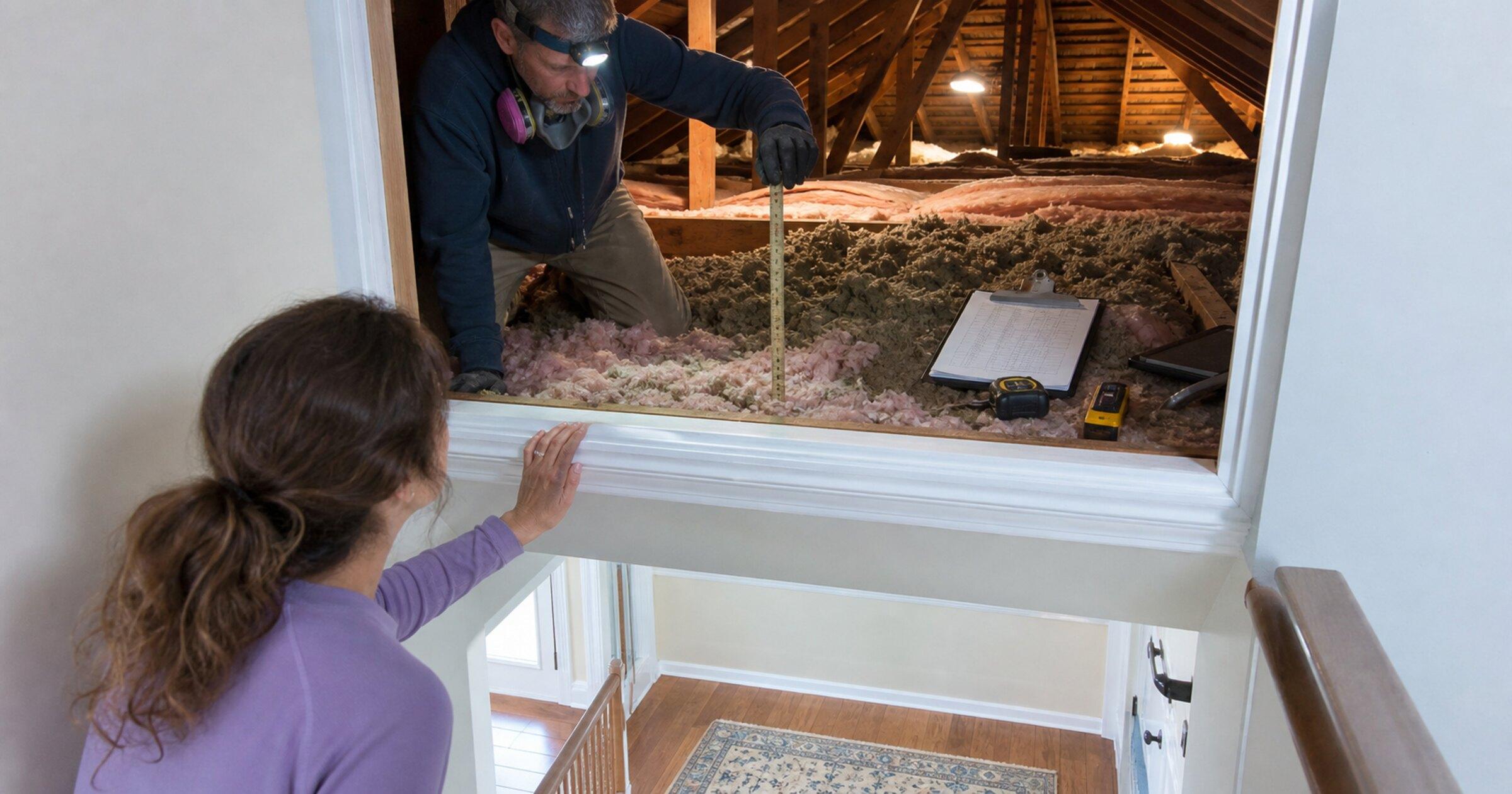
Attic insulation costs about $1,500 to $3,500 for a typical home, or $1.50 to $4 per sq ft. Compare 2026 prices by material, size, R-value, and scope.

Attic insulation removal costs $1–$2 per sq ft, or about $1,600–$3,600 for a typical attic. Rodents, mold, or asbestos push it far higher. Here's the honest 2026 breakdown.
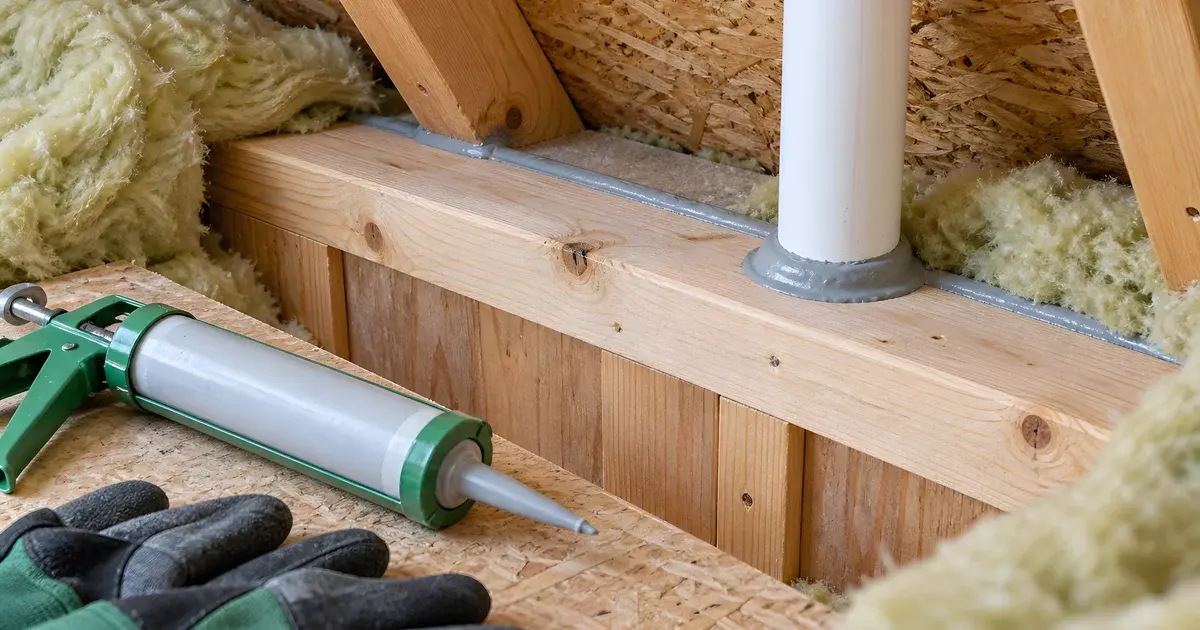
Attic air sealing cost depends on access and leakage scope. Separate sealing, insulation, testing, and restoration before comparing contractor quotes.
Spray foam insulation costs depend on strategy, not hype. Learn open vs closed cell tradeoffs, roofline vs attic floor choices, and how to compare quotes.