Blog
Home Energy Audit Cost | Typical Prices and What You Should Get
A professional home energy audit typically costs $200–$700 in 2026, and many utilities offer free or low-cost assessments. Here's what each price tier gets you.
If you are searching home energy audit cost, here is the short answer. A professional home energy audit typically runs $200 to $700 in 2026, with most homeowners paying somewhere around $350 to $450. Many electric and gas utilities offer free or low-cost assessments, so before you pay out of pocket, check what your utility already provides.
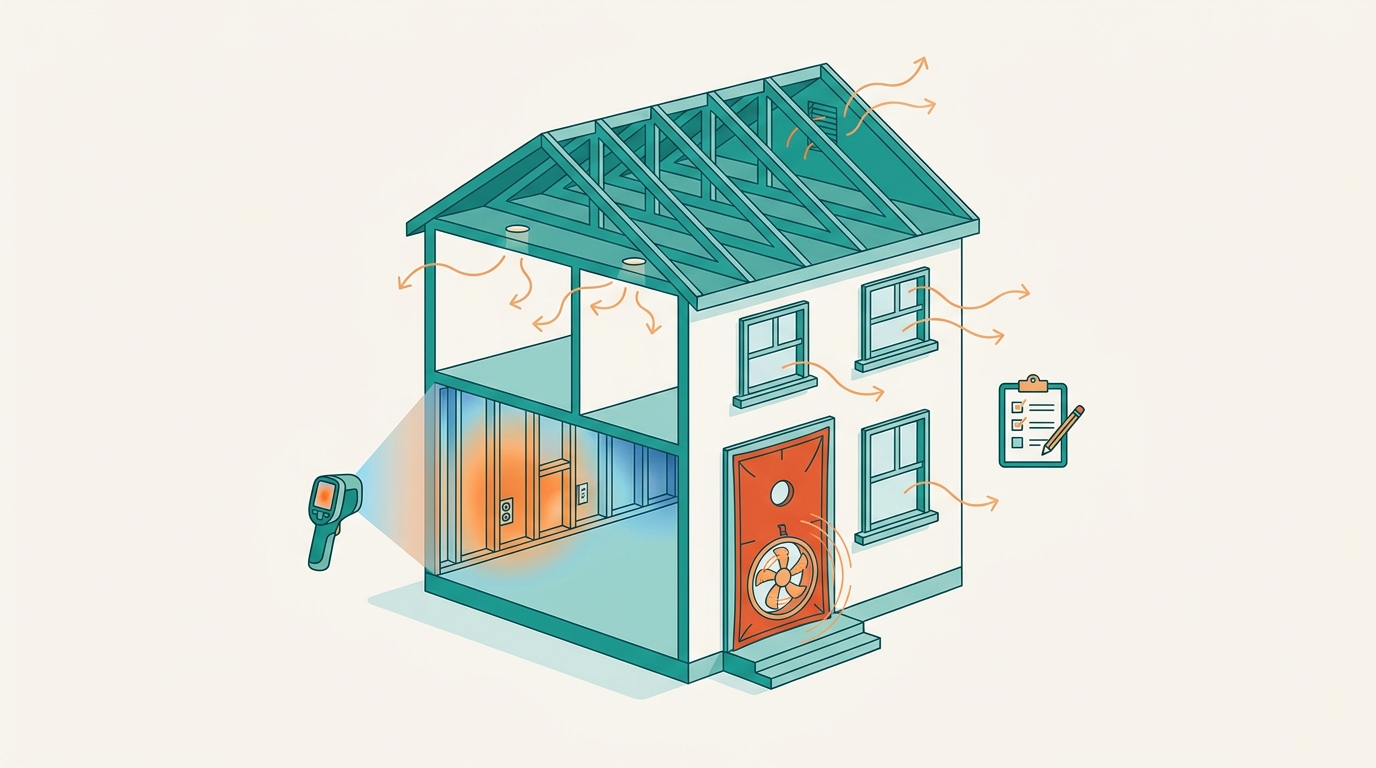
The wide range exists because "audit" means very different things. It can be a 30-minute visual walkthrough, or a three-hour diagnostic visit with a blower door fan, an infrared camera, and a written report you can hand to contractors. What you pay tracks how much testing and explaining you get.
$200–$700
Typical pro audit
most pay $350–$450
$0–$100
Utility / state audit
free to subsidized
$0
Federal audit tax credit in 2026
25C ended after Dec 31, 2025
To connect the audit to your actual usage before you book, start with Bill Breakdown. It helps you spot whether your problem is heating, cooling, or baseload, so the auditor's findings land in context.
On this page
- Home energy audit cost by type
- What you should get for the money
- Free or discounted audits: check these first
- Is there a tax credit for a home energy audit in 2026?
- What drives the price
- DIY first, then pay for what you cannot measure
- How to choose an auditor (and verify credentials)
- Connect the audit to a plan
Home energy audit cost by type
Not every audit includes every test, and that is fine as long as you know what you are buying. The table below breaks down the common tiers, what each one gets you, a realistic 2026 price, and who it suits best. Treat the prices as estimates; they vary by region, home size, and auditor.
| Audit type | What you get | Typical 2026 cost | Best for |
|---|---|---|---|
| Utility-sponsored assessment | Visual walkthrough, basic recommendations, often free direct-install items (LEDs, smart thermostat, pipe wrap) | $0–$100 | Getting started cheaply; baseline before paying for diagnostics |
| Basic walkthrough / consult | Trained eyes on insulation, windows, HVAC, and obvious leaks; verbal or short written priorities | $100–$250 | Simple homes, a second opinion, or a quick gut check |
| Blower door test | Calibrated fan depressurizes the house; leakage measured (CFM50 / ACH50) plus a leak walkthrough | $250–$500 | Drafty homes, planning air sealing, before/after verification |
| Infrared / thermal imaging | Camera reveals missing insulation, cold stud bays, and hidden leak paths; usually added to a blower door visit | +$100–$250 | Chronic cold rooms, suspected insulation gaps, ice dam history |
| Combustion safety testing | CO and draft testing on atmospheric gas/oil appliances; spillage and backdrafting checks | Usually bundled in a full audit | Any home with gas/oil furnace, boiler, or water heater |
| Full audit + written report | Blower door, infrared, duct evaluation, combustion safety, and a prioritized written plan | $400–$800 | Big retrofits, heat pump planning, complex comfort problems |
Home energy audit cost by type
Where the money actually goes
Two audits at the same price can deliver wildly different value. You are not really paying for the fan or the camera. You are paying for the hours the auditor spends investigating your specific home, then turning the numbers into a plan. A rushed visit produces generic advice. A thorough one produces a leak list, an insulation strategy, and a sequence to work through.
What you should get for the money
At minimum, a quality audit leaves you with:
- A plain-language explanation of what is driving your comfort and bill problems
- A prioritized list of upgrades, because sequence matters
- The "why" behind each recommendation
- A way to verify improvements, such as a planned before-and-after blower door reading
Here is what the testing actually looks like in the field, from our reviewer Marcus's perspective.
Blower door. Marcus mounts the calibrated fan in the front door and pulls the house to -50 pascals on the manometer. At that pressure the leaks announce themselves. On one 1960s Cape, the attic hatch was the single loudest leak in the house. You could feel a steady cold draft pouring down past the pull-down stairs while the fan ran. That reading turned a vague "the upstairs is always cold" complaint into a $300 weekend air-sealing job at the hatch and top plates.
Infrared. The thermal camera does not see air directly. It sees temperature. On a cold day, a stud bay that should be one uniform color shows up as a cold blue stripe where the batt insulation slumped or was never installed. Run the blower door at the same time and you also see cold air washing through the drywall around outlets. On a mild day, used alone, the camera can mislead, so a good auditor pairs it with air movement and the weather outside.
Combustion safety. If you have an atmospheric gas water heater or furnace, the audit should include a CO and draft test. Marcus once found a water heater that backdrafted, spilling combustion gases into the basement, but only after the bath fan and dryer ran together and depressurized the house. Tighten a leaky home without checking this and you can create a safety problem. A credible auditor tests for it.
Free or discounted audits: check these first
Before you pay full price, see what is already available. In many cases the assessment is genuinely free, and the freebies that come with it can cover a chunk of your next bill.
Your electric and gas utility. Many utilities run residential energy-assessment programs, often funded by efficiency charges already on your bill. These commonly include a free walkthrough and free direct-install items like LED bulbs, a smart thermostat, or pipe and water-heater insulation. Massachusetts homeowners may know this as Mass Save; other states run similar programs under different names. Start on your utility's website and search for "home energy assessment" or "energy audit."
Your state energy office. Most states have an energy office that lists incentive programs, approved contractors, and sometimes subsidized audits. The U.S. Department of Energy maintains a hub explaining what a home energy assessment covers and how to find help in your area.
Weatherization assistance. Income-qualified households can often get a free audit and free weatherization work through the federal Weatherization Assistance Program, administered locally. Eligibility and waitlists vary by state.
Free is not the same as full
A free utility audit is usually a visual walkthrough. It is a good starting point, and the free measures alone can be worth it. But it often skips the blower door test, the infrared scan, and the detailed written report. If you are planning a major retrofit or chasing a stubborn comfort problem, you may still want a paid diagnostic audit on top of it.
To find the program serving your area, the cleanest path is: check your utility account first, then your state energy office, then a national database for any remaining rebates.
Is there a tax credit for a home energy audit in 2026?
Short version: no federal credit for a 2026 audit.
From 2023 through 2025, the federal 25C Energy Efficient Home Improvement Credit included a home energy audit credit worth 30% of the cost, up to $150. To qualify, the audit had to include a written report and an inspection identifying the most significant, cost-effective efficiency improvements, prepared by a qualified home energy auditor.
That window has closed. The One Big Beautiful Bill Act, signed in July 2025, accelerated the termination of 25C. Per IRS guidance, the credit "will not be allowed for any property placed in service after December 31, 2025." So an audit performed in 2026 earns no federal tax credit.
2025 audit? You can still claim it
If you had a qualifying home energy audit done on or before December 31, 2025, you can still claim the 25C credit (30% up to $150) on the federal return you file in 2026 for tax year 2025, using IRS Form 5695. Keep the auditor's written report, the invoice, and proof of payment. For 2026 audits, look to state and utility incentives instead, which are separate programs and may still help.
This is one place where outdated advice is everywhere. You will still find articles claiming the audit credit "runs through 2032." That was the original schedule before the 2025 law changed it. For 2026, the federal audit credit is gone.
What drives the price
Testing depth. A walkthrough is cheap. Adding a blower door, infrared, duct testing, and combustion safety adds time, skill, and equipment, which is most of the cost spread in the table above.
Home size and complexity. More floors, multiple attics, additions, finished basements, and difficult access all add hours. A 3,500 sq ft home with two HVAC systems costs more to assess than an 1,100 sq ft ranch.
Time spent explaining. The deliverable is the plan. Auditors who spend real time translating findings into a prioritized sequence charge more, and it is usually money well spent.
Whether the auditor sells retrofit work. Some auditors also do contracting. That can be fine, and sometimes the audit fee is credited toward the work. Just ask up front how they separate diagnosis from sales so you trust the recommendations.
DIY first, then pay for what you cannot measure
You can do a meaningful amount yourself for free. Walk the attic and check insulation depth against the framing. Hold a stick of incense near outlets, window trim, and the attic hatch on a windy day to spot drafts. Review where your money goes with Bill Breakdown and learn to read your utility bill.
A professional audit earns its fee when you need the things a DIY pass cannot give you: a calibrated leakage number, an infrared view inside the walls, and a combustion-safety check on gas appliances. If your DIY pass points to air leaks and thin insulation, you can often skip straight to the work. Our Attic Insulation Calculator tool helps you size up the payback, and the insulation upgrade guide explains why air sealing comes before adding insulation.
How to choose an auditor (and verify credentials)
Look for certification from BPI (Building Performance Institute) or RESNET (Residential Energy Services Network). A BPI Building Analyst or RESNET HERS Rater has been trained in blower door testing, building science, and combustion safety, and both organizations publish searchable directories. Your utility or state program may also keep a list of approved contractors.
Before you book, ask:
- Which tests are included (blower door, infrared, duct, combustion safety)?
- What deliverable do I receive (written report, photos, a prioritized sequence)?
- How long will you be on-site?
- Do you also sell retrofit work, and how do you handle that?
During the visit, a good auditor asks about your comfort complaints, checks the usual leakage suspects (attic access, top plates, rim joists, penetrations), and explains findings in plain language. You should leave knowing what to do first, what to do later, and how you will know it worked.
Connect the audit to a plan
An audit is only as good as what you do next. Two ways to keep momentum:
- If air sealing and insulation come up, see what a blower door test alone costs and what it tells you in our blower door test cost guide, and price the follow-up work with attic air sealing cost.
- To turn findings into a sequenced, budgeted roadmap, build a free My Plan. It helps you order upgrades so each one makes the next cheaper.
Sources & further reading
- Energy Efficient Home Improvement Credit (25C), including home energy audits — IRS
- OBBB FAQs: accelerated termination of energy provisions (FS-2025-05) — IRS
- Home energy audits: what they cover and how to find help — U.S. Department of Energy
- Home energy assessments and ENERGY STAR guidance — ENERGY STAR
- Find a certified energy auditor (Building Analyst) — Building Performance Institute (BPI)
- Find a RESNET HERS Rater — RESNET
Frequently asked questions
How much does a home energy audit cost?+
A professional home energy audit runs $200 to $700 in 2026, with most homeowners paying $350 to $450. A 30 to 60 minute visual walkthrough sits at the low end. A full diagnostic with a blower door test, infrared scan, and written report sits at the high end, reaching $600 to $800 on large or complex homes. Utility and state programs run separate assessments for $0 to $100, often bundling free LEDs, a smart thermostat, or pipe insulation, so check your utility before paying out of pocket.
Are home energy audits worth it?+
For most older homes, yes, when the $350 to $450 fee buys a prioritized plan rather than a generic checklist. The payback comes from avoided waste: blowing attic insulation over unsealed air leaks, or oversizing a new heat pump because nobody measured the envelope with a blower door first. A good audit recoups its cost by steering your first one or two upgrades into the right sequence. For a newer, tight home, or when you already know the problem, the payback is weaker and a free utility walkthrough may be enough.
What is included in a blower door test?+
A calibrated fan mounted in an exterior doorway depressurizes the house to 50 pascals and reports leakage as CFM50 or air changes per hour, the numbers contractors verify before-and-after air sealing. The auditor then walks the depressurized house feeling for inflow at the biggest leaks: the attic hatch, recessed lights, top plates, rim joists, and plumbing and wiring penetrations. As a standalone visit it costs $250 to $500 and takes 1.5 to 3 hours; paired with an infrared camera or smoke pencil it pinpoints where to air seal first.
Can I get a free energy audit?+
Often, yes. Many electric and gas utilities offer assessments for $0 to $100, frequently bundling free LED bulbs, a smart thermostat, or pipe and water-heater insulation. The federal Weatherization Assistance Program and state energy offices provide free audits, and free weatherization work, for income-qualified households. These free audits are a 30 to 60 minute visual walkthrough that skips the blower door test, infrared scan, and detailed written report, so confirm the scope before deciding whether you also need a $250 to $700 paid diagnostic on top.
Is there a tax credit for a home energy audit in 2026?+
No. The federal 25C home energy audit credit, worth 30 percent of the cost up to $150, ended after December 31, 2025. The One Big Beautiful Bill Act, signed in July 2025, terminated 25C for property placed in service after that date, so a 2026 audit earns no federal credit, despite older articles claiming the credit runs through 2032. A qualifying audit completed on or before December 31, 2025 is still claimable on the 2025 return you file in 2026 using IRS Form 5695, so keep the written report, invoice, and proof of payment. State and utility incentives are separate and may still apply.
How long does a home energy audit take?+
A basic visual walkthrough takes 30 to 60 minutes. A standard diagnostic with a blower door test runs 1.5 to 3 hours on a typical single-family home. A full assessment that adds infrared scanning, duct testing, and combustion safety checks, plus time to explain the findings, takes 3 to 4 hours or more. Multiple attics, additions, two HVAC systems, or difficult access push every tier toward the upper end.
DIY vs professional energy audit: what is the difference?+
A DIY audit costs nothing: you check attic insulation depth against the framing, hold an incense stick near outlets and the attic hatch on a windy day to spot drafts, and review your bills. A $200 to $700 professional audit adds the three things you cannot replicate at home: a calibrated blower door leakage number (CFM50), an infrared camera that reveals slumped or missing insulation inside walls, and combustion safety testing that catches a backdrafting gas appliance. Do the DIY pass for quick wins, then pay for a pro when planning a larger retrofit or chasing a problem you cannot diagnose.
How do I find a certified home energy auditor?+
Search the BPI (Building Performance Institute) directory at bpi.org or the RESNET (Residential Energy Services Network) directory at resnet.us by location. BPI Building Analyst and RESNET HERS Rater are the two credentials that certify training in blower door testing, building science, and combustion safety. Your utility or state energy office often keeps its own list of approved contractors for rebate programs. Before booking, confirm which tests are included, what written deliverable you get, and whether the auditor also sells the retrofit work they recommend.
Why does a paid audit cost more than a free utility audit?+
Testing depth and the hours spent on it. A free utility audit is a 30 to 60 minute visual walkthrough that surfaces obvious savings and hands out free LEDs or a smart thermostat. The $200 to $700 paid audit buys a blower door leakage measurement, an infrared scan, combustion safety checks where gas appliances are present, and a written, prioritized report you can hand to contractors, over a 1.5 to 4 hour visit. You are paying for diagnosis and an evidence-based sequence, not the fan or camera itself.
Try the companion tool
This post links to an interactive tool built for this topic. Open it to see numbers tailored to your home.
Open the toolGet practical energy tips
Join homeowners getting practical tips on cutting energy bills and staying comfortable.
Practical tips only. Unsubscribe anytime.
Read this next
Related guides selected by topic overlap and upgrade path.
A standalone blower door test runs $150 to $400 in 2026. It's often free through a utility, or bundled into a $300 to $700 audit. Here's what it measures and when paying makes sense.
Attic insulation costs about $1,500 to $3,500 for a typical home, or $1.50 to $4 per sq ft. See 2026 prices by material, attic size, and tax credit.

Blown-in insulation costs $1.50 to $3.50 per sq ft installed in 2026 ($0.90 to $1.80 DIY). Cellulose vs fiberglass by R-value, attic vs walls, bags needed.
Attic insulation removal costs $1–$2 per sq ft, or about $1,600–$3,600 for a typical attic. Rodents, mold, or asbestos push it far higher. Here's the honest 2026 breakdown.