Residential Electrical Load Calculator
This tool shows the steps behind the amp result. Enter the label ratings for your appliances, HVAC system, and EV charger. Then compare the home's estimated demand with the service rating on the main disconnect.
1General dwelling load
Include the dishwasher, disposal, built-in microwave, and other fixed appliances. Enter water heating separately below.
2HVAC, EV, and existing service
For a heat pump, enter the compressor nameplate load here.
Enter the indoor-unit nameplate load, or 0 if it is already included in another equipment rating.
Enter 0 for gas heat. For a heat pump, enter supplemental resistance heat separately; the tool adds 65% of this value.
Example: A 32 A charger at 240 V uses 7,680 W. The tool applies the required 125% continuous-load factor.
Estimated home demand
135.4 A
The next common service size that can cover this load is 150 A.
General load after demand factor
20,600 VA
36,500 VA before the optional-method demand factor.
HVAC load
11,900 VA
EV continuous load
0 VA
Existing service capacity
64.6 A remaining
This planning worksheet follows the 2023 NEC optional method. A permit calculation must use your local code, exact equipment labels, the correct appliance demand rules, loads that cannot run together, backup heat, and local changes.
Inputs stay in this browser. No account or quote request is required.
Quick planning answer
Do not add the numbers on all the breakers to size an electrical service. The NEC uses demand factors because every home load does not run at full power at the same time. HVAC and continuous loads, such as EV charging, have separate rules. An electrician and the local permit office still need to review the final calculation.
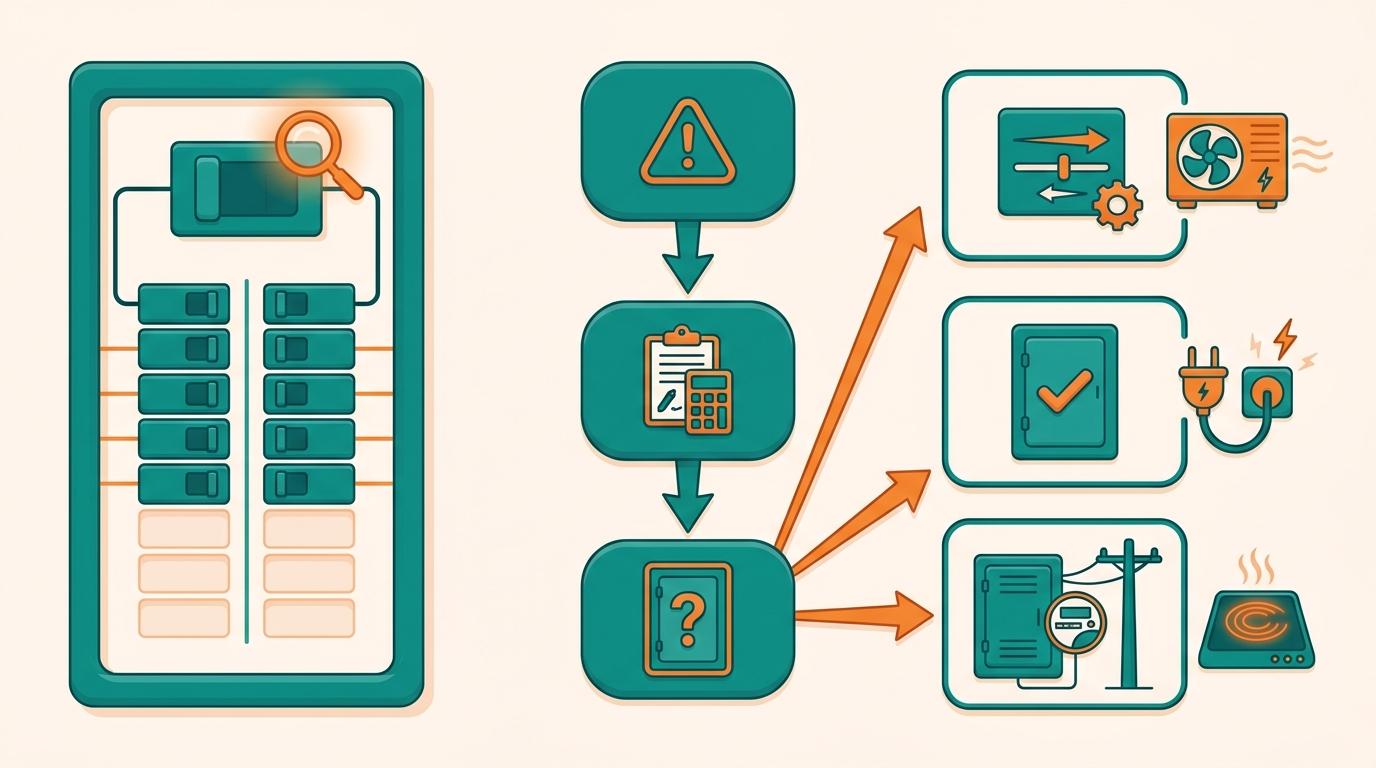
Read equipment labels, but do not open the panel
Write down the volts and amps or watts from the labels on the range, dryer, water heater, HVAC equipment, EV charger, and fixed appliances. Do not remove electrical covers. The service size is often shown on the main breaker or outside disconnect. If the number is hard to read, ask an electrician instead of reaching near live parts.
For single-phase equipment, watts equal volts times amps when the label does not show watts. Motor and HVAC labels may show several current values. A permit calculation must use the values required by code, not simply the largest number on the label.
Electrical capacity and open breaker spaces are different
A panel can have enough electrical capacity but no open breaker spaces. It can also have open spaces but not enough service capacity. An electrician must separately check tandem breaker rules, bus rating, panel condition, wire size, utility equipment, and local code.
- Ask which NEC edition and calculation method your permit office uses.
- Include heat-pump backup resistance heat and every EV charger at its set maximum.
- Treat two loads as unable to run together only when installed controls prevent it.
- Compare load-management controls with the cost of a service upgrade when local rules allow them.
A 200-amp label does not answer every question
Some all-electric homes fit within 200 amps when equipment and controls are chosen carefully. Large homes with resistance heat, several EVs, pools, and electric cooking may need more. Equipment ratings and controls often matter more than floor area.
If the estimate is close to a service-size limit, get a formal calculation before agreeing to an upgrade. Some existing homes may qualify for a method based on measured demand. The adopted code and rules for solar or load controls affect whether that method is allowed.
Questions people ask before buying
How is residential electrical load calculated?
The optional method adds general lighting, required circuits, and appliance label ratings. It applies demand factors, then adds the heating or cooling load that applies and continuous loads such as EV charging.
Can I add all breaker sizes together?
No. Breaker ratings protect each circuit. They do not show how much power the whole home uses at once. A code load calculation uses floor area, equipment labels, demand factors, loads that do not run together, and continuous-load rules.
Does an EV charger require a 200-amp service?
Not always. The answer depends on a formal load calculation, the charger's set current, the other home loads, and any approved load-management system.
Is this calculation valid for a permit?
No. It is a planning worksheet. A permit must follow the code used in your area, local changes, utility rules, exact equipment data, and the form required by the local authority.
Method, sources and limits
The tool follows the 2023 NEC 220.82 planning method. It uses 3 VA per square foot, 1,500 VA for each small-appliance circuit, 1,500 VA for laundry, and the appliance loads you enter. It counts all of the first 10,000 VA and 40% of the amount above 10,000 VA.
The indoor blower or air-handler load is entered separately so it is not omitted. For gas heat with cooling, the tool adds the compressor and indoor blower because they run together. For central resistance heat, it adds the indoor blower to the larger heating or cooling amount. Separately controlled electric units use the larger applicable heating or cooling amount. For heat pumps that can run with supplemental resistance heat, it adds the compressor, indoor air handler, and 65% of supplemental heat. It counts EV charging at 125%, divides total VA by 240 V, and rounds up to a common service size. Enter 0 for the separate air-handler field when that load is already included in another equipment nameplate rating.
- National Electrical Code overview (National Fire Protection Association)
- Single-family dwelling optional service calculation worksheet (City of Sacramento)
- Residential panel and service capacity research (National Renewable Energy Laboratory)