Blog
Crawl Space Encapsulation Cost in 2026: Full Breakdown by Size and Line Item
Crawl space encapsulation costs $3 to $10 per sq ft, or about $5,500 average ($1,500–$15,000). See the line items, DIY vs pro, and what drives the spread.
Crawl space encapsulation cost can jump by several thousand dollars once a contractor gets through the hatch. Budget $3 to $10 per square foot in 2026, with many complete projects near $5,500 and a broad range of $1,500 to $15,000. A reasonably clean 1,500 sq ft space often lands around $5,500 to $8,000.
That range is wide for a reason. One proposal may cover loose plastic and sealed vents. Another includes drainage, wall insulation, air sealing, humidity control, and mold cleanup. The tables below make those scopes easier to compare before you sign.
$5,500
National average
Most projects fall between $1,500 and $15,000
$3–$10
Cost per square foot
Standard $3–$7; $10+ with mold or drainage
$1,000–$3,500
Commercial dehumidifier
70–90 pints/day with auto-drain, installed
15–18%
Research savings range
Heating and cooling in studied sealed, conditioned crawl spaces
If you want to sanity-check whether the insulation and air-sealing portion of an encapsulation pencils out against your heating and cooling bills, start with our Bill Breakdown estimator before you sign. It splits your bills into heating, cooling, and everything else, so you can estimate how much energy spend the crawl space work could affect, separate from the moisture-control parts that protect the house.
On this page
- Crawl space encapsulation cost by size
- The line items behind the total
- Vapor barrier: the mil thickness debate
- Choose a humidity-control method
- Drainage and sump: only if there is water
- What drives the price up or down
- DIY vs. professional encapsulation
- Regional variation
- Tax credits and rebates for 2026
- When encapsulation is NOT worth it
- Red flags and common mistakes
- Next steps
Crawl space encapsulation cost by size
Square footage is the first thing a contractor measures, and it sets the baseline. The ranges below assume a professional job that includes a reinforced liner, sealed vents, and basic humidity control. They do not assume major mold or drainage work, which are add-ons covered further down.
| Crawl space size | Typical total range | Average | Notes |
|---|---|---|---|
| 500 sq ft | $1,500–$6,000 | $3,000 | Small homes, cabins; tight access can still push cost up |
| 1,000 sq ft | $3,000–$10,000 | $5,000 | Common starter range; $4,000–$6,000 for a clean space |
| 1,500 sq ft | $4,500–$15,000 | $7,500 | Most common size; standard job $5,500–$8,000 |
| 2,000 sq ft | $6,000–$20,000 | $10,000 | Add-ons (mold, sump) push toward the top |
| 2,500 sq ft | $7,500–$25,000 | $12,500 | Larger ranch and Southern homes |
| 3,000 sq ft | $9,000–$30,000 | $15,000 | Big footprints; some go well past $30k with repairs |
Cost reality: small does not mean cheap
A 500 sq ft crawl with 18 inches of clearance and standing water can cost more than a clean, walkable 1,200 sq ft space. Per-square-foot pricing gets shaky at the low end because a crew still has to mobilize, remove debris, and detail every pier. A $1,500 proposal deserves a close read; it may cover a ground barrier and vent sealing rather than a complete moisture-control system.
The line items behind the total
Here is the part most cost articles skim. A real encapsulation bid should break into these components. Use it to read your own quote and spot what is missing.
| Line item | Typical cost | What it covers |
|---|---|---|
| Inspection / assessment | $100–$250 | Moisture meter readings, mold check, structural look (often credited if you hire them) |
| Cleanout & old insulation removal | $500–$8,000 | Debris, fallen fiberglass, junk; high end means a true mess |
| Vapor barrier (12–20 mil) installed | $1,200–$4,000 | Floor + walls, seams taped, attached to walls; $0.50–$2.00/sq ft material |
| Vent sealing | $150–$450 | Foam board or covers for 4–8 foundation vents |
| Wall insulation (rigid foam or spray) | $500–$3,700 | R-10 to R-15 on foundation walls and rim joist |
| Dehumidifier (commercial) | $1,000–$3,500 | 70–90 pint/day unit with auto-drain |
| Sump pump + interior drain | $1,200–$5,000 | Only if there is standing water or a high water table |
| Mold remediation | $1,500–$4,000+ | Soda-blast or scrub, treat, dry; $15–$30/sq ft if widespread |
| Permits / termite inspection gap detailing | $100–$250 | Required in most jurisdictions |
Encapsulation line items: low to high (1,500 sq ft crawl)
The core of the job
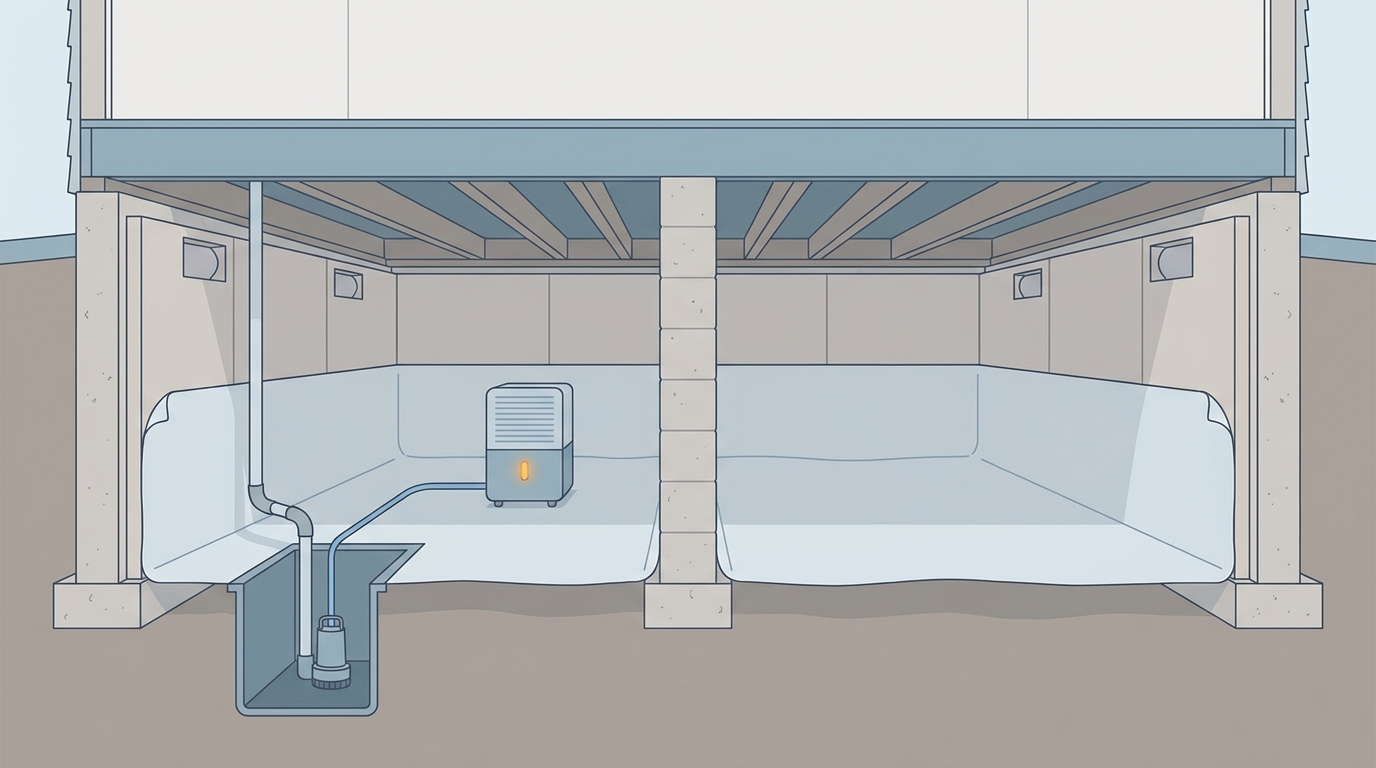
One possible humidity-control method
Conditional
Conditional
Vapor barrier: the mil thickness debate
The liner is the centerpiece, and thickness is where contractors quietly cut corners. The market runs from 6 mil up to 20 mil:
- 6 mil: the cheapest, often used for a loose-laid "vapor barrier" rather than true encapsulation. It tears under crawling and service traffic. Avoid it for anything you walk on.
- 10–12 mil: the practical minimum for full encapsulation. Reinforced (scrim) versions hold up to foot traffic.
- 20 mil: the standard for a quality, warrantied job. Tough, puncture-resistant, and what most reputable crews install up the walls and across the floor.
Expect $0.50 to $2.00 per square foot for the material alone, before labor. A 20 mil reinforced liner with sealed seams and proper wall attachment is what separates a 20-year system from a barrier that peels off the piers in three years.
Choose a humidity-control method
Closing the vents changes how the space dries. The design still needs a way to control humidity, which might be a dedicated dehumidifier, conditioned supply air, or air exchange with the house. Local code and the home's HVAC layout matter here.
A commercial 70 to 90 pint-per-day unit with an automatic drain commonly runs $1,000 to $3,500 installed. Ask for the sizing basis, drainage route, humidistat setting, and filter-access plan in writing. If operating cost is on your mind, our guide to dehumidifier cost per day shows what different units draw.
Drainage and sump: only if there is water
If the crew finds standing water or a high water table, encapsulation becomes the finishing layer on a water-control project. An interior perimeter drain feeding a sump pump adds $1,200 to $5,000 or more. This is not optional when bulk water is present, and no liner or dehumidifier can substitute for it.
What drives the price up or down
Two crawl spaces with identical square footage can come back with quotes thousands of dollars apart. Here is why.
- Access and clearance. Under 18 inches of headroom, or a tiny access hatch, slows everything. Imagine a two-person crew spending its first morning bagging fallen fiberglass and pulling debris through a hatch before a liner comes off the truck. That labor belongs in the quote.
- Existing damage. Active mold, rotted joists, or wet wood (moisture content above about 19 percent) must be handled before the barrier goes down. Mold remediation alone adds $1,500 to $4,000.
- Piers and penetrations. Every support pier, post, plumbing line, and duct has to be detailed and sealed. A space packed with piers is slow work, and rushing it is where failures start.
- Climate. In the humid Southeast, dehumidifiers work harder and may need to be larger, and coastal flood zones can force drainage upgrades or flood-vent compliance instead of full sealing.
- Material grade. A 6 mil liner and a small dehumidifier cost a fraction of a 20 mil system with a properly sized unit, and last a fraction as long.
What a crew can find under a house
The bid you get over the phone is a guess. The real number shows up once someone is under there. Common surprises that move price: a buried sump that was never plumbed to daylight, a dryer vent dumping lint and moisture into the crawl, a slow supply-line drip that kept the soil wet for years, and HVAC ducts so leaky they were raining condensation onto the dirt. Ask every bidder what their change-order policy is if they find water or rot once work starts.
DIY vs. professional encapsulation
You can DIY a basic vapor barrier, and for a small, dry, accessible crawl it can be a reasonable weekend project. The honest trade-offs:
| DIY | Professional | |
|---|---|---|
| Cost | $1,500–$5,000 materials only | $3,500–$15,000 all-in |
| Time | 40+ hours of brutal, cramped work | 5–7 working days |
| Scope | Liner + vent sealing realistically | Liner, insulation, dehumidifier, drainage, mold |
| Warranty | None | 10–25 yr material + workmanship |
| Risk | Trapped moisture if sealed wrong; no mold/structural fix | Verified with moisture testing |
Many people price encapsulation after moisture, mold, or odor has already appeared. Then the work starts with diagnosis. A DIY barrier over an unsolved water problem can hide the soil while the framing remains wet.
Regional variation
Pricing tracks local labor rates and climate. These regional patterns help explain a quote, though they do not replace local code review.
- Humid Southeast (FL, NC, SC, GA, TN). Long humid seasons make moisture control especially important. Termite inspection gaps and closed-crawl requirements vary by jurisdiction and pest-control contract, so have the local inspector and termite provider approve the wall detail.
- Mid-Atlantic and Midwest: clay soils and cold winters make wall insulation pay off in comfort (no more cold floors). Costs near the national average.
- Coastal and flood zones. A below-grade crawl space in a flood hazard area can require engineered or code-compliant flood openings. Confirm the design with the local floodplain official before sealing exterior openings.
- Dry West and high desert: encapsulation is often a weaker value, because a vented crawl may already stay dry. Spend on the actual problem if there is one.
Tax credits and rebates for 2026
Do not subtract a federal home-improvement credit from a 2026 proposal. Section 25C is unavailable for property placed in service after December 31, 2025, according to the IRS summary of the 2025 law.
That means the liner, dehumidifier, labor, insulation, and air-sealing work receive no federal 25C credit when placed in service in 2026. A state or utility program may still rebate insulation or air sealing. Check eligibility and pre-approval rules before the crew starts, since some programs will not accept an application after installation.
A 2025 invoice does not move a 2026 project backward
Federal credit timing generally follows when qualifying property is placed in service. A deposit paid in 2025 does not make crawl space work completed in 2026 eligible for the expired 25C credit. Keep the final invoice anyway; a local rebate or future buyer may want the scope and product details.
One more test belongs on the schedule. EPA recommends testing every home for radon and testing again after major renovation or HVAC changes. Sealing a crawl space changes air pathways, so use a fresh short-term or long-term test once the system is operating.
When encapsulation is NOT worth it
Saying no is sometimes the right call. Be skeptical when:
- You have bulk water you have not fixed. Encapsulating over standing water, roof leaks, or bad grading just traps the problem. Solve drainage, gutters, and grading first, or you will pay to redo the liner.
- Your climate is genuinely dry and the crawl already stays dry year-round. You may need targeted vapor control, not a $10,000 system.
- You are selling within a year or two. Encapsulation can help an inspection, but you rarely recoup the full cost as a line-item resale bump. Weigh it against just disclosing and pricing the home accordingly.
- The quote is a "spray treatment" sold as the fix. Chemical mold sprays over a live moisture source are not a solution. The moisture source is the fix.
Red flags and common mistakes
- A "basic" quote near $1,500 with no dehumidifier and no plan for humidity. That is loose-laid plastic, not encapsulation.
- A 6 mil liner sold as a full system. Ask for the mil thickness in writing.
- No mention of the termite inspection gap where local code requires one.
- Sealing the crawl with no plan for combustion-appliance safety (a gas furnace or water heater in a sealed space needs combustion air handled correctly).
- Blocking access to plumbing and electrical so future repairs tear the liner apart.
- Buying a dehumidifier to "fight" a water problem instead of installing drainage.
Next steps
- Get the scope in writing. Record liner thickness, wall height, humidity control, drainage, insulation, access panels, and termite-inspection details in My Plan.
- Ask each bidder for moisture readings and a plan for bulk water. A photograph of the meter reading is more useful than "looks dry" on an estimate.
- Test for radon after the work. Then place the project beside attic insulation cost, a home energy audit, and a blower door test so the envelope work happens in a sensible order.
Sources & further reading
- Working Families Tax Cuts: changes to credits and deductions — IRS
- Unvented, Insulated Crawlspaces — U.S. Department of Energy Building America Solution Center
- Unvented, Conditioned Crawlspaces: Building America research profile — U.S. Department of Energy
- Requirements for Flood Openings — FEMA
- EPA Radon Action Level — U.S. EPA
- Crawlspaces: Either In or Out — Building Science Corporation
About this post: This is a planning guide built from current federal guidance, building-science references, and 2026 market ranges. We did not inspect your crawl space, and the examples are illustrative. Moisture, structural, pest, combustion-safety, and flood-zone decisions need qualified local review.
Frequently asked questions
How much does crawl space encapsulation cost in 2026?+
Most homeowners pay between $1,500 and $15,000, with a national average near $5,500. On a per-square-foot basis, a standard job runs $3 to $7, rising to $10 or more when there is mold, standing water, or a dehumidifier and drainage in the scope.
How much does it cost to encapsulate a 2,000 sq ft crawl space?+
Plan on roughly $6,000 to $20,000 for a 2,000 sq ft crawl space, with a typical figure near $10,000. A clean, dry space with a basic barrier and sealed vents lands at the low end; add mold remediation, a commercial dehumidifier, and a sump and you reach the top.
What is the cost per square foot for crawl space encapsulation?+
Expect $3 to $7 per square foot for a standard professional encapsulation including labor. Severe humidity, mold, or structural repairs push it to $10 per square foot or higher. A DIY vapor-barrier-only job runs about $1 to $3 per square foot in materials.
How much does the vapor barrier alone cost?+
A reinforced 12 to 20 mil polyethylene barrier installed across the floor and up the walls runs $1,200 to $4,000, or about $0.50 to $2.00 per square foot in material. Avoid 6 mil for full encapsulation; it tears too easily under foot traffic and service work.
Do I need a dehumidifier, and what does it add?+
A closed crawl space needs a deliberate humidity-control plan. Depending on the design and local code, that may be a properly sized dehumidifier, conditioned supply air, or air exchange with the house. A commercial 70 to 90 pint-per-day dehumidifier with an auto-drain commonly adds $1,000 to $3,500 installed.
Is crawl space encapsulation tax deductible or eligible for a rebate?+
There is no federal Section 25C credit for crawl space work placed in service in 2026. The credit ended for property placed in service after December 31, 2025. State and utility rebates for insulation or air sealing may still exist, so check the program before work begins.
How long does crawl space encapsulation last?+
A quality 20 mil liner installed correctly lasts 15 to 25 years, and many carry transferable warranties of 20 years or more. The dehumidifier is the shorter-lived part, typically 8 to 12 years, and the sump pump 7 to 10 years.
Is crawl space encapsulation worth the cost?+
It can be worthwhile when the crawl space has persistent moisture, musty odors, cold floors, or exposed soil. Building America research found 15 to 18 percent heating and cooling energy savings in sealed, conditioned crawl spaces, though results vary by house and climate. Fix bulk water before paying for a liner.
What is the most expensive part of the job?+
Labor is the largest line, at 50 to 70 percent of the total, because the work is slow and physical in a cramped space. After labor, the biggest cost swings come from mold remediation ($1,500–$4,000+) and drainage with a sump pump ($1,200–$5,000+).
Try the companion tool
This post links to an interactive tool built for this topic. Open it to see numbers tailored to your home.
Open the toolGet practical energy tips
Join homeowners getting practical tips on cutting energy bills and staying comfortable.
Practical tips only. Unsubscribe anytime.
Read this next
Related guides selected by topic overlap and upgrade path.
Air duct cleaning costs $300 to $700 for a typical home (about $35 per vent). Honest 2026 guide: what gets upcharged, and why most homes do not need it.

Attic insulation removal costs $1–$2 per sq ft, or about $1,600–$3,600 for a typical attic. Rodents, mold, or asbestos push it far higher. Here's the honest 2026 breakdown.
Spray foam insulation costs depend on strategy, not hype. Learn open vs closed cell tradeoffs, roofline vs attic floor choices, and how to compare quotes.
Heat pump cost to install runs $6,000–$18,000 in 2026, with a typical ducted home near $12,000–$14,000. Compare prices by size, type, and quote scope.