Blog
Whole House Battery Backup Without Solar
Whole house battery backup without solar can charge from the grid. Size usable energy, peak power, outage duration, and recharge needs before buying.
Whole house battery backup without solar works by charging a battery from the grid and using it during an outage. The catch is runtime: without solar or another approved charging source, the stored energy eventually runs out.
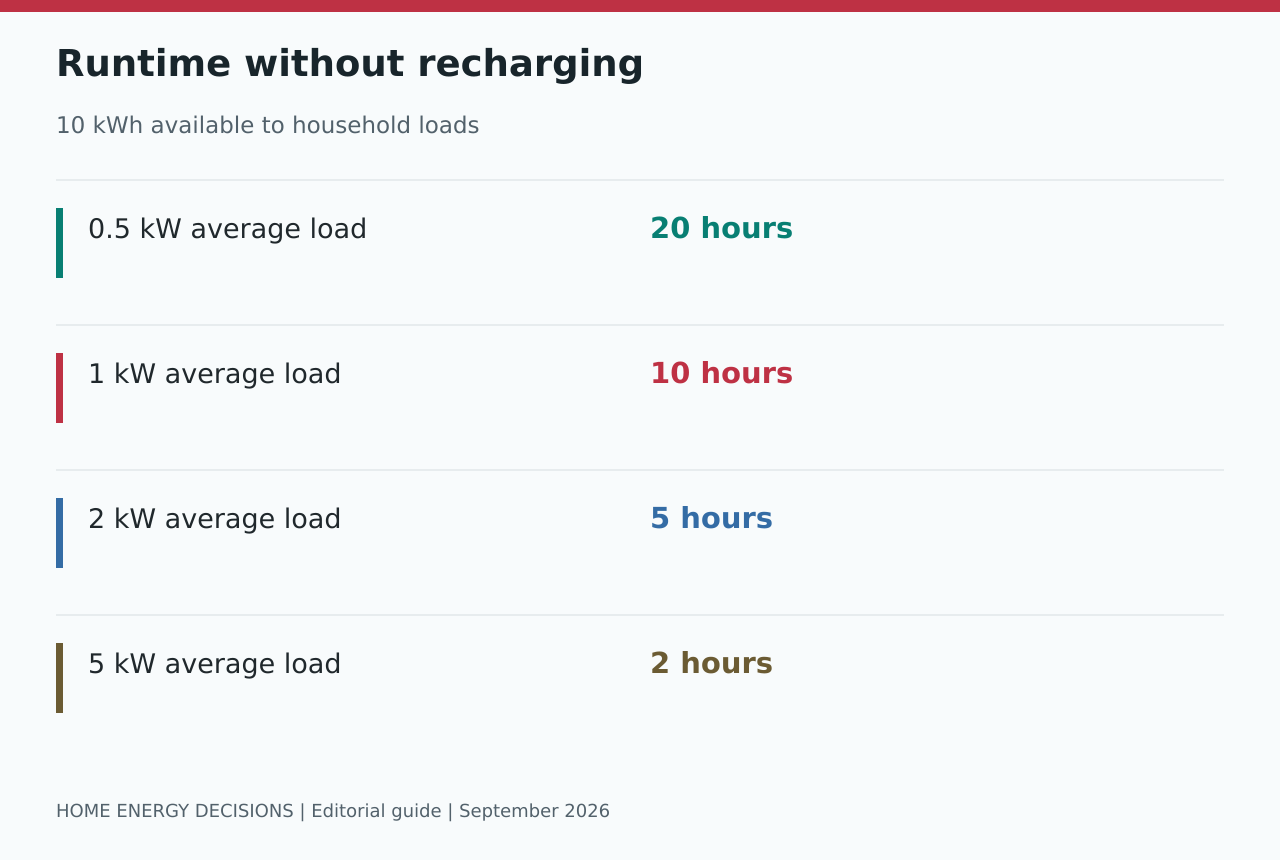
For example, 10 kWh available to household loads lasts about 20 hours at an average 0.5 kW, but only two hours at 5 kW. Decide what must keep running and for how long before choosing a battery count.
Build my backup plan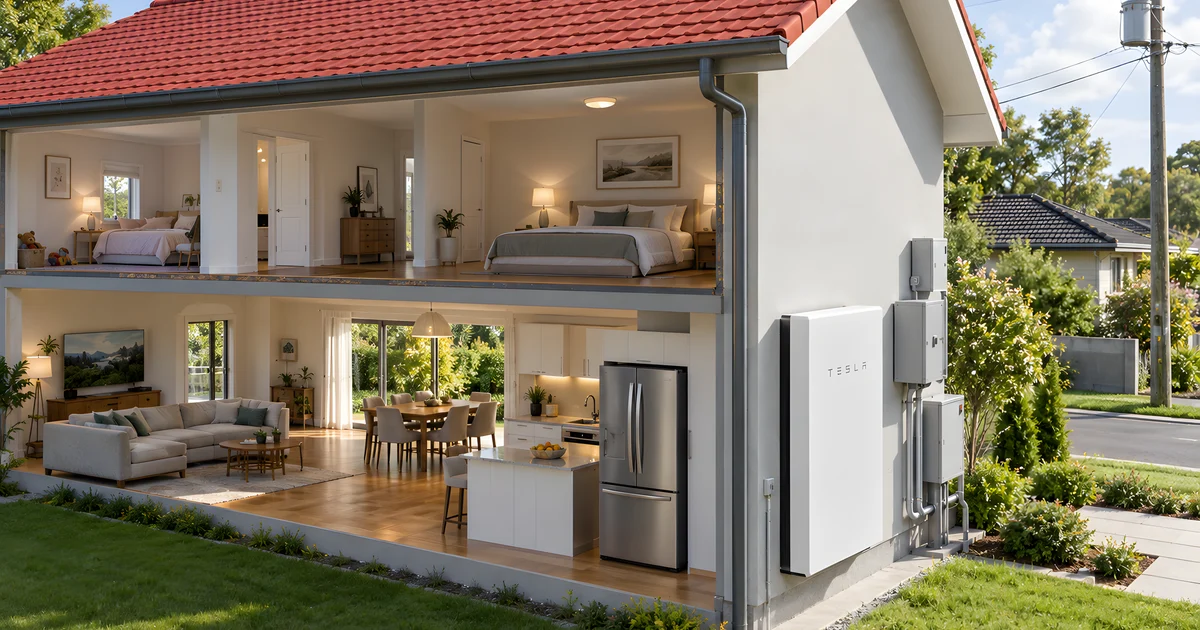
On this page
- How home battery backup works without solar panels
- Whole-home backup versus essential-load backup
- How long does a home battery last without solar?
- Build an outage load worksheet
- Can a battery run air conditioning without solar?
- Whole house battery backup without solar cost
- Home battery backup vs generator
- Will a battery without solar lower electricity bills?
- Build a battery backup plan around one realistic outage
- Compare home batteries without solar using the same assumptions
- Questions to settle before ordering
How home battery backup works without solar panels
A compatible system includes the battery, an inverter, controls, and approved equipment that isolates the backed-up circuits from the utility during an outage. A professionally designed installation avoids energizing utility lines while they are down.
Not every battery product or configuration supports standalone backup. Confirm grid charging, outage operation, export settings, and utility approval for the exact installation.
Tesla says Powerwall 3 can be installed on its own, not only with solar. Other products must be checked against their own current design manuals; a brand's solar-storage offering is not proof that every model works without panels.
A portable power station feeding plugged-in appliances is different from a permanently connected whole-home system. Never connect a battery or generator to household wiring through an ordinary outlet.
Whole-home backup versus essential-load backup
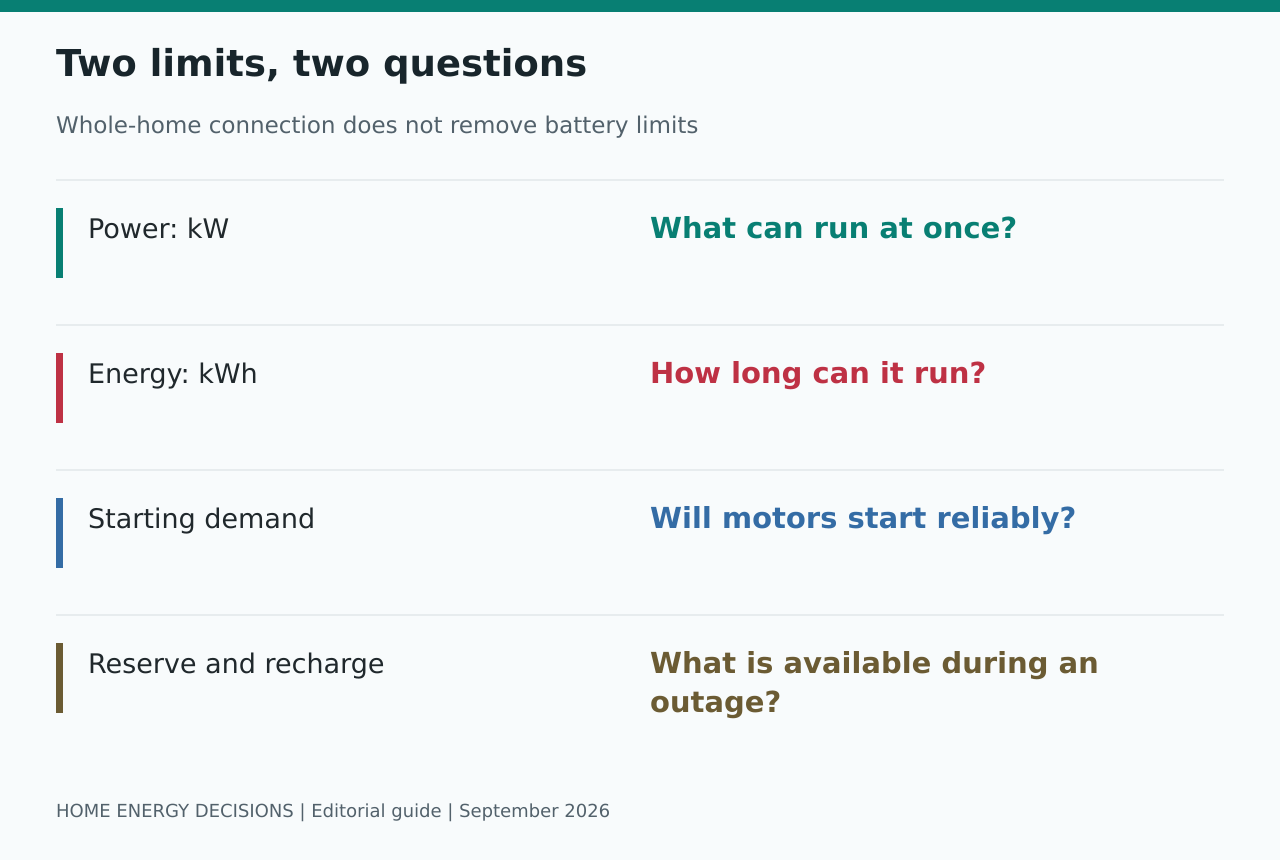
"Whole-home" may describe which circuits are connected, not permission to run every appliance simultaneously. Power and energy impose separate limits.
- kW is power: how much can operate at once.
- kWh is energy: how long loads can run.
- Starting demand: motors can briefly need more than normal running power.
- Load control: may pause EV charging, resistance heat, or other large loads.
Our recommendation is to buy a defined outage outcome, such as refrigeration, communications, selected lights, and a sump pump for a stated period. "Back up the house" is too vague to price or verify.
How long does a home battery last without solar?
Use energy available to loads / average backed-up power. Start with energy actually available at the beginning of the outage, not just nominal capacity.
| Available energy | Average load | Approximate runtime |
|---|---|---|
| 10 kWh | 0.25 kW | 40 hours |
| 10 kWh | 0.5 kW | 20 hours |
| 10 kWh | 1 kW | 10 hours |
| 10 kWh | 2 kW | 5 hours |
| 10 kWh | 5 kW | 2 hours |
These are arithmetic examples using energy already available to the household after whatever allowances the design requires. Real runtime changes with starting state of charge, temperature, degradation, operating losses, and load cycling.
Do not deduct round-trip charging losses again if your available-energy estimate already accounts for usable delivered energy. Ask the installer to explain which capacity basis is being used.
Build an outage load worksheet
List each essential load, running watts, daily hours or duty cycle, and starting demand where relevant. Use measured or manufacturer-supported consumption.
A worked essentials-only example:
| Load assumption | Daily energy |
|---|---|
| Refrigeration, assumed 1.2 kWh/day | 1.20 kWh |
| Internet equipment, 20 W for 24 h | 0.48 kWh |
| Selected LED lights, 40 W for 5 h | 0.20 kWh |
| Laptop, 60 W for 4 h | 0.24 kWh |
| Total of these assumptions | 2.12 kWh |
This is not a complete home's demand. Pumps, HVAC, cooking, medical equipment, and the battery's own consumption may dominate or require special design. Verify essential medical backup requirements with the device supplier; a home battery is not automatically a certified uninterruptible supply.
Can a battery run air conditioning without solar?
Potentially, if its inverter can start and sustain the equipment and enough stored energy is available. Motor-start compatibility and hours of operation must both be documented.
A hypothetical 3 kW average cooling load uses 12 kWh in four hours before adding other loads. Electric resistance backup heat can consume stored energy even faster.
Ask for a demonstration under the agreed outage conditions. "It powers the AC" should specify the exact AC, startup behavior, other simultaneous loads, and expected duration.
Consider shedding EV charging, electric drying, and large cooking loads during an outage. Reducing demand can be more practical than adding enough batteries to maintain normal habits.
Whole house battery backup without solar cost
An installed quote must include battery capacity, inverter capability, isolation equipment, load management, labor, permits, electrical work, and commissioning. Multi-day whole-house coverage can need much more storage than short essential-load backup.
For market context, EnergySage reports approximately $15,647 installed for a 13.5 kWh battery in its 2026 marketplace analysis. That is a broad market benchmark, not a quote for your property or every standalone configuration.
Ask for one-battery and expanded-system alternatives against the same backed-up loads. See the Powerwall 3 price guide for a product-specific example.
Check panel-upgrade costs only if the site assessment calls for that work. Battery installation does not automatically require a service upgrade.
Home battery backup vs generator
| Factor | Grid-charged battery | Fuel-powered generator |
|---|---|---|
| Outage endurance | Limited by stored energy | Can continue with adequate fuel and service |
| Local exhaust | No combustion exhaust in normal use | Requires safe outdoor exhaust management |
| Noise | Model-dependent fan and electronics noise | Engine noise |
| Upkeep | Controls, connections, software, condition checks | Engine maintenance and fuel management |
| Recharging or refueling | Grid return or approved alternate source | Reliable safe fuel supply |
| Installation | Electrical and fire-code requirements | Electrical, fuel, siting, and exhaust requirements |
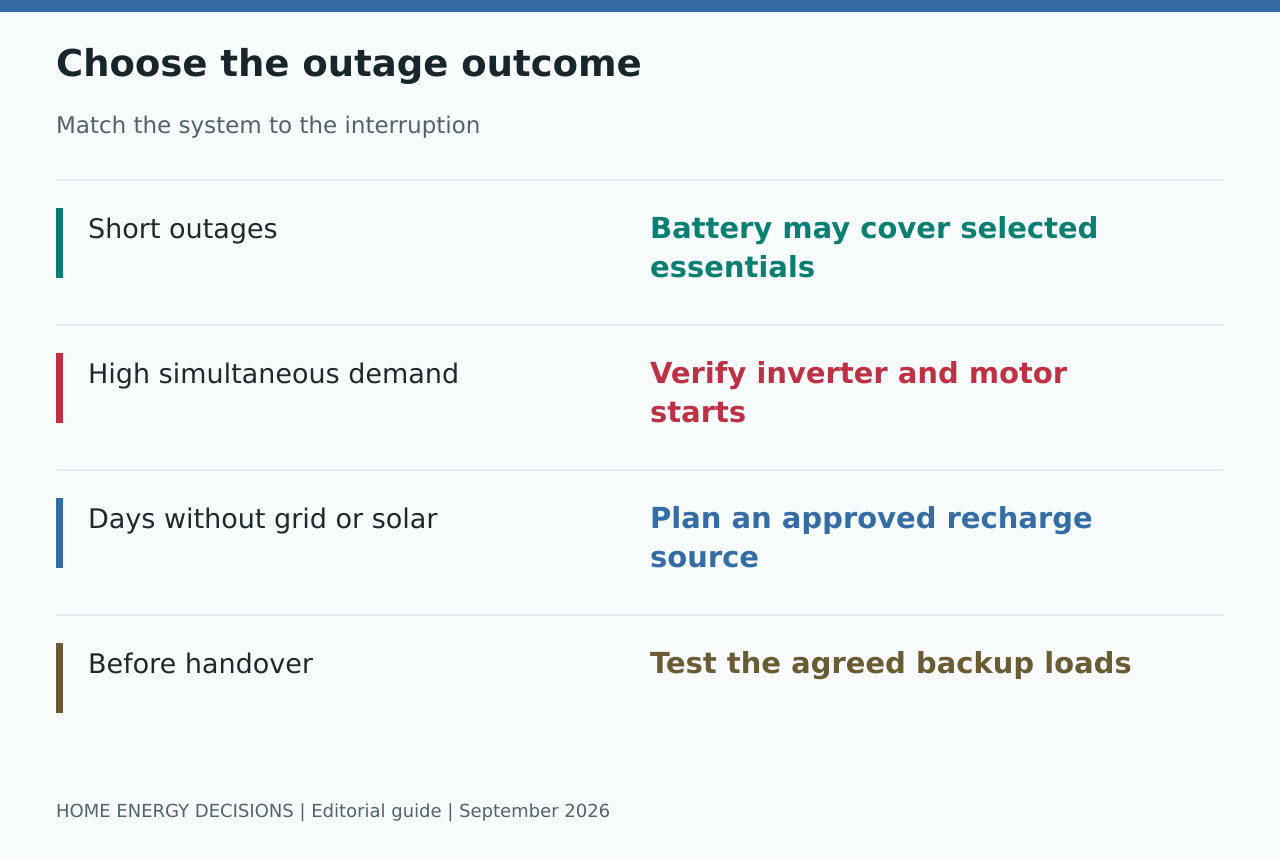
For repeated short outages, a battery may fit well. For days-long outages without a charging source, a generator or professionally designed hybrid solution may be more practical.
Portable generators must never run in a home or garage. Follow CPSC generator safety guidance, including outdoor placement at least 20 feet from the home with exhaust directed away. A permanently installed unit has its own listed siting requirements.
Will a battery without solar lower electricity bills?
Only if the tariff and operating permissions make the math work. On a flat rate, storing and discharging grid energy introduces losses rather than creating free electricity.
For time-of-use screening, suppose you deliver 10 kWh at a $0.40 peak rate. At 90% round-trip efficiency, charging requires about 11.11 kWh. At a $0.15 off-peak rate, charging costs $1.67 and avoids $4 of purchases: approximately $2.33 per cycle before degradation and other charges.
Three hundred such cycles would be about $700/year under those assumptions. They are not guaranteed, and maintaining an outage reserve can reduce available cycling energy.
Do not automatically subtract the former residential federal clean-energy credit from a new 2026 project. Check the IRS termination rules and separately verify utility or state programs.
Build a battery backup plan around one realistic outage
Choose a specific planning scenario before selecting battery capacity. For example, you might want essential lighting, refrigeration, communications, and selected outlets overnight. That is a clearer requirement than saying you want the whole house powered normally through any outage.
List the appliances you would actually use in that scenario and the hours you expect to need them. Distinguish devices that operate continuously from those that cycle or are used briefly. Treat the resulting energy estimate as a starting point for the installer, not as proof that the system can start every appliance.
Next, write down what you are willing to postpone. Laundry, some cooking, and other discretionary loads may be excluded from your outage plan. Do not quietly exclude a major load from the calculation while expecting it to work normally once the battery is installed.
Discuss these choices with everyone who will use the home during an outage:
- Which outlets and circuits will have backup power.
- Which appliances should remain off or be used selectively.
- Where the system displays remaining charge and operating status.
- Who to contact if the system does not transfer as expected.
- What the household will do if the outage outlasts the battery.
An explicit household plan is especially important without solar because there is no solar recharging contribution to assume. Ask the installer to document the actual available charging sources and any limitations instead of relying on a generic demonstration from another installation.
Compare home batteries without solar using the same assumptions
Give each bidder the same load list and outage scenario. Ask for proposed usable energy, supported output, selected circuits, installation scope, and the assumptions behind the runtime estimate. A longer quoted runtime is not necessarily better equipment if it was calculated with fewer loads.
Keep optional features separate from the minimum working installation. Future solar compatibility, additional battery capacity, and expanded circuit coverage may be valuable, but they should not obscure the cost of the backup arrangement you need now.
Request a written commissioning and handover plan. It should explain how backup behavior will be demonstrated, what documentation you receive, and who handles a service issue. Ask how settings can be reviewed after your household's priorities change.
Our preference is to size the purchase around a clearly stated resilience goal rather than an impressive capacity number. You may decide that a smaller essential-load system addresses the most disruptive consequences of an outage. Alternatively, a larger system may be justified by loads you cannot reasonably postpone. The important step is documenting that choice before comparing prices.
Questions to settle before ordering
Ask for the backed-up circuit list, continuous power, motor-start capability, runtime assumptions, outage starting charge, and how recharge works if the outage continues.
Confirm indoor or outdoor siting, working clearance, flood exposure, noise, internet dependence, warranty usage conditions, and local service. Generator charging or future solar compatibility must be supported by the exact system, not a salesperson's general assurance.
Finally, request a documented outage commissioning test. Keep the test result and operating instructions with your backup plan. A battery is most useful when everyone knows which loads to pause before the lights go out.
Try the companion tool
This post links to an interactive tool built for this topic. Open it to see numbers tailored to your home.
Open the toolGet practical energy tips
Join homeowners getting practical tips on cutting energy bills and staying comfortable.
Practical tips only. Unsubscribe anytime.
Read this next
Related guides selected by topic overlap and upgrade path.
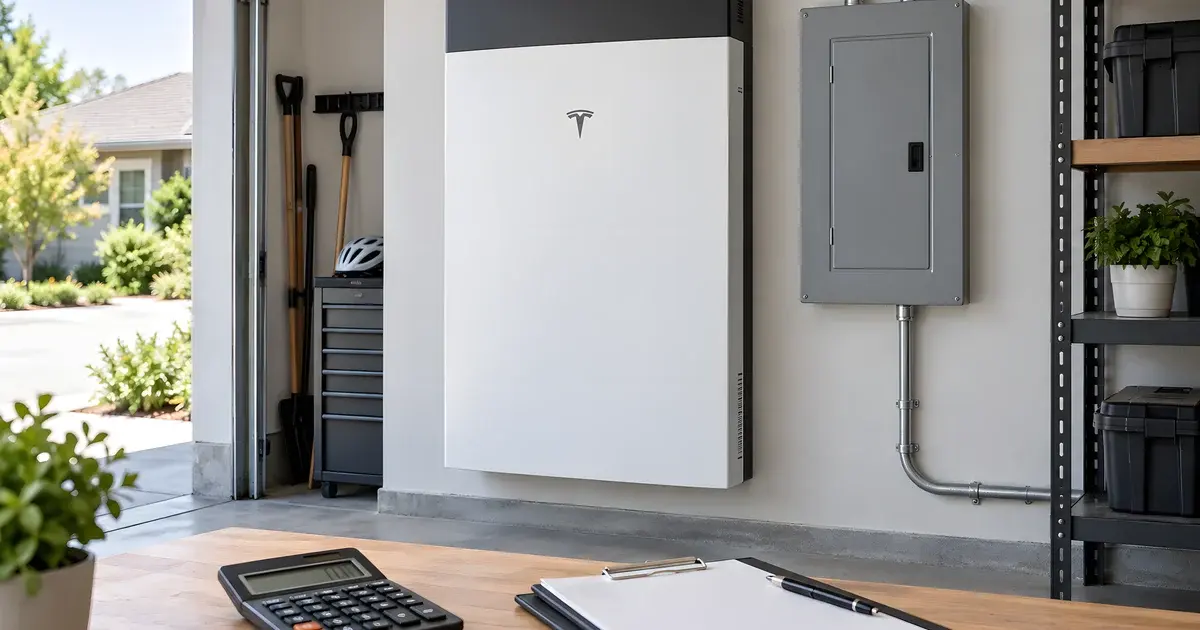
Tesla Powerwall 3 price in 2026 depends on the installed scope. Compare hardware, backup equipment, labor, capacity, and incentives without misleading net prices.
Electrical panel upgrade cost depends on more than the panel. Use this homeowner checklist to understand scope, avoid surprises, and compare quotes.
Upgrading from 100A to 200A can be a simple panel swap or a full service upgrade. Here's what's included, what triggers extra cost, 2026 price ranges, and a quote checklist.
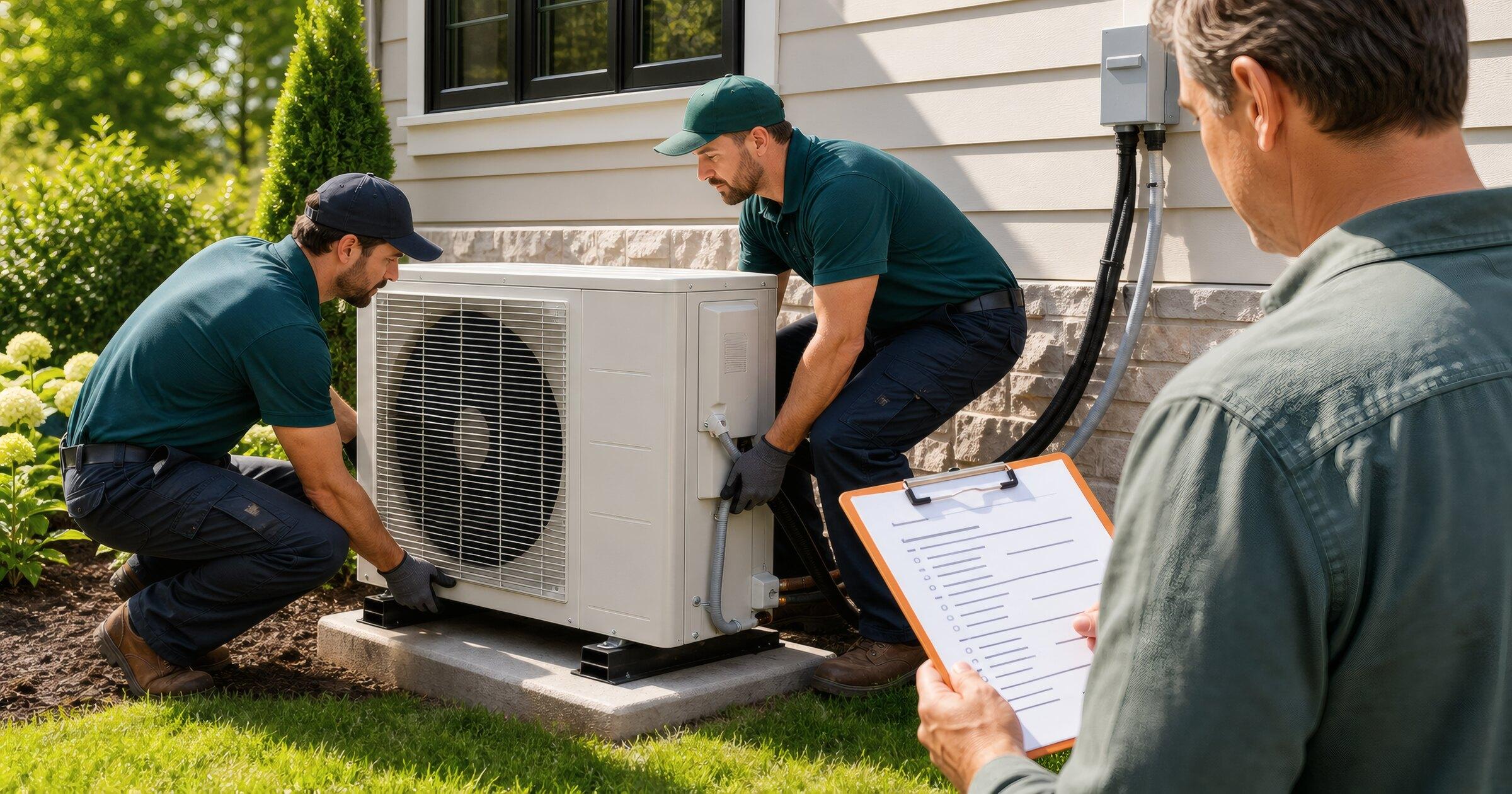
Heat pump cost to install runs $6,000–$18,000 in 2026, with a typical ducted home near $12,000–$14,000. Compare prices by size, type, and quote scope.