Blog
Tesla Powerwall 3 Price 2026
Tesla Powerwall 3 price in 2026 depends on the installed scope. Compare hardware, backup equipment, labor, capacity, and incentives without misleading net prices.
Tesla Powerwall 3 price 2026 depends on your address, battery count, backup equipment, and electrical work; Tesla does not publish one universal installed price on its support page. For preliminary budgeting, use roughly $15,600 as a broad 13.5 kWh installed-battery market reference, then obtain a current Powerwall-specific quote.
That reference comes from EnergySage's 2026 marketplace analysis, not a Tesla price promise. A hardware-only listing or a price after an unavailable credit is not comparable to a complete cash installation quote.
Plan my battery budget
On this page
- Tesla Powerwall 3 installation cost: what the price includes
- Powerwall 3 price versus total project cost
- Tesla Powerwall 3 specifications that affect value
- Powerwall 3 Expansion price versus a second Powerwall
- How long will one Powerwall 3 run a house?
- Tesla Powerwall rebates and tax credits in 2026
- Is Powerwall 3 worth its installed price?
- Compare Powerwall 3 quotes line by line
- Evaluate Powerwall 3 value without overstating savings
- Before accepting a Powerwall installation quote
Tesla Powerwall 3 installation cost: what the price includes
Tesla directs customers to its address-based ordering process for pricing. Get that result and at least one itemized certified-installer quote where available.
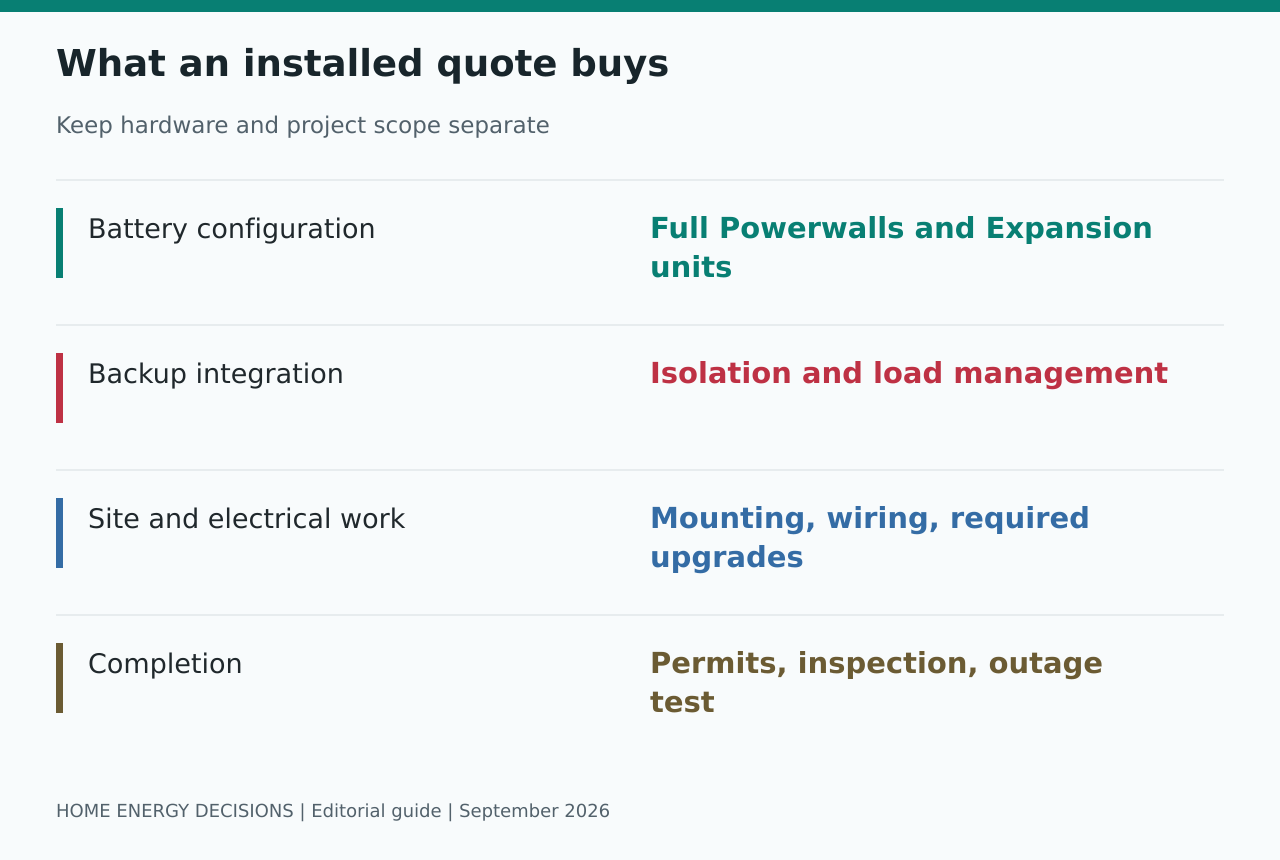
A useful quote separates:
| Item | What to confirm |
|---|---|
| Powerwall equipment | Number of full units and any Expansion units |
| Isolation equipment | Supported Gateway or Backup Switch configuration |
| Electrical integration | Conductors, conduit, breakers, metering, load controls |
| Site work | Mounting, routing, trenching, protection, access |
| Labor | Installation, setup, commissioning |
| Approvals | Permit, inspection, utility coordination |
| Other work | Panel changes, relocation, solar retrofit compatibility |
| Final amount | Taxes, confirmed discounts, exclusions, financing fees |
Ask whether the quote includes whole-home connection or a selected-load panel. Those scopes can have very different costs and operating limits.
Our recommendation is to compare the pre-incentive cash total first. It exposes what you are actually buying before promotional assumptions obscure the comparison.
Powerwall 3 price versus total project cost
A low battery-only price does not include all the equipment and work needed to keep a house operating during an outage. Conversely, a higher quote may include substantial service or site work that another quote omits.
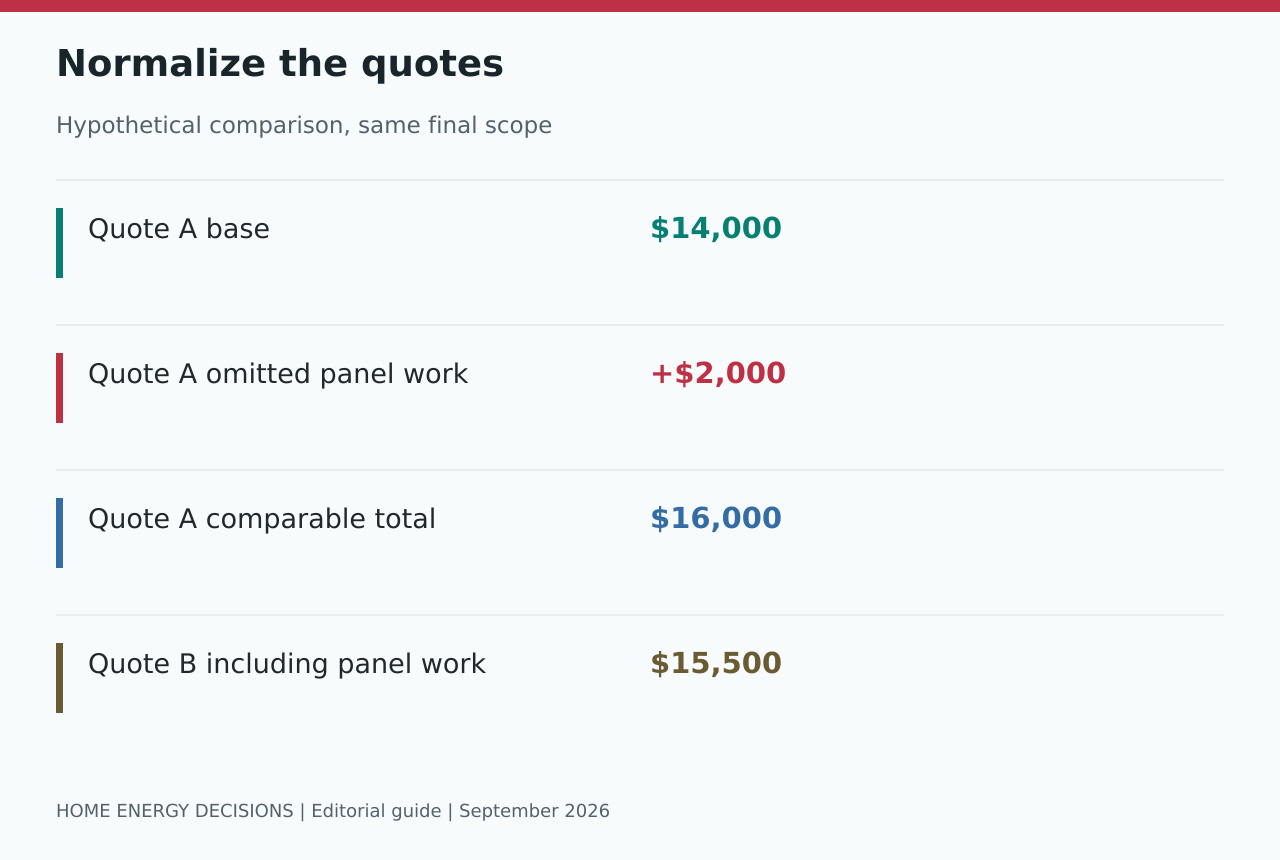
A hypothetical comparison makes this clear:
- Quote A: $14,000 installed, but excludes $2,000 of required panel work.
- Quote B: $15,500 installed, including that same panel work.
- Comparable totals: $16,000 versus $15,500, assuming no other differences.
These are example quotes, not current Tesla offers. Ask both bidders to state the same exclusions, backup loads, warranty labor, and commissioning tests.
Monthly financing figures need another comparison: term, APR, dealer fees, down payment, and total paid. A lower monthly payment can cost more overall.
Tesla Powerwall 3 specifications that affect value
The following figures refer to the US Powerwall 3 model 1707000 family in Tesla's linked datasheet. Match the delivered part number and regional manual before ordering.
| Specification | Published value |
|---|---|
| Nominal battery energy | 13.5 kWh AC |
| Nominal AC output configurations | 5.8, 7.6, 10, or 11.5 kW |
| Nominal grid connection | 120/240 V split phase, 60 Hz |
| Dimensions with front cover | 43.5 x 24 x 7.6 inches |
| Installed weight including bracket | 291.2 lb in this datasheet |
| Mounting | Floor or wall |
| Operating temperature | -4 F to 122 F; derating may apply above 104 F |
| Typical / maximum noise at 1 meter | Below 50 / 62 dBA |
| Warranty period | 10 years |
The distinction between nominal output settings matters: a quote should state the actual approved configuration, not automatically assume the highest headline power.
Physical size is not installation clearance. Ask for the complete layout, working access, local fire-code requirements, and any impact on parking or flood exposure. The white enclosure shown in marketing is not an invitation to paint or wrap the product; follow Tesla's instructions.
Powerwall 3 Expansion price versus a second Powerwall
An Expansion unit adds stored energy to a compatible Powerwall 3 system. It should not be treated as an independent inverter-equipped Powerwall providing the same additional power as a full unit.
If your problem is overnight runtime and power is sufficient, expansion may be worth quoting. If your problem is simultaneous large loads, adding energy alone may not solve it.
Ask the installer to show both kWh and available kW after expansion. Confirm unit limits, mounting, cable routing, and compatibility with the exact existing equipment. Powerwall 3 is not a straightforward add-on to Powerwall 2 or Powerwall+; Tesla's compatibility FAQ makes that distinction.
How long will one Powerwall 3 run a house?
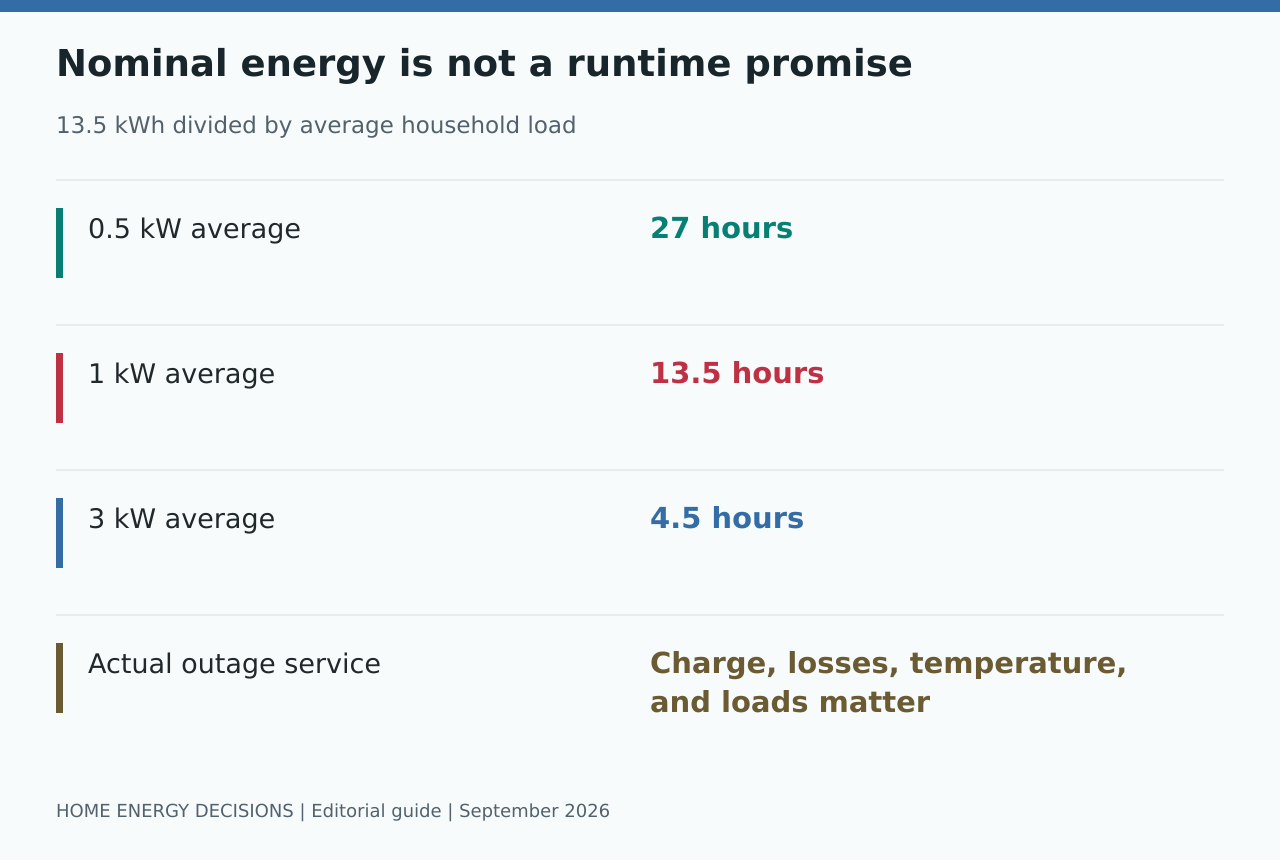
Capacity divided by average load gives a first estimate. Using 13.5 kWh nominal energy, the arithmetic is 27 hours at 0.5 kW, 13.5 hours at 1 kW, or 4.5 hours at 3 kW.
Those are nominal-capacity illustrations, not promised outage runtimes. Starting charge, reserve behavior, temperature, aging, system consumption, and real load variation affect delivered service.
A heat pump, electric range, EV charger, and dryer can compete for available power and energy. Ask for your actual critical-load schedule rather than a vague "one day of backup."
For a roof without panels, read whole house battery backup without solar. Once stored energy is depleted, a grid-only system needs the grid to return unless an approved alternate charging arrangement exists.
Tesla Powerwall rebates and tax credits in 2026
The former 30% homeowner residential clean-energy credit should not be subtracted from a new 2026 installation. The IRS states that the credit does not apply to expenditures after December 31, 2025, and its timing rules address completed installation.
Tesla's Powerwall rebate page lists a promotion with an order window ending June 30, 2026. Do not assume a new September order qualifies. Earlier eligible orders still need to meet the published installation and redemption terms.
State, utility, and virtual-power-plant offers have separate rules. Confirm eligibility, enrollment obligations, event dispatch, minimum reserve, payment conditions, and whether funds are actually reserved. Keep unapproved offers out of the guaranteed net price.
Is Powerwall 3 worth its installed price?
Separate backup value from bill savings. A battery does not generate electricity. Savings depend on time-of-use spreads, solar export rules where applicable, operating losses, and how much capacity you keep for outages.
If a hypothetical $15,600 system saves $600/year, simple recovery is 26 years before financing, maintenance, and degradation. That may still be worthwhile for a buyer who values reliable backup, but it is not a quick energy-payback claim.
Ask for annual savings with your actual tariff and interval use. Have the proposal distinguish energy shifting from incentive payments so the same kWh is not credited twice.
This is someone else's installation experience, not ours. Its historical costs and incentives are not a current quote.
Compare Powerwall 3 quotes line by line
Create a shared scope sheet before asking multiple installers for prices. Include the proposed battery count, whether solar is included, which circuits need backup, and any loads you expect to operate during an outage. Otherwise, two totals may describe substantially different systems.
Ask each installer to mark every line as included, excluded, optional, or subject to site inspection. A blank line is not an assurance that the work is free. Resolve the largest uncertainties before comparing a financed monthly payment or an advertised starting price.
Useful lines for the scope sheet include:
- Exact equipment models and quantities.
- Backup coverage and any proposed load controls.
- Electrical work identified during the site assessment.
- Permitting, utility coordination, and inspection responsibilities.
- Installation, commissioning, cleanup, and documentation.
- Any separately priced future expansion provisions.
If an allowance is included for work that has not been assessed, ask what happens if the actual cost is higher or lower. Get the process for approving changes in writing. That makes the quoted total more meaningful than a headline price followed by undefined site-dependent extras.
Keep cash pricing separate from financing. Compare the deposit, fees, total scheduled payments, and any conditions attached to promotional terms. A monthly payment alone does not tell you the installed price or the cost of borrowing.
Evaluate Powerwall 3 value without overstating savings
Separate outage protection from electricity-bill savings in your worksheet. Backup capability may have personal value even when the energy-only payback is unattractive. Conversely, projected bill savings do not prove that the quoted system covers the loads you care about during an outage.
Ask the installer to identify the tariff, charging assumptions, reserve setting, and household usage profile behind any savings estimate. Keep these inputs with the proposal so you can see what would change if your utility rate or operating preferences change.
For the outage case, request a load-specific explanation rather than a single whole-home runtime claim. Identify the equipment assumed to be running and the starting charge assumption. If two proposals use different assumptions, ask for a comparable scenario before treating the difference as a product advantage.
Our buying preference is a complete, auditable proposal over a low headline number. Ask what will be demonstrated at handover, how the system's settings will be documented, and who takes responsibility for service. Those questions do not guarantee a trouble-free installation, but they make the purchase easier to evaluate and give you a clearer record if the finished project differs from what was promised.
Before accepting a Powerwall installation quote
Request the final cash price, exact unit configuration, included electrical work, utility approval responsibilities, estimated timeline, and documented outage test.
Clarify who handles warranty labor and service visits. Keep copies of the warranty applicable to the sale, not only a headline duration. Ask which internet functions remain available during an outage and how household members should respond to alerts.
Compare the result with the loads and outage duration in My Plan. The best price is the lowest complete price for the backup service you actually need, not the smallest number printed beside a battery.
Try the companion tool
This post links to an interactive tool built for this topic. Open it to see numbers tailored to your home.
Open the toolGet practical energy tips
Join homeowners getting practical tips on cutting energy bills and staying comfortable.
Practical tips only. Unsubscribe anytime.
Read this next
Related guides selected by topic overlap and upgrade path.

Whole house battery backup without solar can charge from the grid. Size usable energy, peak power, outage duration, and recharge needs before buying.

Electrical panel upgrade cost depends on more than the panel. Use this homeowner checklist to understand scope, avoid surprises, and compare quotes.

Are solar panels worth it in 2026? The 30% federal credit ended Dec 31, 2025. Here is the payback math an engineer actually uses: real costs, net billing, batteries, and when to walk away.

Upgrading from 100A to 200A can be a simple panel swap or a full service upgrade. Here's what's included, what triggers extra cost, 2026 price ranges, and a quote checklist.