Solar Battery Size Calculator
This tool keeps energy and power separate. Daily kWh and backup time tell you how much battery storage you need. The largest group of loads running at once tells you whether the inverter is powerful enough.
1Define the energy target
Use the one-way efficiency from stored battery energy to AC loads, not round-trip efficiency.
2Match the hardware
Rated battery capacity
17.8 kWh
2 modules at 13.5 kWh each provides 27.0 kWh.
Usable energy target
14.4 kWh
Battery-bank capacity
370 Ah
At a rated 48 V.
Inverter power check
The continuous load fits
6.0 kW peak load compared with a 11.5 kW inverter.
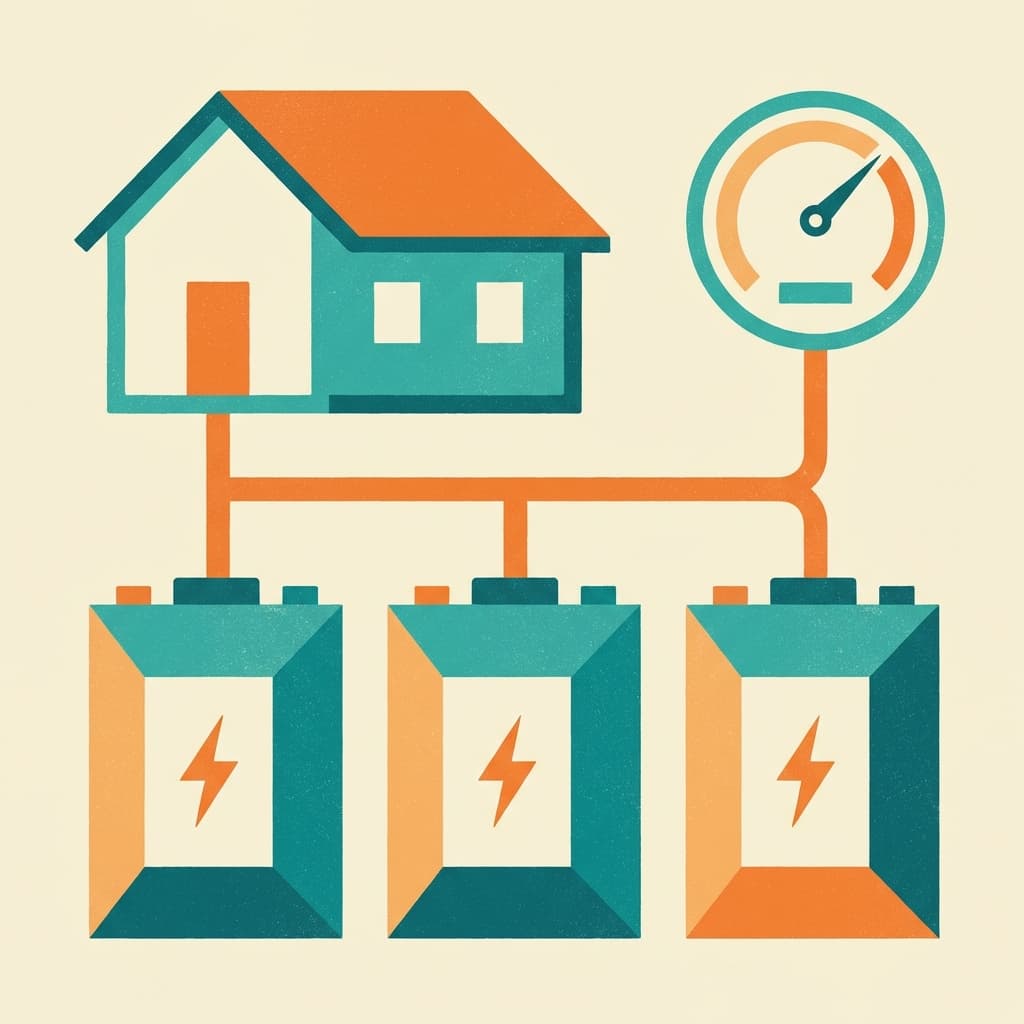
Battery energy affects how long loads can run. Inverter output affects what can start and run together. A full design must also cover solar panel size, winter production, generator charging, battery temperature, warranty limits, and code-required equipment.
Inputs stay in this browser. No account or quote request is required.
Quick planning answer
A home that needs 12 kWh per day for one day without solar needs about 17.8 kWh of rated battery storage when it keeps a 20% reserve and uses 90% depth of discharge and 90% discharge-and-inverter efficiency. Since batteries come in set module sizes, the installed capacity will usually be a little higher.
Build the essential-load total from a real day
Use utility interval data, a circuit monitor, or appliance measurements when you can. Whole-home use may include electric heat, water heating, EV charging, and cooking that you could pause during an outage. A plan for essential loads is often much smaller and cheaper.
The season matters. A summer average may miss winter heat-pump use. A yearly average may miss heavy air-conditioning during a hurricane outage. Test the hardest season and decide which loads can turn off automatically.
Choose how many cloudy days to cover
One day of backup may be enough for a grid-connected home that can recharge from solar. A remote off-grid system needs a weather model, several low-sun days, a generator plan, and room for seasonal load changes. Buying batteries for a rare week-long outage may cost more than using storage with a generator or automatic load controls.
- Check continuous kW for the largest group of loads that may run together.
- Check short surge power for compressors, well pumps, and sump pumps.
- Check usable energy within the battery's allowed charge range and warranty.
- Confirm island operation, transfer equipment, black start, and solar charging during an outage.
Solar panels must be able to refill the battery
A battery stores energy. It does not make energy. Size the solar panels and charge controller to cover daily use plus system losses during the season with the least useful sun. Inverter clipping and battery charge limits can also waste some available solar power.
For a grid-connected home, include the utility rate plan. A battery may be useful during outages but save little money under a flat rate. Low export credit and high evening rates can make daily battery use more valuable.
Questions people ask before buying
How many kWh of battery does a house need?
It depends on which loads you want to run and for how long. Add the essential kWh used in one day. Multiply by the number of backup days and the reserve. Then divide by allowed depth of discharge and one-way discharge-and-inverter efficiency.
What is the difference between kW and kWh?
kW is the amount of power used at one moment. It tells you what can run at the same time. kWh is stored or used energy. It tells you how long those loads can run.
Should I use whole-home electricity use?
Only if you want the whole home to run without changing your habits. Most backup systems cost less when they pause or manage EV charging, resistance heat, dryers, and other optional loads.
Can solar recharge a battery during an outage?
Only if the system is designed and approved to run on its own during an outage. The inverter, transfer equipment, solar panels, controls, and battery must all support this mode.
Method, sources and limits
Required usable energy equals daily load × backup days × (1 + reserve). To find rated battery capacity, the tool divides usable energy by both allowed depth of discharge and one-way discharge-and-inverter efficiency. Charging losses affect how much solar or generator energy is needed to refill the battery, not the stored-capacity result. The tool uses the entered bank voltage to show the same capacity in amp-hours.
The tool rounds up to a whole number of battery modules. It compares the largest load in kW with the inverter's continuous output. You still need to check short starting surges separately.
- Solar-plus-storage system basics (U.S. Department of Energy)
- PVWatts production modeling (National Renewable Energy Laboratory)
- Homeowner’s guide to solar (U.S. Department of Energy)