Solar Panel Angle Calculator
This tool gives you a simple starting angle for fixed solar panels. It also shows angles for summer, winter, spring, and fall. Choose a U.S. city or enter your latitude. Then compare the result with the roof you already have.
1Locate the array
Use a positive number north of the equator. Choose the custom location option to use this field.
Year-round fixed angle
39.7°
When the site allows it, face the panels toward azimuth 180°.
Summer tilt
24.7°
Spring / fall
39.7°
Winter tilt
54.7°
Roof difference
12.7° shallower
Latitude gives you a useful starting point. Roof direction, shade, snow, wind, mounting limits, local weather, time-of-use rates, and monthly power use may change the best angle. Check the final layout in NREL PVWatts.
Inputs stay in this browser. No account or quote request is required.
Quick planning answer
For fixed panels, an angle close to the local latitude is a useful first estimate. A flatter angle often works better in summer. A steeper angle often works better in winter. Roof direction, shade, snow, wind, mounting limits, utility rates, and the time you use power may matter more than a few degrees of tilt.
Your existing roof may be the best choice
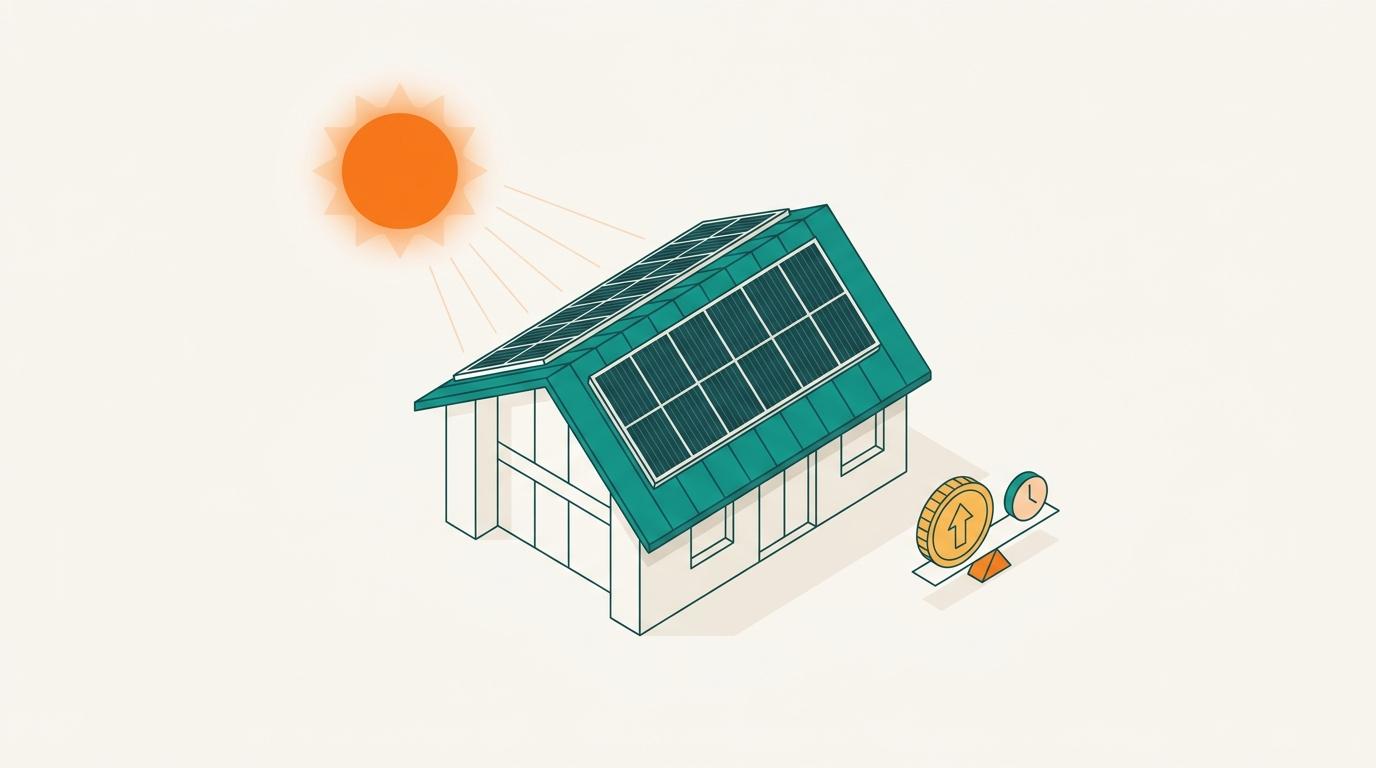
A raised rack may gain a little more energy, but it also adds wind load, roof connections, labor, and height. A strong, unshaded roof with a reasonable slope may give better value when the panels can sit close to the roof.
Azimuth means the compass direction the panels face. An azimuth of 180 degrees is south, and 0 degrees is north. In the continental United States, south often makes the most yearly energy. West may be useful when late-afternoon power costs more or when the home uses the most power after work.
Shade can matter more than tilt
A chimney shadow crossing the panels in late afternoon may matter more than changing the tilt from 28 to 31 degrees. Check nearby trees, roof sections, vents, walls, and future tree growth through the year. Panel-level electronics can limit some losses, but they cannot replace blocked sunlight.
- Use a shade study or a design model that includes the horizon.
- Leave the roof access and fire-code space required in your area.
- Check roof strength, waterproof mounts, wind loads, and falling snow.
- Enter the final direction, tilt, losses, and system size in NREL PVWatts.
Seasonal changes work best on ground mounts
The summer and winter angles only help if someone can safely adjust the rack. Climbing onto a roof several times a year is rarely worth a small energy gain. Ground mounts and small off-grid systems are easier to adjust, especially when winter energy is limited.
For bill savings, the time of day also matters. Export credit, time-of-use rates, battery charging, and inverter clipping may favor an angle or direction that does not make the most total energy each year.
Questions people ask before buying
What is the best angle for solar panels?
A fixed angle near the site's latitude is a useful first estimate. Before building, also check local weather, roof shape, shade, snow, wind, the time power is made, and utility rates.
Should solar panels face true south?
In the Northern Hemisphere, true south often makes the most yearly energy for an unshaded fixed system. Southwest or west may better match late-day power use or time-of-use rates.
Is roof pitch the same as solar panel tilt?
Both describe slope, but they use different units. Solar tilt is measured in degrees above horizontal. Roof pitch is often written as inches of rise for 12 inches of run. A 6:12 roof is about 26.6 degrees.
How much does a few degrees of tilt matter?
It often matters less than shade, panel direction, equipment losses, and available roof area. Compare both angles in PVWatts before paying for extra racking to gain a small amount of energy.
Method, sources and limits
The year-round fixed tilt equals the site's latitude, using a practical range of 5 to 60 degrees. The summer angle is 15 degrees lower. The winter angle is 15 degrees higher. Spring and fall use the year-round angle.
Panels face azimuth 180 degrees north of the equator and 0 degrees south of it. These simple geometry rules do not include hourly sunlight, clouds, land shape, shade, reflected light, snow, electric rates, or mounting limits.
- PVWatts Calculator (National Renewable Energy Laboratory)
- Homeowner’s guide to solar (U.S. Department of Energy)
- Solar resource maps and data (National Renewable Energy Laboratory)