Blog
Heat Pump Water Heater vs Gas
Compare heat pump and gas water heaters using your rates, installed quotes, recovery needs, noise, space, and a transparent annual-cost example.
Heat pump water heater vs gas comes down to local energy prices, installation conditions, and hot-water demand: a heat pump uses less purchased energy, but it is not automatically cheaper to operate where electricity is expensive and gas is cheap.
In the worked example below, a heat pump costs about $171/year and a gas tank $400/year for the same modeled heat demand. Change the tariffs and that result can reverse. These are calculations, not measurements from a home we tested.
Compare water-heating costs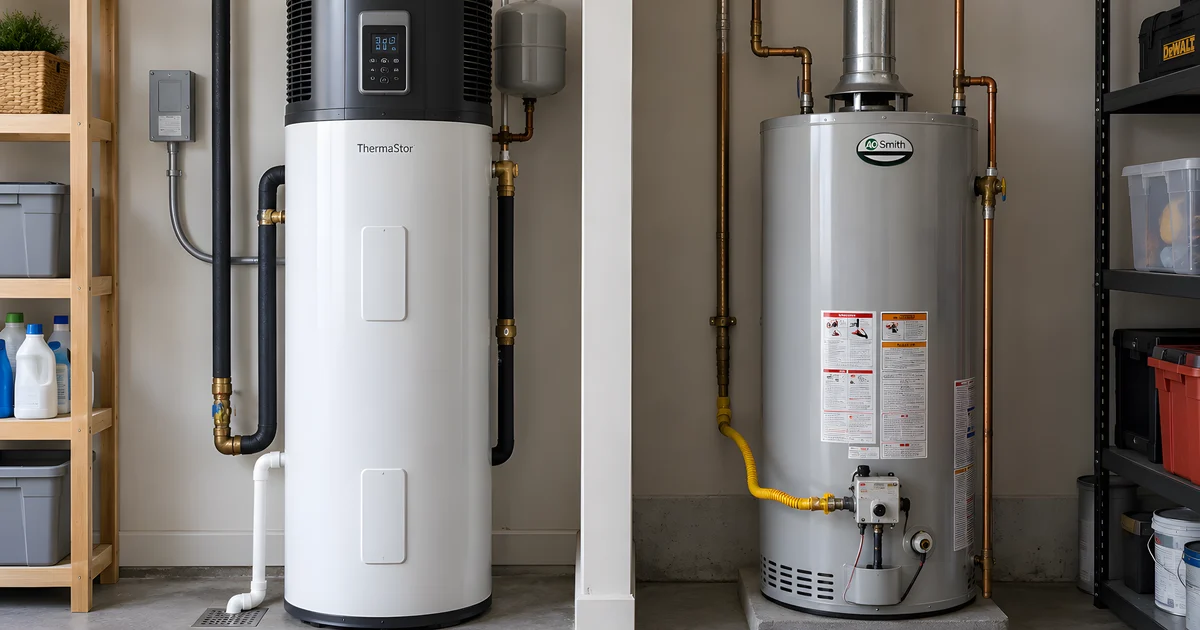
On this page
- Heat pump vs gas water heater running cost
- When gas is cheaper than a heat pump water heater
- Heat pump water heater vs gas installation cost
- Calculate incremental payback, not the whole replacement bill
- Heat pump water heater noise, space, and recovery
- Compare first-hour rating, not just gallons
- Gas vs hybrid water heater maintenance and reliability
- Heat pump water heater incentives in 2026
- Compare heat pump and gas water heaters using your household schedule
- Make heat pump water heater versus gas quotes comparable
- Which water heater should you choose?
Heat pump vs gas water heater running cost
Compare delivered hot water, not identical fuel consumption. A therm contains approximately 29.3 kWh of heat before appliance losses.
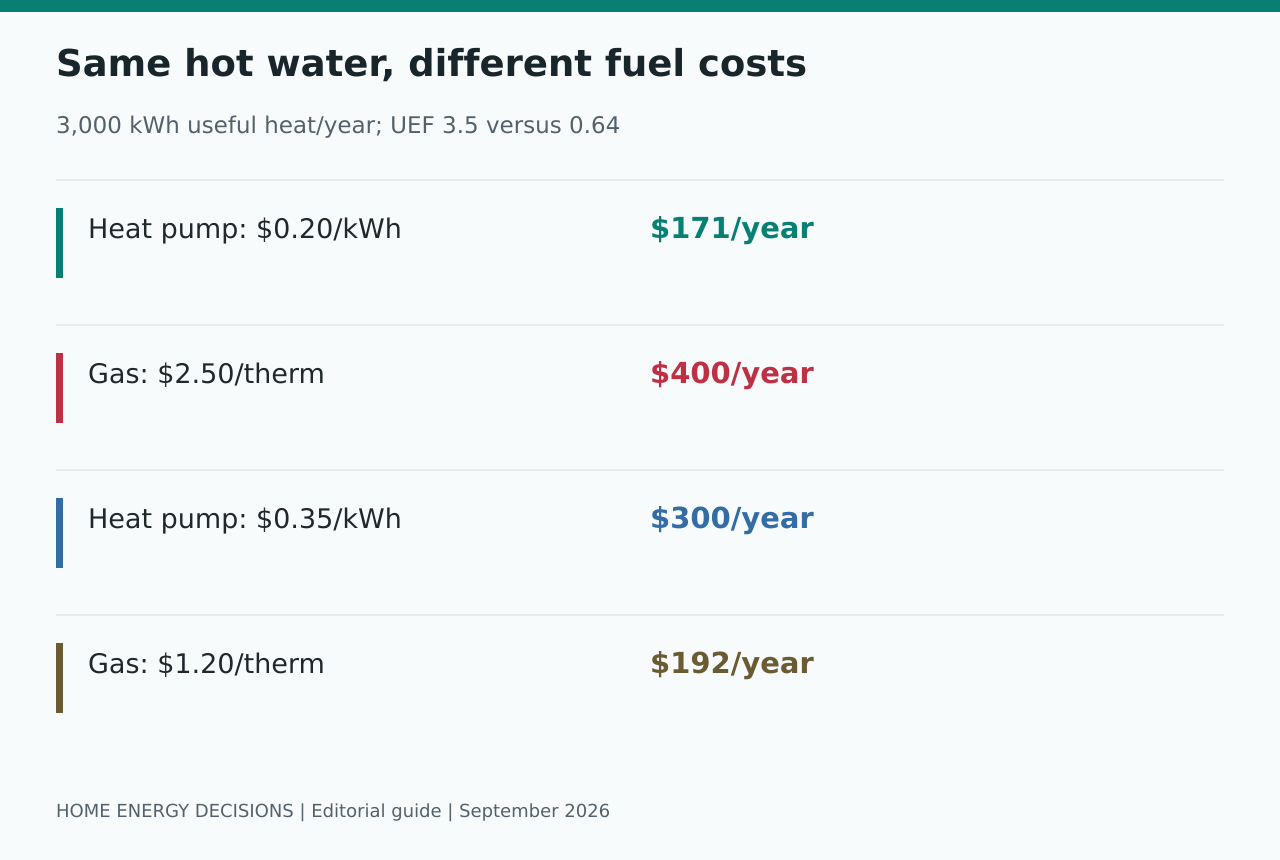
For a screening estimate, assume 3,000 kWh/year of useful hot-water heat, a heat-pump UEF of 3.5, and a gas-tank UEF of 0.64. UEF is a standardized efficiency rating; actual consumption depends on draw pattern, ambient conditions, and operating mode.
- Heat-pump electricity: 3,000 / 3.5 = approximately 857 kWh/year.
- Gas use: 3,000 / 29.3 / 0.64 = approximately 160 therms/year.
- At $0.20/kWh and $2.50/therm: approximately $171 versus $400/year.
The assumed useful demand is not a household-size guarantee. For purchase decisions, compare EnergyGuide estimates for similarly sized models and the same usage category, then substitute your tariff. ENERGY STAR's savings guidance primarily compares heat pumps with standard electric resistance heaters; do not apply that savings figure directly to a gas replacement.
When gas is cheaper than a heat pump water heater
Using the same assumed equipment, gas at $1.20/therm costs approximately $192/year. Heat-pump electricity at $0.35/kWh costs $300/year. The heat pump now costs roughly $108 more annually.
A useful break-even electricity price is:
Gas price per therm x heat-pump UEF / (29.3 x gas UEF).
At $1.20 gas, UEF 3.5 and 0.64, that is about $0.224/kWh. Below it, the modeled heat pump has the lower variable energy bill. Above it, gas does. This screening formula excludes gas ancillary electricity, fixed charges, space-conditioning interactions, and maintenance.
Our recommendation: do this tariff check before discussing payback. A salesperson's percentage saving cannot replace your actual fuel prices.
Heat pump water heater vs gas installation cost
Get two complete installed quotes for the same usable service, not two retail appliance prices. See the separate heat pump water heater cost guide for the broader installation budget.
| Quote item | Heat pump conversion | Gas replacement |
|---|---|---|
| Electrical | Circuit capacity, wiring, disconnect if required | Power for controls or powered vent, model-dependent |
| Air and exhaust | Air volume, louver or ducting requirements | Listed vent system and combustion-air requirements |
| Water | Pipe changes, shutoffs, relief discharge | Same site-specific plumbing checks |
| Drainage | Condensate route or approved pump | Condensate for condensing models |
| Site work | Height, service access, tank removal | Vent compatibility and gas-line condition |
| Approvals | Permits and inspection | Permits and inspection |
A 120-volt heat pump can avoid some electrical work, but recovery and installation requirements differ by model. It is not interchangeable with every 240-volt unit. Compare 120V heat pump water heater options only after confirming the exact product's requirements.
Calculate incremental payback, not the whole replacement bill
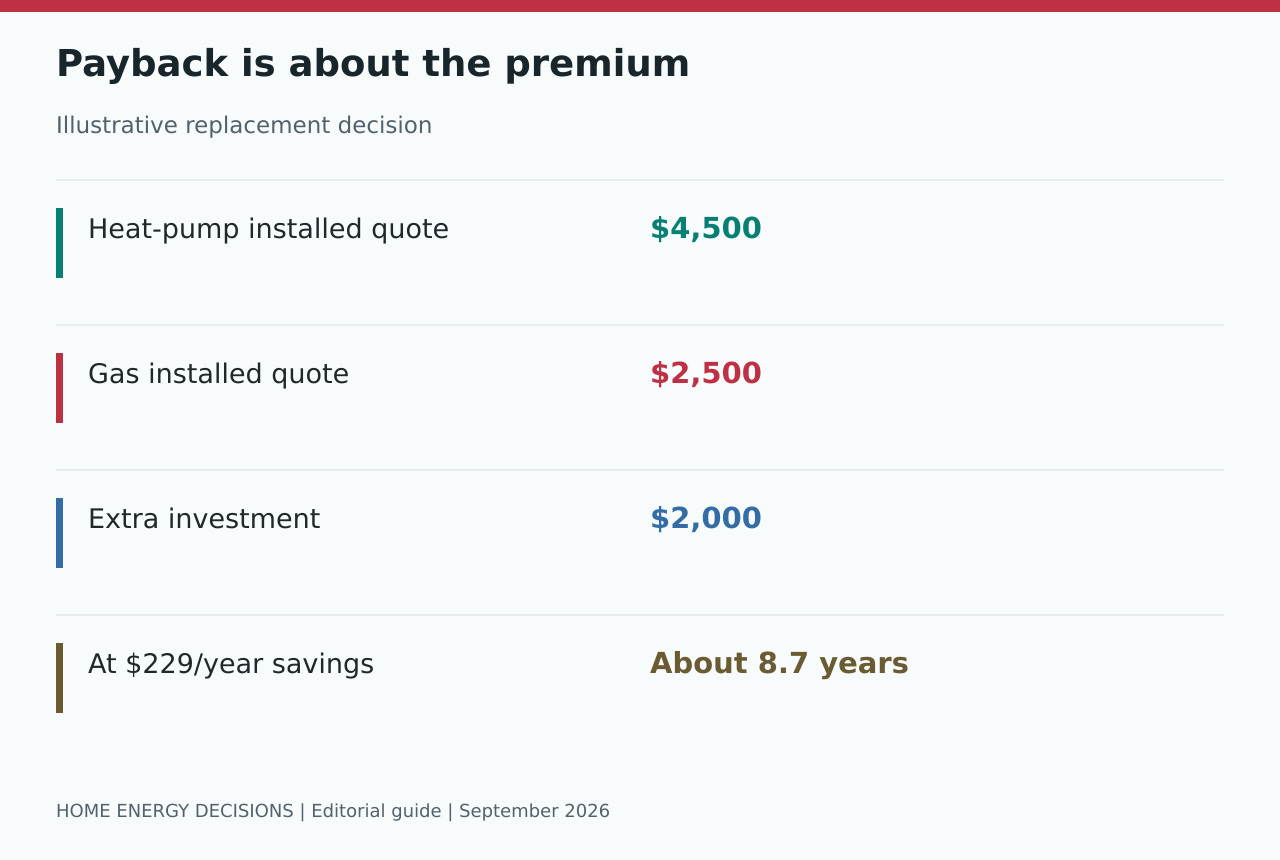
Suppose a gas replacement costs $2,500 and a heat-pump conversion $4,500. The premium is $2,000. At $229/year modeled operating savings, simple payback is approximately 8.7 years, before maintenance, financing, or changes in rates.
If operating savings are negative, there is no energy-only payback. Electrification, eliminating combustion, and eventual removal of gas service can still be goals, but describe them honestly.
Do not count the monthly gas customer charge as avoided while a furnace, range, or dryer still keeps the account open.
Heat pump water heater noise, space, and recovery
A heat-pump water heater includes a compressor and fan. Ask for the manufacturer's sound specification and listen to a comparable operating unit where possible, especially near a bedroom or home office. A utility-room partition does not guarantee silence.
It extracts heat from surrounding air and produces condensate. In a heated room during winter, the space-heating system may replace some of that heat. In a warm, humid location, the cooling and dehumidification effect may be useful. Neither effect makes it a substitute for proper HVAC design.
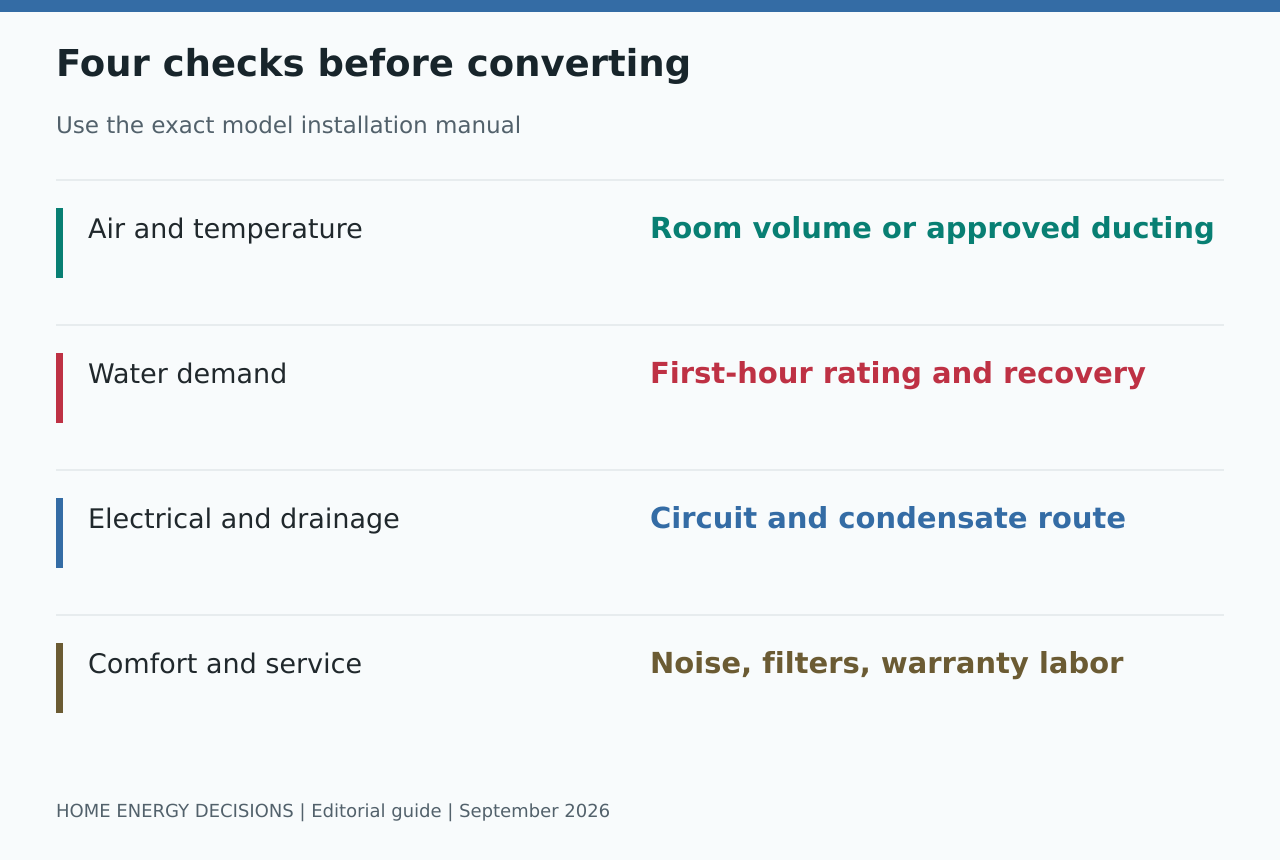
Do not use a universal room-size rule. Required air volume, ducting options, minimum ambient temperature, clearances, height, and filter access vary by model.
Compare first-hour rating, not just gallons
A 50-gallon label describes storage volume, not how many consecutive showers the appliance can support. Compare the first-hour rating, recovery, and your busiest hour.
Heat-pump-only operation may recover more slowly than a gas tank. Hybrid mode can recruit resistance elements for high demand, raising electricity use. A larger tank may let you remain in efficient mode more often, but it needs more space.
Before changing water temperature, follow the manufacturer's instructions and consider scald protection and household health requirements with your plumber. Do not increase temperature simply to conceal undersizing.
Gas vs hybrid water heater maintenance and reliability
Budget for model-required maintenance rather than treating either appliance as maintenance-free.
For a heat pump, check air-filter cleaning, condensate drainage, anode protection where applicable, and service access for the refrigeration assembly. For gas, include venting and combustion checks by a qualified technician as well as tank maintenance. Hard water, leakage, and corrosion can affect both.
Ask who provides local warranty service, what labor is covered, how long parts typically take, and whether permit or removal costs are included in a warranty replacement. A long parts warranty does not guarantee a free installed replacement.
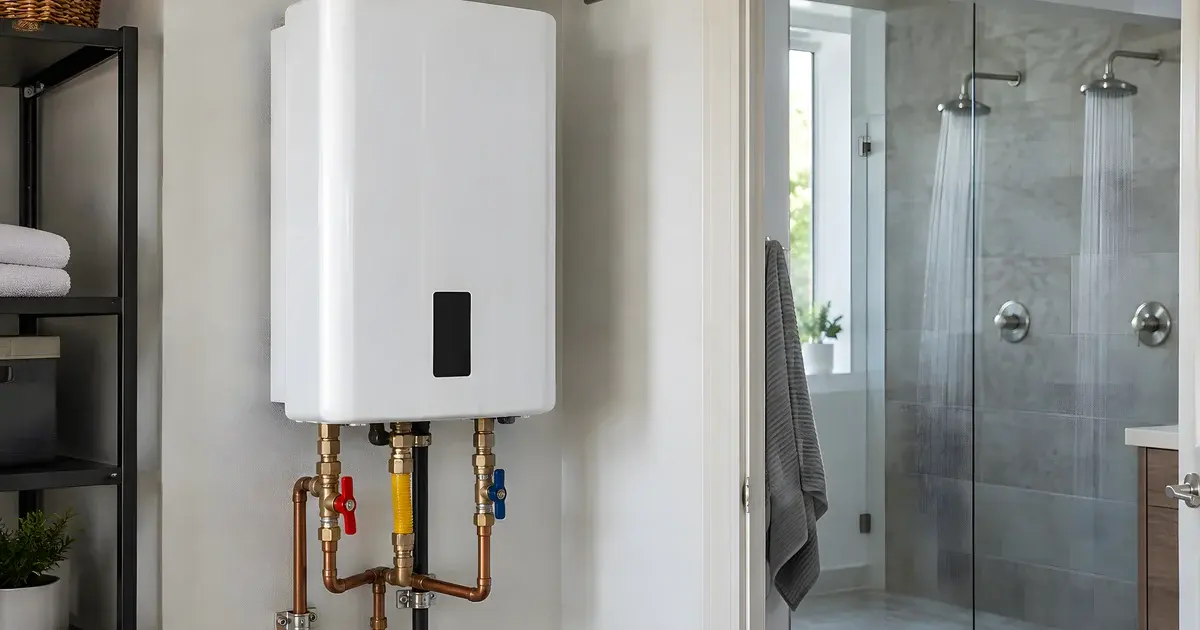
This third-party segment introduces the equipment choice; it is not our installation or test. Use current quotes and the exact model manual for purchase decisions.
Heat pump water heater incentives in 2026
Do not subtract an automatic federal credit from a new 2026 project. The IRS explains the termination dates for residential energy credits. State and utility offers need separate eligibility and funding checks.
Get written confirmation of approved equipment, income rules, contractor requirements, preapproval, and whether funding is reserved. Our water-heater tax-credit guide separates historical claims from current shopping.
Compare heat pump and gas water heaters using your household schedule
Before choosing a model, describe your busiest hot-water period to the installer. Two showers spread across a morning are a different requirement from showers, laundry, and kitchen use happening together. A household average can hide the short period that determines whether the replacement feels adequate.
Build a one-page household profile with the following information:
- How many people normally use hot water, and whether that changes seasonally.
- Which fixtures are commonly used at the same time.
- Whether morning or evening is the busiest period.
- The existing heater's model, tank capacity, and any comfort complaints.
- The proposed installation location and nearby occupied rooms.
- Whether you expect to remove other gas appliances later.
Ask the contractor to match this profile to the proposed unit's published performance data and operating modes. Do not accept tank volume alone as proof that two heaters will deliver an identical experience. Also ask which settings were assumed when the contractor estimated running costs.
For a heat pump model, request an explanation of when backup resistance heating may operate and how that changes the estimate. For a gas model, ask which efficiency value was used and whether its venting and installation requirements match your home. Put those assumptions beside the quote so you can compare them later.
Make heat pump water heater versus gas quotes comparable
Create separate lines for the appliance, necessary installation work, optional improvements, and ongoing costs. A quote that includes electrical work and removal of the old heater is not directly comparable with a price that covers only delivery of a replacement tank.
It is also worth separating costs that disappear from costs that remain. If other appliances keep the gas account open, replacing the water heater does not eliminate the account's fixed charge. Conversely, do not assume closing the account is possible until you have identified every appliance using it and checked the utility's process.
Ask for a written handover checklist: equipment model, installed settings, warranty documents, maintenance requirements, and the appropriate service contact. Keep photographs of the labels and an accessible copy of the invoice. These details are useful when comparing a later bill or arranging service, even if the installation initially seems straightforward.
Our decision preference is to resolve installation fit and peak demand before debating small differences in estimated annual cost. A modest projected saving is not persuasive if the quote leaves important work undefined. Choose the option with a documented scope and a realistic operating-cost range, then revisit the assumptions after you have actual bills from the new system.
Which water heater should you choose?
Choose a heat-pump quote for closer evaluation when the tariff math works, adequate air and drainage are available, and recovery meets peak demand. Favor the simpler gas replacement when conversion work is disproportionate, the site is unsuitable, or the rate comparison is unfavorable.
Consider a third option rather than forcing a binary choice: a properly sized electric tank or a different installation location. If exploring on-demand gas, read tankless water heater disadvantages before assuming tankless fixes every limitation.
Write down five numbers before deciding: installed premium, expected annual energy cost, first-hour rating, maintenance allowance, and warranty labor exposure. That is more useful than a generic "worth it" verdict.
Get practical energy tips
Join homeowners getting practical tips on cutting energy bills and staying comfortable.
Practical tips only. Unsubscribe anytime.
Read this next
Related guides selected by topic overlap and upgrade path.

Heat pump water heaters run $3,000–$6,500 installed in Austin. Austin Energy pays an $800 rebate, but the federal 25C credit ended in 2025. Here's the real 2026 math.
Tankless water heater disadvantages include upfront conversion cost, limited flow, maintenance, hot-water delays, and electrical or gas upgrades.

Window replacement tax credits can be real—but only if you can document what qualifies. Here’s a practical checklist for homeowners to reduce uncertainty.

A practical, documentation-first guide to electric panel upgrade tax credits: what to confirm before work starts, what receipts to keep, and how to reduce uncertainty.