Blog
Tankless Water Heater Disadvantages
Tankless water heater disadvantages include upfront conversion cost, limited flow, maintenance, hot-water delays, and electrical or gas upgrades.
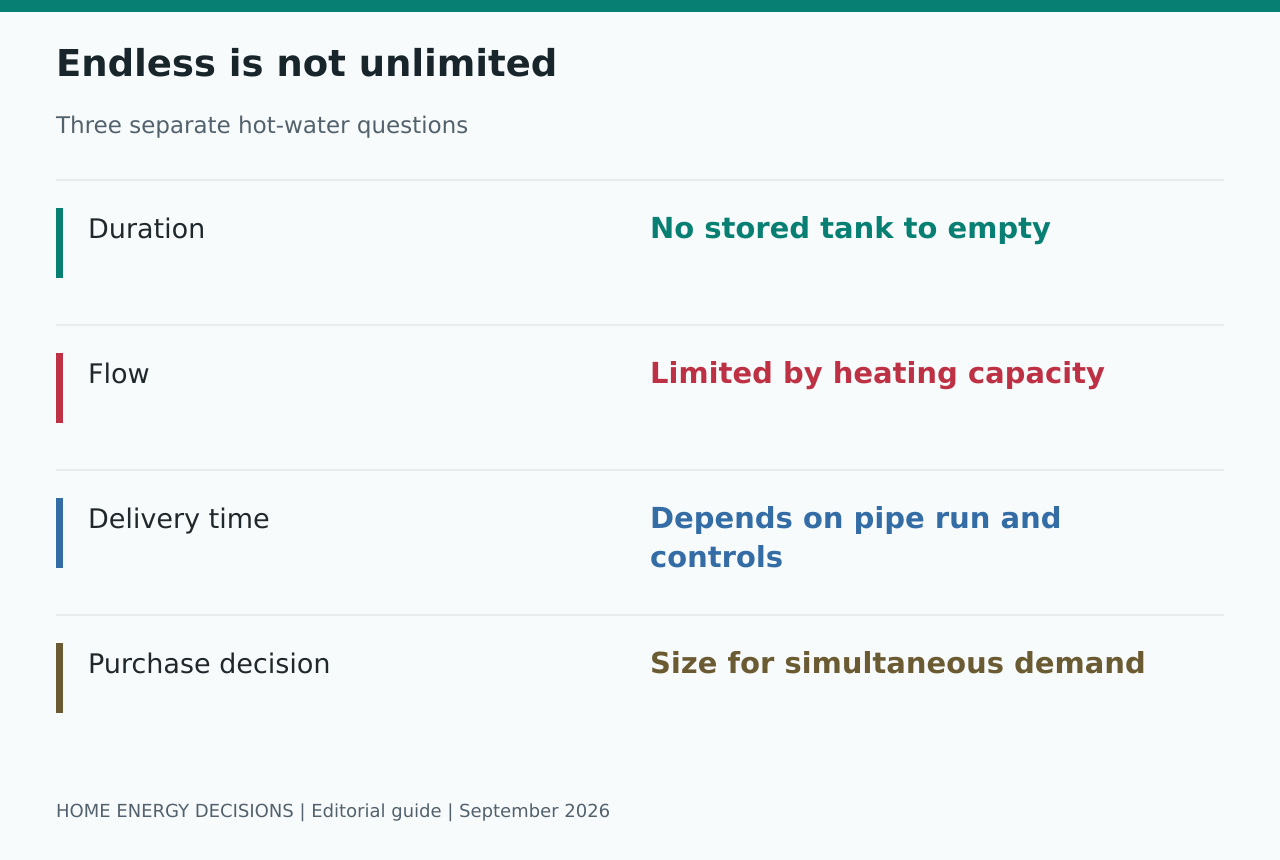
Tankless water heater disadvantages include higher conversion costs, limited simultaneous hot-water flow, maintenance, and possible gas or electrical upgrades. "Endless hot water" means no storage tank to empty; it does not mean unlimited flow or instant hot water at every faucet.
Before replacing a working tank, check your winter inlet-water temperature, busiest hour, utility service, and itemized installation quote. Those details determine whether tankless is a useful upgrade or an expensive mismatch.
Compare water-heater costs
On this page
- The main disadvantages of tankless water heaters
- Tankless water heater installation cost versus a tank
- Tankless flow rate drops when incoming water is colder
- Does tankless mean cold showers?
- Electric tankless water heater disadvantages
- Gas tankless water heater disadvantages
- Tankless maintenance, scale, and warranty
- Tankless hot-water delay and the cold-water sandwich
- Is tankless worth the extra cost?
- Check tankless water heater drawbacks against your daily routine
- Plan tankless maintenance costs before buying
- Who should avoid a tankless conversion?
The main disadvantages of tankless water heaters
| Drawback | When it matters most | What to verify |
|---|---|---|
| Conversion cost | Replacing an existing tank | Gas, electrical, venting, permits, pipework |
| Limited flow | Multiple showers or fixtures | Output at your actual temperature rise |
| Delivery delay | Long pipe runs | Pipe volume and recirculation options |
| Maintenance | Hard water or heavy use | Water-quality limits and service schedule |
| Dependence on power | Frequent outages | Controls, freeze protection, backup plan |
| Service complexity | Limited local support | Parts availability and labor coverage |
A buyer's guide such as This Old House's tankless overview highlights flow limits and conversion work. The more useful purchase question is whether those disadvantages apply to your particular fixtures and utility connections.
Our recommendation: do not pay a large conversion premium purely for the word "endless." Pay for a documented hot-water service improvement that your household will actually use.
Tankless water heater installation cost versus a tank
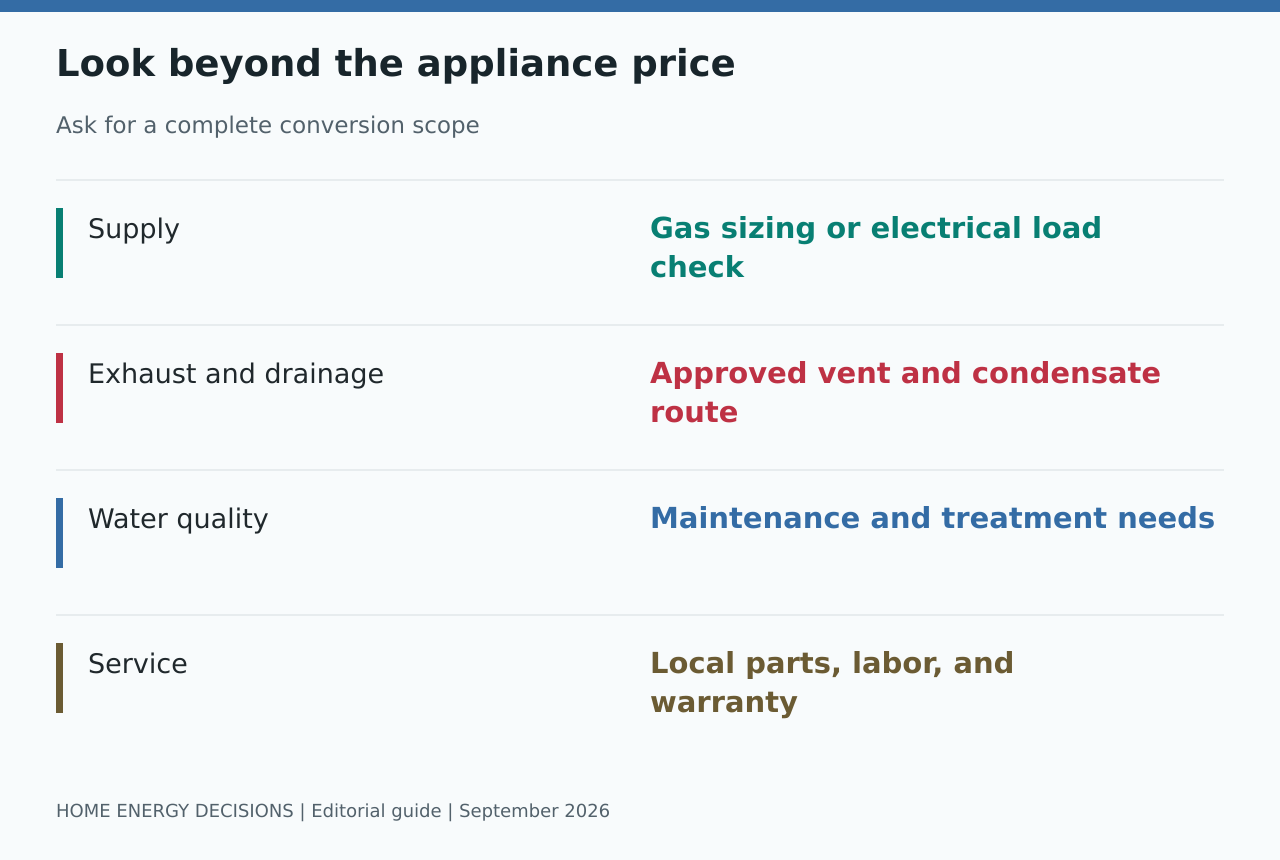
The appliance box is only part of the project. A gas tankless conversion can need a different vent system, a larger gas supply, condensate handling for a condensing model, service valves, and an electrical outlet.
An electric tankless conversion can require major circuit or service work. Spare breaker spaces do not prove the home's service has enough capacity. Ask for an electrical load calculation.
Compare quotes with these items explicitly included:
- Exact model, capacity, fuel, and installation location.
- Removal of the old tank and disposal.
- Water connections, shutoffs, service valves, and required safety devices.
- Gas sizing or electrical supply work.
- Approved venting and condensate treatment where needed.
- Permit, inspection, commissioning, and finish restoration.
- Labor warranty, ongoing maintenance, and exclusions.
Do not compare a basic tank swap with a tankless quote that also relocates the heater and repairs unrelated plumbing. Separate necessary conversion work from optional improvements.
Tankless flow rate drops when incoming water is colder
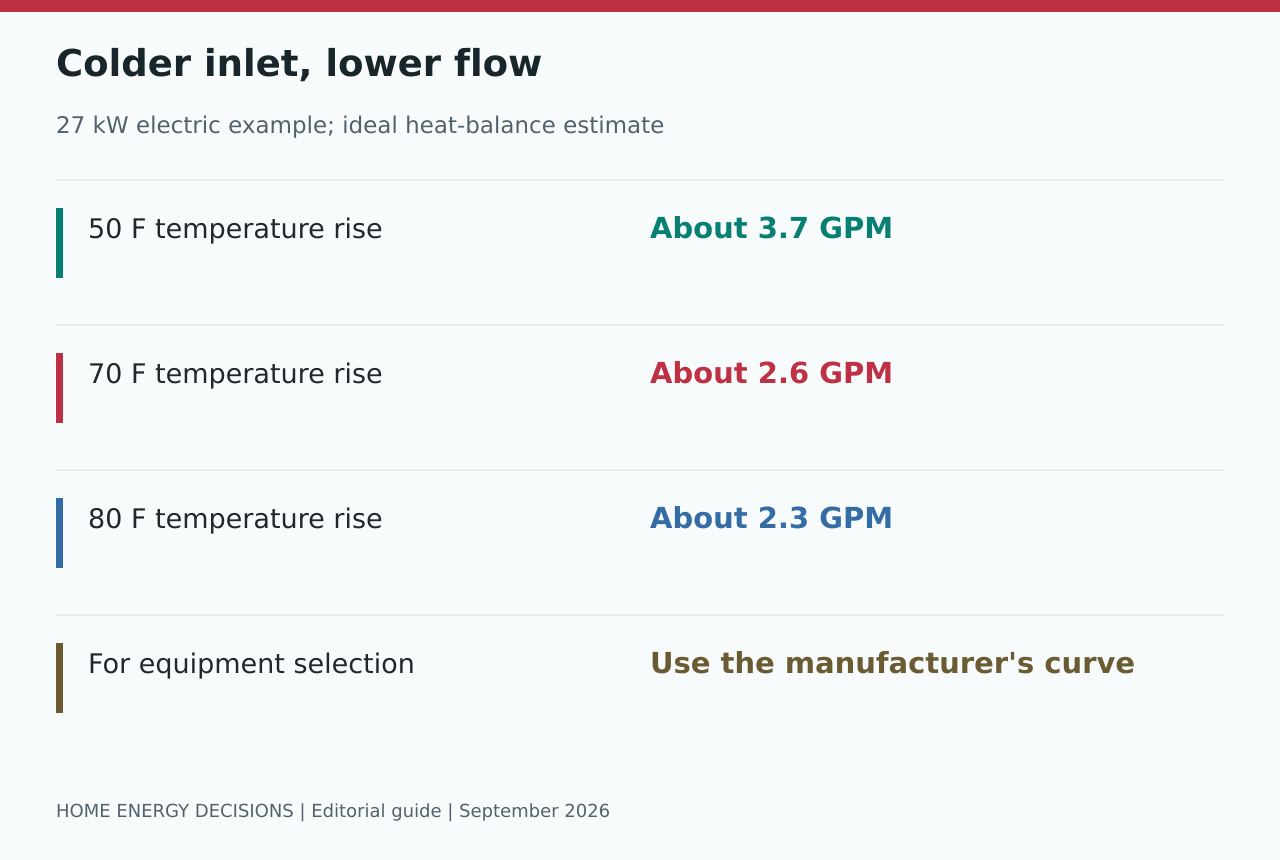
Temperature rise is desired outlet temperature minus incoming water temperature. At a 120 F outlet and 50 F inlet, the rise is 70 F. At a 70 F inlet, it is only 50 F.
The same heater can serve more flow at the smaller rise. A headline maximum GPM measured under favorable conditions is not the number to use for a cold-climate winter.
For an illustrative electric heater, the heat-balance estimate is:
GPM = kW x 3,412 / (500 x temperature rise in F).
A 27 kW unit works out to about 3.7 GPM at a 50 F rise, 2.6 GPM at 70 F, and 2.3 GPM at 80 F, before minor losses and product limits. Use the manufacturer's performance curve for selection.
Two 2-GPM showers already demand 4 GPM before other fixtures. Mixing at the fixtures changes the required hot-water flow, so have the plumber calculate the actual design case rather than simply adding fixture labels.
Does tankless mean cold showers?
Not if properly sized and operated within its capacity. If demand exceeds capacity, a model may restrict flow or fail to maintain the requested temperature. The behavior depends on its controls.
Ask the installer to demonstrate your agreed simultaneous fixture combination at commissioning. A brief test at one sink does not validate a two-shower design.
Electric tankless water heater disadvantages
A large instantaneous electric load is the central issue. For illustration, 27 kW / 240 V equals 112.5 amps of operating current. That calculation is not a circuit-sizing instruction; actual branch circuits, conductors, and service capacity must follow the listed equipment and applicable code.
An inexpensive retail unit can become expensive if the service needs upgrading. Check electrical panel upgrade costs, but do not assume every project requires a new panel or that a new panel alone solves utility-service limitations.
Electric tankless is still resistance heating. It does not have a heat pump's heat-moving efficiency. For whole-house use, compare it with a correctly sized heat-pump tank before paying for an electrical conversion.
Gas tankless water heater disadvantages
Gas capacity and venting are the main conversion questions. The existing tank's gas pipe and vent cannot be assumed suitable for a higher-input appliance.
Condensing models also need an appropriate condensate route and any required neutralization. Exterior models have climate and freeze-protection requirements. Follow the exact installation manual and local rules.
A gas unit commonly needs electricity for controls, ignition, or fans. Do not assume natural gas means hot water through every outage. Freeze-protection behavior during power loss is particularly important in exposed locations.
Tankless maintenance, scale, and warranty
Scale can impair the heat exchanger, especially with hard water. Ask for your model's water-quality limits and descaling instructions rather than assuming every home follows the same annual interval.
Request a written service price and schedule. Check inlet screens, isolation valves, and accessibility. Water treatment may be recommended for local conditions, but get the test result and rationale before buying it.
Warranty terms may distinguish heat exchanger, other parts, and labor. Maintenance obligations, registration, water quality, and installation errors can affect coverage. A long exchanger warranty is not the same as free service for the entire system.
Tankless hot-water delay and the cold-water sandwich
Tankless heats at the appliance; cooled water already sitting in the pipe still has to travel to the faucet. Removing the tank does not shorten that pipe.
Some units require a minimum flow to activate. Very low-flow draws or rapid stop-start use may produce temperature fluctuations. A recirculation system can reduce wait time, but adds equipment, controls, pumping, and pipe heat losses.
Demand-controlled recirculation can be preferable to running a loop continuously, depending on the installation. Ask what changes the proposed setup makes to water savings and energy use separately.
Is tankless worth the extra cost?
Use incremental cost and net annual savings. A hypothetical $2,500 premium with $100/year energy savings takes 25 years to recover before maintenance and financing.
If added service costs $100/year more than the tank alternative, those assumed savings disappear. Conversely, limited floor space or long consecutive showers may have real value even without rapid payback.
The Vermont Energy Saver tankless guide explains the on-demand principle and its trade-offs. For a different alternative, see heat pump water heater vs gas.
Do not assume a new 2026 project receives an old federal incentive. Confirm current utility or state eligibility separately and compare pre-incentive prices.
Check tankless water heater drawbacks against your daily routine
Describe the busiest hot-water period in your home before comparing model brochures. Write down which showers, sinks, and appliances are used together, not just the total number of bathrooms. A rarely used guest bathroom should not automatically carry the same weight as two showers used simultaneously every morning.
Ask the installer to show how the proposed model handles that combination at the incoming-water temperature used for sizing. Keep that temperature assumption with the quote. A quoted flow rate without its temperature-rise condition is not enough to judge whether the system matches your routine.
Also describe the complaint you are trying to solve. Running out of hot water, waiting for hot water at a distant sink, and wanting more storage space are different goals. A conversion that helps one may leave another unchanged unless the quote includes a specific solution.
Use a simple acceptance checklist:
- The expected simultaneous fixtures are written down.
- The model and sizing assumptions are identified.
- Required electrical or gas work is included rather than left implicit.
- Any proposed recirculation arrangement has a defined control strategy.
- Maintenance access and service responsibility are clear.
- The installer explains which existing problems the conversion will not solve.
This last question is particularly valuable. An honest limit in a proposal is more useful than a broad promise of unlimited hot water, instant delivery, and lower bills without conditions.
Plan tankless maintenance costs before buying
Request the manufacturer's maintenance instructions for the exact model, then ask a local service provider what that work would cost for the proposed installation. Keep the service scope beside the price. A basic inspection and a more involved maintenance visit are not necessarily equivalent offers.
Ask who is responsible for any water-quality assessment and what findings would change the recommendation. If treatment equipment is proposed, include its installation, replacement supplies, and upkeep in the comparison. Do not count only the water heater while leaving a necessary supporting system outside the budget.
For a useful ownership worksheet, compare the tankless proposal with a suitable tank replacement over the same period. Include installation, estimated energy, expected scheduled maintenance, and financing. Label uncertain repair allowances as scenarios rather than predictions.
Our preference is to make the comparison before the old heater becomes an emergency replacement. That leaves room to ask about service availability and installation constraints without treating the first available quote as the only possible choice. Keep the final proposal, model documentation, and commissioning record together so future service starts with the correct information.
Who should avoid a tankless conversion?
Pause if you have inadequate electrical or gas capacity, no feasible vent route, unresolved hard-water issues, limited local service, or a large premium with little benefit for your usage.
Tankless can make sense where the installation fits, the performance curve meets demand, and space or continuous-use needs justify it. A well-sized storage tank is not a failure to modernize; it may simply be the better fit.
Bring your fixture list, winter inlet temperature, current model, and two complete quotes to the decision. Use the water-heater comparison tool to organize cost assumptions, then have a qualified installer validate sizing.
Try the companion tool
This post links to an interactive tool built for this topic. Open it to see numbers tailored to your home.
Open the toolGet practical energy tips
Join homeowners getting practical tips on cutting energy bills and staying comfortable.
Practical tips only. Unsubscribe anytime.
Read this next
Related guides selected by topic overlap and upgrade path.
Heat pump water heaters run $3,000–$6,500 installed in Austin. Austin Energy pays an $800 rebate, but the federal 25C credit ended in 2025. Here's the real 2026 math.
Heat pump cost to install runs $6,000–$18,000 in 2026, with a typical ducted home near $12,000–$14,000. Compare prices by size, type, and quote scope.
Tesla Powerwall 3 price in 2026 depends on the installed scope. Compare hardware, backup equipment, labor, capacity, and incentives without misleading net prices.
Air duct cleaning costs $300 to $700 for a typical home (about $35 per vent). Honest 2026 guide: what gets upcharged, and why most homes do not need it.