Blog
Replacing Air Ducts in Attic
Replacing air ducts in an attic should start with damage, leakage, and airflow testing. Compare repair, sealing, materials, quote scope, and final verification.
Replacing air ducts in attic spaces makes sense when runs are torn, crushed, disconnected beyond repair, contaminated, or unsuitable for the required airflow. Leaky but otherwise sound ducts may need sealing rather than wholesale replacement.
Before accepting a quote, ask for photos of the defects, a room-by-room airflow assessment, and separate repair and replacement options. Do not replace an entire duct system solely because it is old or one room feels uncomfortable.
Plan my duct repair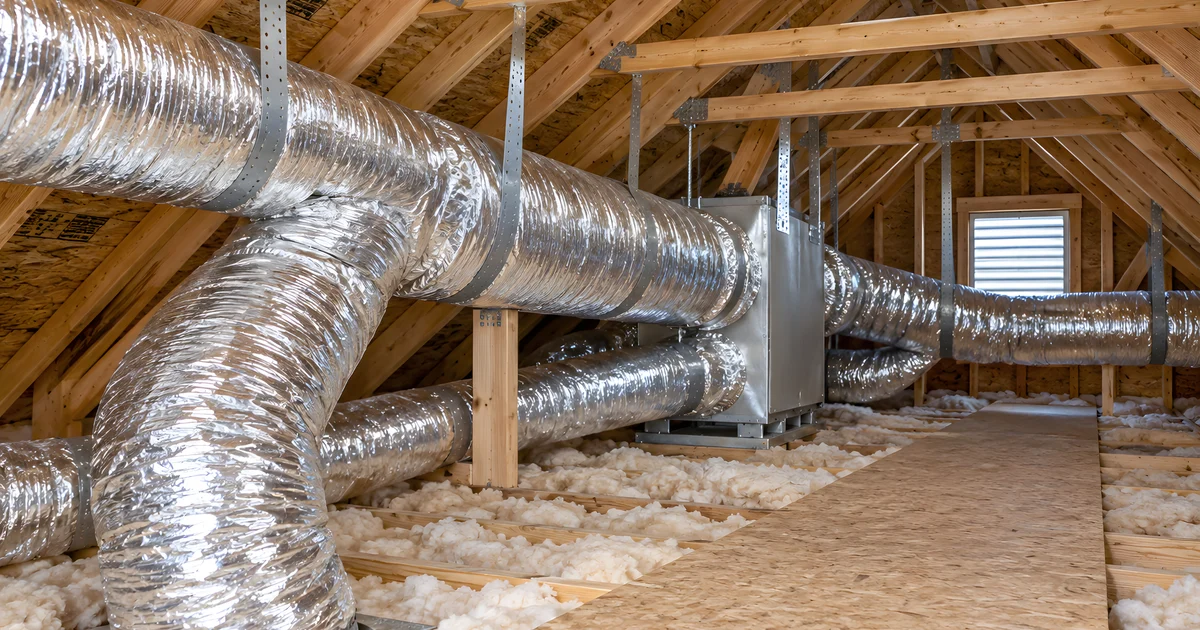
On this page
- When to replace attic ductwork instead of sealing it
- Cost to replace air ducts in attic
- Flexible duct versus sheet metal in an attic
- How attic air duct replacement should be planned
- What happens to the existing attic insulation?
- Replacing attic ducts safely
- Airflow testing after replacing air ducts
- What if the bedroom is still hot or cold?
- How long does attic duct replacement take?
- Prepare an attic duct replacement scope before comparing bids
- Review attic duct replacement results before closing the job
- Attic duct replacement questions
- Should all old ducts be replaced?
- Is duct cleaning an alternative?
- What should be in the final quote?
When to replace attic ductwork instead of sealing it
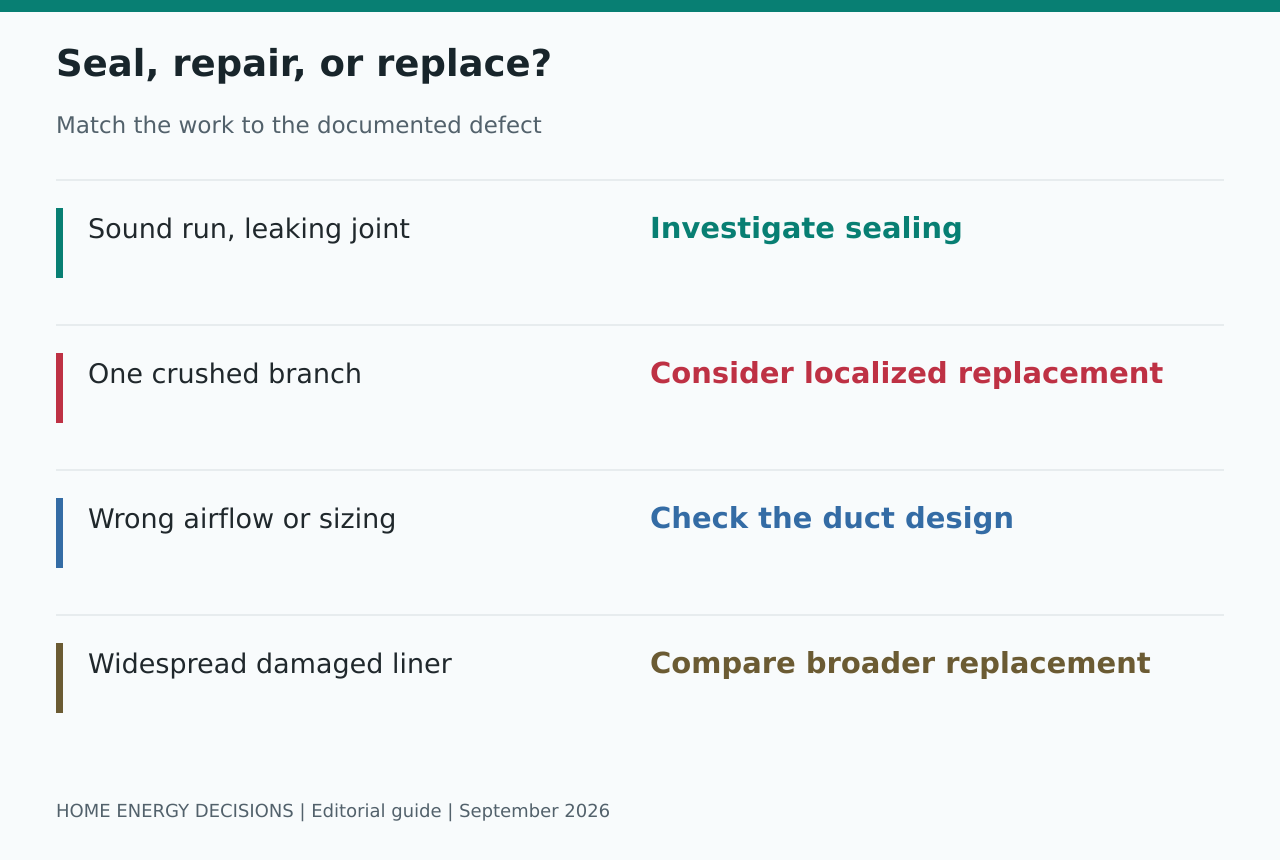
The question is what failed. A leaking connection, damaged outer jacket, collapsed inner liner, and undersized branch are different problems.
| Finding | Option to investigate | Evidence to request |
|---|---|---|
| Leaking joints, sound runs | Seal and retest | Leakage measurement and joint photos |
| Localized crushed or torn run | Replace affected section | Damage extent and cause |
| Widespread brittle or damaged flex | Broader replacement | Photos across several runs |
| Inadequate airflow with sound ducts | Design or balancing correction | Airflow and static-pressure readings |
| Wet insulation or persistent contamination | Correct source, then appropriate replacement | Moisture or contamination assessment |
| Dirty register alone | Investigate, do not assume replacement | Condition inside the system |
ENERGY STAR's duct guidance distinguishes sealing and insulating accessible ducts from replacing them. Its typical duct-leakage estimate is not a guarantee that replacement will cut your utility bill by the same percentage.
Our preference is to pay for the diagnosis that tells you what to leave alone. Replacing intact ducts is not automatically better than sealing a small number of bad connections.
Cost to replace air ducts in attic
Attic access, run count, material, routing, removal, and testing determine the price. A full-house national ductwork price is not automatically an attic-specific quote.
Use the broader ductwork replacement cost guide for budget context. For this project, request a count-and-scope estimate rather than relying only on home square footage.
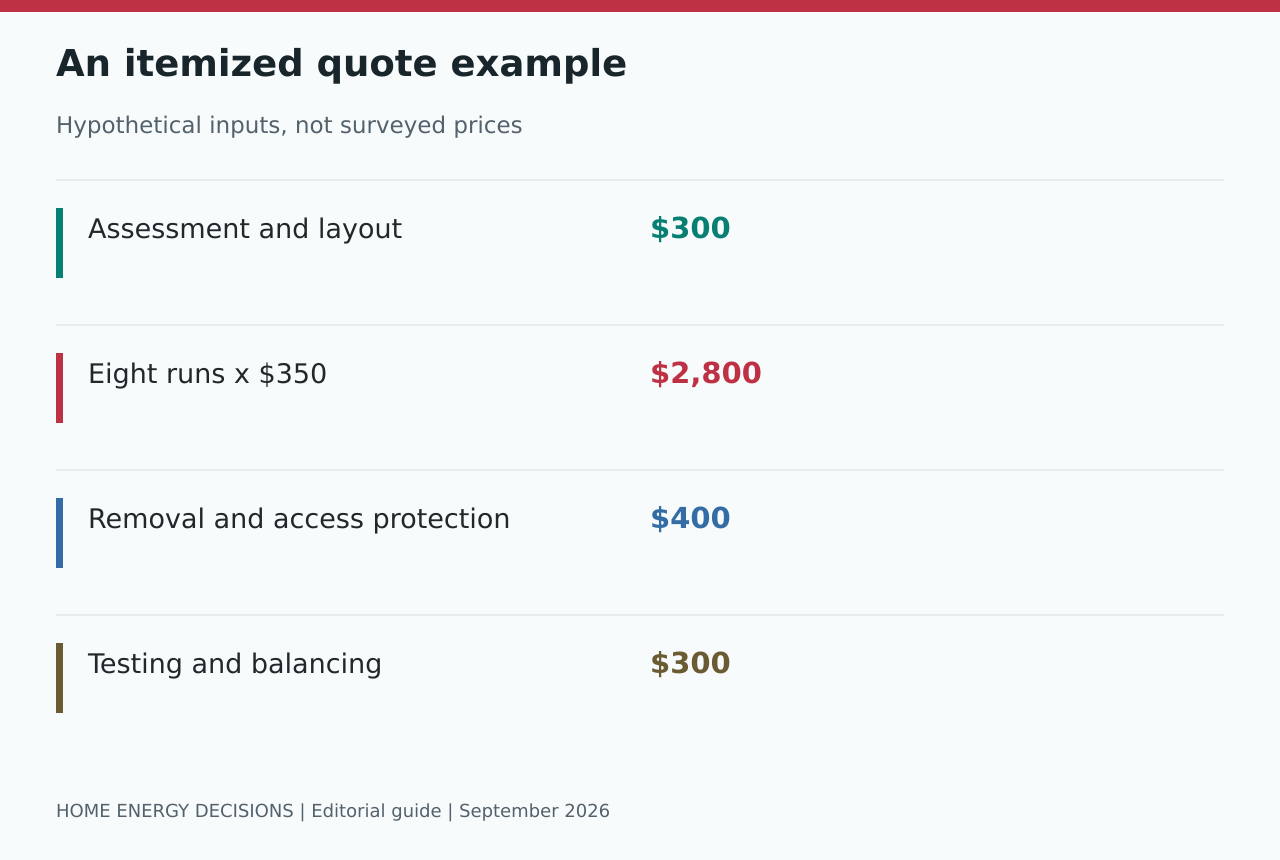
A hypothetical quote exercise:
| Line item | Example allowance |
|---|---|
| Assessment and layout | $300 |
| Eight replacement runs at $350 each | $2,800 |
| Removal, disposal, and access protection | $400 |
| Testing and balancing | $300 |
| Example subtotal | $3,800 |
These are invented budgeting inputs to show the arithmetic, not surveyed contractor prices. They exclude taxes, permits, trunk changes, hazardous-material work, insulation restoration, and difficult access unless the actual quote includes them.
A quote for two short accessible branches cannot be compared with a full trunk-and-branch redesign. Ask both contractors to state what remains in place and who repairs any access damage.
Flexible duct versus sheet metal in an attic
Flexible duct can suit short branch runs with appropriate routing and support. It is vulnerable to kinks, compression, excessive sag, and damage. A generous-looking diameter does not compensate for a crushed liner.
Sheet metal is rigid and can provide a durable smooth path, but needs suitable fabrication, joint sealing, and insulation where required. Its installation can cost more in cramped spaces.
Duct board combines structure with insulation but must be appropriate for the environment and kept in good condition. Do not select material by price alone if moisture or contamination is unresolved.
Ask for the product type, diameter or dimensions, insulation specification, joint treatment, and support details. The installer should follow the listed material instructions and applicable code, not a generic rule from a blog.
How attic air duct replacement should be planned
A good contractor documents the existing system before removing anything. The work may range from replacing a damaged branch in kind to a substantial duct redesign.
For a redesign, room heating and cooling loads, equipment airflow, return capacity, and pressure losses matter. Ask how the new layout was sized; copying an inadequate old layout reproduces the problem in shiny material.
Smart Climate Solutions' attic-duct guide covers the professional sequence of assessment, design, installation, sealing, and balancing. For your job, turn that sequence into measurable deliverables:
- Record the affected rooms and their current performance.
- Photograph damage and identify the cause.
- Define runs, trunks, returns, boots, and registers included.
- Agree on access, removal, disposal, and protection.
- Install to the approved design and product instructions.
- Verify leakage, airflow, and system operation.
- Restore disturbed insulation and provide handover records.
What happens to the existing attic insulation?
Ask whether workers will move or compress insulation and who will restore it. New ducts do not make up for bare ceiling areas left behind.
If you are also planning attic air sealing, coordinate access before adding insulation. Do not bury components or ductwork contrary to the design; condensation risks and local requirements vary.
Replacing attic ducts safely
A homeowner can document symptoms and view accessible areas from a safe location. Full replacement is not a beginner weekend job.
Attics can contain fragile ceiling surfaces, heat stress, exposed electrical hazards, sharp fasteners, and old materials requiring assessment. Do not walk on ceiling drywall or disturb suspect asbestos-containing wrap.
Moisture, pest contamination, or damaged wiring should be addressed before replacement. Take special care around combustion venting; duct work must not alter required clearances or appliance air supplies.
Never use candles or open flames to hunt attic leaks. Do not enter a dangerously hot or poorly accessible attic for a photograph.
Airflow testing after replacing air ducts
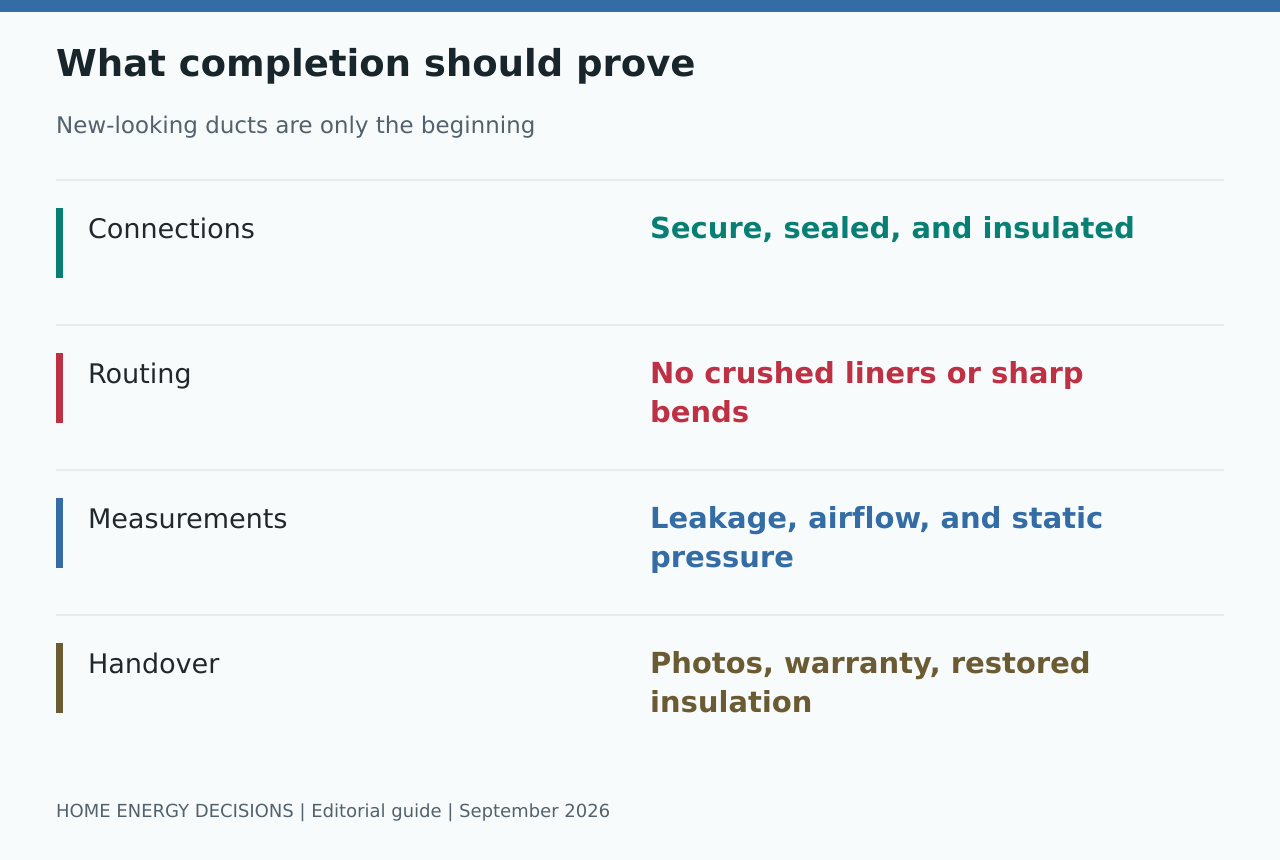
Completion should mean more than seeing new silver insulation.
Ask for before-and-after leakage results where testing is included or required, delivered airflow to the problem rooms, and static pressure compared with the equipment's allowed range.
Have the contractor confirm that flex is properly extended and supported, connections are secure and sealed, insulation jackets are intact, and room temperatures improve under relevant operating conditions. Ask for final photos of areas you cannot safely inspect.
What if the bedroom is still hot or cold?
An attic duct repair cannot correct every building defect. Missing floor insulation, an inadequate return path, solar gain, and poor room sizing can remain.
A cold bedroom above a garage warrants a floor and air-barrier inspection. Do not keep enlarging its supply duct without checking heat loss and return airflow.
If replacing HVAC at the same time, use the HVAC 5000 rule guide to separate equipment repair economics from duct-system needs.
How long does attic duct replacement take?
A limited repair may be much shorter than a full redesign, and access restrictions can dominate the schedule. Ask for workdays, anticipated HVAC downtime, inspection timing, and any weather-related limitations rather than accepting a universal duration.
Arrange suitable conditions for vulnerable occupants while heating or cooling is unavailable. Confirm who moves storage and protects the access route.
Prepare an attic duct replacement scope before comparing bids
Start with a list of rooms and the complaints you want investigated. Note whether each problem concerns temperature, airflow, noise, or visible damage. Include when the problem occurs and whether it existed before a recent equipment replacement or remodeling project.
Ask the contractor to distinguish observations from conclusions. A room that feels warm does not, by itself, prove its duct needs replacement. The proposal should connect the identified condition to the work being recommended, especially when only part of the system is being replaced.
Request a room-by-room or branch-by-branch scope that identifies what remains and what changes. Keep supply ducts, return ducts, plenums, connections, and registers separate where relevant. This makes it easier to recognize when a lower-priced bid simply covers less of the system.
Before signing, clarify the practical details:
- How workers will access the attic and protect occupied rooms.
- Which existing materials will be removed from the property.
- Whether insulation disturbed during the work will be restored.
- Which connections and accessories are included in the price.
- What conditions could require a written change order.
- Who documents the finished work and performs the agreed checks.
Do not rely on a verbal statement that everything is included. A short written exclusion list can be just as useful as an inclusion list, particularly when concealed conditions cannot be fully assessed in advance.
Review attic duct replacement results before closing the job
Arrange the handover requirements before work begins rather than requesting new deliverables after the installation is complete. Ask for photographs of areas that will become difficult to inspect and a record of the tests specified in the contract.
Have the contractor explain the results in relation to the original complaint. A new duct installation and a resolved room-comfort problem are related goals, but they are not automatically the same outcome. If a room still performs poorly, ask what the findings suggest should be investigated next.
Keep the old and new scope documents together. When a later service visit occurs, it helps to know which sections were replaced and which were deliberately retained. Save the equipment details and any relevant settings recorded during commissioning as well.
Our preference is to agree on evidence of completion, not just a promise that the house will feel better. That evidence might include specified airflow checks, photographs, and a clear explanation of any unresolved limitations. It gives you a practical basis for accepting the work while avoiding unrealistic guarantees about temperatures under every possible weather condition.
Attic duct replacement questions
Should all old ducts be replaced?
No universal age alone proves failure. Inspect condition, leakage, sizing, and performance. A sound metal run and a deteriorated flex branch do not have identical replacement needs.
Is duct cleaning an alternative?
Cleaning removes deposits; it does not repair collapsed liners, fix leakage, or redesign airflow. See air duct cleaning cost only if inspection establishes a cleaning need.
What should be in the final quote?
Run count and materials, retained components, insulation, access, removal, permits, sealing, testing, balancing, restoration, warranty, and exclusions. Keep this scope in My Plan when comparing bids.
Try the companion tool
This post links to an interactive tool built for this topic. Open it to see numbers tailored to your home.
Open the toolGet practical energy tips
Join homeowners getting practical tips on cutting energy bills and staying comfortable.
Practical tips only. Unsubscribe anytime.
Read this next
Related guides selected by topic overlap and upgrade path.

Heat pump cost to install runs $6,000–$18,000 in 2026, with a typical ducted home near $12,000–$14,000. Compare prices by size, type, and quote scope.
Air duct cleaning costs $300 to $700 for a typical home (about $35 per vent). Honest 2026 guide: what gets upcharged, and why most homes do not need it.

Mini split installation cost runs about $3,000–$6,000 for one zone and $8,000–$18,000+ for a whole-home system. Compare prices by zone count and BTU.
Ductwork replacement cost runs about $1,400–$7,000 for most homes. Estimate your HVAC ductwork price by home size, access, material, and project scope.