Blog
Cost of Dehumidifier
Compare portable and whole-home dehumidifier prices, installation, electricity use, and the moisture fixes that reduce lifetime cost.
With a basement unit cycling beside the laundry sink, the cost of dehumidifier ownership comes from the purchase, any installation and drainage work, and every kilowatt-hour it uses afterward.
For a common portable unit, budget roughly $150 to $300 upfront plus $10 to $80 a month in many use patterns. A ducted whole-home system commonly lands around $1,000 to $2,800 installed according to Carrier; difficult duct, electrical, or drainage work can push a premium project toward $3,800.
On this page
Price the whole job
Search results for this topic mix $150 portable machines with multi-thousand-dollar HVAC projects. They solve different problems.
| Type | Typical 2026 price | Installation | Fits |
|---|---|---|---|
| Small-room or compact portable | About $50 to $150 | Plug in; empty bucket | Closets, bathrooms, and mild single-room moisture |
| Common 30- to 50-pint portable | About $150 to $300 | Plug in; optional gravity hose | Basement or one open area |
| Crawlspace/commercial portable | Roughly $400 to $1,000+ | Usually hose or pump drainage | Low spaces, tougher moisture loads, continuous drainage |
| Ducted whole-home | About $1,000 to $2,800 installed; some complex projects reach $3,800 | HVAC duct, drain, controls, and electrical work | Humidity across several connected rooms |
Portable prices above reflect common U.S. retail listings checked in August 2026, so treat them as a shopping range rather than a quote. Whole-home figures come from Carrier, Bryant, and Angi. Capacity, access, a condensate pump, new return duct, permits, and a dedicated circuit move the number.
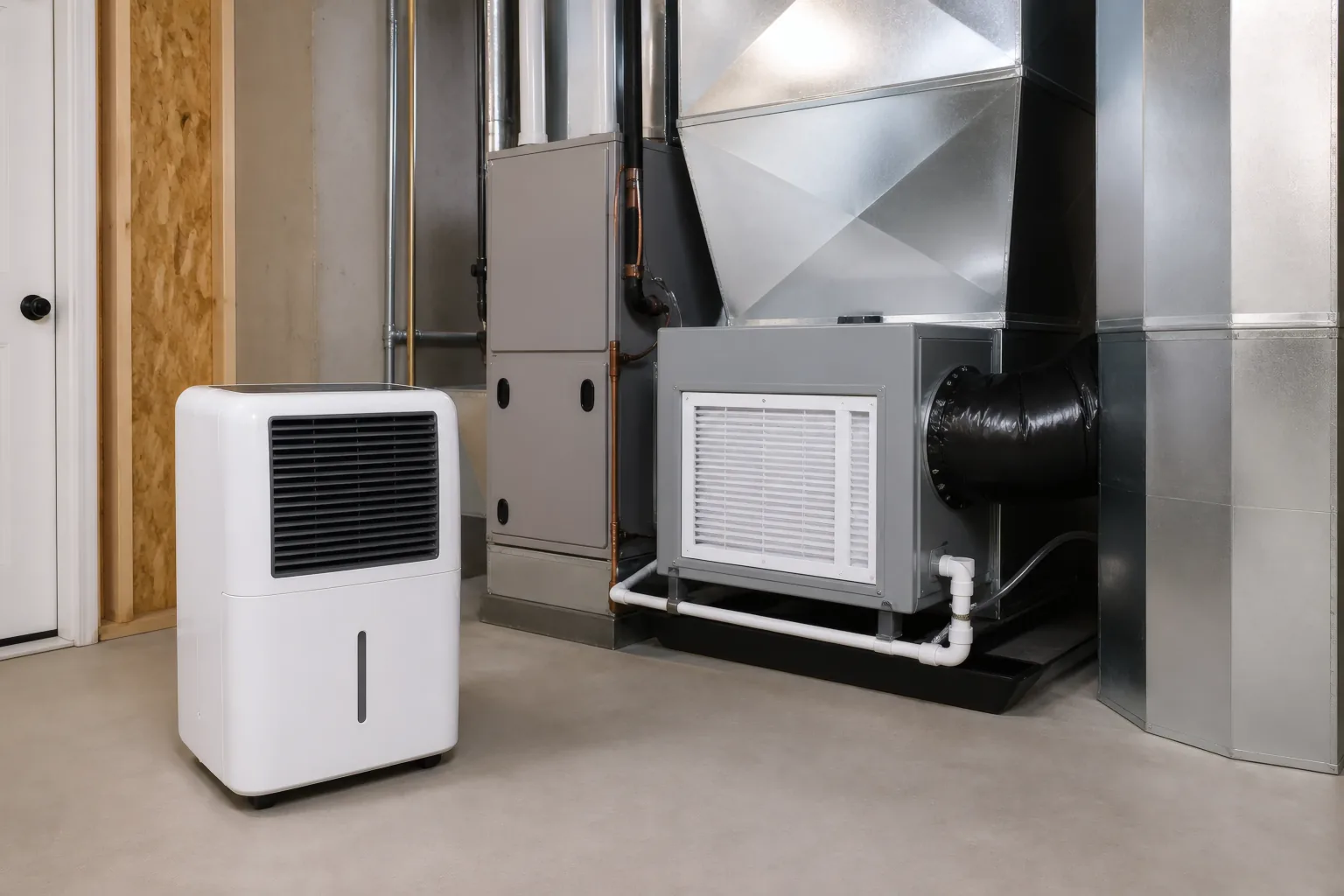
One mild opinion: paying extra for a hose connection is usually wiser than paying first for app control. Reliable drainage prevents a full bucket from stopping the unit while nobody is watching.
Calculate the electricity cost
Use the wattage while the compressor runs, rather than the pint rating or an advertised coverage area.
Daily cost = watts / 1,000 x running hours x electricity price per kWh
| Running draw and time | At $0.16/kWh | At $0.25/kWh |
|---|---|---|
| 250 W for 8 hours/day | $0.32/day; $9.60/month | $0.50/day; $15/month |
| 500 W for 12 hours/day | $0.96/day; $28.80/month | $1.50/day; $45/month |
| 700 W for 24 hours/day | $2.69/day; $80.64/month | $4.20/day; $126/month |
These are scenarios, not expected-use labels. A humidistat cycles the compressor after the room reaches its target. A wet basement during a rainy week may run far longer than the same machine in October.
The quickest estimate for your rate is the Bill Breakdown Estimator. If you know the room size and dampness level but not the needed capacity, use the Dehumidifier Size Calculator first.
Measure one week instead of guessing
A plug-in electricity meter catches cycling, fan-only draw, and standby use. The nameplate gives a ceiling; the meter gives the bill.
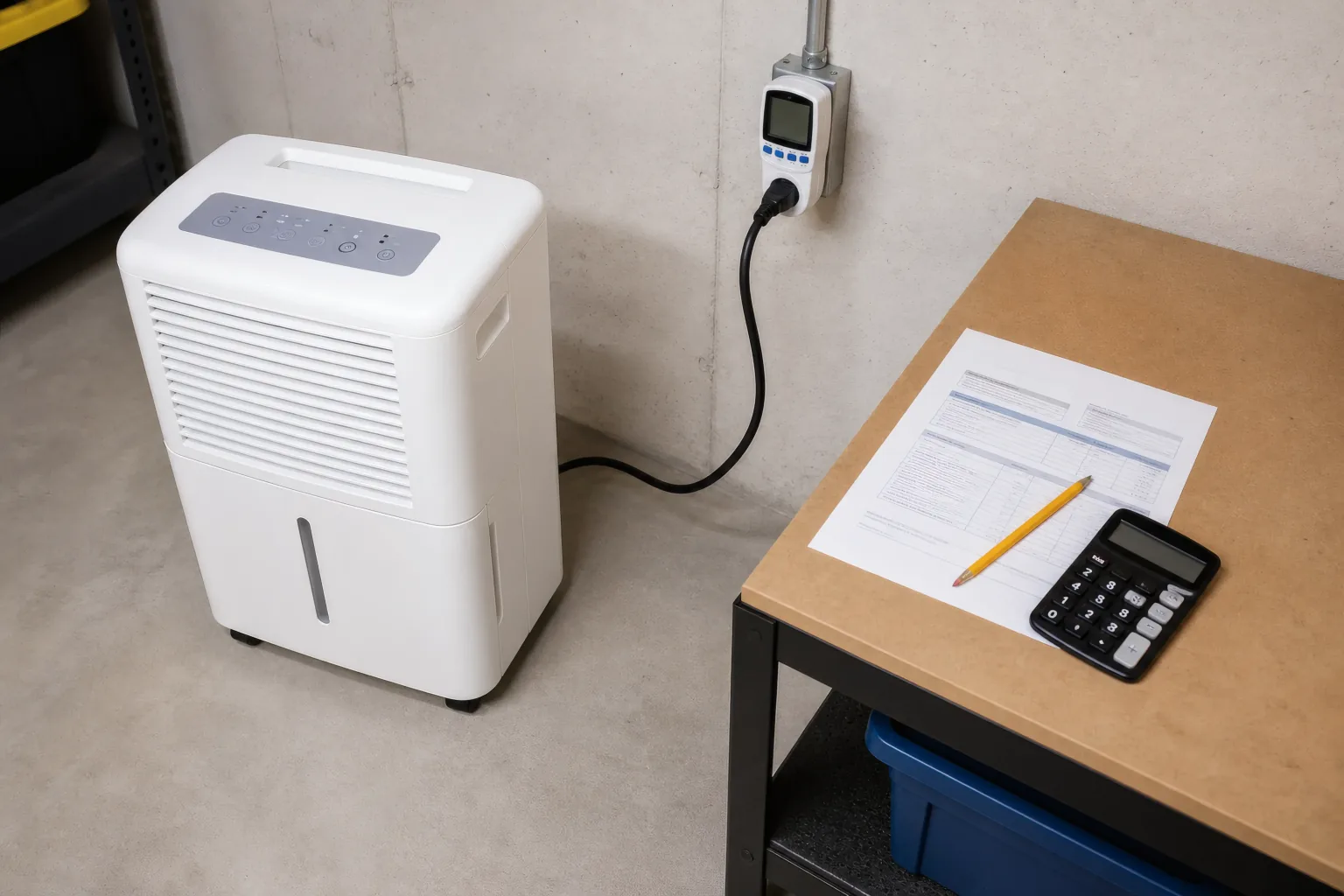
- Put the machine on its own wall outlet according to its manual. Do not use an extension cord.
- Connect a correctly rated plug-in kWh meter, then reset its total.
- Run the usual setpoint for seven ordinary days. Keep doors and windows in their normal positions.
- Write down total kWh and average relative humidity. A separate hygrometer several feet away checks whether the built-in sensor is representative.
- Divide kWh by seven, multiply by your utility's all-in per-kWh rate, and then multiply by 30.
For a reproducible example, 9.1 kWh over seven days equals 1.3 kWh/day. At $0.18/kWh, that is $0.234 daily, or about $7.02 per 30-day month. Repeat after a drainage or air-sealing fix using the same setpoint; otherwise the comparison is weak.
Buy for pints and efficiency, not square feet alone
Capacity says how many pints the unit removes in 24 hours under a defined test condition. Actual removal falls in a cooler room, and moisture severity matters as much as floor area.
ENERGY STAR's useful comparison number is Integrated Energy Factor (IEF), liters of water removed per kWh. Higher is better. Current Version 6.0 criteria start at 1.70 L/kWh for portable units at or below 25 pints/day and 2.01 for units from 25.01 to 50 pints/day. Whole-home units use separate capacity classes and thresholds, so compare within the same product type and capacity class.
Look past the front label.
- Continuous hose drainage, with enough fall to reach a real drain.
- Cold basement. Auto-defrost or low-temperature operating guidance in the manual matters.
- A washable filter you can remove without moving the machine.
- Noise rating if the unit shares a wall with a bedroom. Compressor cycling at 2 a.m. is more irritating than a steady fan, at least for many people.
- After an outage, auto-restart is useful in a second home or seldom-visited basement.
- Bucket size and a full-bucket shutoff still matter even when you plan to attach a hose.
Set a target the machine can hold
EPA advises keeping indoor relative humidity below 60%, ideally between 30% and 50%. ENERGY STAR gives the same broad optimum and notes 30% to 40% may reduce window condensation in a cold heating season.
Start a basement around 50% RH. If odor or condensation remains, lower it gradually while watching runtime. A 35% target in a leaky summer basement can keep the compressor running for very little practical gain.
Place a separate hygrometer away from the dry discharge air. Leave the clearances in the manual, clean the filter, and keep room doors in the position the unit is meant to serve. Warm exhaust air is normal; ENERGY STAR notes that dehumidification slightly warms the surrounding space.
Reduce the moisture load before buying bigger
A dehumidifier is for water vapor. Liquid water entering through a wall, floor, roof, pipe, or overflowing gutter needs repair.
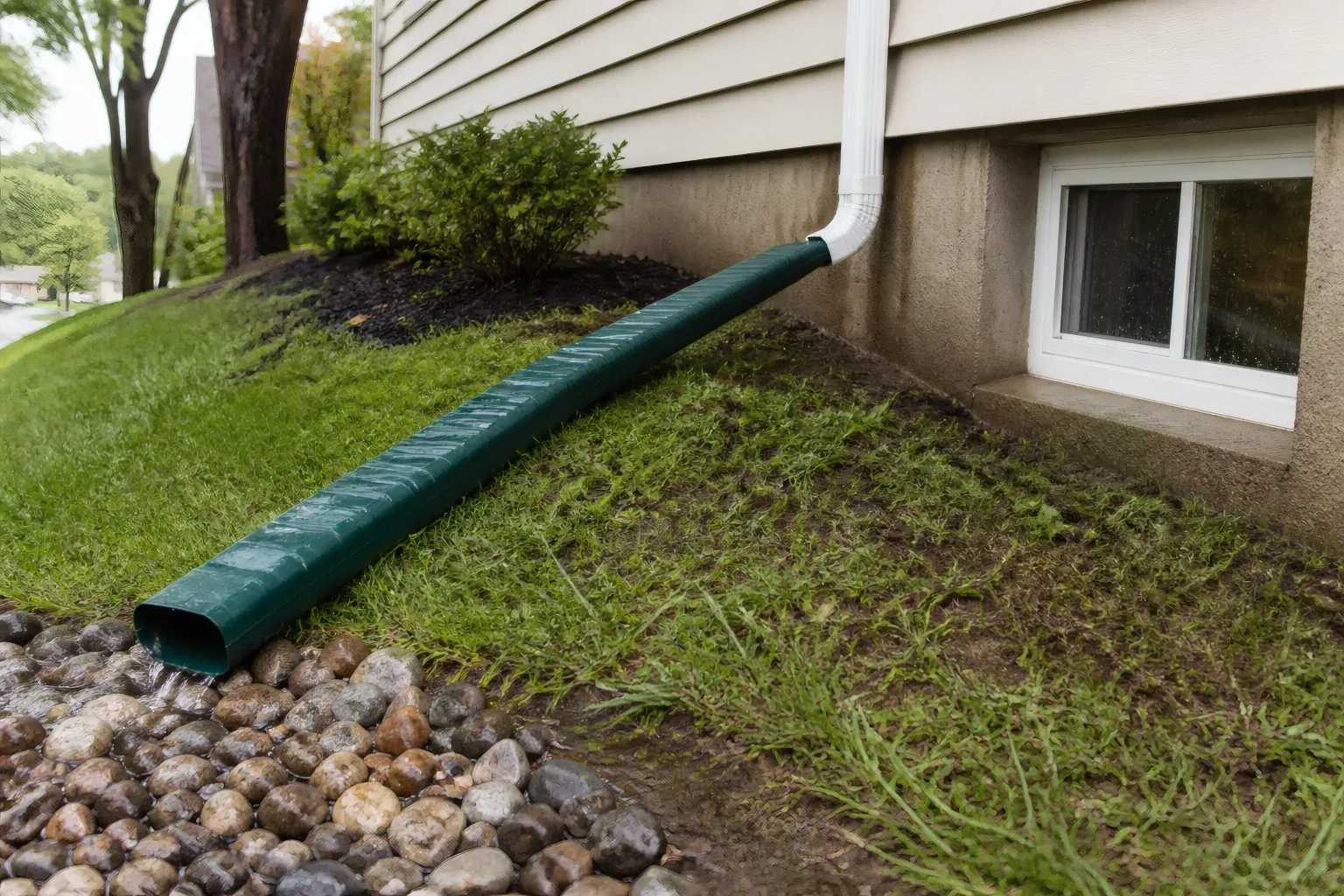
Walk outside during or just after rain. Check whether downspouts discharge beside the foundation, soil slopes toward the wall, or gutters spill at one corner. Inside, look for a sharp waterline, wet masonry, plumbing drips, an uncovered sump, or exposed crawlspace soil.
Then check air paths. A leaky rim joist or open crawlspace can feed humid outdoor air into a cool basement. The air-sealing weekend checklist covers accessible gaps, while the crawlspace encapsulation cost guide explains when the ground and walls need a larger system.
Do not use a dehumidifier as flood remediation
Shut off unsafe electrical equipment and address active water entry first. EPA advises drying wet materials within 24 to 48 hours when possible. Extensive water, sewage, visible mold, or contaminated materials calls for qualified cleanup guidance.
Portable or whole-home
Choose a portable machine when one basement or room is the problem, you rent, or you want to measure the load before making a larger commitment. It is easy to replace, though bucket work, noise, and uneven humidity come with it.
A whole-home unit makes sense when several rooms stay humid, doors need to remain closed, a portable machine cannot distribute dry air, and the HVAC layout offers sound return, supply, and drainage options. Ask the contractor for the following.
- Design capacity at your expected room temperature and humidity.
- Duct diagram. It should show where air enters and returns, plus how the system avoids unwanted airflow when HVAC equipment is off.
- Drain route, trap or pump details, filter access, service clearance, controls, permits, and electrical scope.
- Measured startup commissioning and the labor warranty.
Do not accept square footage as the only sizing explanation. Moisture load, outdoor air leakage, building volume, temperature, and how rooms connect all change the result.
Before checkout
- Measure the actual area and note its usual temperature.
- Record humidity for several damp days with a separate hygrometer.
- Find the water source first. After rain is the revealing time.
- Read the capacity and IEF from the same test standard.
- Price the hose, pump, filter, electricity, and warranty, not only the machine.
- For a portable, confirm a grounded outlet and a safe drain path.
- For ducted work, collect two detailed HVAC quotes and compare the diagrams.
Sources & further reading
- Dehumidifiers — ENERGY STAR
- Dehumidifiers Key Efficiency Criteria — ENERGY STAR
- A Brief Guide to Mold, Moisture and Your Home — U.S. Environmental Protection Agency
- How Much Is a Dehumidifier? — Carrier
- Whole House Dehumidifier Cost and Installation Guide — Bryant
- Whole House Dehumidifier Cost in 2026 — Angi
Frequently asked questions
How much does a dehumidifier cost?+
Common portable basement units were listed around $150 to $300 at a major U.S. retailer in August 2026. Carrier lists a typical whole-home system at $1,000 to $2,800 installed, while more complex or premium installations can reach roughly $3,800.
How much does a dehumidifier cost to run per month?+
Multiply watts by runtime hours, divide by 1,000, then multiply by your electricity rate and 30 days. A 500-watt unit running 12 hours a day at $0.16 per kWh costs about $28.80 per month.
What humidity should I set my dehumidifier to?+
ENERGY STAR generally considers 30% to 50% relative humidity optimal, though 30% to 40% may help avoid window condensation during cold heating seasons. A basement setpoint near 50% is a practical starting point.
Is a whole-home dehumidifier worth the cost?+
It can be when humidity affects several connected rooms, portable units cannot hold the target, and an HVAC contractor can provide sound ducting and drainage. One isolated damp room usually favors a portable unit first.
Why does my dehumidifier run constantly?+
Continuous operation can come from a low setpoint, an undersized or dirty unit, cold-room performance, open doors or windows, humid-air leakage, exposed crawlspace soil, or bulk water entering near the foundation.
Try the companion tool
This post links to an interactive tool built for this topic. Open it to see numbers tailored to your home.
Open the toolGet practical energy tips
Join homeowners getting practical tips on cutting energy bills and staying comfortable.
Practical tips only. Unsubscribe anytime.
Read this next
Related guides selected by topic overlap and upgrade path.
Calculate what a 1500W space heater costs per day at your electric rate, then see cheaper comfort fixes that reduce the need for it.

Start at 68°F while awake, use a careful winter setback, and adjust for heat pumps, humidity, sleep, pets, health, and time-of-use rates.
Duct sealing closes leaks at plenums, branches, boots, and returns. Learn which materials work, when DIY is safe, and what a measured quote should include.
Is it OK to close air vents? Learn what one closed register changes, why several can raise duct pressure, and how to fix an uneven room safely.