Blog
How Much Does a Space Heater Cost to Run
A 1,500-watt space heater costs $0.30 an hour at $0.20/kWh. Calculate your daily cost, thermostat cycling, and when room heating saves money.
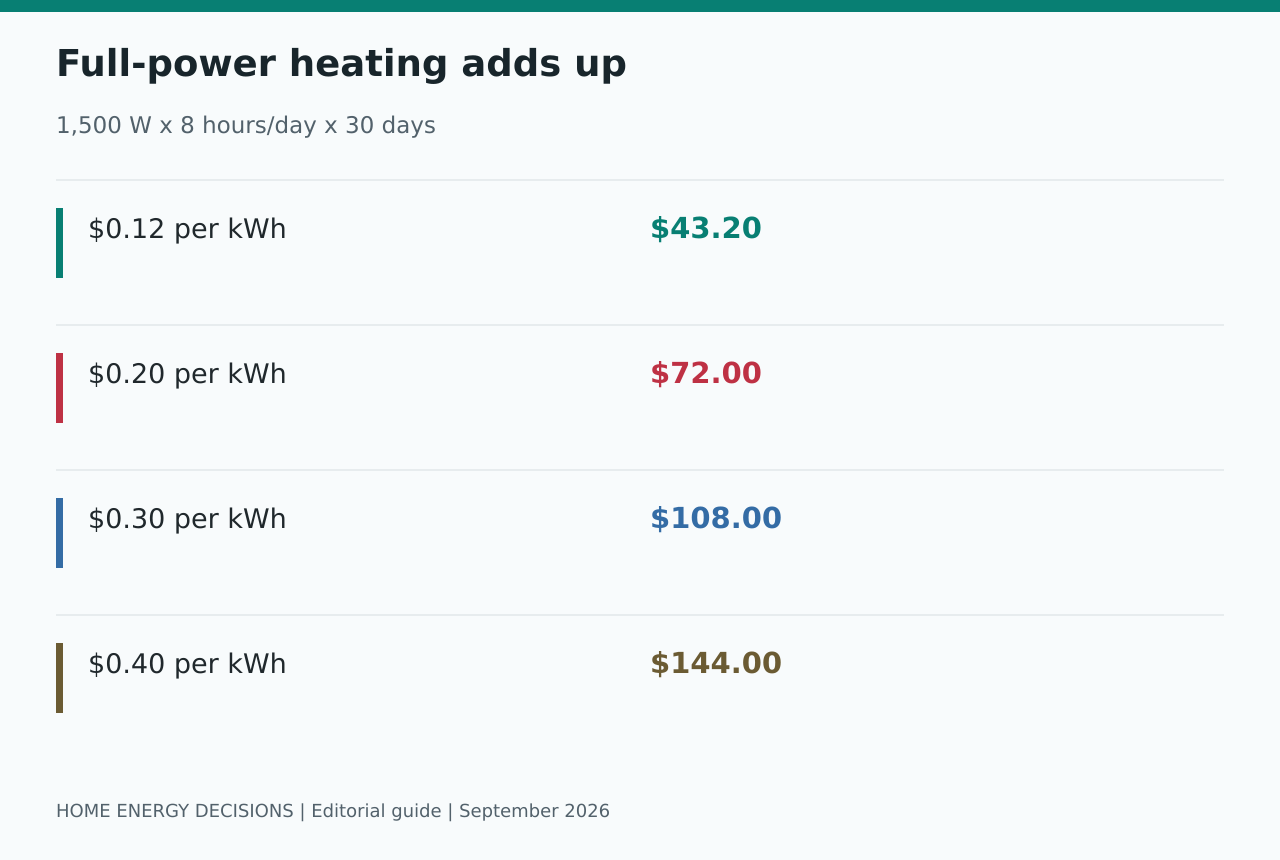
How much does a space heater cost to run? A 1,500-watt heater costs $0.30 per hour at $0.20/kWh, or $72 for 30 days at eight full-power hours a day. Your wattage, electricity tariff, and actual heating time determine the bill, not whether the casing says ceramic, oil-filled, or infrared.
For one occupied room, start with the label and your bill. For several cold rooms, investigate the heating problem before buying more heaters.
Estimate my electricity use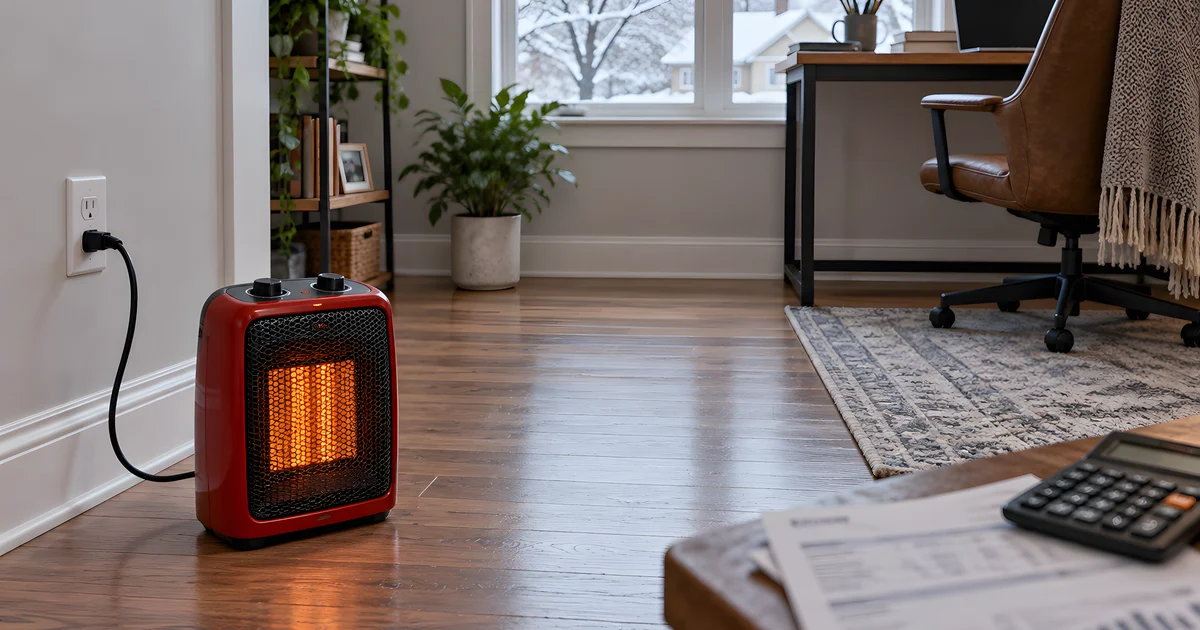
On this page
- 1500 watt space heater cost per hour
- Use the marginal electricity rate, not just the supply charge
- Cost to run a space heater all day
- A practical measurement worksheet
- Space heater vs central heat cost
- Are oil-filled and infrared heaters cheaper to run?
- Space heater safety and cheaper comfort fixes
- Estimate your space heater electricity cost from a weekly schedule
- Check whether a space heater actually reduces total heating cost
- Use the right electricity price in your heater estimate
- Space heater running-cost questions
- Does turning it up make the room heat faster?
- Does an electric blanket cost less?
- What should I do first?
1500 watt space heater cost per hour
Divide watts by 1,000, then multiply by your electricity price in dollars per kilowatt-hour. A 1,500-watt unit draws 1.5 kW while its element is on.
Cost = kW x heating hours x price per kWh.
| Electricity price | One hour | Eight hours | 30 days, eight hours/day |
|---|---|---|---|
| $0.12/kWh | $0.18 | $1.44 | $43.20 |
| $0.20/kWh | $0.30 | $2.40 | $72.00 |
| $0.30/kWh | $0.45 | $3.60 | $108.00 |
| $0.40/kWh | $0.60 | $4.80 | $144.00 |
These are calculated scenarios, not national price averages. Two identical heaters running the same schedule double the figures. At $0.20/kWh, a 750-watt setting costs $0.15 per element-on hour.
Use the marginal electricity rate, not just the supply charge
Add the supply and delivery charges that change with each kWh. Leave out fixed monthly customer charges when calculating the extra cost of one appliance: they remain even if you unplug it.
On time-of-use pricing, calculate peak and off-peak hours separately. On tiered pricing, use the tier your additional consumption falls into. Taxes or surcharges that scale with use also matter. Our utility bill guide helps separate those lines.
Cost to run a space heater all day
A 1,500-watt heater at full power for 24 hours uses 36 kWh. At $0.20/kWh that is $7.20 per day, or $216 over 30 days. This is a cost illustration, not a recommendation to leave a portable heater on unattended or while sleeping.
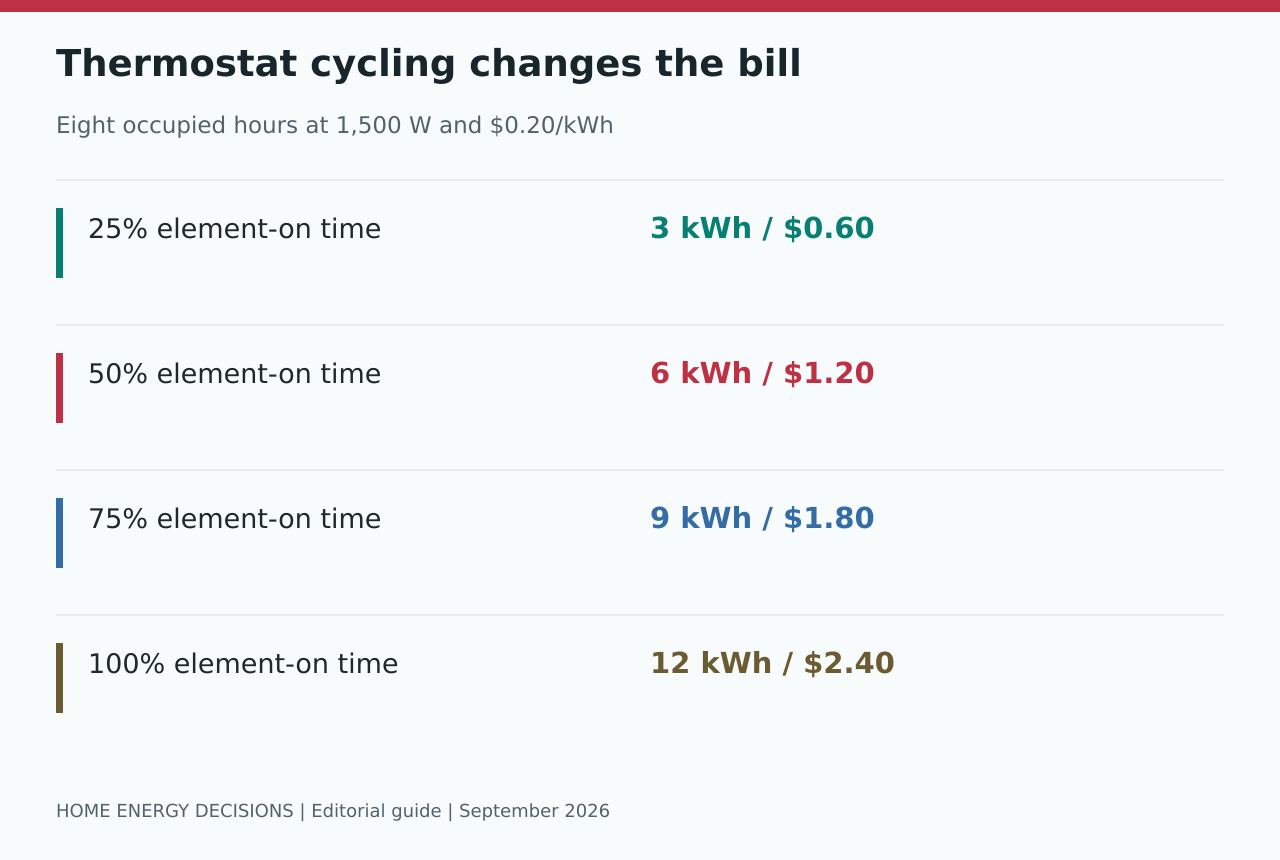
A thermostat usually cycles the element. If it heats for half of an eight-hour occupied period, the element uses approximately 6 kWh rather than 12 kWh: $1.20 instead of $2.40 at the example tariff. Fan and standby consumption may add a small amount.
Do not assume a 50% duty cycle. A drafty room or undersized heater may run continuously. Measure a representative occupied period and repeat during colder weather.
A practical measurement worksheet
- Record the nameplate wattage and the heat setting you actually use.
- Write down occupied hours rather than estimating from memory.
- Check whether the element cycles; an indicator light is not always an element-on indicator.
- Compare utility interval data on similar-weather days with and without the heater.
- Keep central thermostat settings consistent unless you are deliberately testing zoned savings.
A plug-in monitor is useful only if both the heater and monitor manufacturers permit that connection and the monitor is rated for the load. Otherwise use utility data or a qualified electrician's measurement. Never bypass a direct-wall-outlet safety instruction to collect data.
Space heater vs central heat cost
The important comparison is extra room-heater cost versus central-heating cost actually avoided. Adding a heater while leaving the thermostat unchanged normally adds expense.
A worked example: one office heater uses 6 kWh during an occupied day, costing $1.20. If lowering the central thermostat genuinely avoids more than $1.20 of gas or electricity that day, the combination saves money. If it avoids $0.80, total cost rises by $0.40.
Our editorial preference is to try one measured room-heating experiment before buying a second heater. A pleasant warm desk does not prove the whole-house bill fell.
Heat pumps can deliver more heat per unit of electricity than resistance heaters. Their performance changes with weather and equipment. Compare the room strategy against the actual system, not a blanket claim that small heaters always beat central heat.
Do not create unsafe cold conditions elsewhere. Protect plumbing, maintain appropriate temperatures for vulnerable occupants, and do not close large numbers of HVAC vents to imitate zoning. See whether closing air vents is OK.
Are oil-filled and infrared heaters cheaper to run?
At the same wattage and element-on time, electric resistance heaters consume essentially the same electricity. Oil-filled radiators spread heat over time; infrared heaters can make a nearby person feel warm without warming every surface in the room.
Those comfort differences can let you use a lower setting or shorter runtime. They do not turn 1 kWh of electricity into several kWh of heat. An "eco" mode should be judged by measured consumption and comfort, not its name.
A lower-wattage heater also is not automatically cheaper for the same room temperature: it may simply run longer.
Space heater safety and cheaper comfort fixes
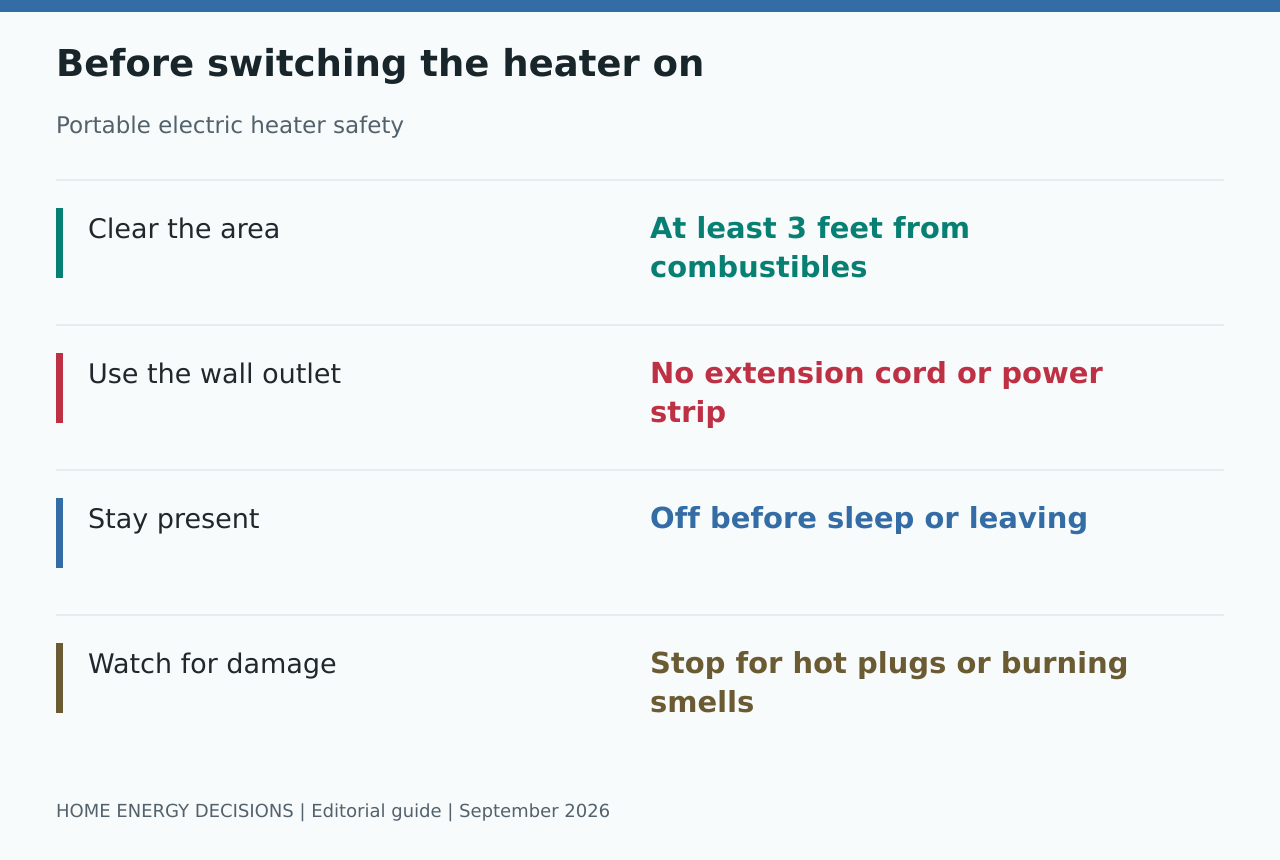
CPSC's winter safety guidance calls for at least three feet from combustible materials and plugging electric space heaters directly into wall outlets, never power strips or extension cords. Turn them off before sleeping or leaving the room.
Stop using a heater with a hot plug, loose outlet, damaged cord, burning smell, or repeated breaker trips. Have the fault checked rather than changing to a bigger breaker. Keep heaters on the manufacturer's approved stable surface, away from water, children, and pets.
For permanent savings, investigate drafts, blocked supplies, inadequate returns, and insulation gaps. A cold bedroom above a garage needs a different repair from a whole-house heating fault.
If winter consumption is still unexplained, follow the winter electric-bill diagnostic. Use My Plan to compare a comfort repair with repeated seasonal heater spending.
Estimate your space heater electricity cost from a weekly schedule
A useful estimate starts with the hours you actually occupy the room, not the number of hours the heater could theoretically run. Write down your weekday and weekend schedules separately. Include the time spent warming the room before you arrive only if that is part of your real routine.
For a hypothetical home office, suppose a 1,500-watt heater runs at full power for four hours on each of five weekdays. That is 20 hours, or 30 kWh per week. At an example variable electricity price of $0.20 per kWh, the weekly cost is $6. A four-week period costs $24; a calendar month will not always contain exactly four working weeks.
Now compare that schedule with using the same heater for eight hours on each weekday. The estimate doubles to $12 per week under the same assumptions. Buying a different resistance heater does not change that calculation if its power consumption and operating hours stay the same.
Use this short worksheet before deciding whether the extra comfort fits your budget:
- Record the heater's rated watts at the setting you plan to use.
- Divide watts by 1,000 to get kilowatts.
- Multiply by expected element-on hours for the billing period.
- Multiply by the applicable variable electricity rate.
- Repeat for a shorter schedule and compare the difference.
If the thermostat cycles, treat continuous full-power operation as a planning case rather than a measured result. Do not assume a specific cycling percentage just because the room feels warm. Weather, drafts, thermostat placement, and your chosen temperature can all make one day's operation different from another's.
Check whether a space heater actually reduces total heating cost
Our preferred comparison is the total household heating bill, not the price of running the portable heater in isolation. A heater that adds $24 without reducing any other heating use increases your cost by $24. That may still be worthwhile for comfort, but it is not a saving.
Keep a simple log of occupied hours, heater settings, outdoor conditions, and central thermostat settings. Compare similar periods rather than a mild week with a freezing week. Utility interval data can help you spot changes, although it measures other household loads too.
Separate the money decision from the comfort decision. Write down whether your goal is a warmer desk, a usable guest room, or lower whole-house spending. Then choose a stopping point: for example, a maximum weekly budget or a request for a draft assessment if the room remains uncomfortable. That turns an open-ended habit into a deliberate trial.
Use the right electricity price in your heater estimate
Check whether your bill separates energy supply from delivery charges. For an incremental running-cost estimate, include the charges that increase with additional kWh, but do not allocate the entire fixed monthly account charge to the heater. You would normally pay that fixed charge whether you used the heater or not.
If your tariff varies by time, split the planned operating hours across the relevant periods instead of applying the lowest advertised rate to every hour. Ask the utility to explain unclear bill components before relying on the result. Keep taxes and other usage-related adjustments consistent when comparing your estimate with the actual statement.
Space heater running-cost questions
Does turning it up make the room heat faster?
Raising a thermostat setpoint often just makes the heater run longer. A separate wattage selector changes output. Follow the manual rather than assuming a high temperature setting increases power.
Does an electric blanket cost less?
A lower-wattage blanket can use less electricity than heating an entire room, but check its label and safety instructions. At an illustrative 100 watts, eight hours of full draw uses 0.8 kWh, costing $0.16 at $0.20/kWh. Actual cycling varies.
What should I do first?
Calculate one day's cost with your tariff. Then decide whether the goal is temporary warmth at a desk or fixing a persistently cold room. Those are different purchases.
Try the companion tool
This post links to an interactive tool built for this topic. Open it to see numbers tailored to your home.
Open the toolGet practical energy tips
Join homeowners getting practical tips on cutting energy bills and staying comfortable.
Practical tips only. Unsubscribe anytime.
Read this next
Related guides selected by topic overlap and upgrade path.
Start at 68°F while awake, use a careful winter setback, and adjust for heat pumps, humidity, sleep, pets, health, and time-of-use rates.
Compare portable and whole-home dehumidifier prices, installation, electricity use, and the moisture fixes that reduce lifetime cost.
Is it OK to close air vents? Learn what one closed register changes, why several can raise duct pressure, and how to fix an uneven room safely.
Learn what duct sealing fixes, what it costs, and the questions that separate real work from spray-and-pray.